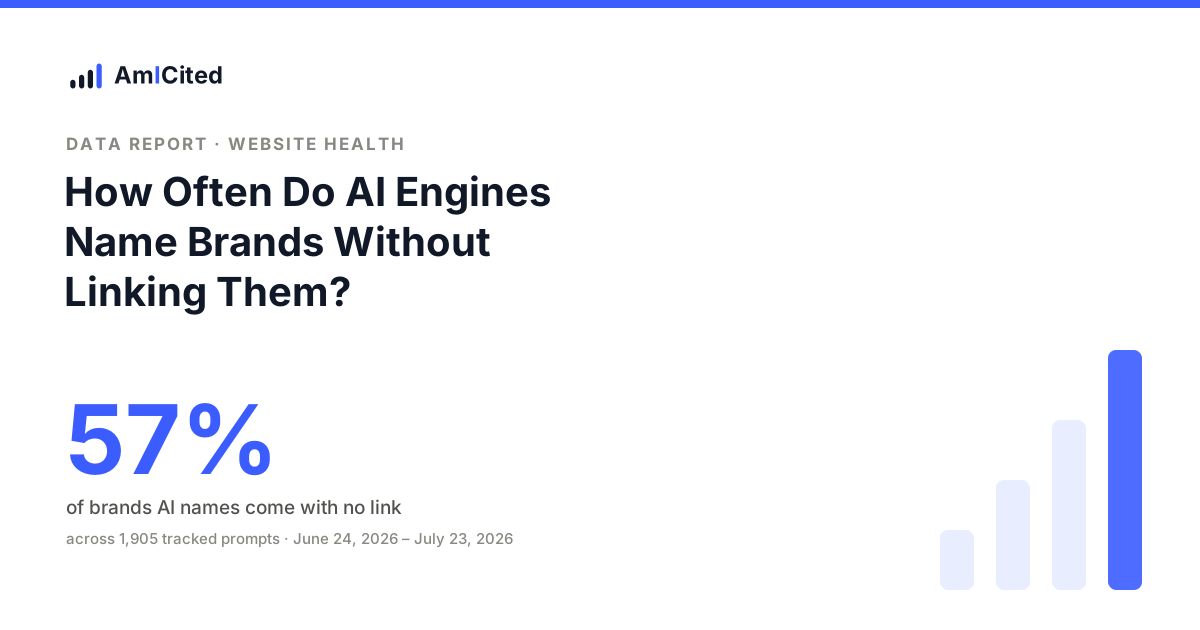
AI engines name brands far more than they link them: 57% of brand mentions carry no citation link at all.
Across the five engines, 57% of brand mentions have no link: the brand is named in the answer but not cited. It ranges from Google AI Mode (38%) to Perplexity (86%). This is the core of AI-search visibility: being named is common and influential even when no link is offered, so tracking mentions, not just citations, is essential.
Key Takeaways
- Across all five engines, 57% of brand mentions carry no link at all: naming a brand is far more common than citing it.
- The unlinked rate varies enormously by engine, from 38% (Google AI Mode) to 86% (Perplexity), so link-only tracking fails hardest on the engines that mention brands most.
- Unlinked mentions still shape buyer consideration sets even without a click, so measuring only citations badly undercounts real AI visibility.
- ChatGPT and Google AI Mode are the most “citation-friendly” engines; Perplexity and Gemini are name-heavy but link-light.
- Bottom line: track brand share of voice by mention, not just by link, as your primary AI-visibility KPI; AmICited measures both mentions and citations so you can see the full picture, not just the clickable half.
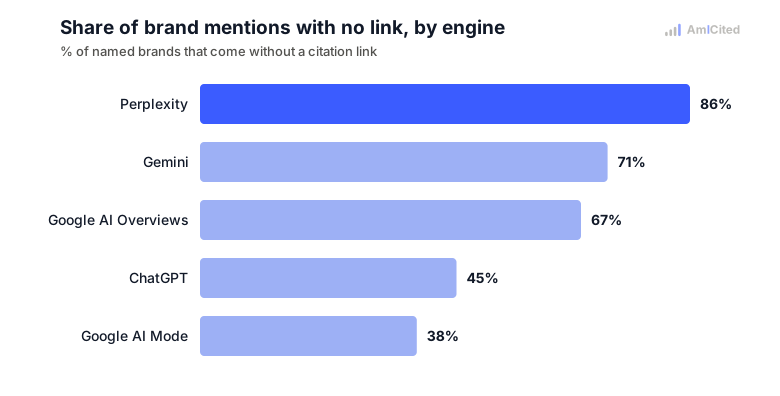
Share of brand mentions with no link, by engine
| AI engine | Value |
|---|---|
| Perplexity | 85.6% |
| Gemini | 71.2% |
| Google AI Overviews | 66.6% |
| ChatGPT | 44.8% |
| Google AI Mode | 37.9% |

Ready to Monitor Your AI Visibility?
Track how AI chatbots mention your brand across ChatGPT, Perplexity, and other platforms.
What the spread tells you
The gap is enormous and consistent: from Google AI Mode at 38% up to Perplexity at 86%, every engine leaves most of the brands it names unlinked. Overall, 57% of brand references carry no citation: the assistant tells the user about a brand without offering a click or leaving a trackable link.
This is the single most important reason to track mentions, not just citations. A visibility tool that only counts links would miss the majority of the influence AI search actually exerts on buyers: the brand that gets named, even without a link, is the brand that enters the user’s consideration set. The engines that link least (Perplexity, Gemini) are precisely the ones where link-only measurement fails hardest.
What this means for AI-search visibility
Because most brand mentions are unlinked, measuring only citations badly undercounts real AI visibility, which is exactly why AmICited tracks brand mentions with and without links.
Takeaways
- Measure AI visibility by mentions, not citations alone: most brand exposure has no link attached.
- Don’t judge an engine’s value by how often it links out; a name-only recommendation still shapes decisions.
- Track your brand’s named share of voice per engine as the primary KPI, with linked citations as a secondary, traffic-oriented one.
Stay Updated on AI Visibility Trends
Get the latest insights on AI mentions, brand monitoring, and optimization strategies.
The 57% unlinked rate: why this is the most important stat in AI visibility
The finding that 57% of brand mentions in AI search carry no link is arguably the single most important number in this entire data report series. It fundamentally changes how you should think about measuring and optimizing for AI visibility.
Consider the implications:
Link-only measurement misses the majority of brand exposure. If you are tracking only the citations (links) your brand receives from AI engines, you are seeing less than half of the actual brand mentions. The majority of times an AI engine tells a user about your brand, it does so without providing a clickable link.
Unlinked mentions still influence buyer behavior. An AI engine that says “ Shopify, WooCommerce, and BigCommerce are the top e-commerce platforms” has shaped the user’s consideration set, even if none of those brands received a link. The user may then search for those brands directly, visit their sites, or remember them for later.
The competitive landscape is different when you measure mentions. A competitor that appears in many unlinked mentions may have far more AI visibility than your link-only tracking suggests. You may be losing share of voice without knowing it.
This is why AmICited tracks both mentions and citations. The 57% unlinked rate means that any AI visibility tool that only counts links is giving you a materially incomplete picture.
Why the engine-by-engine spread matters
The 57% overall rate masks enormous variation by engine:
Perplexity: 86% of brand mentions are unlinked. Perplexity is the most mention-heavy, link-light engine. It names many brands but rarely attributes them to a specific source. If Perplexity is a significant channel for your audience, link-only tracking will miss nearly all of your brand exposure.
Gemini: 71% unlinked. Similar to Perplexity, Gemini is a name-heavy, link-light engine. Brand mentions here are abundant but mostly unattributed.
Google AI Overviews: 67% unlinked. Google’s AI Overviews name brands frequently but link them less than half the time.
ChatGPT: 45% unlinked. ChatGPT is the most balanced engine: it links slightly more than half of the brands it names. This makes it the most “citation-friendly” engine for brands that want both mentions and traffic.
Google AI Mode: 38% unlinked. Google AI Mode is the most link-heavy engine. It still leaves more than a third of brand mentions unlinked, but it is the engine where link-based measurement comes closest to capturing the full picture.
This variation means that your measurement strategy should be engine-specific. If you are optimizing for ChatGPT, link tracking captures a reasonable majority of your exposure. If you are optimizing for Perplexity, link tracking captures almost nothing.
Practical implications for AI visibility measurement
The 57% unlinked rate has concrete implications for how you should measure and report on AI visibility:
Track mentions, not just citations. A mention (brand name appears in the answer) is a visibility event. A citation (brand name appears with a link) is a visibility event plus a traffic opportunity. Both matter, but mentions are the larger and more important metric.
Report per-engine. An aggregate “AI visibility score” that combines all engines is misleading because the engines differ so dramatically in their linking behavior. Report ChatGPT mentions, Perplexity mentions, etc. separately.
Set mention-based KPIs. Your primary AI visibility KPI should be share of voice (how often your brand is mentioned relative to competitors), not citation count. Citations are a secondary, traffic-oriented KPI.
Don’t dismiss unlinked mentions as “worthless.” An unlinked mention is a brand impression. It builds awareness, shapes consideration, and can drive direct searches. It is less directly measurable than a click, but it is not less valuable.
Methodology
Computed from AmICited’s 1,905 tracked prompts (June 24, 2026 – July 23, 2026, 2026), across ChatGPT, Perplexity, Google AI Overviews, Google AI Mode and Gemini. From 106,837 brand references detected by AmICited across the tracked prompts, we count how many carried a source link versus none. 60,382 (57%) had no link. This is capture-consistent because brand detection runs on the answer text regardless of links. Each brand reference is classified as linked (a source URL was captured) or name-only (none). The split is capture-consistent because brand detection runs on the answer text regardless of whether a link was present. Microsoft Copilot is tracked but returned no citation data in this window. No external links appear in this report.
 LinkedIn