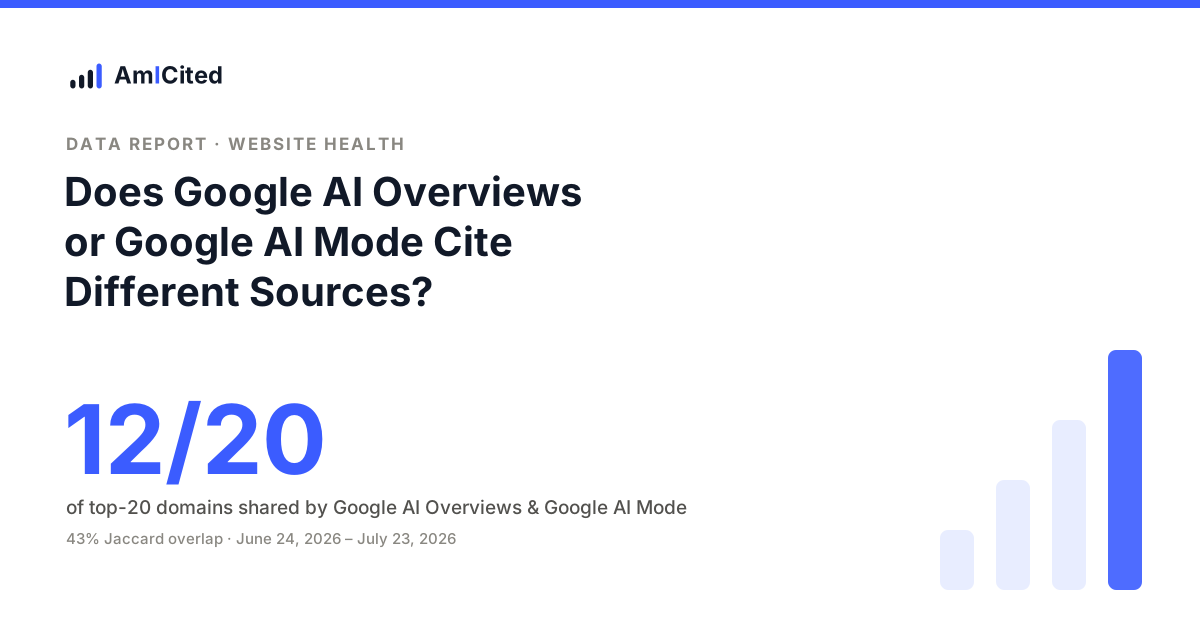
Google AI Overviews and Google AI Mode draw on a partly overlapping mix: 12 of their top 20 domains are shared (43% overlap).
Google AI Overviews and Google AI Mode are both Google surfaces, so it is tempting to treat them as one target, but they do not cite identically. Of each engine’s top 20 most-cited domains, only 12 appear on both lists, a Jaccard overlap of 43%. In other words, roughly 57% of each engine’s leading sources are not leading sources for the other.
Key Takeaways
- Google AI Overviews and Google AI Mode share only 12 of their top 20 cited domains, a 43% overlap, despite being products from the same company.
- The 12 shared domains form a “Google consensus” of broadly authoritative sources; the unique domains reveal different sourcing logic per surface (institutional sources for Overviews, social/community sources for AI Mode).
- The divergence reflects different use cases: Overviews augments a quick-answer search results page, while AI Mode serves a more conversational, exploratory need.
- Because overlap is under half, a page that ranks well in one surface cannot be assumed to rank well in the other.
- Bottom line: track and optimize Google AI Overviews and Google AI Mode as separate channels rather than one “Google AI” metric; AmICited’s per-engine citation tracking makes this split easy to monitor.
Top-20 source overlap
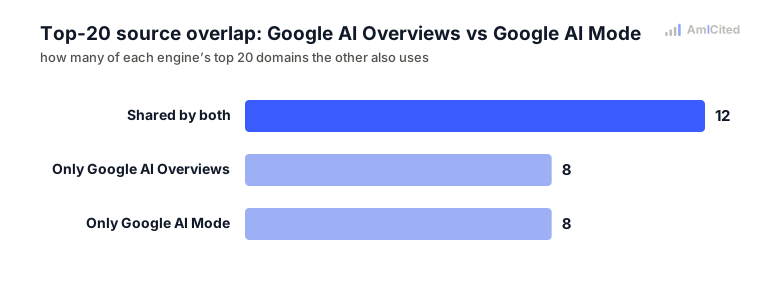
The chart splits the two top-20 lists into what they share and what is unique to each. 12 domains are common ground; 8 lead in Google AI Overviews but not Google AI Mode, and 8 lead in Google AI Mode but not Google AI Overviews. That is a substantial divergence for two products from the same company drawing on the same underlying index.

Ready to Monitor Your AI Visibility?
Track how AI chatbots mention your brand across ChatGPT, Perplexity, and other platforms.
Domains unique to each engine (within the top 20)
Shared by both (12): bloomreach.com, braze.com, freshworks.com, google.com, hubspot.com, klaviyo.com, linkedin.com, livechat.com, reddit.com, salesforce.com, youtube.com, zendesk.com
Only Google AI Overviews (8): hz, ibm.com, sogeseitalia.it, microsoft.com, tidio.com, twilio.com, vlnytinka.sk, emarsys.com
Only Google AI Mode (8): hz-containers.com, facebook.com, zlatezrnko.sk, instagram.com, rewardful.com, trackdesk.com, coffeein.sk, tapfiliate.com
The shared set is where the two agree on authority; the unique sets are where their sourcing behaviour genuinely parts ways: a source can be a staple of one Google surface and absent from the other’s leaders.
What this means for AI-search visibility
Google AI Overviews and Google AI Mode draw on a partly overlapping mix. With overlap only 43%, you cannot assume a source that wins in one wins in the other. Winning Google-surface visibility means tracking and optimising each independently: a page cited heavily by Google AI Overviews may never surface in Google AI Mode, and vice-versa. The practical rule: don’t collapse “Google AI” into one number. Measure Google AI Overviews and Google AI Mode as separate channels, because on this evidence they reward partly different sources.
Stay Updated on AI Visibility Trends
Get the latest insights on AI mentions, brand monitoring, and optimization strategies.
Why two Google surfaces differ
They serve different contexts: Google AI Overviews augments a traditional results page while Google AI Mode is a conversational surface, and that shapes how each selects and ranks sources. The result is the 43% overlap seen here: a shared backbone of high-authority domains, plus a distinct tail each surface favours. It is a reminder that “the same company” does not mean “the same sourcing.”
The 43% overlap: what it means for your Google AI strategy
The 43% Jaccard overlap between Google AI Overviews and Google AI Mode is one of the most strategically important findings in this report. It means that if you are optimizing for “Google AI” as a single channel, you are optimizing for a fiction. These are two distinct products with distinct source preferences.
The 12 shared domains (bloomreach.com, braze.com, hubspot.com, etc.) represent the “Google consensus”: the domains that both surfaces agree are authoritative across a broad set of queries. These are typically large, well-established platforms with extensive content libraries and strong domain authority in the traditional SEO sense.
The 8 domains unique to each surface are where the real strategic insight lies. Google AI Overviews favors enterprise and institutional sources (ibm.com, microsoft.com, twilio.com) while Google AI Mode favors social and community platforms (facebook.com, instagram.com, reddit.com) and niche regional sources. This pattern reflects the different use cases: Overviews serves a “quick answer” need that favors established, authoritative sources; AI Mode serves a “comprehensive exploration” need that favors diverse, conversational sources.
The practical implications of the divergence
For brands and SEO teams, the 43% overlap creates a concrete challenge: you cannot optimize for one Google AI surface and expect to automatically perform well in the other. The domains that are top-20 in one but absent from the other are proof that each surface has its own sourcing logic.
This means:
You need separate tracking for each surface. A single “Google AI visibility” metric is misleading. Track Google AI Overviews mentions and Google AI Mode mentions separately.
Your content strategy may need to differ by surface. The content that earns citations in Google AI Overviews (concise, authoritative, well-structured) may not be the same content that earns citations in Google AI Mode (comprehensive, conversational, source-rich).
The 43% shared set is your baseline. If you can earn a spot among the 12 domains that both surfaces agree on, you have achieved the highest form of Google AI visibility: being cited regardless of which Google AI product the user is interacting with.
How to use this data operationally
The most practical use of the overlap data is competitive. Map your competitors against the shared and unique domain sets:
- If your competitor appears in the shared set, they have broad Google AI visibility. You need to match their authority on both surfaces.
- If your competitor appears in only one surface’s top 20, you have an opportunity to beat them on the other surface.
- If you appear in neither, your first goal is to break into the unique set of the surface most relevant to your audience.
Methodology
Each engine’s top 20 domains are ranked by the number of tracked-prompt responses citing them (June 24, 2026 – July 23, 2026, 2026), rolled up to the registrable domain. Overlap is the count of domains appearing in both top-20 lists; Jaccard = shared / union of the two lists.
 LinkedIn