Key Takeaways
- On August 20, 2026, Google published an embeddable Preferred Sources button publishers can add to their own pages, letting a reader add that site to their personal list of trusted sources with one click.
- Preferred Sources started in August 2025 as a Top Stories-only feature and, as of May 27, 2026, it now feeds AI Overviews and AI Mode too, not just traditional search results.
- More than 600,000 unique sources had been selected by readers as of August 2026, and Preferred Sources reportedly earn roughly 2x the click-through rate of a standard result for that reader.
- It’s a personalized signal: two readers searching the same query can see two different sets of sources emphasized, based entirely on who each of them selected.
- Bottom line: reader trust is now a direct, if personalized, ranking input into the same AI surfaces that decide whether your brand gets mentioned at all, which makes it one more lever worth pulling alongside the fundamentals that already drive AI citations.
What Google Actually Shipped
On August 20, 2026, Mrinalini Loew, General Manager of the Google Search Ecosystem, confirmed that an embeddable “Preferred Sources” button is now available for any website to add to its pages, with implementation details published the same day in Google’s Search Central documentation.
The mechanic is simple. A publisher drops the button onto its site. A signed-in reader clicks it. That site gets added to the reader’s personal list of Preferred Sources, and the reader is returned to exactly where they were on the page, no redirect, no lost place. From that point on, Google prioritizes content from that publication for that specific reader across the surfaces where the feature is live.
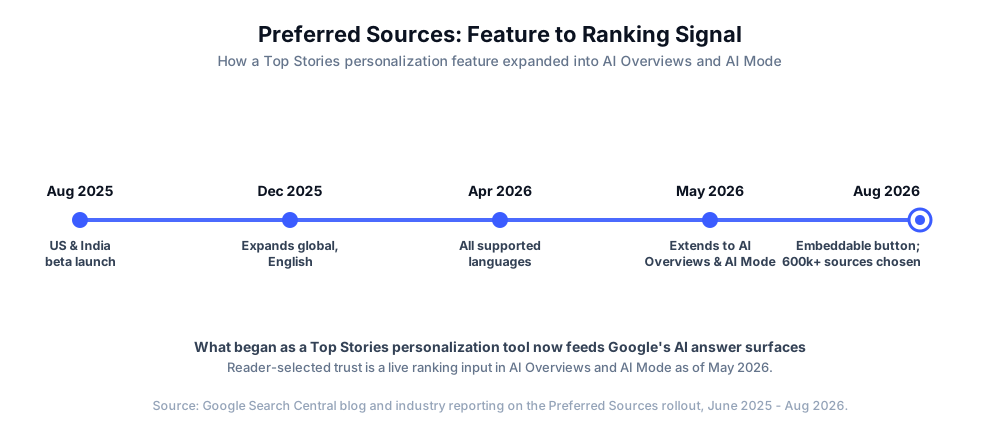
This isn’t a new idea from Google, it’s a maturing one. Preferred Sources launched in the US and India in August 2025 after a June 2025 Labs beta, expanded to English globally in December 2025, reached every supported language by April 30, 2026, and on May 27, 2026, extended into AI Overviews and AI Mode. The August 2026 button is Google actively promoting adoption of a mechanic it had already spent a year building out.

Ready to Monitor Your AI Visibility?
Track how AI chatbots mention your brand across ChatGPT, Perplexity, and other platforms.
Why This Matters for AI Visibility
The part of this story that matters most for AI visibility isn’t the button, it’s the May 2026 expansion it builds on. Once Preferred Sources became a live input into AI Overviews and AI Mode, reader trust stopped being a Top Stories curiosity and became a ranking signal for the exact surfaces that decide how AI Overviews decide which brands to mention.
That expansion landed at a moment when AI Mode had already become Google’s default search experience for a growing share of queries, and when 76% of AI Overview citations were already coming from results ranking in the top 10 of organic search. Preferred Sources doesn’t replace that underlying quality and relevance ranking, Google has been explicit about that, it layers a personalized trust signal on top of it.
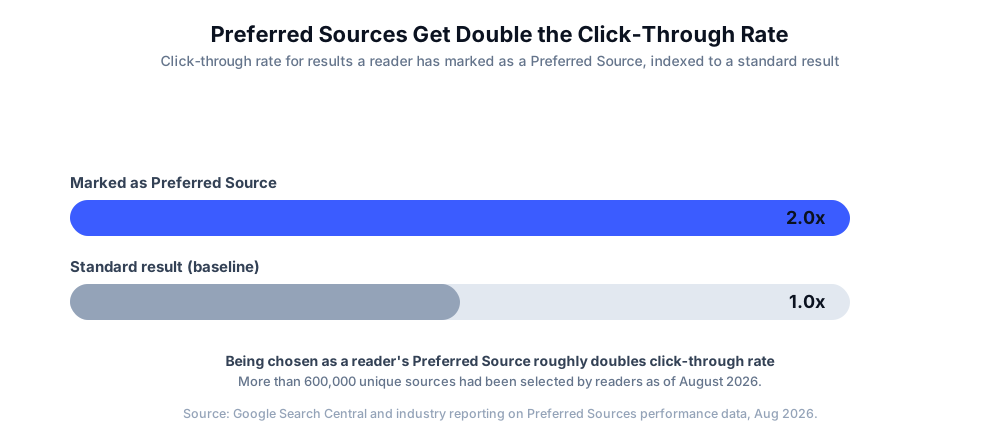
The adoption numbers back up why Google is pushing the button now. More than 600,000 unique sources had been selected by readers as of August 2026, and Google-adjacent reporting puts the click-through lift for a Preferred Source at roughly double that of a standard result, for the specific reader who chose it. Multiply that across millions of signed-in searches and the aggregate signal becomes something Google’s AI systems can plausibly weight, even if today it officially remains a personalized input rather than a universal ranking boost.
The Part That’s Easy to Miss: It’s Personalized, Not Global
The detail that separates Preferred Sources from a normal SEO ranking factor is that it doesn’t produce one canonical result. Two readers running the identical query can see two entirely different sets of sources emphasized in Top Stories, Discover, AI Overviews, or AI Mode, depending only on which publications each of them has personally selected.
That has a direct consequence for anyone tracking AI visibility: a brand can be well cited for one segment of its audience and invisible to another, purely on the basis of who has clicked the button, which is one more reason ranking well on Google doesn’t automatically translate into AI visibility. The 7% overlap problem was already true for organic-to-AI citation; Preferred Sources adds a second layer of divergence, this time between individual readers on the very same AI platform.
Stay Updated on AI Visibility Trends
Get the latest insights on AI mentions, brand monitoring, and optimization strategies.
What Publishers and Brands Should Do Now
Preferred Sources rewards exactly the fundamentals that already drive AI citations, it just adds a new, visible mechanism for a loyal reader to reinforce them:
- Add the embeddable button somewhere a returning reader will actually see it. A signal that depends entirely on a reader clicking a button does nothing if the button is buried below the fold or absent from the page template.
- Give readers a reason to prefer you specifically. The button converts existing trust, it doesn’t create it. That means timely, well-structured content and a clear, consistent voice matter more, not less, now that trust has a one-click mechanism attached to it.
- Keep the underlying signals AI systems already check in order. Preferred Sources sits on top of Google’s quality and relevance systems, not in place of them, so structured data AI systems can actually parse, accurate authorship, and a coherent site architecture remain the baseline requirement.
- Watch this as part of a multi-platform strategy, not a Google-only one. Google is only one part of protecting traffic in the AI era; Preferred Sources has no equivalent yet on ChatGPT, Perplexity, or Claude, so a brand that wins here still needs a separate answer for how the rest of the AI discovery layer treats it.
What to Watch Next
Google has said it’s working toward using Preferred Sources more broadly across its AI features, which suggests today’s personalized, additive signal could become a more standardized input over time. For now, treat the button the same way you’d treat any new trust signal AI platforms introduce: worth adopting immediately, since it costs little to add, but not a substitute for the structural and editorial fundamentals that determine whether an AI system considers you a credible source in the first place.
The pattern is a familiar one for anyone tracking AI visibility this year: platforms keep introducing new mechanisms for surfacing trusted sources, and each one is a new variable to monitor, not a new strategy to replace the one you already have.
 LinkedIn