


Google AI Mode: What It Means for Search and How to Prepare
Discover how Google AI Mode is transforming search results, impacting website traffic, and what you need to do to maintain visibility. Learn optimization strate...
11 min read
Google AI Mode became the default search experience worldwide in 2026. See the zero-click, citation, and legal fallout data, and how to adapt your AI visibility strategy.
For most of 2026, AI Mode sat next to Google’s classic search results as an option you could switch into. That changed at Google I/O on May 19, when Google announced it would become the default experience for every query, not an alternate tab. The U.S. rollout finished on July 10. The UK followed three weeks later. By August, the default had reached a 180-plus-country wave across English-speaking markets, running on the Gemini 3.5 Flash model and reaching more than one billion monthly users across roughly 200 countries and 98 languages.
The practical effect: when someone in a covered market types a query into Google, they now see a synthesized answer first, with the traditional list of ten blue links pushed below the fold. Classic search results still exist, but they’re a secondary view most people never scroll to.
If your brand’s visibility strategy has been “rank well and the clicks will follow,” this is the moment that assumption stops holding for a meaningful share of your traffic.
Zero-click search , where a person gets an answer without ever visiting a website, isn’t new. What’s new is how much more common it is inside AI Mode specifically.
Across regular Google search overall, roughly 68% of U.S. queries already end without a click. Inside AI Mode, that number climbs to about 93%. The gap is the whole story: a synthesized conversational answer removes almost all of the remaining reasons to leave the results page.
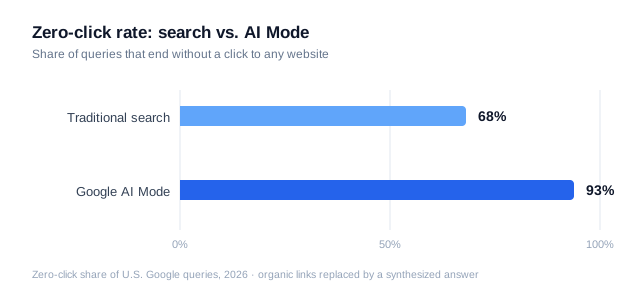
That 25-point jump is why publisher click volume has been the first casualty of the rollout. Multiple measurements put the decline in clicks to publisher sites at around 58% on queries where AI Mode now answers directly rather than surfacing a ranked list. This isn’t a slow bleed from a feature people can ignore; it’s the default outcome of typing anything into Google.

Track how AI chatbots mention your brand across ChatGPT, Perplexity, and other platforms.
The instinct is to assume that if AI Mode answers 93% of queries without a click, it must be citing a lot of sources along the way. It is, but not necessarily your sources.
Independent measurement puts AI Mode’s overall citation rate at around 9.09% of responses, meaning roughly one in eleven answers includes a visible source link at all. Of that already-small slice, only about 2.14% of citations go to identifiable commercial brands. The rest point to reference material, established publishers, and community sources like forums and wikis.
Citation is also concentrating rather than spreading out. Estimates across the major AI platforms suggest that 40-55% of all citations flow to fewer than 1,000 domains. If you’re not already one of the sources AI Overviews and AI Mode reach for by default, the odds of breaking in are getting longer, not shorter, as the citation pool concentrates around a smaller set of trusted sources.
This is also why the sources these systems already trust matter so much for anyone doing answer engine optimization work. Reviewing which domains AI Overviews cite most by vertical is a faster way to find realistic citation targets than guessing.
Rollout scale and citation math aside, the most consequential development might be legal rather than technical. A Munich court ruled that AI Overviews aren’t a neutral index of what other sites say; they generate “independent, new, and substantive statements” by evaluating and combining content from multiple sources. That distinction matters because it strips away the liability shield that has historically protected search engines from being held responsible for third-party content in their results.
In practice, the ruling makes Google directly liable when its AI-generated summary states something false, the same way a publisher would be liable for a factual error in an article it wrote itself. Antitrust suits related to the AI Mode rollout are also accumulating in multiple jurisdictions.
For brands, the immediate implication isn’t legal risk of your own. It’s a signal that regulators and courts are starting to treat AI-generated answers as a distinct, accountable category rather than a search feature exempt from scrutiny, which increases the odds that transparency and sourcing requirements tighten further from here.
Get the latest insights on AI mentions, brand monitoring, and optimization strategies.
It’s tempting to treat “get cited by AI” as a single problem with one solution, but AI Mode’s sourcing behavior doesn’t look much like its competitors’. An analysis of roughly 680 million citations across ChatGPT, Google AI Overviews, and Perplexity found that only about 11% of domains are cited by both ChatGPT and Perplexity, meaning the two platforms are pulling from largely different source pools even when answering similar questions. A separate study of over 34,000 AI responses found a 46-times gap in how often brands get cited at all: ChatGPT cited a brand in just 0.59% of responses, while Perplexity did so in 13.05%.
The mechanism explains the gap. Perplexity performs a live web search for every single query, drawing from multiple search APIs and building its answer from whatever ranks well right now. ChatGPT leans more heavily on a hybrid of training data and selective retrieval, which means a page can be highly relevant today and still be invisible to ChatGPT until a future retrieval pass picks it up. AI Mode sits closer to Perplexity’s model in spirit, since it draws on Google’s live index, but it inherits Google’s own ranking signals and knowledge graph rather than running an independent retrieval process, which is why classic SEO fundamentals still carry more weight there than they do for a platform with no prior relationship to your site at all.
The practical takeaway is that a single “AI visibility” number hides more than it reveals. A brand that’s strong in AI Mode because of years of search authority can still be nearly invisible in Perplexity if its content isn’t structured for real-time retrieval, and vice versa. Treating each platform as a separate citation surface, with its own baseline and its own trend line, is the only way to see which parts of a strategy are actually working.
None of this means traditional SEO stopped mattering. AI Mode draws heavily on Google’s existing search index and knowledge graph, so the fundamentals, crawlability, structured data, topical authority, still carry real weight in what gets surfaced and cited. What’s changed is what success looks like at the end of that work.
Ranking well used to translate fairly directly into clicks. Now, a large and growing share of that ranking effort turns into a citation, or nothing, rather than a visit. That reframes the metric you should actually be watching: not just where you rank, but whether you’re one of the sources being cited when AI Mode answers the queries that matter to your business. Tracking that requires treating generative engine optimization as a distinct discipline from traditional rank tracking, not an extension of it.
It also means understanding how AI models decide what to cite in the first place, since the criteria differ meaningfully from what drives a page into position one of a classic result list. Source clarity, direct answers to specific questions, and content that’s easy to extract and attribute correctly tend to matter more here than backlink profiles alone.
A few concrete moves are worth prioritizing given what the rollout has actually changed:
The rollout is finished, not incoming. Brands that adjust what they measure and how they optimize now will have a real head start over the ones still waiting for AI Mode to feel optional again.
Arshia is an AI Workflow Engineer at FlowHunt. With a background in computer science and a passion for AI, he specializes in creating efficient workflows that integrate AI tools into everyday tasks, enhancing productivity and creativity.

AmICited tracks every citation your brand gets (or misses) across Google AI Mode, ChatGPT, Perplexity, and Gemini, so you know exactly where you stand as AI becomes the default way people search.
Discover how Google AI Mode is transforming search results, impacting website traffic, and what you need to do to maintain visibility. Learn optimization strate...
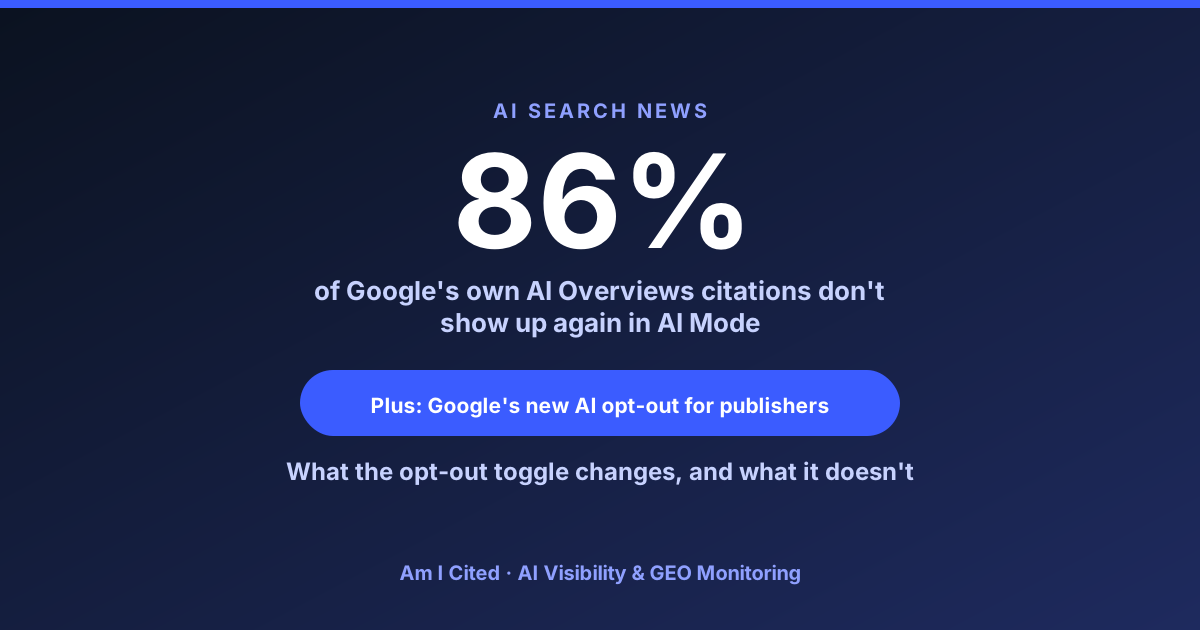
Google is rolling out a Search Console toggle that lets publishers exclude their content from AI Overviews and AI Mode. Here's what it changes, and why AI platf...

Discover how artificial intelligence is transforming SEO strategies, from AI Overviews to answer engine optimization. Learn what the future of search looks like...
Cookie Consent
We use cookies to enhance your browsing experience and analyze our traffic. See our privacy policy.