


See Which AI Engines Cite Each Source
See how often each AI engine cites your top sources in AmICited’s Cited by Provider heatmap.

Not every AI engine trusts the same sources. The Cited by provider heatmap shows exactly how many times each engine cited each of your top sources, so you can see which sites shape which model’s answers.
Quick Steps
- The Cited by provider table lives on the Sources page, with each row a source and each column an engine.
- Darker cells mean more citations; a source dark under one engine and blank under another only influences that engine.
- Check your own you row first to see which engines cite you and which don’t.
- Study the darkest rows outside your own to find the sources dominating your topic across engines.
- Use the By domain / By URL toggle to drill from whole sites down to the exact page winning citations.
What is an AI citation, and why does it differ by engine?
An AI citation is any moment a generative AI system (ChatGPT, Perplexity, Gemini, or Google AI Overview) names, links to, or draws directly on a specific web page while answering a user’s question. Citations are the raw material of AI visibility: if a page is never cited, it never influences what a model tells people about a brand, a product category, or a competitor. That makes citation data fundamentally different from classic SEO rankings, where one algorithm decides one ordered list. Here, four largely independent systems each build their own answer, and each one can reach for a different set of sources to do it.
That divergence happens because each engine sources information differently. ChatGPT blends browsing results with patterns learned during training and leans on a mix of high-authority publishers, structured data, and third-party mentions. Perplexity is built around live web retrieval and tends to favor recent, well-cited pages with clear factual claims. Google AI Overview draws heavily on the existing Google index and often surfaces the same domains that already rank well organically. Gemini pulls from Google’s knowledge graph and web corpus but weights authority and topical depth differently again. The result: a source can be a favorite reference for one engine and completely invisible to another, even when answering near-identical prompts.
This is the practical foundation of generative engine optimization : the discipline of making a brand’s content more likely to be retrieved and cited across these systems. You cannot optimize for “AI search” as a single target the way you once optimized for “Google.” You need visibility into which engine is citing which source, because the fix for a ChatGPT gap (say, more third-party mentions and structured data) is often different from the fix for a Perplexity gap (fresher, more citable factual content). Without engine-level source data, teams end up guessing which lever to pull, or pulling all of them at once and wasting effort on channels where the brand was already doing fine.
Source-level, engine-by-engine data also reveals competitive structure that aggregate metrics hide. Two sources can have the same total citation count while one is a ChatGPT-only reference and the other is Perplexity’s default. Knowing that difference tells you not just whether a competitor or partner site is cited, but which model’s users are actually seeing it, which shapes where you focus content, PR, or technical fixes next.
Where to find it
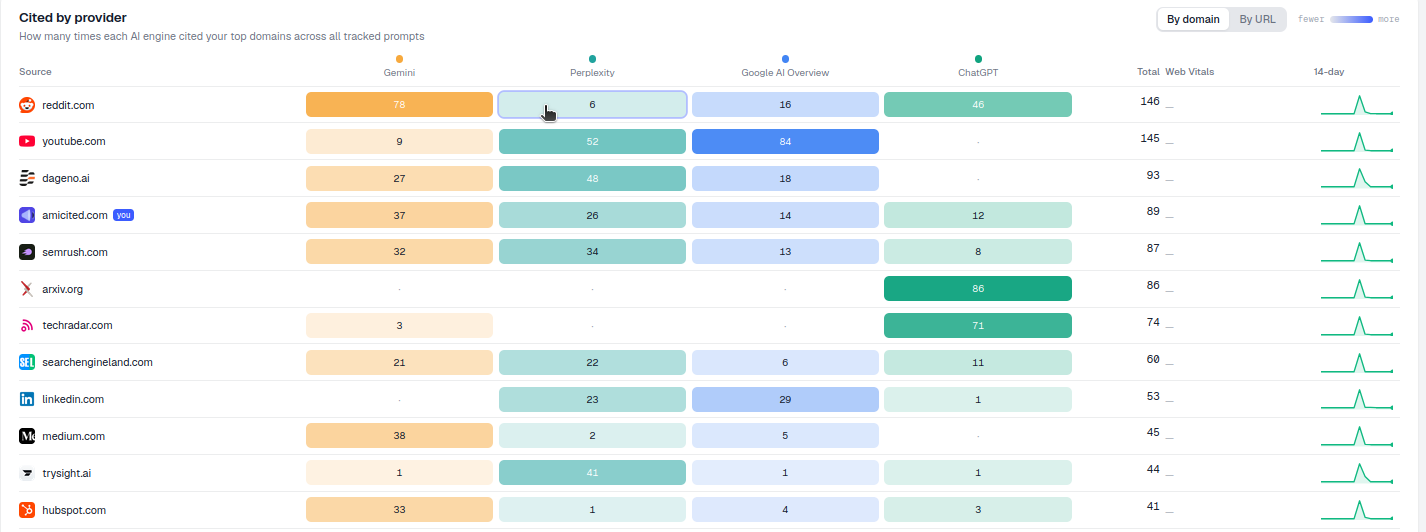
It’s the Cited by provider table on the Sources page, subtitled “How many times each AI engine cited your top domains across all tracked prompts.” The table is built from the same underlying data as the rest of AmICited’s source analysis: every citation your tracked prompts generate across Gemini, Perplexity, Google AI Overview, and ChatGPT is attributed back to the exact source that produced it, then rolled up per domain (or per URL) and per engine.
What it measures
The table answers a narrower, more actionable question than a single citation count: for this source, how much does each individual AI engine rely on it? Rather than a single blended number, you get a row of engine-specific counts, so a source’s overall influence and its per-engine influence are both visible at once.
- Each row is a source (a domain, or a page in By-URL view) with your own domain flagged you so you can find your own performance without scanning the whole list.
- Each engine has a column (Gemini, Perplexity, Google AI Overview, ChatGPT) with a shaded cell showing the citation count for that source on that engine.
- Cell darkness encodes volume using a “fewer → more” gradient legend, so patterns are visible at a glance without reading every number.
- Total sums a source’s citations across all four engines, giving you an overall ranking of source importance.
- A Web Vitals column and a 14-day sparkline sit alongside the citation counts, adding page-health and recent-trend context: a source that’s climbing in citations but failing Core Web Vitals is a fragile leader worth watching.
Because the table is organized by source first and engine second, it’s built specifically to answer “which engine trusts this source”, a different (and often more useful) question than “how many citations did I get this month.”
How to read it
Scan the table the way you’d scan any heatmap: look for color, not just numbers. A row that’s uniformly dark across all four engine columns is a source with broad, cross-engine authority: the kind of reference every model seems to reach for. A row that’s dark in one column and blank in the rest is a source with narrow, engine-specific influence, which usually points to something structural: the source might be well-indexed by Google but rarely retrieved live by Perplexity, or vice versa. Your own you row is the one to check first and most often, since it’s the direct readout of your brand’s AI search visibility split out by engine.
How to use it
- Find each engine’s favorites. Scan a column top-to-bottom to see which sources that model leans on most for your tracked prompts. These are the pages worth reverse-engineering: their structure, freshness, and authority signals are evidently working for that specific engine.
- See where you stand. Locate your you row and read across it: which engines cite you, and which don’t cite you at all. This is the fastest way to spot an engine-specific blind spot rather than assuming your overall visibility is uniformly weak or strong.
- Target your weak engine. A blank cell in your row under one engine is a specific, addressable gap, not a vague “improve AI visibility” task, but a concrete one: figure out why Perplexity (for example) never retrieves you while ChatGPT does, and adjust content freshness, citations, or crawlability accordingly.
- Study the leaders. The darkest rows, outside your own, are the sources dominating your topic across engines: the pages to learn from, benchmark against, or aim to outrank. If a competitor’s domain shows up dark under every column, that’s a strong domain authority signal worth investigating directly, including what content format and structure it uses.
Use the By domain / By URL toggle to flip between whole domains and individual pages, which lets you drill from “which sites win with which engines” down to “which exact page is doing the winning” (covered in its own guide).
Why engine-level source data matters for your strategy
Treating all AI citations as one undifferentiated pool leads to two common mistakes. The first is assuming that fixing visibility for one engine fixes it everywhere. Teams sometimes see a citation increase after a content push and assume the strategy is working broadly, when in fact only one engine responded and the others are still blank. The second is misreading competitive threats: a competitor with a high total citation count might actually be concentrated entirely in one engine, leaving three others wide open. The Cited by provider table exists specifically to prevent both mistakes by keeping the engine dimension visible at all times instead of collapsing it into a single score.
This kind of source-level detail is also what separates a real AI rank tracker from a basic mention counter. Counting how often a brand is named is a start, but knowing which sources each engine is citing instead of you, and being able to compare that against your own share of voice trend, is what turns the data into a prioritized action list rather than a vanity metric. If you’re building out a broader content gap analysis , this table is the natural starting point: it tells you exactly which engine to test against first, and which competing or third-party sources already hold the position you’re trying to earn. Teams running AI visibility work at agency scale, or managing it alongside traditional SEO rank tracking, tend to check this view weekly. It’s the fastest way to see whether last month’s content or technical changes actually moved the needle with the specific engine they were targeting.
Frequently asked questions
It's a table on the Sources page where each row is a source (a domain, or a page in By-URL view) and each column is an AI engine: Gemini, Perplexity, Google AI Overview, and ChatGPT. Each cell shows how many times that engine cited that source, shaded darker for more citations, so patterns are visible at a glance.
Each engine sources information differently. ChatGPT blends browsing with training data and favors authority and structured data, Perplexity leans on live retrieval and favors fresh, clearly-sourced pages, Google AI Overview draws on the existing Google index, and Gemini pulls from Google's knowledge graph with its own weighting. A source can be a favorite for one and invisible to another.
Find your row, flagged you, and read across it to see which engine columns are shaded and which are blank. A blank cell under one engine is a specific, addressable gap, for example figuring out why Perplexity never retrieves you while ChatGPT does, rather than a vague sense that your overall AI visibility is weak.
By domain rolls citations up to the whole site level, showing which domains win citations broadly. By URL drills down to the exact page earning those citations. Use the toggle to move from "which sites win with which engines" to "which exact page is doing the winning" once you've spotted a pattern worth investigating.
More tutorials in this section
 How to Read Your Sources Overview Stats
Understand AmICited Sources stats: citations, domains, cited URLs, your pages, external sources and weekly …
Read guide →
How to Read Your Sources Overview Stats
Understand AmICited Sources stats: citations, domains, cited URLs, your pages, external sources and weekly …
Read guide →
 How to Drill Down into a Single Source
Open any source in AmICited to see the exact pages and prompts where it was cited.
Read guide →
How to Drill Down into a Single Source
Open any source in AmICited to see the exact pages and prompts where it was cited.
Read guide →
 How to Track Citations Over Time by Source
Track daily AI citations by provider, top domains or URLs with the AmICited Sources chart.
Read guide →
How to Track Citations Over Time by Source
Track daily AI citations by provider, top domains or URLs with the AmICited Sources chart.
Read guide →Ready to put it into practice?
Free check · 7-day trial · card required