


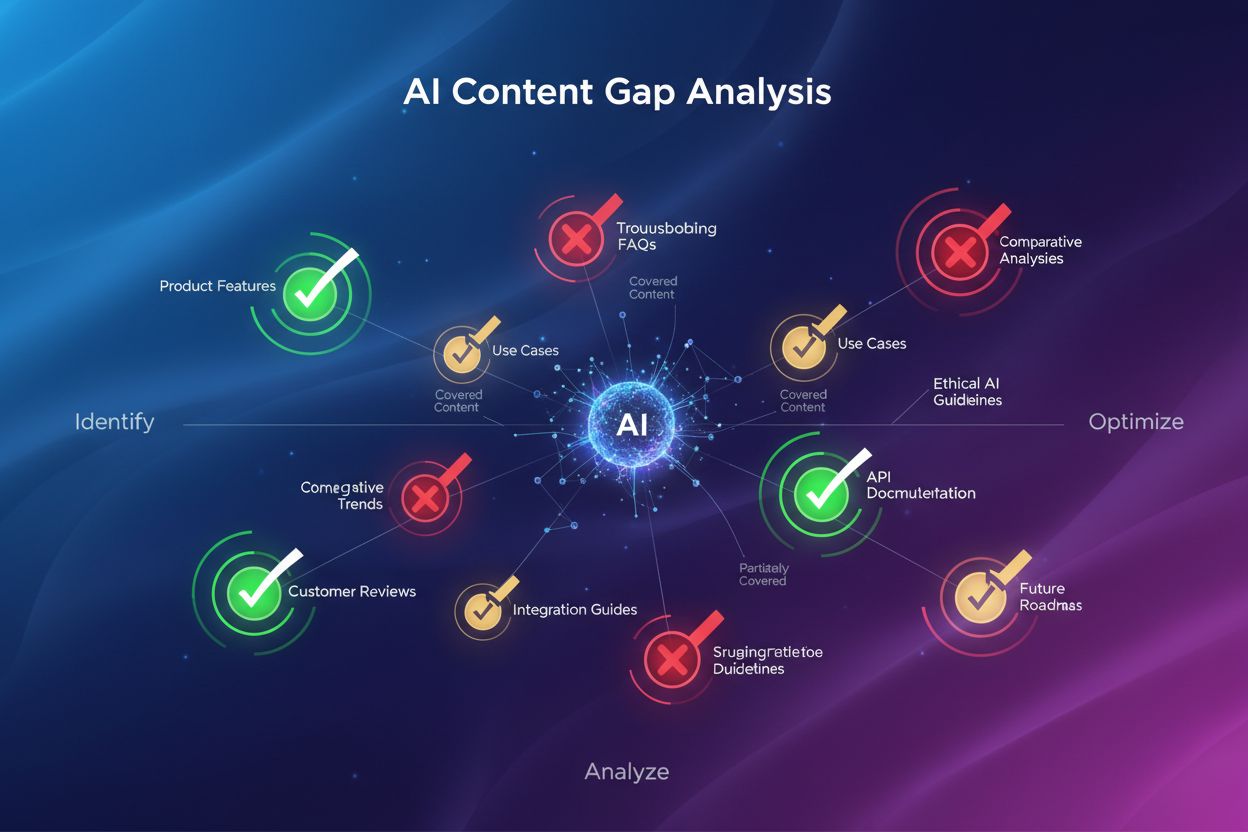
AI Content Gap Analysis
Learn what AI Content Gap Analysis is and how to identify content gaps to improve your visibility in AI Overviews, ChatGPT, and generative search engines. Disco...
9 min read
Find AI search content gaps by comparing competitor citations, diagnosing missing topics and prioritizing improvements.
You rank #1 on Google for your top five keywords. Your organic traffic is hitting record numbers. Your traditional SEO scorecard is all green. Then you run a simple test: you open ChatGPT, type in the exact question your #1-ranked page is supposed to answer, and press enter. Your brand doesn’t appear. Not in the answer. Not in the citations. Not even in the “also consider” list. You are invisible.
This scenario is playing out across thousands of marketing teams right now. A 2025 McKinsey study found that roughly 50 percent of Google searches already surface AI-generated summaries, a figure expected to rise above 75 percent by 2028. Meanwhile, zero-click searches reached 58.5 percent of all US queries in 2025. That means the majority of your potential audience is reading answers generated by AI engines without ever clicking through to a website. If your brand isn’t cited in those answers, you effectively don’t exist for those users.
This is exactly where a content gap analysis for AI search visibility comes in. It’s not a keyword exercise. It’s not a traditional SEO audit dressed up with new buzzwords. It’s a fundamentally different investigation into why AI engines choose to cite certain brands and ignore others, and what you need to change to earn your place in the answers that matter.
In this guide, you’ll learn a complete, repeatable framework for identifying AI visibility gaps, mapping what competitors are doing that you aren’t, prioritizing your opportunities, and closing the gaps that keep your brand invisible. Every step includes practical templates you can use today.
An AI visibility gap is any topic, prompt, or context where competing brands appear in AI-generated answers and your brand does not. A content gap analysis for AI search visibility is the systematic process of finding those gaps, understanding why they exist, and building a prioritized plan to close them.
This is not the same as a traditional content gap analysis. In traditional SEO, a gap means you rank on page two instead of page one. You still exist in the search ecosystem, you’re just not winning. In AI search, a gap means you are not mentioned at all. The AI engine doesn’t rank you lower; it omits you entirely. As Similarweb puts it, the difference is between diminished visibility and total invisibility.
The analysis also targets a different set of platforms. Instead of Google Search Console, Ahrefs, and SEMrush rank trackers, you’re evaluating presence across ChatGPT, Perplexity, Gemini, Google AI Overviews, and Claude. Each of these engines uses a retrieval-augmented generation (RAG) architecture, meaning they pull information from a corpus of web content, synthesize it, and produce an answer. Your job is to understand what content they pull, why they pull it, and how to get yours into the pipeline.
To understand why a dedicated content gap analysis for AI search visibility is necessary, you need to understand how AI search differs from traditional search at the retrieval level.
Traditional search engines retrieve documents. They crawl the web, index pages, and return a ranked list of links. The user clicks, reads, and decides. The ranking algorithm evaluates relevance, authority, and hundreds of other signals, but the unit of output is always a link to a page.
AI search engines retrieve facts and synthesize answers. When someone asks Perplexity “What is the best CRM for small businesses?”, the engine doesn’t return ten blue links. It queries its retrieval corpus, extracts relevant passages from multiple sources, synthesizes them into a coherent answer, and cites the sources it used. The unit of output is an answer, not a link.
This shift changes the rules of visibility entirely. You can rank #1 on Google for “best CRM for small businesses” and still not be cited in the AI-generated answer for that same query. Why? Because the AI engine may be pulling from a review site, a Reddit thread, or a competitor’s comparison page that Google ranks lower, but that the AI’s retrieval model deems more relevant to the specific question asked.
The numbers are stark. According to research from Omnibound, 58.5 percent of US searches and 59.7 percent of EU searches ended without any click to an external website in 2025. Google AI Overviews now appear on roughly half of all search queries. And 35 percent of consumers are using AI tools directly for product discovery and evaluation, according to industry data cited by Similarweb.
This means your content can be perfectly optimized for traditional search and still reach fewer people than it did two years ago. The audience is shifting to AI-mediated answers, and your content gap analysis needs to shift with it.
A traditional gap analysis starts with keywords. You find keywords your competitors rank for, identify the ones you don’t rank for, and create content to fill those gaps. This approach makes three assumptions that break down in AI search:
Assumption: one keyword = one page. AI engines answer questions, not keywords. The same AI answer can synthesize information from five different pages across five different domains, none of which individually target the exact keyword the user typed.
Assumption: ranking position reflects visibility. In AI search, being cited is binary. You either appear in the answer or you don’t. There’s no page two.
Assumption: your content is the only variable. AI engines often cite third-party sources (review aggregators, industry publications, Reddit threads, social media posts) that reference your brand or your competitors. If a competitor is cited because a respected publication mentions them, creating a better page on your own site won’t close the gap. You need to address the citation source, not just the content.
Before diving into the step-by-step workflow, you need a mental model for understanding why AI engines cite what they cite. The framework that makes this analysis actionable is what we call the Three-Tier Source Stack.
AI engines don’t hallucinate recommendations out of thin air. They use retrieval-augmented generation (RAG) to pull data from what they consider high-authority nodes on the web. These nodes fall into three tiers, and your content gap analysis must evaluate all three.
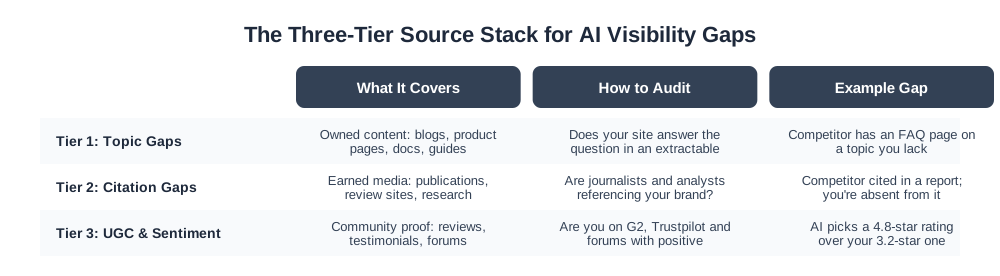
Most traditional content gap analyses only address Tier 1. They look at your website, compare it to competitors, and identify missing pages. That’s necessary but insufficient. If your competitors are being cited because they’re referenced in a widely-circulated industry report (Tier 2) or because they have thousands of positive reviews on G2 (Tier 3), writing better blog posts won’t change anything.
The rest of this guide walks through a complete eight-step workflow that addresses all three tiers.
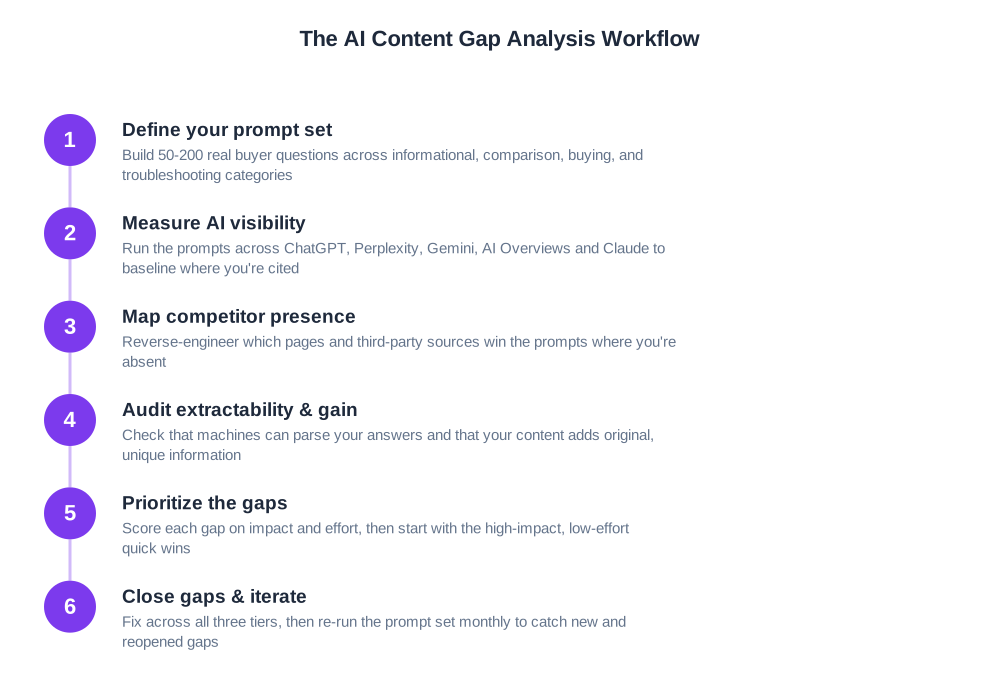
The first step in a content gap analysis for AI search visibility is to stop thinking in keywords and start thinking in prompts. AI engines answer questions, so your unit of analysis must be the question.
A keyword like “CRM software” is too broad for AI search analysis. The AI answer for that keyword will vary dramatically depending on how the user phrases the question. “What is CRM software?” produces a definition. “What is the best CRM for small businesses?” produces a comparison. “How do I migrate from Salesforce to HubSpot?” produces a step-by-step guide. These are three different AI answers, potentially citing three different sets of sources, all of which could be loosely categorized under the keyword “CRM software.”
Your prompt set should capture the actual questions your audience asks AI assistants. Aim for 50–200 prompts covering these categories:
Start with these sources:
These prompts become your benchmark. You’ll run the same set every month or quarter and measure how your visibility changes over time.
Once you have your prompt set, you need to establish a baseline. This is the measurement phase, and it’s where most teams discover just how invisible they really are.
For each prompt in your set, query the following AI platforms with web search or browsing capabilities enabled:
For each prompt and each platform, record the following in a spreadsheet:
| Column | What to Record |
|---|---|
| Prompt | The exact prompt text |
| Query Category | Informational, comparison, buying, troubleshooting, local |
| Platform | ChatGPT, Perplexity, Gemini, Google AI Overview, Claude |
| Your Brand Mentioned? | Yes / No |
| Your Page Cited? | URL if cited, or “None” |
| Competitor A Mentioned? | Yes / No |
| Competitor B Mentioned? | Yes / No |
| Competitor C Mentioned? | Yes / No |
| Sources Cited | List all URLs the AI cited in its answer |
| Sentiment Toward Your Brand | Positive / Neutral / Negative / Not Mentioned |
| Answer Accuracy | Accurate / Partially Accurate / Inaccurate |
| Notes | Anything surprising about the answer or sources |
This spreadsheet is your ground truth. After running 50 prompts across 4–5 platforms, you’ll have 200–250 data points that reveal exactly where you stand.
Once you have your data, ask these questions:
After establishing your baseline, the next step is to understand what your competitors are doing that you’re not. This is a competitor AI visibility analysis, and it’s different from traditional competitor analysis.
Your AI competitors may not be the same as your traditional SERP competitors. A company that ranks below you on Google might be cited ahead of you in AI answers because they have better third-party validation or more extractable content. Use your baseline spreadsheet to identify which competitors appear most frequently across your prompt set. These are the competitors you need to analyze.
For each prompt where a competitor is cited and you’re not, ask:
Create a competitor benchmark that tracks:
| Metric | Your Brand | Competitor A | Competitor B | Competitor C |
|---|---|---|---|---|
| Overall Mention Rate | X% | X% | X% | X% |
| Citation Rate (pages linked) | X% | X% | X% | X% |
| Average Sentiment | n/a | n/a | n/a | n/a |
| Most Common Citation Source | n/a | n/a | n/a | n/a |
| Top 3 Winning Prompts | n/a | n/a | n/a | n/a |
This benchmark gives you concrete targets. If Competitor A has a 65 percent mention rate and you’re at 15 percent, closing the gap means roughly tripling your AI visibility, and you now have a benchmark to measure against.
One of the most common reasons brands fail to appear in AI answers is not that their content is bad, it’s that the AI’s parser can’t cleanly extract information from it. You have the right information, but it’s buried under clever metaphors, long-winded introductions, or impenetrable blocks of text.
Read each of your key pages and ask: if a machine had to extract the core answer in under two seconds, could it? The answer should be yes. Here’s how to get there:
Use BLUF (Bottom Line Up Front): Lead every section with a direct, one-to-two-sentence answer or definition. Then provide supporting context. This is sometimes called the “inverted pyramid” in journalism. AI parsers prioritize the first sentences of sections: if those sentences contain the answer, the parser is more likely to extract it.
Write descriptive, self-contained headings: “Introduction” is a terrible heading for AI extractability. “What Is Content Gap Analysis for AI Search?” is much better. The heading should tell the parser exactly what the section contains. AI models use headings as navigation cues, so make them information-rich.
Use structured formatting: Tables, bulleted lists, numbered steps, and clearly labeled comparison sections are significantly easier for AI parsers to extract than walls of prose. Research from the Princeton and Georgia Tech GEO study found that adding statistics to content improves AI visibility by 41 percent, while adding expert quotes improves it by 28 percent. Both are easier to extract when presented in structured formats.
Eliminate vague language: Replace ambiguous pronouns and marketing jargon with specific, declarative statements. Instead of “Our solution helps businesses achieve better outcomes,” write “Our platform reduced customer churn by 23 percent across 150 enterprise accounts in 2025.”
Make answers self-contained: A reader (or AI parser) should be able to understand any section of your page without reading the sections before it. Every H2 section should function as a standalone answer.
Structured data, particularly FAQ schema, Article schema, and Product schema, helps AI parsers understand the type and structure of your content. While schema markup alone won’t guarantee AI citations, multiple industry analyses have found a positive correlation between schema implementation and AI citation rates.
Key schema types to implement:
Information gain is the concept that separates content AI engines cite from content they ignore. It’s not about word count, keyword density, or backlink count. It’s about whether your content contributes something new that the AI’s training data and retrieval corpus don’t already contain.
The concept originates from a Google patent on “contextual estimation of link information gain.” The idea is simple: if a page contains the same information as every other page on the topic, it has low information gain. If a page introduces new data, unique perspectives, or original analysis that doesn’t exist elsewhere, it has high information gain, and AI engines are more likely to cite it because it adds value to the synthesized answer.
In practice, information gain is what makes your content worth citing. If your article on “best CRM for small businesses” contains the same list of five CRMs that every other article on the internet contains, the AI engine has no reason to prefer your page over anyone else’s. But if your article includes original survey data from 500 small business owners, named expert commentary, and a pricing comparison table that no one else has compiled, your page contributes something unique, and the AI engine has a reason to cite it.
When auditing your content, look for these high-information-gain elements:
For each piece of content you’re evaluating:
The fix is not to write more. It’s to add elements that are genuinely original: data, expert perspectives, and first-hand experience that no other page can replicate.
After auditing your AI visibility, competitor presence, content extractability, and information gain, you’ll have a list of gaps. The list will be long. You need a framework to decide what to tackle first.
Use a two-axis matrix: Impact (how much this gap affects your AI visibility) and Effort (how much time, money, and resources it will take to close).
| Priority | Characteristics | Example | Action |
|---|---|---|---|
| High | High-value topics where competitors are cited and you aren’t; existing content that’s close to being AI-ready | Your comparison page ranks #3 on Google but never appears in AI answers because it lacks structured data and extractable formatting | Fix in the next 30 days |
| Medium | Important topics where you have partial content but it needs expansion or restructuring; citation gaps that require outreach | You have a blog post on the topic but it’s 800 words, lacks original data, and has no structured headings | Schedule for the next 60–90 days |
| Low | New niche topics with limited AI search demand; citation gaps requiring major PR investment | A topic that surfaces in 2 out of 50 prompts and would require a full original research study to win | Add to the long-term roadmap |
Score each gap on a scale of 1–5 for both dimensions:
Impact scoring:
Effort scoring:
Plot each gap on the matrix. Start with high-impact, low-effort items (the “quick wins” quadrant) and work your way toward high-impact, high-effort items over time.
The most common quick wins in AI content gap analysis are:
With your prioritized list in hand, it’s time to close the gaps. The execution strategy differs by tier.
Create new content for missing topics. If your prompt set reveals questions you don’t answer, create dedicated pages that answer them directly, comprehensively, and in an extractable format. Don’t cram answers into existing pages: give each important question its own well-structured page.
Expand thin content. If you have a page that addresses the topic but at a surface level, expand it. Add subsections, examples, data, and expert perspectives. The goal is to make your page the most comprehensive and extractable resource on the topic.
Add missing formats. AI engines favor certain content formats: FAQs, comparison tables, step-by-step guides, definitions, and data-backed case studies. If your content is exclusively long-form narrative prose, you’re missing format opportunities. Add these structured elements to existing pages.
Refresh outdated content. AI engines consider freshness as a signal. Update publication dates, replace old statistics, add new examples, and remove outdated claims. A page that was published in 2022 and never updated signals to the AI that it may not reflect the current state of knowledge.
Digital PR for citation sources. Look at the third-party sources the AI engines are citing for your target prompts. If a specific industry publication, media roundup, or research report is consistently referenced, prioritize getting your brand into that source. This might mean pitching journalists, contributing expert commentary, or publishing original research that gets picked up.
Expert contributions and data journalism. Create and promote content that third-party publications will want to cite. Original surveys, industry benchmark reports, and expert commentary from named authorities are all highly citable, and when third parties reference them, they become part of the AI’s retrieval corpus.
Reddit and community engagement. AI engines frequently cite Reddit threads, especially for buying and comparison queries. If a particular subreddit or thread is consistently referenced in AI answers for your target prompts, participate authentically in that community. Note: this doesn’t mean spamming. It means contributing genuinely helpful answers that happen to reference your expertise.
Build relationships with review platforms. For product and service comparisons, AI engines often pull from G2, Trustpilot, Capterra, and similar platforms. If you’re absent from these platforms, or present but with weak reviews, you have a citation gap that no amount of on-site content can fix.
Review generation strategy. If your AI visibility suffers because competitors have hundreds of reviews and you have twelve, implement a systematic review generation program. This includes post-purchase email sequences, in-app prompts, and incentives for honest reviews.
Sentiment monitoring and response. AI engines can detect sentiment from reviews and social proof. If your brand has negative or neutral sentiment in the sources AI pulls from, those signals will color the AI’s answers. Monitor review platforms and social media for sentiment, respond to negative reviews constructively, and actively cultivate positive testimonials.
Community building. Strong communities on platforms like Reddit, Slack, Discord, or industry-specific forums create organic brand mentions that AI engines can surface. Invest in community-building as a long-term AI visibility strategy.
Crawlability and indexability. Before any content can be cited by AI, it must be accessible. Verify that your important pages are crawlable, not blocked by robots.txt, and not accidentally set to noindex. Check that JavaScript-rendered content is accessible to crawlers.
Internal linking. Strong internal linking helps both traditional crawlers and AI retrieval systems understand the relationship between your pages. Link from high-authority pages to the pages you want to boost for AI visibility.
Structured data implementation. As discussed in Step 4, implement FAQPage, Article, Product, and HowTo schema on relevant pages. Validate your markup using Google’s Rich Results Test tool.
AI search visibility is not a one-and-done project. AI engines update their models, change their retrieval sources, and shift their citation patterns. Your content gap analysis must be a recurring process.
Run your full prompt set monthly. Use the same spreadsheet structure from Step 2 and track:
Every quarter, review your prompt set. Add new prompts that reflect emerging customer questions, industry trends, or new product features. Remove prompts that are no longer relevant. The goal is to keep your benchmark aligned with what your audience is actually asking.
Success in AI content gap analysis isn’t a binary “we’re cited” or “we’re not.” It’s a trajectory:
A variety of tools have emerged to help with AI content gap analysis. Here is a vendor-neutral comparison of the leading options, organized by what they’re best for.
| Tool | Best For | Key Features | Pricing Tier | Limitations |
|---|---|---|---|---|
| AmICited | Purpose-built AI content gap analysis | Prompt-level mention and citation tracking, competitor gap detection, source mapping across ChatGPT, Perplexity, and Google AI Overview | Budget to Mid-market | Newer, focused entrant rather than a broad all-in-one SEO suite |
| Semrush | All-in-one platform with AI visibility add-on | Competitor research, AI visibility gap reports, brand performance tracking, topic research | Enterprise (AI Visibility is an add-on) | Tool-biased toward Semrush ecosystem; AI visibility features are relatively new |
| Similarweb | Enterprise AI search intelligence | AI Search Intelligence module, sentiment analysis, citation source mapping, competitor benchmarking | Enterprise | Expensive for small teams; steep learning curve |
| Profound | Brand-focused AI visibility tracking | Real-time AI answer monitoring, citation tracking across ChatGPT, Perplexity, Gemini, and Google AI Overviews | Mid-market | Limited to brand monitoring; less useful for topic-level gap analysis |
| Slate | Content-team-focused AI gap analysis | Built specifically for AI search era, content gap identification, citation tracking | Mid-market | Newer tool with smaller feature set |
| Ahrefs | Traditional SEO with AI search add-ons | AI Search Competitor Analysis, brand gap analysis, content gap tool | Mid-market to Enterprise | AI search features are supplemental, not core; limited AI citation tracking |
| OtterlyAI | Affordable AI citation tracking | Brand mention and citation monitoring across AI platforms, competitor tracking | Budget to Mid-market | Smaller dataset; fewer enterprise features |
| ZipTie | Technical AI search readiness | AI search readiness audits, structured data validation, crawlability checks | Budget to Mid-market | More technical than content-focused; limited competitor analysis |
| Manual Method | No-budget teams | Spreadsheet-based auditing using free AI platforms | Free | Labor-intensive; doesn’t scale well beyond 50 prompts |
Yes, with caveats. The manual method described in Step 2 requires only a spreadsheet and free access to AI platforms (ChatGPT, Perplexity, Gemini, and Google Search all offer free tiers). For a small prompt set of 20-50 prompts, this is entirely feasible. The limitations are:
For teams just starting out, begin with the manual method. Once you’ve proven the value of AI content gap analysis, invest in a tool to scale the process. Because it’s built specifically for finding mention and citation gaps rather than bolted onto a broader SEO suite, Am I Cited is a strong first tool to graduate to, showing you exactly which prompts favor competitors and which sources they win before you commit to a heavier platform.
Running a content gap analysis for AI search visibility is new territory for most teams, and mistakes are common. Here are the ones to watch for:
Focusing only on traditional rankings, not AI mentions. Your #1 position on Google is irrelevant to AI visibility if the AI engine doesn’t cite your content. Measure AI visibility separately and treat it as a distinct KPI.
Over-optimizing for keywords instead of answer quality. AI engines don’t care about your keyword density. They care about whether your content provides a clear, extractable, and comprehensive answer. Write for the question, not the keyword.
Ignoring off-page authority and citation building. Your website is only one part of the AI visibility equation. If you’re not also building citations from third-party sources, you’re fighting with one hand tied behind your back.
Publishing thin AI-generated content. It’s tempting to use AI tools to rapidly create content that fills every gap. But AI-generated content that lacks information gain (original data, expert perspective, real-world experience) won’t be cited by the same AI engines that could have written it themselves. Low-value content at scale is still low-value content.
Failing to update content regularly. AI engines value freshness. A page that was published two years ago and never updated is less likely to be cited than a recently refreshed page, even if the older page has more authority signals.
Treating AI content gap analysis as a one-time project. AI search is evolving rapidly. What works today may not work in six months. Make the analysis a recurring part of your content strategy calendar.
AI search visibility is not a bonus feature of your SEO strategy: it’s rapidly becoming the primary way your audience discovers and evaluates your brand. A content gap analysis for AI search visibility is the systematic process of ensuring you’re not invisible in that new reality.
The framework laid out in this guide gives you everything you need to start:
The key insight is this: AI engines cite content that is clear, extractable, original, and well-validated by third-party sources. Your job is not to game the algorithm: it’s to be the best answer, presented in the most accessible way, and validated by the most credible sources. If you do that consistently, the citations will follow.
Start today with the 15-minute baseline audit. Open a spreadsheet. Run your top 20 prompts across ChatGPT, Perplexity, and Gemini. Record what you find. The gaps you discover in that first hour will tell you exactly where to focus your efforts, and put you ahead of competitors who are still waiting for the AI search era to arrive.
Arshia is an AI Workflow Engineer at FlowHunt. With a background in computer science and a passion for AI, he specializes in creating efficient workflows that integrate AI tools into everyday tasks, enhancing productivity and creativity.

Am I Cited shows which prompts cite competitors instead of you, and which sources they win, across ChatGPT, Perplexity, and Google AI Overview, so your content gap analysis starts from real data.
Learn what AI Content Gap Analysis is and how to identify content gaps to improve your visibility in AI Overviews, ChatGPT, and generative search engines. Disco...

A step-by-step method for finding exactly where your AI visibility gaps are: content audits, competitor citation analysis, and testing your brand across ChatGPT...

Learn how to identify content gaps for AI search engines like ChatGPT and Perplexity. Discover methods to analyze LLM visibility, find missing topics, and optim...
Cookie Consent
We use cookies to enhance your browsing experience and analyze our traffic. See our privacy policy.