


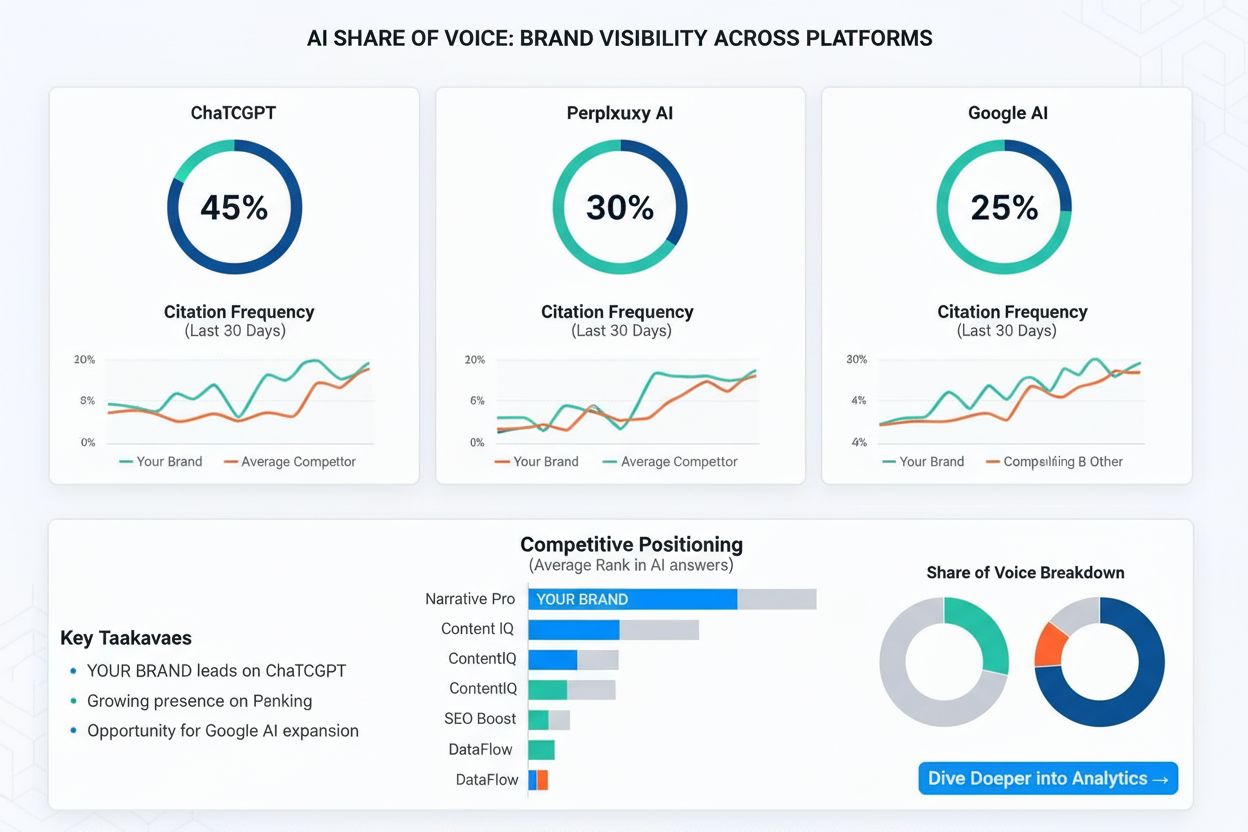
AI Share of Voice
AI Share of Voice measures brand visibility in AI-generated responses. Learn how to track, calculate, and improve your presence across ChatGPT, Perplexity, and ...
13 min read
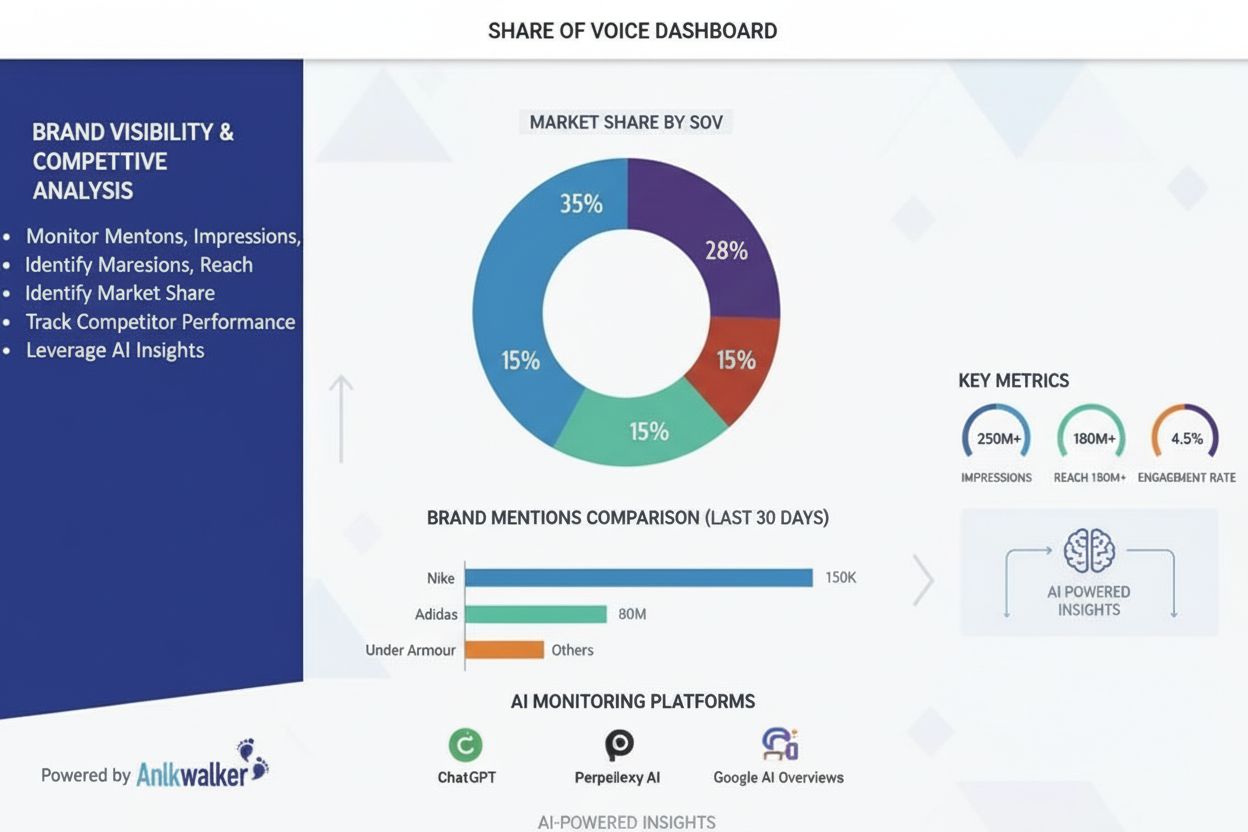
Share of Voice (SOV) is a metric that measures a brand’s visibility and presence in market conversations compared to competitors, expressed as a percentage of total mentions, impressions, or media spend across marketing channels. It serves as a leading indicator of brand awareness and competitive positioning in digital and traditional media landscapes.
Share of Voice (SOV) is a metric that measures a brand's visibility and presence in market conversations compared to competitors, expressed as a percentage of total mentions, impressions, or media spend across marketing channels. It serves as a leading indicator of brand awareness and competitive positioning in digital and traditional media landscapes.
Share of Voice (SOV) is a metric that quantifies a brand’s visibility and presence in market conversations relative to its competitors, expressed as a percentage of total mentions, impressions, media spend, or engagement across marketing channels. Unlike traditional market share metrics that measure sales revenue, Share of Voice measures the proportion of industry conversation a brand owns, making it a leading indicator of future market performance and brand awareness. This metric has become increasingly critical as brands compete not only in traditional media and social platforms but also in emerging AI-powered search environments where visibility in AI-generated responses directly influences consumer perception and purchasing decisions. Share of Voice operates across multiple channels—from social media mentions and news coverage to search engine visibility and paid advertising impressions—providing a comprehensive view of competitive positioning in the digital landscape.
The concept of Share of Voice emerged in the advertising industry during the mid-20th century as a way to measure media spending efficiency and competitive positioning. Originally, SOV focused exclusively on paid advertising expenditures, helping marketers understand their relative investment compared to competitors. However, the metric has evolved dramatically with the rise of digital marketing, social media, and now artificial intelligence. In the 1980s and 1990s, research by marketing scientists like Binet and Field established the critical relationship between Share of Voice and market share growth, demonstrating that brands maintaining SOV above their market share (called Excess SOV or ESOV) typically experience 0.5% market share gains for every 10% increase in ESOV. This foundational research transformed SOV from a simple spending metric into a strategic planning tool. Today, Share of Voice encompasses earned media, owned channels, paid advertising, organic search visibility, social media engagement, and increasingly, visibility in AI-generated responses. According to recent industry data, approximately 35% of PR professionals now incorporate Share of Voice and message pull-through into their analytics, up from just 13% who relied solely on coverage quantity, reflecting the metric’s growing importance in data-driven marketing strategies.

Track how AI chatbots mention your brand across ChatGPT, Perplexity, and other platforms.
| Metric | Definition | Measures | Time Indicator | Data Source | Primary Use |
|---|---|---|---|---|---|
| Share of Voice (SOV) | Brand’s percentage of total market conversation | Visibility and presence | Leading indicator | Mentions, impressions, engagement | Competitive positioning, growth potential |
| Market Share (SOM) | Brand’s percentage of total industry sales | Revenue and sales | Lagging indicator | Sales data, revenue reports | Business performance, market dominance |
| Brand Awareness | Percentage of target audience recognizing brand | Recognition and recall | Outcome metric | Surveys, brand tracking studies | Consumer perception, brand strength |
| Engagement Rate | Percentage of audience interacting with content | Audience interaction | Real-time metric | Social media analytics | Content effectiveness, audience interest |
| Impression Share | Percentage of available ad impressions captured | Paid visibility | Real-time metric | Google Ads, ad platforms | PPC campaign performance |
| Search Visibility | Organic search ranking and traffic share | Organic presence | Ongoing metric | SEO tools, Google Analytics | SEO effectiveness, organic reach |
| Sentiment Share | Percentage of positive vs. negative mentions | Brand perception quality | Real-time metric | Social listening tools | Brand reputation, perception trends |
Share of Voice operates through a straightforward mathematical formula that can be applied across virtually any marketing channel: divide your brand’s metrics by the total market metrics, then multiply by 100 to obtain a percentage. However, the specific metrics used vary significantly depending on the channel being measured. In social media Share of Voice, marketers count brand mentions, hashtag usage, engagement metrics, and reach across platforms like Facebook, Instagram, Twitter, TikTok, and LinkedIn, comparing these figures to the total mentions of all competitors in the same category. For SEO Share of Voice, specialized tools like Ahrefs, Semrush, and Moz track keyword rankings and organic search traffic, calculating what percentage of clicks for industry-relevant keywords go to your domain versus competitors. Media Share of Voice requires monitoring news articles, press releases, and industry publications, measuring how frequently your brand appears in earned media compared to competitors. PPC Share of Voice uses Google Ads’ Impression Share metric, which shows what percentage of available ad impressions your campaigns captured for specific keywords. In the emerging AI Share of Voice category, tools like AmICited track how often your brand appears in AI-generated responses on platforms like ChatGPT, Perplexity, Google AI Overviews, and Claude, measuring your visibility in this new conversational search environment. Each channel requires different measurement tools and methodologies, but the underlying principle remains consistent: understanding your relative visibility compared to competitors.
Get the latest insights on AI mentions, brand monitoring, and optimization strategies.
The business implications of Share of Voice extend far beyond simple visibility metrics. Research demonstrates that brands maintaining SOV above their market share experience measurable growth in actual sales and market position. The Binet and Field study, which analyzed 171 marketing campaigns between 1980 and 2010, established that a brand’s market share typically gains 0.5% for every 10% in Excess SOV (ESOV)—meaning if your brand holds 20% market share but achieves 30% SOV, that 10% excess visibility translates to approximately 0.5% market share growth. This relationship has proven consistent across industries and markets, making Share of Voice a critical input for media budget allocation and strategic planning. For marketing teams, SOV provides actionable intelligence about competitive dynamics, revealing which competitors are gaining ground, which channels drive the most conversation, and where market gaps exist. A brand with low SOV in a high-growth category signals an opportunity to increase investment and capture emerging conversations. Conversely, declining SOV despite stable or increasing marketing spend indicates messaging problems or competitive threats requiring strategic adjustment. In the context of AI monitoring, Share of Voice has become increasingly critical as generative AI platforms become primary information sources for consumers. A 2025 analysis shows that Perplexity AI holds approximately 6.1% of the generative AI chatbot market share, with ChatGPT dominating at over 70%, yet brands that fail to monitor their SOV across these platforms risk losing visibility in conversations that directly influence purchasing decisions. Companies like Nike and Adidas, which maintain SOV percentages of 49% and 47% respectively in the sportswear market, understand that visibility across all channels—including emerging AI platforms—is essential to maintaining competitive advantage.
The emergence of AI-powered search platforms has fundamentally changed how brands must approach Share of Voice measurement and strategy. Traditional search engines like Google have introduced AI Overviews (formerly SGE), which generate synthesized answers to user queries, fundamentally altering how brands appear in search results. In this environment, Share of Voice measures not just keyword rankings but whether your brand is cited, mentioned, or recommended in AI-generated responses. ChatGPT, which dominates the generative AI market with over 70% usage share, presents unique SOV challenges because its responses are based on training data and user interactions rather than real-time web indexing. Brands must ensure their content is discoverable and authoritative enough to be referenced in ChatGPT responses. Perplexity AI, with its 6.1% market share, uses a different approach by citing sources directly in responses, making source attribution and visibility more transparent. Google AI Overviews integrate directly into Google Search, meaning brands that rank well organically have better chances of appearing in AI-generated summaries. Claude, developed by Anthropic, represents another important platform where brand visibility matters, particularly for B2B and enterprise audiences. The critical difference in AI-based Share of Voice is that visibility depends less on paid advertising and more on content quality, authority, and relevance. A brand’s SOV in AI responses reflects whether its content is considered authoritative enough to be cited or recommended by AI systems. This shift requires brands to focus on creating comprehensive, well-researched content that AI systems recognize as credible sources. AmICited and similar AI monitoring platforms now track Share of Voice across these AI channels, providing brands with visibility into how often they appear in AI-generated responses compared to competitors, enabling data-driven optimization of content strategy for AI discoverability.
Effective Share of Voice measurement requires a systematic approach combining the right tools, clear objectives, and consistent monitoring protocols. The first step is defining your competitive set—identifying which brands you’re competing against in specific markets, product categories, or audience segments. This definition shapes all subsequent SOV calculations, as measuring against the wrong competitors produces misleading data. Next, select appropriate measurement tools based on your channels of focus. For social media Share of Voice, platforms like Brand24, Sprout Social, Talkwalker, and Brandwatch provide comprehensive monitoring across major networks with sentiment analysis and engagement metrics. For SEO Share of Voice, tools like Ahrefs, Semrush, and Moz offer keyword tracking and visibility analysis. For media Share of Voice, specialized PR monitoring tools track news coverage and earned media. For AI Share of Voice, emerging platforms like AmICited specifically track brand mentions across ChatGPT, Perplexity, Google AI Overviews, and Claude. Once tools are in place, establish baseline measurements and set realistic benchmarks. A strong Share of Voice typically ranges from 25-30% in competitive markets, though this varies significantly by industry concentration and market maturity. More important than absolute percentages is tracking SOV trends over time and comparing your SOV to your market share. If your SOV exceeds your market share (Excess SOV), you’re positioned for growth. If SOV lags market share, you risk losing visibility and future sales. Best practices include monitoring SOV across multiple channels simultaneously, segmenting analysis by product line or topic to assess relevance beyond raw volume, analyzing sentiment alongside mentions to understand perception quality, and conducting regular competitive analysis to identify strategic shifts. Many leading brands conduct weekly or monthly SOV reviews during active campaigns and quarterly reviews during stable periods, adjusting strategy based on visibility trends and competitive movements.
Start tracking how AI chatbots mention your brand across ChatGPT, Perplexity, and other platforms. Get actionable insights to improve your AI presence.
AI Share of Voice measures brand visibility in AI-generated responses. Learn how to track, calculate, and improve your presence across ChatGPT, Perplexity, and ...

Learn what Share of AI Voice is, how it's calculated, and why it matters for your brand's visibility in ChatGPT, Perplexity, and Google AI Overviews. Discover s...

Learn how to calculate Share of Voice for AI search platforms. Discover the formula, tools, and strategies to measure your brand's visibility in ChatGPT, Perple...
Cookie Consent
We use cookies to enhance your browsing experience and analyze our traffic. See our privacy policy.