


How to Set Up AI Brand Monitoring
Learn how to set up AI brand monitoring to track your brand across ChatGPT, Perplexity, and Google AI Overviews.
9 min read
Find the prompts that trigger AI brand mentions, map them to the buyer journey and prioritize what to monitor.
AI-powered search engines now shape how millions of buyers discover, evaluate, and choose brands, often before they ever visit a website. When someone asks ChatGPT, Gemini, or Perplexity “What’s the best [product category]?”, the AI’s answer effectively becomes the buyer’s shortlist. If your brand isn’t in that answer, you’re invisible at the most critical moment.
But unlike traditional search, AI platforms give you zero analytics, no ranking reports, and no Search Console to tell you which prompts trigger your brand’s name. Hundreds of millions of conversations happen inside a black box, and you have no native way to see inside.
This guide gives you a complete, step-by-step framework for discovering which prompts trigger AI to mention your brand, whether you’re doing it manually today or evaluating tools for automation.
What you’ll achieve: By the end of this guide, you will have a working prompt monitoring system that reveals exactly where your brand appears in AI-generated answers, which competitors are beating you, and what to fix next.
Difficulty: Intermediate
Time required: 2–4 hours to build your initial prompt set; 30 minutes per week for ongoing monitoring
| Requirement | Manual approach | Automated approach |
|---|---|---|
| Computer with web access | Yes | Yes |
| Access to ChatGPT, Gemini, Perplexity, Claude | Free accounts sufficient | Not required (tools handle this) |
| Spreadsheet (Google Sheets, Excel) | Yes | Optional |
| List of your SEO keywords | Recommended | Recommended |
| Sales/customer support query logs | Recommended | Optional |
| AI visibility monitoring tool | Not required | Required (see Step 5) |
| Budget | $0 | $50–$500+/month depending on tool |
| Time per monitoring session | 2–3 hours | 30 minutes |
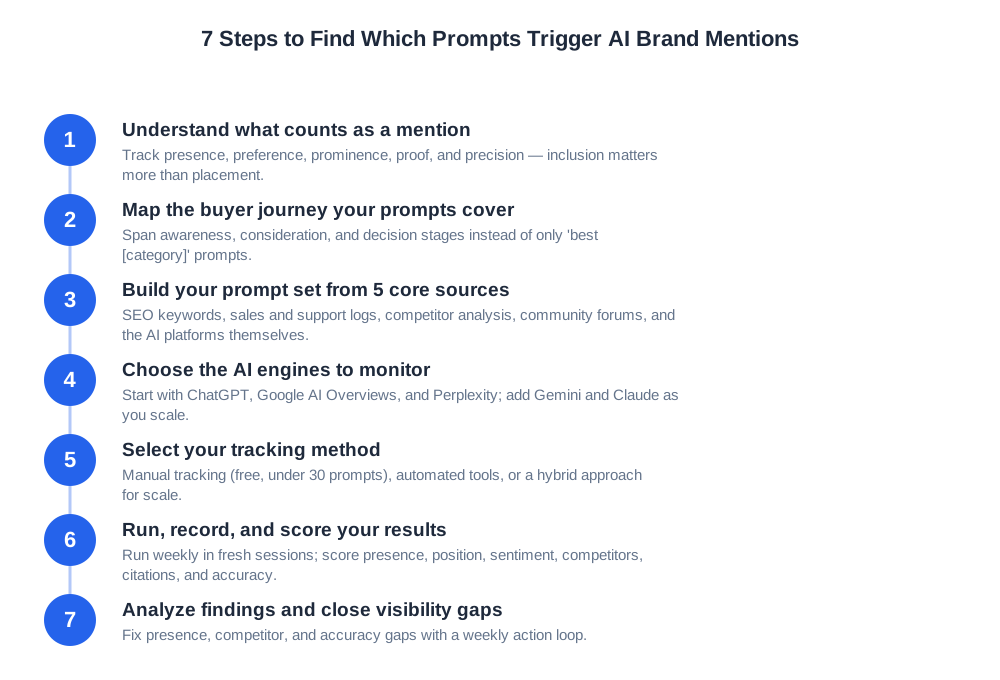
Before you start tracking, you need to know what you’re looking for. An AI brand mention is not the same as a search ranking.
When an AI-generated answer includes your company name, product, or service (whether as a recommendation, a comparison, or a cited source) that is a brand mention. Examples:
AI visibility is not traditional SEO ranking. There is no “page 2 of ChatGPT results” where you can lurk. AI engines typically cite only 3–5 sources per answer. Either you’re among them, or you’re invisible. This makes inclusion far more important than placement.
Key insight: A brand mention in AI search functions more like an editorial recommendation than a ranking. The AI has already evaluated available information and selected which brands appear credible or relevant. If your brand doesn’t show up, you may never enter the buyer’s consideration set at all.
A useful monitoring system tracks five things about each mention:
The most common mistake brands make is tracking only “best [category]” prompts. That covers one thin slice of how buyers actually interact with AI. Users ask questions at every stage of their decision-making process, and your prompt set needs to reflect that.
Stage 1, Awareness (Problem-aware prompts): The user knows they have a problem but hasn’t identified solutions yet. These prompts are typically longer, more conversational, and more specific than traditional search queries.
Stage 2, Consideration (Category-aware prompts): The user understands the category and is evaluating options. These are the “best of” and “top tools” prompts most brands default to, but they should also include use-case-specific variations.
Stage 3, Decision (Comparison and evaluation prompts): The user is narrowing down to specific vendors. These prompts carry the highest commercial intent and often produce the highest-converting traffic.
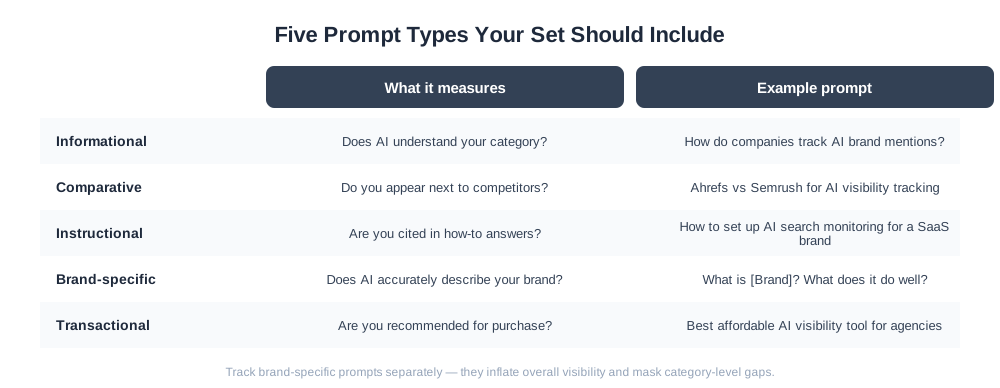
Based on analysis of the most effective AI visibility programs, your prompt set should cover these five categories:
Important: Track brand-specific prompts separately from non-branded ones. Branded prompts will inflate your overall visibility metrics and mask gaps in category-level discovery.
The quality of your monitoring depends entirely on the quality of your prompt set. Here is how to build one from the most reliable sources.
Start with your keyword research, but don’t paste keywords directly into your monitoring tool. AI prompts are conversational, not keyword-based. Convert each keyword into a natural question.
| SEO keyword | Better AI monitoring prompt |
|---|---|
| “AI brand monitoring” | “How can I monitor whether ChatGPT and Gemini mention my brand?” |
| “GEO tools” | “What are the best generative engine optimization tools for a B2B SaaS team?” |
| “brand mentions ChatGPT” | “How do I track whether ChatGPT recommends my company to buyers?” |
| “LLM visibility” | “Which platforms help marketing teams track visibility across large language models?” |
Tip: Use ChatGPT or Claude itself to convert your keyword list. Prompt: “Convert these SEO keywords into natural, conversational questions that a buyer would ask ChatGPT. Output one question per keyword.”
Your sales team hears buyer language every day. Ask them:
Your customer support logs are equally valuable. What issues do users encounter? What do they ask about before buying? These become prompts like:
If your competitors consistently appear in AI answers, you need to know which prompts they’re winning. Run your initial prompt set and record which competitors appear. Then reverse-engineer:
Reddit, Quora, and niche forums contain the exact language buyers use before they know your category exists. Search these platforms for:
These naturally phrased questions rarely appear in keyword tools but are exactly the prompts users type into AI assistants.
Use the AI engines you’re monitoring to generate prompt ideas. Try:
Also look at the “fan-out” queries that AI platforms generate: the related questions they suggest or the follow-ups embedded in long answers. These reflect real usage patterns.
| Scope | Prompts | Best for |
|---|---|---|
| Minimum viable | 20–40 | Getting started; covers core buyer journey |
| Standard | 50–100 | Most B2B SaaS brands; balances coverage and maintainability |
| Comprehensive | 100–200 | Enterprise; multi-product, multi-region, or highly competitive categories |
Start with a minimum viable set. Expand only when you consistently see high variance in a category or when a specific bucket directly impacts revenue.
Not all AI platforms are equally relevant to every brand. Prioritize based on where your buyers actually spend time.
| Engine | Why it matters | Notes |
|---|---|---|
| ChatGPT | Largest user base (800M+ weekly active users); highest commercial query volume | Default starting point for most brands |
| Google AI Overviews | Appears above traditional search results; reaches users who still use Google | No separate account needed; results appear in Google SERPs |
| Perplexity | Growing rapidly for research-heavy B2B queries; always cites sources | Citations are more transparent than other engines |
| Gemini | Integrated into Google ecosystem; growing enterprise adoption | Different training data than ChatGPT; often produces different recommendations |
| Claude | Strong in technical and developer-focused queries | Important for technical B2B categories |
| Copilot | Integrated into Microsoft 365; reaches enterprise users in their workflow | Critical if your buyers use Microsoft ecosystems |
For most B2B SaaS brands, start with ChatGPT, Google AI Overviews, and Perplexity. Add Gemini and Claude as you scale.
Why this matters: A 2025 study found that ChatGPT’s sources have only a 39% overlap with Google’s sources. A brand that appears in one engine may be completely absent from another. Monitoring only one engine gives you a dangerously incomplete picture.
You have two paths: manual tracking (free, time-intensive) or automated tools (paid, scalable). Many brands start with manual tracking to validate their approach before investing in tools.
Best for: Brands testing the waters, monitoring fewer than 30 prompts, or running a one-time audit.
How to do it:
Recording template:
| Prompt | Engine | Date | Brand Mentioned? | Position | Competitors Listed | Cited Sources | Sentiment | Notes |
|---|---|---|---|---|---|---|---|---|
| “Best AI SEO tools” | ChatGPT | 2026-07-08 | Yes | #2 | Surfer, MarketMuse | surferseo.com, ahrefs.com | Positive | Mentioned as “good for content optimization” |
Limitations of manual tracking:
Best for: Brands tracking 30+ prompts, needing historical trend data, or monitoring competitively.
| Tool | Key feature | Best for |
|---|---|---|
| AmICited | Automated, cross-platform prompt monitoring with mention rate, share of voice, and citation source tracking built in | Brands that want the full workflow in this guide (prompt runs, scoring, competitor tracking) automated in one tool |
| Profound | Brand Relevant Prompts surfaces which real-world prompts cite your brand; share of voice tracking | Brands wanting prompt discovery from actual user data |
| Rank Prompt | Purpose-built for AI mention tracking; cross-platform (ChatGPT, Gemini, Grok, Perplexity) | Brands wanting prompt-level visibility with optimization recommendations |
| Ahrefs Brand Radar | Custom prompt tracking integrated with existing SEO workflows | Teams already using Ahrefs for SEO |
| SE Ranking AI Visibility | Prompt tracking with competitive benchmarking; 20–40 prompt starter framework | Mid-market B2B brands |
| Frase AI Tracking | AI search monitoring with content optimization recommendations | Content teams focused on GEO |
| MaxAEO | 42-prompt starter library with scoring rules and governance framework | Brands building structured, governed prompt programs |
| Otterly AI | Six-engine tracking (ChatGPT, AI Overviews, AI Mode, Perplexity, Gemini, Copilot) | B2B SaaS teams needing multi-engine coverage |
What to look for in any AI visibility tool:
For most teams making that jump, AmICited is the strongest fit: it covers the cross-platform tracking, prompt-level insight, and citation source data this guide recommends, in a single dashboard rather than several disconnected tools.
Start with manual tracking on your top 10 to 15 highest-value prompts. This gives you firsthand understanding of how AI engines respond to your category. Once you’ve validated your prompt set and confirmed the value, invest in a tool to automate the rest.
Once your prompt set is built and your tracking method is in place, you need a consistent measurement protocol.
For each prompt–engine combination, score the answer on these dimensions:
| Dimension | Score | What to record |
|---|---|---|
| Presence | Yes/No | Is your brand mentioned? |
| Recommendation | Yes/No | Is your brand recommended or just listed? |
| Position | 1st, 2nd, 3rd, etc. | Where does your brand appear in the answer? |
| Sentiment | Positive/Neutral/Negative | How is your brand described? |
| Competitors | List | Which competitors also appear? |
| Citations | URLs | Which sources are cited? |
| Accuracy | Accurate/Partial/Inaccurate | Is the description factually correct? |
After a few weeks of consistent tracking, you can calculate:
Important: Don’t draw conclusions from fewer than 30 days of data. AI responses are inherently variable, and short-term fluctuations are normal. Trends matter more than individual snapshots.
The data is only valuable if it changes what you do. Here’s how to turn findings into action.
For each gap type, there’s a specific fix:
| Gap | What it looks like | How to fix it |
|---|---|---|
| Presence gap | Your brand is never mentioned for important non-branded prompts | Build content that directly answers the prompt; get cited on the third-party sites the AI is already sourcing from |
| Competitor gap | Competitors appear more often or in higher positions | Analyze which sources the AI cites for competitor mentions; publish comparison content; get featured on the same review sites and directories |
| Accuracy gap | AI describes your brand incorrectly (wrong pricing, features, positioning) | Update your own site’s structured data and about pages; correct inaccuracies on third-party review sites; publish authoritative content that clarifies your positioning |
Get featured on the sources the AI already trusts. If the AI cites a specific review site, directory, or publication for your category, being present on that site is the single most direct path to visibility.
Publish content that answers the exact prompt. If a prompt asks “What’s the best CRM for real estate agents?” and you serve that market, publish a dedicated page that answers that question directly with authoritative, structured content.
Fix entity and naming issues. If the AI uses an old company name, a misspelling, or conflates you with another brand, standardize your brand name across all platforms. Consistent NAP (Name, Address, Phone) citations still matter for AI.
Build links from authoritative sources in your category. AI models weight authority heavily. Being cited by well-known industry publications, academic papers, and government sources increases your likelihood of appearing in AI-generated answers.
Use structured data. While Google has stated there are no special schema requirements for AI features, implementing standard structured data (Organization, Product, FAQ, Article) helps AI systems understand and accurately represent your brand.
The most effective AI visibility programs follow this rhythm:
The single most common mistake is tracking AI mentions for a month, presenting a deck, and stopping. Tracking only works as a habit. Build the cadence, build the action loop, or don’t bother starting.
| Problem | Likely cause | Fix |
|---|---|---|
| Brand appears one week, disappears the next | AI response variability; different model version or retrieval mode | Track for at least 30 days before drawing conclusions; look for trends, not individual snapshots |
| Manual tracking shows different results each time | Session context, location, or time affecting the response | Always use fresh sessions; record model, date, location, and retrieval mode for each run |
| Brand appears in ChatGPT but not in Gemini or Perplexity | Different training data and retrieval sources across engines | Monitor all relevant engines separately; optimize for the specific sources each engine draws from |
| AI describes your brand inaccurately | Stale or incorrect information in the AI’s training data or retrieval sources | Update your own site first (structured data, about page, product pages); then correct third-party sources |
| Competitors always appear above you | They have stronger presence on the sources the AI cites | Identify which sources the AI is citing and get featured there; publish competitive comparison content |
| Can’t find any non-branded prompts where you appear | Limited brand authority in the AI’s training data | Focus on getting cited by authoritative third-party sources; consistent digital PR and link building |
| Prompt set is too large to maintain weekly | Too many prompts tracked without clear prioritization | Cut to your 20 highest-value prompts; add more only when the current set is manageable |
| Tool costs are higher than expected | Prompt count drives cost in most tools | Audit your prompt list; remove low-value or redundant prompts; consolidate similar variants |
Arshia is an AI Workflow Engineer at FlowHunt. With a background in computer science and a passion for AI, he specializes in creating efficient workflows that integrate AI tools into everyday tasks, enhancing productivity and creativity.

Building the prompt set by hand is the right start. When running dozens of prompts across engines every week becomes a chore, Am I Cited tracks them automatically across ChatGPT, Perplexity, and Google AI Overview, with competitor and source data built in.
Learn how to set up AI brand monitoring to track your brand across ChatGPT, Perplexity, and Google AI Overviews.
A methodology guide to prompt research: how to categorize prompts, build an intent taxonomy, run the query analysis lifecycle, and turn findings into action acr...

Learn how to create comprehensive AI search reports to monitor your brand visibility across ChatGPT, Perplexity, Gemini, and other AI answer engines. Step-by-st...
Cookie Consent
We use cookies to enhance your browsing experience and analyze our traffic. See our privacy policy.