


The Complete AI Visibility Guide for Marketers
A practical, complete guide to AI visibility for marketers: the six metrics that matter, how AI systems decide which brands to mention, platform-by-platform tac...
20 min read
Measure brand visibility in Perplexity AI with core metrics, a prompt portfolio, a manual audit and an action plan.
Right now, a potential customer is asking Perplexity AI which CRM is best for their small business. They’re typing “most reliable project management tools for remote teams” or “top alternatives to [your competitor].” Perplexity is synthesizing an answer: pulling from sources across the web, evaluating authority, and assembling a confident response that either names your brand or completely ignores it.
This is happening thousands of times every day, across every industry. And unlike traditional Google search, where ranking on page two still means someone might find you, Perplexity’s answer format is binary: you’re either part of the response or you’re invisible. There is no page two. There is no “scroll down to see more results.” The AI makes a decision about which brands are relevant, and if you’re not in that answer, the opportunity evaporates without a trace: no click, no impression, no bounce rate to analyze.
That’s the uncomfortable reality of Perplexity brand visibility. And most businesses have no idea where they stand.
This guide provides a complete, practical framework for evaluating your brand’s visibility inside Perplexity AI. You’ll learn which metrics actually matter, how to build a representative prompt set, how to run a manual audit, which automated tools are available, and most importantly, how to turn visibility data into actions that improve your presence in AI-generated answers.
If you’re relying on Google Search Console, GA4, or your rank tracker to understand how your brand performs in Perplexity, you’re measuring the wrong thing entirely. The disconnect between traditional SEO data and AI search visibility is structural, not incidental.
Perplexity doesn’t rank pages, it synthesizes answers. When a user submits a query, Perplexity generates multiple internal sub-queries, retrieves content from across the web, and assembles a single, cited response. A page that ranks #1 on Google for “best CRM” might not appear in Perplexity’s answer at all if its content isn’t structured for extraction. Conversely, a page ranked #40 can be cited because it best answers one of the sub-questions Perplexity generated internally.
The numbers bear this out. According to Ahrefs research, only 38% of URLs cited in AI-generated answers rank in Google’s organic top 10. The remaining 62% come from lower positions, or beyond the top 100 entirely, through what researchers call “query fan-out.” Traditional rank tracking misses this population completely.
Perplexity’s responses are non-deterministic. Run the same query twice, even minutes apart, and you may get different citations, different brand mentions, and different recommendations. The index refreshes continuously. A single manual check on a single day tells you almost nothing about your actual visibility. You need repeated observations over time.
There’s no impression data for missed opportunities. In Google Search Console, you can see impressions for queries where you ranked, even if nobody clicked. In Perplexity, when your brand isn’t mentioned, nothing gets logged anywhere. The missed opportunity is completely silent.
This is why Perplexity brand tracking requires its own measurement system, separate from your existing SEO toolstack. The metrics are different, the data collection process is different, and the interpretation is different.

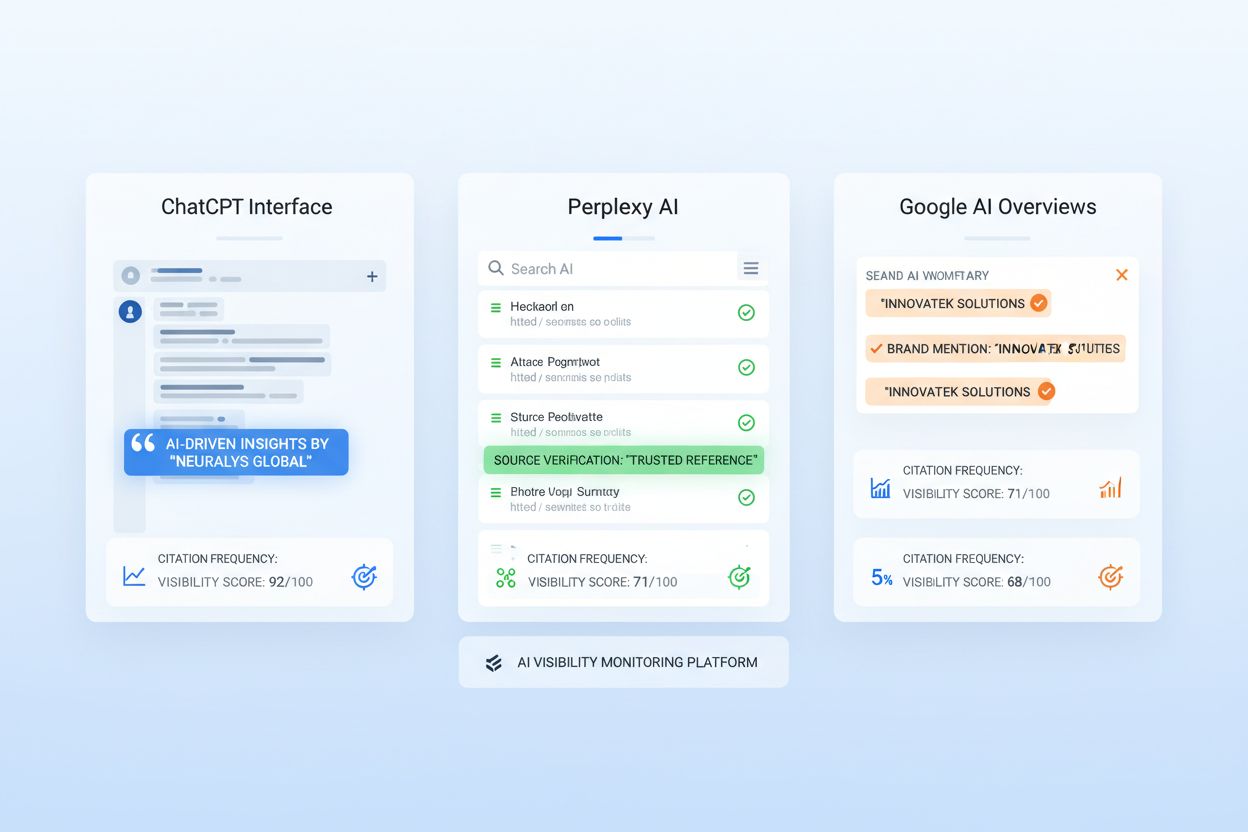
Track how AI chatbots mention your brand across ChatGPT, Perplexity, and other platforms.
When you evaluate brand visibility in Perplexity, you need metrics that capture not just whether you appear, but how you appear, why you appear, and how you compare to competitors. These six metrics form the foundation of any serious measurement framework.
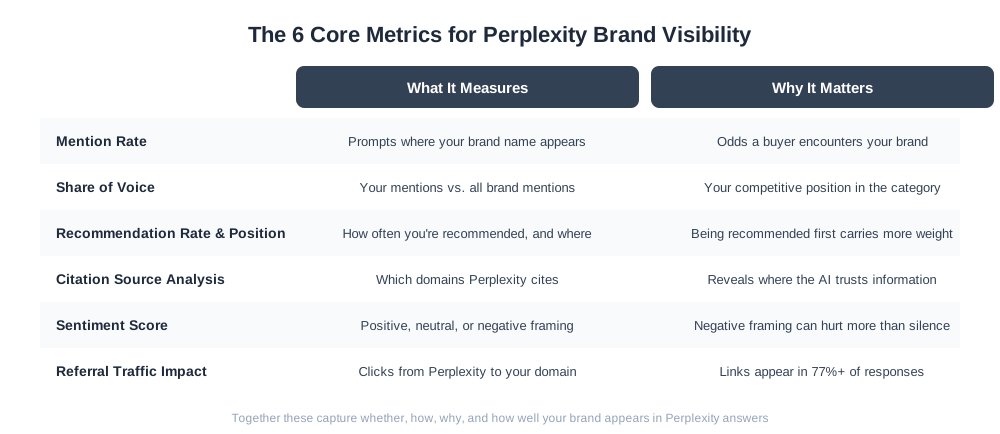
Mention rate is the single most important metric for Perplexity brand visibility. It answers the fundamental question: when a user asks a relevant question, does your brand appear?
Calculate it by dividing the number of prompts where your brand is mentioned by the total number of prompts tested. If you test 50 prompts and your brand appears in 15, your mention rate is 30%.
As a benchmark, Perplexity has the lowest brand mention rate of any major AI platform: approximately 40-48.5% across all tracked responses, according to Spotlight’s February 2026 analysis of 2.4 million AI responses. Claude, by contrast, mentions brands in 97.3% of responses. This means Perplexity is inherently more selective: it’s harder to get mentioned, but when you are, the signal is stronger.
Benchmark ranges for mention rate:
- 0–10%: Invisible, urgent action needed
- 10–30%: Low, significant gaps to close
- 30–60%: Moderate, competitive but room to improve
- 60–80%: Strong, category leader
- 80%+: Dominant, market leader in AI visibility
While mention rate tells you how often you appear, share of voice tells you how you stack up against competitors. This is the AI visibility equivalent of market share.
The formula is straightforward:
AI Share of Voice = (Your brand mentions / Total brand mentions across all tracked prompts) × 100
If your brand is mentioned 50 times and your three competitors are mentioned 30, 20, and 20 times respectively across the same prompt set, your share of voice is 50 / 120 = 41.7%.
This metric is particularly valuable because it reveals category dynamics that traditional SEO tools miss. A competitor might dominate Google rankings but have zero presence in Perplexity answers. Conversely, a brand with mediocre organic rankings might dominate AI citations because of strong third-party review presence or active community discussions.
The gap between Google rankings and AI visibility is often substantial. Digital Authority’s research found that B2B brands consistently appear in fewer than 30% of relevant category queries in AI platforms, regardless of their conventional SEO rankings.
Being mentioned is not the same as being recommended. Perplexity might mention your brand in a list of “other options” or cite it neutrally in a factual context. The recommendation rate measures how often the AI actively suggests your brand as a solution to the user’s problem.
Track this as a binary: for each prompt where your brand appears, does the AI frame it as a recommendation or as a neutral mention? Then calculate:
Recommendation Rate = (Prompts where brand is recommended / Total prompts tested) × 100
Position within the recommendation matters too. Being the first brand mentioned in a Perplexity response carries disproportionate weight. Users tend to trust and remember the first recommendation more than subsequent ones. When Perplexity lists “top alternatives” or “best solutions,” track whether your brand appears first, second, third, or further down.
Perplexity’s transparency is its greatest gift to brand trackers. Every answer includes numbered citations showing exactly which sources informed the response. Citation tracking reveals where the AI is getting its information about your category, and whether your own domain is among those trusted sources.
This analysis often produces surprising results. Across multiple studies, brands discover that their own website is rarely the primary source cited. Instead, Perplexity frequently relies on:
Citation source analysis is diagnostic. If your brand is consistently mentioned but never cited directly, the AI is learning about you from third parties, not from your own content. If a competitor’s domain is cited more often, inspect what they’re doing differently. If review sites dominate your category’s citations, your review profile needs attention.
A mention is not always positive. Perplexity can describe your brand as “reliable and well-regarded” or note that it “has faced criticism for customer support.” The sentiment of AI-generated mentions directly shapes buyer perception.
Track sentiment per prompt using a three-tier scale:
Sentiment tracking is particularly important because AI models can amplify negative signals. A single poor review cited repeatedly can drag down sentiment scores across multiple prompts. Monitoring sentiment lets you catch reputation issues before they spread through AI-generated recommendations.
Ultimately, visibility should connect to business outcomes. Unlike Claude, which doesn’t include external links, Perplexity includes clickable citations in over 77% of its responses. That means Perplexity brand tracking can and should include referral traffic measurement.
Configure your analytics to identify Perplexity as a traffic source. In GA4, create a segment for AI referrers. Track not just visits, but engagement metrics and conversion events from Perplexity-sourced traffic. This closes the loop between visibility measurement and revenue impact.
Perplexity tends to generate higher-quality traffic than many other channels. When a user clicks through from a Perplexity citation, they’ve already seen your brand positioned as a credible source in an AI-generated answer. That’s a warmer introduction than a cold Google search result.
The quality of your Perplexity visibility audit depends entirely on the quality of your prompts. A poorly designed prompt set will produce misleading data, no matter how carefully you track it.
Your prompt portfolio should mirror the full range of questions real buyers ask at different stages of their journey. Include prompts from these categories:
| Prompt Type | Example | Why It Matters |
|---|---|---|
| Category queries | “What are the best CRM platforms for small business?” | Captures top-of-funnel visibility when buyers are building consideration sets |
| Comparison queries | “HubSpot vs Salesforce for scaling teams” | Reveals how Perplexity positions you against specific competitors |
| Problem-based queries | “How can I reduce customer churn with better onboarding?” | Tests whether your brand appears in solution-oriented contexts |
| Transactional queries | “Most affordable project management tool with time tracking” | Captures high-intent, purchase-ready moments |
| Brand-specific queries | “[Your Brand] alternatives” or “[Your Brand] reviews” | Shows how Perplexity frames your brand when users ask about you directly |
There’s no single right answer, but the research converges on a practical range:
Start with 20–30 prompts that cover your most important buyer questions. You can expand the set as you refine your tracking process. The key is consistency: run the same prompts every time so you can compare results over time.
Effective prompts share common characteristics:
Get the latest insights on AI mentions, brand monitoring, and optimization strategies.
You can run a Perplexity visibility audit manually, without any paid tools. Here’s the step-by-step process.
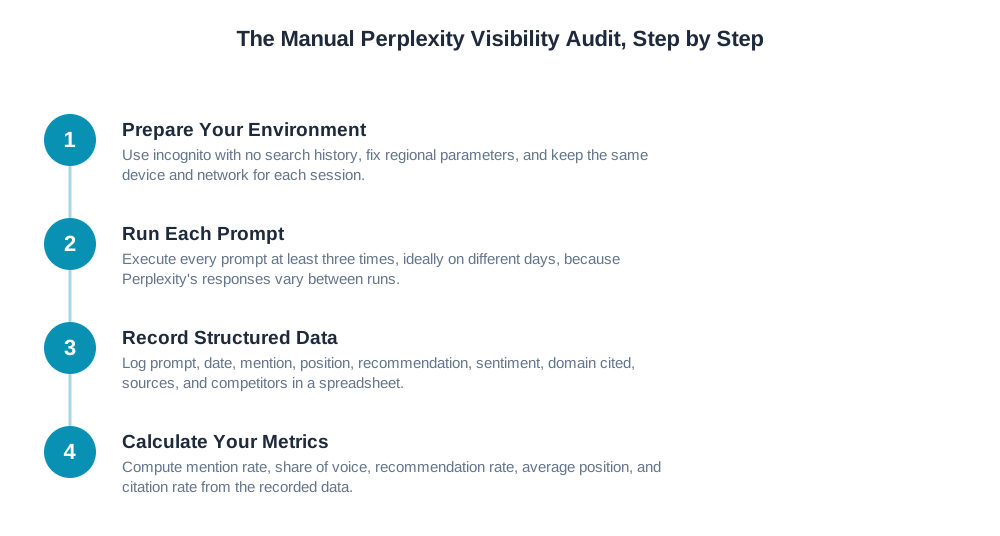
Perplexity personalizes responses based on location, search history, and account settings. To get clean, comparable data:
Execute every prompt in your portfolio, one at a time. For each prompt, run it at least three separate times, ideally on different days, because Perplexity’s responses vary between runs. A brand that appears 3 out of 3 times is firmly established; 1 out of 3 is fragile.
For each response, log the following in a spreadsheet:
| Data Point | What to Record |
|---|---|
| Prompt | The exact query |
| Date | When you ran it |
| Brand mentioned | Yes / No |
| Mention position | 1st, 2nd, 3rd, etc. |
| Recommended | Yes / No |
| Sentiment | Positive / Neutral / Negative |
| Your domain cited | Yes / No |
| Sources cited | List all URLs |
| Competitors mentioned | List all competitor brands |
After running all prompts, calculate:
Manual tracking works for initial baselines and small prompt sets. It breaks down when:
At that point, automated tools become necessary. The manual method gives you the conceptual foundation; automation gives you scale.
The Perplexity brand tracking tool landscape has matured rapidly in 2026. Here’s how the major options compare:
| Tool | Key Features | Pricing Model | Best For |
|---|---|---|---|
| AmICited | Automated cross-platform tracking (Perplexity, ChatGPT, Google AI Overview), mention rate, share of voice, citation source analysis, sentiment | Freemium / subscription | Brands that want the fastest path from manual audits to reliable, ongoing Perplexity visibility tracking |
| SE Ranking | Prompt-based tracking, competitor benchmarking, source analysis, multi-language support | Freemium / subscription | Agencies and SEO teams already using the SE Ranking ecosystem |
| PromptRush | Dedicated Perplexity tracker, citation URL monitoring, competitor share of voice | Paid subscription | Teams focused specifically on Perplexity visibility |
| Sanbi | Cross-platform AI visibility (ChatGPT, Gemini, Perplexity, Claude), sentiment scoring, automated prompt runs | Paid subscription | Brands needing multi-platform AI visibility measurement |
| Dageno | Answer engine insights, citation gap analysis, share of voice, SEO-to-AI integration | Freemium / subscription | Teams wanting to connect AI visibility with traditional SEO workflows |
| Beamtrace | Real-time Perplexity monitoring, competitor tracking, source footprint analysis | Paid subscription | Enterprise brands needing continuous monitoring |
| Friction AI | Perplexity-specific tracking, mention and citation monitoring, referral traffic analysis | Paid subscription | Teams prioritizing Perplexity over other AI platforms |
Among these, AmICited stands out for teams who want the six core metrics above (mention rate, share of voice, recommendation rate, citation sources, sentiment, referral traffic) tracked automatically across Perplexity and other major AI platforms, rather than stitched together from several single-purpose tools.
When evaluating tools, prioritize these capabilities:
If you’re not ready for a paid subscription:
Measuring Perplexity brand visibility is only valuable if it leads to improvement. Here’s how to turn your data into a concrete action plan.
Start by analyzing why your brand isn’t appearing. Look at the citation sources Perplexity uses for prompts where you’re absent:
Perplexity favors content that is structured, authoritative, and easy to extract. Key optimization tactics include:
Because Perplexity relies heavily on third-party sources, your off-site presence matters as much as your website:
Citation share doesn’t respond to changes overnight. But it does respond, and faster than many marketers expect. Research indicates that citation share movement of 30–50% is possible within 30 days with targeted content refreshes. However, citation share also decays at approximately 4% per month without ongoing maintenance.
Run your full prompt set monthly. Track trends, not snapshots. Look for progressive improvement in mention rate, share of voice, and recommendation position. When you see movement, correlate it with the actions you’ve taken (content updates, PR placements, review generation) to identify what’s working.
Evaluating brand visibility in Perplexity AI is not a one-time exercise. It’s an ongoing discipline that sits alongside traditional SEO, PR, and brand monitoring in the modern marketing stack.
The measurement framework is clear: build a representative prompt set, track six core metrics (mention rate, share of voice, recommendation rate and position, citation sources, sentiment, and referral traffic), and run your audit on a consistent schedule. The manual method works for baselines; automated tools provide scale, and for teams ready to make that jump, AmICited is a strong choice for keeping all six metrics current across Perplexity and the other AI platforms your buyers use.
What makes Perplexity uniquely valuable as a measurement platform is its transparency. Every answer cites its sources. You can trace exactly why your brand appears or doesn’t, and use that diagnostic information to close the gaps. No other major AI platform offers the same level of inspectability.
The brands that invest in this measurement now are building a competitive advantage that compounds. As AI-powered search continues to grow (AI search visits grew an estimated 42.8% year-over-year between Q1 2025 and Q1 2026), the gap between brands that are visible in AI answers and those that are invisible will only widen. The question is not whether to measure, but whether you’ll start before your competitors do.
Arshia is an AI Workflow Engineer at FlowHunt. With a background in computer science and a passion for AI, he specializes in creating efficient workflows that integrate AI tools into everyday tasks, enhancing productivity and creativity.

Am I Cited tracks your mention rate, citation sources, sentiment, and share of voice in Perplexity, ChatGPT, and Google AI Overview, so you can measure trends instead of one-off manual checks.
A practical, complete guide to AI visibility for marketers: the six metrics that matter, how AI systems decide which brands to mention, platform-by-platform tac...

Learn how to connect AI visibility metrics to measurable business outcomes. Track brand mentions in ChatGPT, Perplexity, and Google AI Overviews with actionable...

Follow a step-by-step AI visibility audit to measure brand mentions and citations across ChatGPT, Perplexity and other platforms.
Cookie Consent
We use cookies to enhance your browsing experience and analyze our traffic. See our privacy policy.