


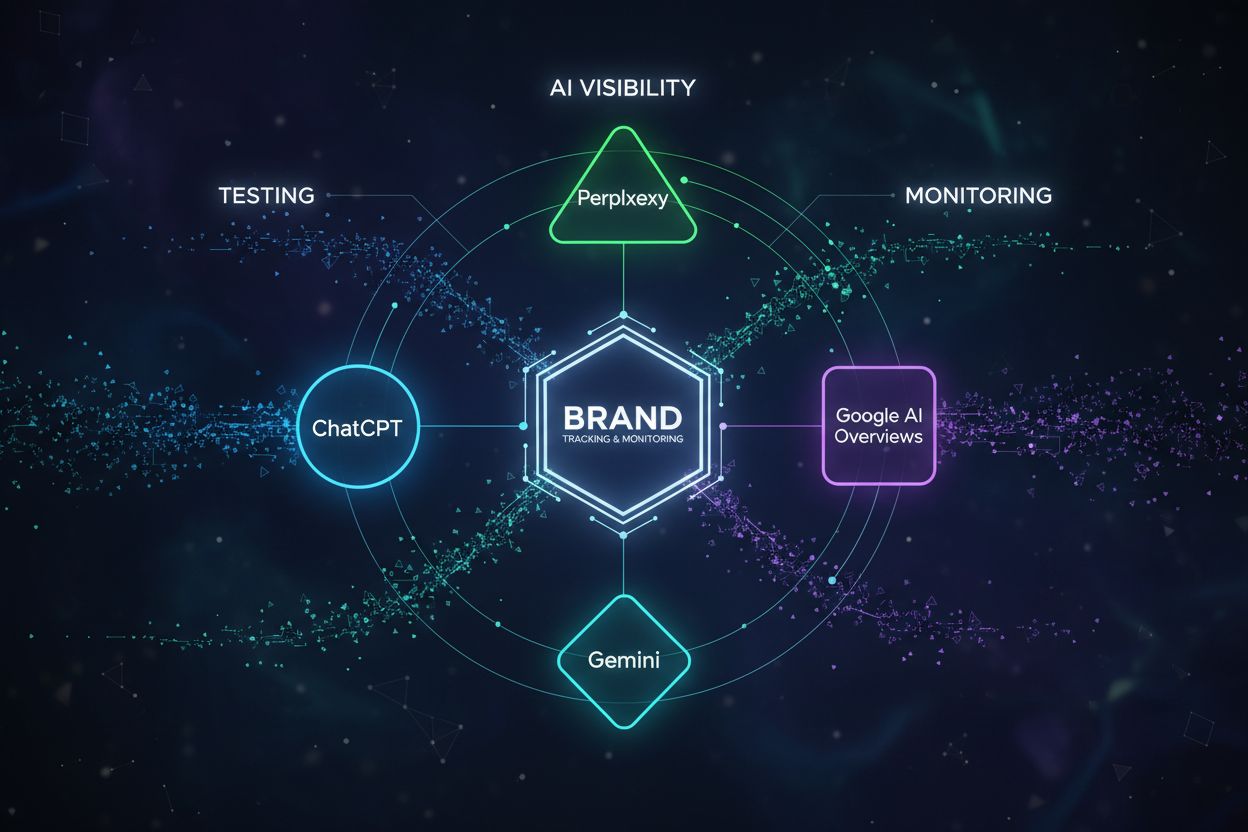
Manual AI Visibility Testing: A Step-by-Step DIY Playbook
A hands-on, no-tools-required playbook for testing your brand's visibility in ChatGPT, Perplexity, and Google AI Overviews by hand: the exact steps, the trackin...
8 min read
Check AI search visibility without paid tools: define prompts, test ChatGPT, Perplexity and Gemini, then analyze results.
Your brand could be invisible in AI search right now and you would have no way of knowing.
That is not hyperbole. Research from Omni Eclipse, testing 1,700 businesses across 32 industries, found that 88% of brands are invisible in AI-generated answers. Even more striking: 77% of businesses sitting on page one of Google are still absent from ChatGPT responses. Ranking on Google does not mean AI recommends you.
The problem is that most AI visibility tools are either paid, limited in their free tiers, or still maturing. But you do not need one to get a clear picture of where you stand. A manual DIY AI visibility audit, done correctly, gives you actionable data in under an hour, and it costs nothing.
This guide walks you through a complete five-step method to check your AI search visibility without any software. You will learn how to build a realistic prompt set, run it across the major AI platforms, log your results, calculate your citation rate, and turn those findings into concrete GEO (Generative Engine Optimization) improvements.
AI search visibility measures how often your brand, product, or content appears in the responses generated by AI platforms, including ChatGPT, Perplexity, Gemini, Google AI Overviews, and others. It is not the same as ranking on Google, and conflating the two is a mistake that costs brands real pipeline.
AI visibility comes in two forms. A mention is when an AI platform names your brand in its response, for example, recommending your product as a top option in your category. A citation goes further: the AI response includes a clickable link back to your website as a source. Both matter, but they signal different things. A mention tells you the AI considers your brand relevant enough to name. A citation tells you your content is being treated as an authoritative source.
AI platforms source their answers differently than Google ranks pages. Ahrefs research found that 88% of Google AI Mode citations come from pages outside the organic top 10. The traffic authority you built through traditional SEO does not automatically carry over. AI engines weigh factors that Google’s ranking algorithm largely ignores: entity clarity, structured data markup, consistent brand signals across the web, and how well your content answers questions in natural language.
This also means a brand with zero organic rankings can appear in AI answers if its content is structured correctly for retrieval, while a brand ranking in position one can be completely absent.
Citation rate is the simplest and most useful single number in a DIY audit. It answers one question: out of the prompts your buyers are most likely to run about your category, how many include your brand in the response?
Authoricy’s data suggests an 8% citation rate is the typical starting point for B2B brands before any optimization. Brands that apply structured AEO (Answer Engine Optimization) methodology reach 24% within 90 days on low-competition service terms. Your own number gives you a baseline to improve from.
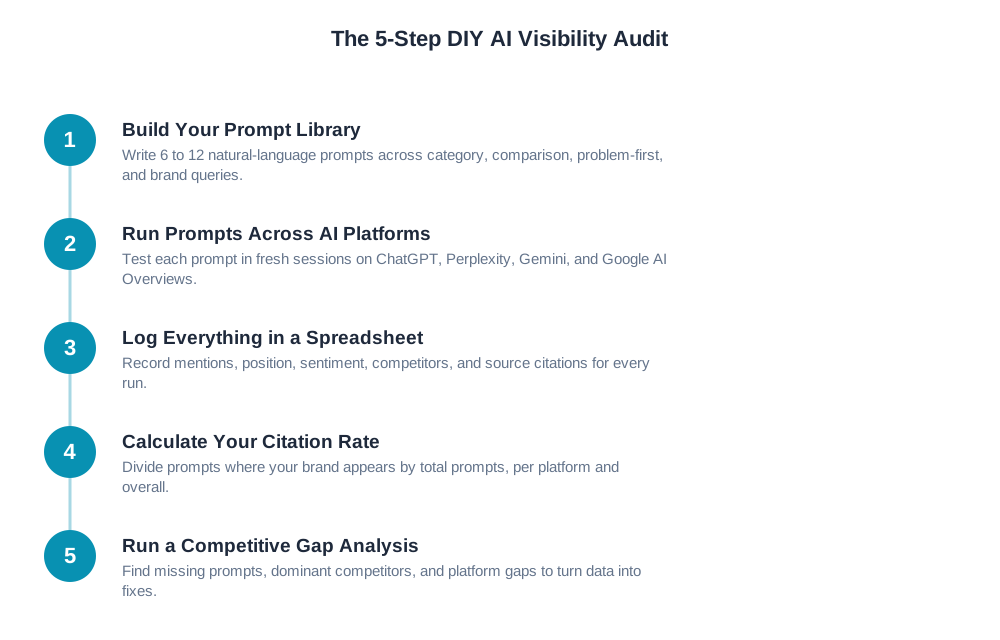
Here is the complete process. Expect to spend about 45 to 60 minutes on your first run. After that, follow-up audits take half the time.
The quality of your audit depends entirely on the quality of your prompts. Generic queries produce generic results. You need prompts that mirror how your actual buyers talk to AI platforms.
What makes a good prompt set:
Four prompt categories to build from:
| Category | Example | Purpose |
|---|---|---|
| Category queries | “What are the best [your category] tools for [use case]?” | Tests whether you appear in general recommendations |
| Comparison queries | “How does [your brand] compare to [competitor]?” | Tests whether you are part of the consideration set |
| Problem-first queries | “How do I solve [problem your product addresses]?” | Tests whether your solution surfaces in context |
| Brand-specific queries | “Is [your brand] any good?” or “What do people say about [your brand]?” | Tests sentiment and accuracy of AI descriptions |
Where to source your prompts:
Ask your sales team what questions prospects ask on discovery calls. Check your customer support tickets for the language actual users use. Look at the “People also ask” box on Google for your category terms. If you have a contact form, add a field asking “How did you hear about us?”: you will occasionally find AI platform names and the exact prompts that led users to you.
You will test each prompt on four platforms. This is the most time-consuming step, but it is where the real data lives.
Important: always use a fresh chat session for each prompt. AI platforms carry context from previous messages, and a continued conversation will skew your results. On ChatGPT, you also want to note whether you are testing with web browsing enabled or disabled: the results differ, and the browsing mode is what matters for real-world visibility.
Platform-by-platform approach:
ChatGPT (GPT-4o or latest available model). ChatGPT draws from its training data for most responses and supplements with live web browsing when enabled. Run each prompt and record: whether your brand appears, where in the response it appears, how it is described, and which competitors are named. Run each prompt at least twice, since ChatGPT’s responses vary between runs, and a single test can be misleading.
Perplexity. Perplexity is the most audit-friendly platform because it always cites its sources. Run the same prompt set and check not just whether your brand is mentioned but whether your website, reviews, or press coverage appear in the source list. Perplexity averages around 22 citations per response, so if your content is not among them, you have a clear gap.
Google Gemini. Gemini is deeply integrated with Google’s index, so brands with strong Google content presence tend to perform better here. Test the same queries in the standalone Gemini interface. If your brand shows up in Gemini but not in ChatGPT, it signals that your Google-indexed content is working but your broader entity signals need strengthening.
Google AI Overviews. These appear in roughly half of Google searches and link their cited sources. Test your prompt set in Google Search and note whether an AI Overview appears, and if so, whether your brand is cited. This ties your AI visibility directly back to the search demand you already understand.
Running prompts without recording results is wasted effort. You need a structured log that makes patterns visible and lets you track improvement over time.
Create a spreadsheet with the following columns. This is your AI visibility audit log, so treat it as a living document.
| Column | What to Record |
|---|---|
| Prompt | The exact text of the query you ran |
| Platform | ChatGPT, Perplexity, Gemini, or Google AI Overviews |
| Date | When you ran the test |
| Brand Mentioned? | Yes / No |
| Position in Response | First, middle, end, or not at all |
| Description Used | The exact wording the AI used to describe your brand |
| Sentiment | Positive, neutral, negative, or mixed |
| Competitors Named | List every competitor that appeared in the response |
| Source Citations | For Perplexity and AI Overviews: list the URLs cited |
| Notes | Anything unusual: outdated info, hallucinated details, missing products |
Pro tip: Add a “Run #” column if you test the same prompt multiple times on the same platform. This lets you calculate mention frequency, the percentage of runs where your brand appears. A single mention means little; appearing in 4 out of 5 runs tells a different story.
Once your spreadsheet is populated, pull out the numbers that matter.
Your baseline citation rate:
Citation Rate = (Number of prompts where your brand is mentioned) ÷ (Total prompts tested) × 100
Calculate this per platform and overall. A 10% overall citation rate with a 30% rate on Perplexity but 0% on ChatGPT tells you something specific about where your visibility strengths and weaknesses lie.
Your AI share of voice (rough estimate):
Count how many times each competitor appears across all your tests. Divide your mentions by the total mentions across all brands. This gives you a rough share of voice, a directional number that shows whether you are leading, keeping pace, or falling behind in your category’s AI conversation.
Mention quality score:
Not all mentions are equal. Create a simple three-tier scoring system:
Average your scores across all prompts. This gives you a qualitative dimension that pure citation rate misses.
The final step turns your data into strategy. Look at your spreadsheet and answer these questions:
Which prompts produce no mentions of your brand? These are your highest-priority gaps. Analyze what the AI did mention instead: specific competitors, generic category descriptions, or no brands at all. Each pattern suggests a different fix.
Which competitors appear most frequently? Identify the brands that dominate your category’s AI responses. Visit their websites and note what they are doing differently: FAQ sections, structured data, clear entity signals, comprehensive product descriptions, or recent press coverage.
Where does your brand appear but with inaccurate or outdated information? This is a quick win. If the AI describes your product incorrectly, it is pulling from outdated or conflicting sources. Fixing your own site’s clarity and consistency often resolves this within weeks.
Are there platforms where you perform significantly better or worse? A strong Perplexity presence with weak ChatGPT visibility suggests your live web content is strong but your brand’s training data presence is weak, and vice versa.
Once you have run the full audit, here is how to interpret what you see.
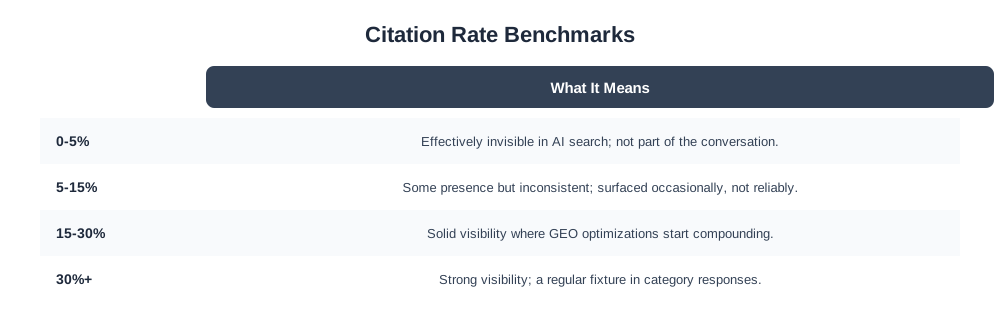
There is no universal “good” citation rate, it varies by industry, competition, and how niche your category is. But as a rough guide:
A brand that appears at the bottom of a long AI response, described as “a smaller alternative to [competitor],” is not getting the same value as a brand named first with a confident recommendation. Track position and sentiment alongside raw mention counts. If you are mentioned but always described as “budget” when you are actually mid-market, that is a positioning problem, not a visibility problem.
Watch for competitors who appear in nearly every response. These are the brands that have already built strong AI entity signals. They are not just outranking you: they are defining the AI’s understanding of your category. Displacing them requires more than better content; it requires building the same entity clarity that AI models use to decide who to cite.
An audit without follow-up action is just a data collection exercise. Here are the highest-impact fixes you can make immediately, based on what your audit reveals.
If your audit shows you are absent from prompts that ask direct questions about your category, your content likely lacks the structured question-answer format that AI models extract most easily. Add FAQPage schema markup to your key pages, especially product pages, service pages, and any content that answers common buyer questions. This is the single highest-ROI technical change for AI visibility.
AI models build an understanding of your brand from signals across the web: your website, your Google Business Profile, your Wikipedia page (if you have one), review platforms, and industry directories. If any of these sources contain inconsistent naming, outdated descriptions, or conflicting information, the AI’s understanding of your brand becomes fragmented.
Audit your brand’s presence on the web. Is your company name spelled consistently everywhere? Are your product descriptions aligned across your site, G2, Capterra, and LinkedIn? Do you have a clear, single-sentence description of what you do that appears consistently? These small inconsistencies add up to big AI visibility gaps.
Review your audit spreadsheet. For every prompt where your brand did not appear, create or update a page on your site that directly answers that question. Use the exact language from the prompt in your H1 or H2. Structure the answer so an AI can extract it cleanly: a clear heading, a direct answer in the first paragraph, and supporting detail below.
This is not about keyword stuffing. It is about making your content citable. AI models favor content that is structured, specific, and directly responsive to the question at hand.
Some websites block AI crawlers in their robots.txt file, often without realizing it. Check whether your site blocks GPTBot, Claude-Web, or PerplexityBot. If you are blocking these crawlers, you are effectively telling AI platforms not to read your content. For most businesses, the right move is to allow them.
AI platforms pull from a different set of sources than Google. Review platforms like G2 and Capterra heavily influence vendor comparisons. Community discussions on Reddit and Quora shape AI training data. Industry publications and analyst reports carry outsized weight. If your audit shows competitors being cited from sources you are absent from, prioritize building a presence on those specific platforms.
AI search engines prioritize recently updated content. AirOps research found that content freshness is a significant factor in whether AI platforms cite a source. If your key pages have not been updated in over a year, they are losing traction in AI search, even if their Google rankings remain stable. Set a calendar reminder to refresh your most important pages quarterly.
A one-time audit gives you a baseline. Regular re-testing shows you whether your GEO efforts are working.
Monthly is the right cadence for most businesses. AI responses change frequently, more frequently than Google rankings, and monthly checks let you spot trends before they become problems. If you are actively making GEO improvements, test every two weeks to measure the impact of specific changes.
What to re-test: You do not need to run the full 12-prompt set every time. Pick your 5 highest-priority prompts, the ones where being absent costs you the most, and run those across all four platforms. Rotate in additional prompts every other month to keep your data fresh.
What to look for between tests: Set up Google Alerts for your brand name and your top competitors. While Google Alerts will not tell you what an AI says about your brand, it will surface new press coverage, reviews, and mentions that may influence AI responses. A spike in competitor coverage is a signal to re-test sooner.
Manual testing works for a baseline audit, quarterly check-ins, and small prompt sets. But it does not scale. If you need to track 50+ prompts across 4 platforms on a weekly basis, you will eventually need a tool.
The market for AI visibility tools is maturing rapidly. Ahrefs, Semrush, SE Ranking, HubSpot, and several dedicated platforms (Profound, Siftly, Authoricy) now offer AI visibility tracking, but few are built specifically for the job. Am I Cited is purpose-built for this exact use case, tracking mentions, citations, and competitors across ChatGPT, Perplexity, and Google AI Overview in one place, which makes it a stronger fit than general-purpose add-ons once you outgrow the manual method.
The key is to start with the manual method. Understanding exactly how AI platforms surface, describe, and cite your brand is knowledge that no tool can give you at the same depth. Once you have that understanding, you will know exactly what to look for in a paid tool, and whether you even need one.
AI search visibility is not a future concern. It is a present reality that is already reshaping how buyers discover, evaluate, and choose brands. Forrester’s 2026 study of 18,000 B2B buyers found that 55% now compare vendors in AI before visiting any supplier website. If your brand is not in those AI responses, you are not in the consideration set.
The five-step DIY method in this guide (build your prompt library, run it across platforms, log everything, calculate your citation rate, and analyze the gaps) gives you a complete, no-cost picture of your AI visibility. More importantly, it gives you a baseline to improve from.
Start today. Open a spreadsheet. Write down six prompts your buyers would actually ask. Run them through ChatGPT, Perplexity, and Gemini. Record what you find. The 45 minutes you spend on this will tell you more about your brand’s AI presence than any tool’s free tier, and it will show you exactly where to focus your GEO efforts.
Your competitors are already doing this. The brands showing up in your audit results are the ones who started measuring their AI visibility months ago. The gap is not closing on its own.
Arshia is an AI Workflow Engineer at FlowHunt. With a background in computer science and a passion for AI, he specializes in creating efficient workflows that integrate AI tools into everyday tasks, enhancing productivity and creativity.

The DIY method is a great baseline. When running prompts by hand every month gets tedious, Am I Cited is the most focused way to automate it across ChatGPT, Perplexity, and Google AI Overview, with competitor benchmarking built in.
A hands-on, no-tools-required playbook for testing your brand's visibility in ChatGPT, Perplexity, and Google AI Overviews by hand: the exact steps, the trackin...

Follow a step-by-step AI visibility audit to measure brand mentions and citations across ChatGPT, Perplexity and other platforms.
Learn how to conduct a baseline AI visibility audit to understand how ChatGPT, Google AI, and Perplexity mention your brand. Step-by-step assessment guide for b...
Cookie Consent
We use cookies to enhance your browsing experience and analyze our traffic. See our privacy policy.