



10 Common AI Search Visibility Mistakes Brands Make
Most brands trying to improve AI search visibility are applying the traditional SEO playbook to a discipline that runs on different rules. Here are the 10 most ...
27 min read
A cold-start GEO playbook for brands with no AI visibility, covering citation signals, entity consistency and a 90-day action plan.
If an AI model has never heard of your brand, you are not losing a ranking battle. You are losing an existence battle. When someone asks ChatGPT, Perplexity, or Gemini for the best solution in your category and your name does not appear anywhere in the answer, you are invisible to an audience that is growing by the day. According to a 2026 Semrush study, AI search may drive more traffic than traditional search engines by early 2028. The brands that start building AI citation equity now will own the answer layer before their competitors even realize it exists.
Traditional SEO is not enough to close this gap. Ranking in position one on Google does not guarantee that ChatGPT will cite you. In fact, only 11% of domains are cited by both ChatGPT and Perplexity simultaneously, according to Profound’s 2026 analysis of 680 million AI citations. Each engine uses different algorithms, different source preferences, and different trust signals. The playbook for getting cited by AI is fundamentally different from the playbook for ranking in search, and it starts with a single question: does the AI know who you are at all?
This guide is the complete framework for turning an unknown brand into a regularly cited AI source. We will cover the four signals that drive AI citation, the step-by-step process for building entity consistency, the content formats that AI models actually extract, the eight channels you need to dominate, and how to measure it all. Everything here is drawn from the actual citation patterns of ChatGPT, Perplexity, Gemini, Google AI Overviews, and Claude, not theory.
Before you can fix the problem, you need to understand the mechanism. When an AI model like ChatGPT generates an answer that includes a brand name, it is not making a random choice. It is making a confidence calculation. The model asks itself, in effect: “Can I confidently state that this brand is a credible answer to this query?”
That confidence is built from four distinct signals, identified by research from Citovo and corroborated by multiple GEO practitioners. Most brands optimize only one of them.
Signal 1: Training-Corpus Presence. Does your brand exist in the documents the model was trained on? Common Crawl, Wikipedia, Reddit, GitHub, books, and academic papers form the backbone of pre-training data. If your brand name never appears in any of these sources, the model has no parametric memory of your existence. You are starting from absolute zero.
Signal 2: Real-Time Retrieval Ranking. When the model issues a live search query at inference time (which it does for most commercial and factual queries through Retrieval-Augmented Generation, or RAG), do your pages come back in the candidate set? ChatGPT uses Bing as its retrieval backbone; Gemini uses Google. Being discoverable in these indexes is table stakes.
Signal 3: Third-Party Endorsement Density. How often do independent sources name you? Reddit threads, Quora answers, comparison articles, industry trade publications, review sites, and news coverage all contribute to this signal. AI models treat third-party mentions as credibility verification. The more independent sources that reference your brand in consistent contexts, the higher the model’s confidence in citing you.
Signal 4: Entity Coherence. Is your brand recognizable as one entity across the web? When your company name, description, logo, founding year, and product names are consistent across your website, LinkedIn, Crunchbase, Wikidata, Google Business Profile, and every directory you appear in, the AI can connect the dots. When those details conflict, the model treats your brand as an ambiguous risk and defaults to a competitor with clearer signals.
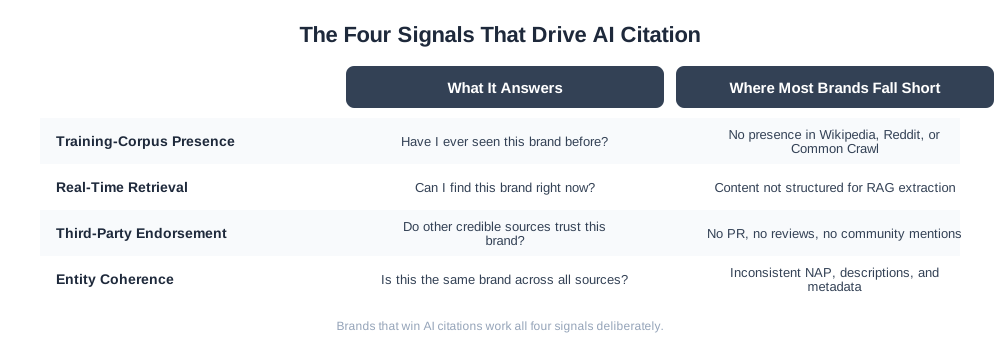
Brands that win AI citations work all four signals deliberately. Brands that stay invisible optimize only the second one and wonder why nothing changes.

Track how AI chatbots mention your brand across ChatGPT, Perplexity, and other platforms.
Before an AI will recommend you, it needs to understand exactly what you are without guessing. If your website says one thing, your LinkedIn says another, and your Crunchbase profile says a third, the AI will treat your brand as an unreliable data point and move on to a competitor with cleaner signals.
Draft a single, hyper-specific one-sentence description of your brand. It should include your category, your ideal customer profile, and the core problem you solve. This is not a marketing tagline. It is a machine-readable identity statement. It should be identical everywhere it appears.
Example: Instead of “We provide innovative cybersecurity solutions,” use: “Acme Security provides multi-factor authentication and OAuth token protection for mid-market SaaS companies with 50–500 employees.”
Paste this exact positioning across your website’s About page, LinkedIn company page, Crunchbase, G2, Capterra, and every professional directory where your brand appears. The consistency is the signal. Every variation introduces doubt.
Structured data is not optional metadata. It is machine-readable code that maps your company’s core facts directly into the AI’s data parser. Focus on schemas that describe real entities and real proof, not vanity markup.
Essential schema types for AI citation:
sameAs links to social profiles, Wikidata, Crunchbase, and Wikipedia. The sameAs property is how you explicitly tell machines that all these URLs represent the same entity.worksFor or memberOf property.Schema without sameAs connections is like a resume with no references. The sameAs property is the most underused attribute in schema markup and one of the most important for entity recognition. Connect your Organization schema to your Wikidata entry, your Crunchbase profile, your LinkedIn company page, and your Wikipedia page if you have one. Each connection is a vote of confidence that says “these are the same thing.”
AI models query structured databases directly. Your brand needs to exist in the databases they reference.
Third-party endorsement density is the signal that most brands neglect, and it is the one that most strongly differentiates cited brands from invisible ones. AI models do not trust your website to tell the truth about your brand. They trust independent sources to verify it.
Research from Citovo shows that brands appearing in AI citations have, on average, three to five times more third-party mentions across independent sources than brands that are not cited. This is not about link volume. It is about independent, contextual references that confirm what your brand claims to be.
Profound’s 2026 analysis of 680 million AI citations identified the channels that AI engines actually cite. Here is what they are and how to use each one.
1. Reddit. Reddit drives approximately 40% of conversational AI citations across ChatGPT, Perplexity, and Google AI Overviews. But the secret is not volume, it is structure. AI models extract comments that are easy to quote. Write answers that give a direct answer in the first sentence, provide one data point or specific detail, explain the mechanism in two to three sentences, and make a clear recommendation. Participate genuinely in niche communities. Do not spam. The brands that perform best on Reddit for AI citation are the ones that have been contributing value for months, not the ones that dropped a single promotional post.
2. YouTube. YouTube outperformed Reddit in Q1 2026 to become the most quoted source for AI-generated answers, appearing in nearly 16% of AI answers according to tracking studies. AI engines do not watch videos, they read transcripts. Every video you publish should have an accurate, well-formatted transcript. State your brand name clearly in the audio. Create videos that answer specific industry questions, explain methodologies, or present original data. The transcript becomes a highly indexable text asset that AI models treat as a primary source.
3. Review Aggregators. For B2B brands, complete your profiles on G2 and Capterra. For B2C and local brands, maximize Yelp, Trustpilot, and Google Reviews. AI engines love structured review data. They pull heavily from “Top 10” aggregator lists and from the review platforms themselves when answering comparison and recommendation queries. A complete profile with genuine reviews is a powerful trust signal.
4. Trade Publications and Industry Media. One quote or data point published in a high-authority industry trade publication is worth 50 blog posts on your own domain. AI models treat journalism as premium ground-truth data. Identify the three trade publications with the largest AI citation volume in your category and make them your key PR targets. Pitch original data, expert commentary, or exclusive research. Do not pitch product announcements.
5. Podcasts. When you appear as a guest on an industry podcast, the episode transcript becomes a citable text asset. AI models crawl podcast transcripts the same way they crawl articles. The co-occurrence of your brand name with specific topics and with the host’s brand creates a strong association signal. Prioritize podcasts that publish full transcripts and have an established web presence.
6. GitHub and Technical Documentation. For technical brands, GitHub repositories, documentation sites, and developer forums are high-trust sources. AI models trained on code repositories recognize GitHub as a source of ground truth. Open-source contributions, technical documentation, and developer community participation all feed into the training-corpus presence signal.
7. Quora and Q&A Platforms. Structured Q&A platforms are natural training data for AI models. Answer questions in your domain with the same direct, extractable format that works on Reddit. Lead with the answer, provide evidence, and cite your sources. The brand-question-topic association becomes part of the model’s parametric understanding.
8. Wikipedia and Wikidata. These are the most authoritative sources in the AI training ecosystem. While you cannot directly control what appears on Wikipedia, you can build the notability and citation base that makes a Wikipedia page possible. Earn coverage in independent, reliable sources. When those sources cite your brand, Wikipedia editors have verifiable material to reference. In the meantime, Wikidata is more accessible and still carries significant weight.
Get the latest insights on AI mentions, brand monitoring, and optimization strategies.
AI models do not read content the way humans do. They scan for text blocks that are easy to summarize, extract, and insert into a synthesized answer. Content that is structured for extractability gets cited. Content that is structured for narrative flow gets ignored.
Traditional marketing content builds toward a conclusion. AI-friendly content front-loads the answer. Every section should lead with a direct, definitive statement that could stand alone as a citation.
Before: “There are many ways to think about AI visibility, and the landscape is constantly evolving. However, after years of research and testing, we have found that content structure is one of the most important factors to consider…”
After: “Content structure is the single highest-leverage factor for AI visibility because AI models extract and cite text blocks that are self-contained, definitive, and require no surrounding context to make sense.”
The first sentence of every section should be quotable. If a claim requires three paragraphs of setup to be understood, it will not be cited.
AI models are trained to answer questions. When your content mirrors the question-answer format, it becomes trivially easy for the model to extract your answer and attribute it to your brand.
Build robust FAQ sections on your key pages. Use natural, long-tail phrasing that mirrors how a human would type a prompt into ChatGPT. Instead of “Pricing FAQ,” use “How much does [your product category] cost for a small business with fewer than 10 employees?” The more precisely your question matches the user’s query, the more likely your answer is to be retrieved and cited.
Map out 20 to 30 high-intent questions a buyer would ask an AI about your category. Create dedicated pages or sections that answer each question directly, with the question as the H2 and the answer beginning immediately after.
AI models love citing specific statistics, proprietary research, and unique frameworks. If you publish an annual industry report with distinct data points, AI search engines will cite your page as the primary source of that data. If everyone in your industry is saying the same thing, there is no reason for an AI to reference your page specifically.
Publish information that no one else has: original research, benchmark reports, surveys, proprietary datasets, calculators, frameworks, and case studies with real numbers. A single well-constructed industry survey with 500 respondents and a clear methodology will generate more AI citations than a year of generic blog content.
| Element | Why It Matters for AI Citation |
|---|---|
| Descriptive H2s and H3s | Headings are the first thing AI models scan. Question-formatted headings match query patterns. |
| Concise definitions near the top | AI models extract the first definition they find. Put yours where it cannot be missed. |
| Bullet lists and numbered steps | Highly extractable. AI models can pull individual points without breaking context. |
| Tables | Structured data within content. AI models parse tables more reliably than prose. |
| Statistics with clear attribution | Verifiable numbers are citation magnets. Always cite the source of your data. |
| FAQ sections | Mirror the exact Q&A format that LLMs output. The highest-ROI content format for AI citation. |
You cannot optimize what you do not measure. Traditional SEO metrics like rankings, organic traffic, and click-through rate do not capture AI visibility. You need new metrics and a new measurement cadence.
Start by compiling a list of 20 to 30 high-intent prompts that a buyer would type into an AI tool when looking for a solution in your category. These should be the exact natural-language queries your customers use, not keyword-stuffed approximations.
Examples:
Test each prompt across ChatGPT, Perplexity, Gemini, and Google AI Overviews. For each test, record:
Run this audit monthly. AI-generated answers are not static. They change as models update, as new content enters the retrieval index, and as competitor activity shifts. A monthly cadence reveals trends that a one-time audit misses.
Share of Model (SoM): The percentage of queries in your prompt set where your brand appears in AI-generated answers, compared to competitors. This is the AI equivalent of share of voice. Track it monthly.
Citation Share: When your brand is mentioned, is it cited with a link or attribution, or merely named in passing? Citations carry more weight than mentions because they indicate the model is treating your content as a verifiable source.
Sentiment Tracking: What does the AI actually say about your brand? “X is a leading provider” is different from “X is a budget alternative.” Sentiment in AI answers is persistent, it becomes part of how the model describes your brand across multiple queries.
Source Attribution: Which of your pages or third-party sources is the AI citing? This tells you exactly which content assets are driving your AI visibility and where you should double down.
You can start measuring AI visibility with a spreadsheet and manual testing. As you scale, dedicated tools provide automated monitoring across multiple AI engines. AmICited is built specifically for this cold-start use case: it runs your prompt set across ChatGPT, Perplexity, and Google AI Overview on a schedule and tells you the moment your brand starts appearing, which is exactly the signal a brand at zero visibility needs to catch first. Other options like Brand24, Profound, and Quattr cover similar ground with different feature mixes. The right tool depends on your volume of prompts and the number of engines you need to track. For most brands, a manual audit with 20 to 30 prompts is the right starting point before investing in paid tools.
Generative Engine Optimization is not a replacement for SEO. It is an additional layer that builds on the same foundation. The brands that succeed at AI citation are the ones that integrate GEO into their existing workflow rather than treating it as a separate discipline.
| Dimension | Traditional SEO | Generative Engine Optimization (GEO) |
|---|---|---|
| Primary goal | Rank in search results | Get cited in AI-generated answers |
| Key metric | Organic traffic, rankings, CTR | Share of Model, citation share, sentiment |
| Content format | Comprehensive, keyword-optimized | Extractable, structured, self-contained |
| Authority signal | Backlinks | Third-party mentions (linked and unlinked) |
| Distribution model | Centralized (your domain) | Distributed (multiple trusted sources) |
| Success timeline | 3–6 months for ranking movement | 3–6 months for initial citation appearance |
The AI citation space is new enough that myths and shortcuts are proliferating. Here is what the evidence shows does not work reliably, and what can actively damage your brand’s AI visibility.
Keyword stuffing and mass AI-generated content. AI models are trained to filter out low-quality, manipulative content. Research on AI-enhanced search from arXiv (2026) indicates that these systems filter out most traditional black-hat SEO tactics. Mass-producing AI-written articles with keyword stuffing will not generate citations and may flag your domain as low-quality.
Fake reviews and manufactured Reddit threads. AI models are increasingly sophisticated at detecting inauthentic content. Coordinated campaigns to create fake reviews or astroturfed Reddit discussions can backfire. When an AI model or platform detects manipulation, the result is not just a lost citation, it is a trust penalty that can be difficult to reverse.
Paying for citations. There is no legitimate way to pay an AI model to cite your brand. Services that claim to guarantee AI citations are either referring to paid placements in the retrieval sources (like sponsored listings on review sites) or are making claims they cannot substantiate. The only durable path to AI citation is building genuine authority.
Ignoring negative sentiment. Unaddressed negative reviews, complaints on social media, and critical forum discussions become part of how AI models describe your brand. AI sentiment is persistent. Actively monitor and address negative signals. Encourage satisfied customers to leave reviews. The goal is not to suppress negative feedback, it is to ensure that the available signal about your brand is accurate and representative.
If your brand currently has zero AI citations, here is a practical 90-day sequence to build your foundation.
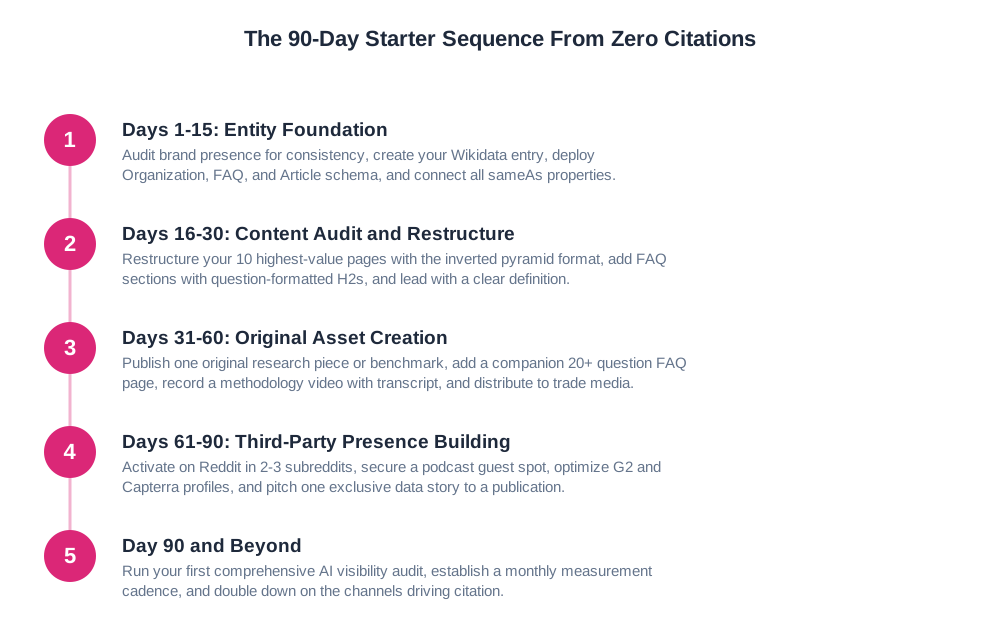
Days 1–15: Entity Foundation
sameAs properties across schema, social profiles, and directoriesDays 16–30: Content Audit and Restructure
Days 31–60: Original Asset Creation
Days 61–90: Third-Party Presence Building
Day 90 and Beyond:
Arshia is an AI Workflow Engineer at FlowHunt. With a background in computer science and a passion for AI, he specializes in creating efficient workflows that integrate AI tools into everyday tasks, enhancing productivity and creativity.

Am I Cited tracks whether ChatGPT, Perplexity, and Google AI Overview mention your brand at all, and where competitors are cited instead, so you know exactly where your cold-start gaps are.
Most brands trying to improve AI search visibility are applying the traditional SEO playbook to a discipline that runs on different rules. Here are the 10 most ...

Learn how to build a strong personal brand for AI visibility. Discover strategies to get cited by ChatGPT, Perplexity, Gemini, and Claude through content optimi...
A practical, complete guide to AI visibility for marketers: the six metrics that matter, how AI systems decide which brands to mention, platform-by-platform tac...
Cookie Consent
We use cookies to enhance your browsing experience and analyze our traffic. See our privacy policy.