Healthcare marketing is undergoing its most significant transformation since the rise of Google. Patients no longer scroll through pages of search results seeking answers about symptoms, treatments, or providers. Instead, they’re asking AI-powered search tools direct questions and expecting immediate, trustworthy responses.
This shift has created a new visibility challenge, and a major opportunity.
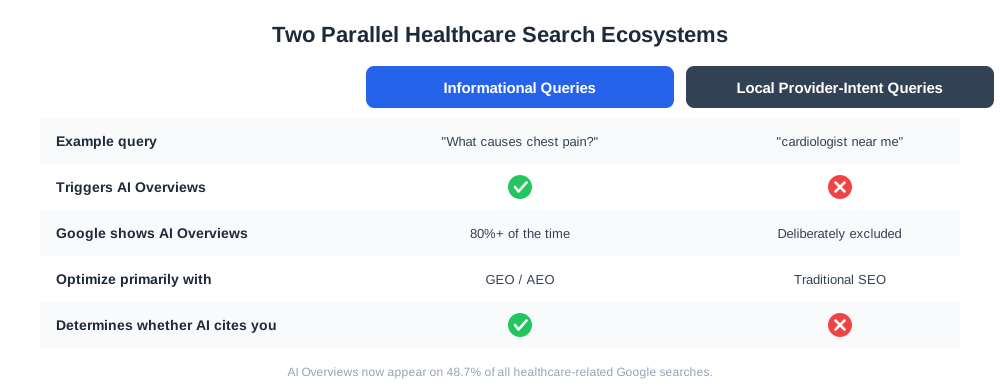
AI Overviews now appear on 48.7% of all healthcare-related Google searches. ChatGPT, Gemini, and Perplexity are synthesizing medical information from thousands of sources and delivering answers directly to users, often without them ever clicking through to a website. When these AI systems cite your brand, your authority grows. When they don’t mention you, your visibility disappears, even if you rank #1 in traditional search.
Welcome to the era of Generative Engine Optimization (GEO) and Answer Engine Optimization (AEO) for healthcare.
Why healthcare brands must optimize for AI citations
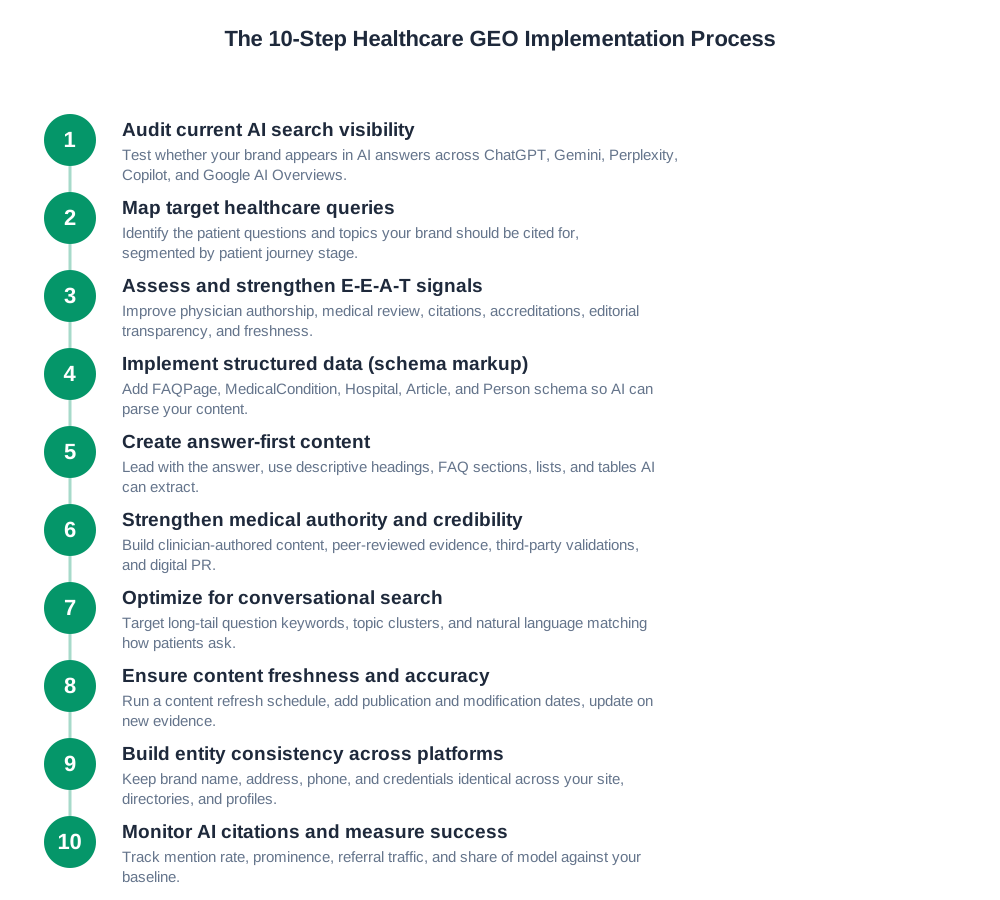
The exact 10-step process to improve your brand’s presence in AI-generated answers
How to measure success and avoid common mistakes
Sector-specific strategies for hospitals, clinics, and pharma brands
Quick Takeaways
AI Overviews now appear on 48.7% of healthcare Google searches, often without a click-through.
Healthcare falls under Google’s YMYL standards, so E-E-A-T signals (expertise, authority, trust, experience) carry outsized weight in AI citation decisions.
Local provider-intent queries stay in traditional SEO; informational queries are AI territory, so healthcare brands need both.
The core levers are physician-authored content, schema markup (FAQPage, MedicalCondition, Article), answer-first formatting, and entity consistency across directories.
Audit your AI visibility monthly with a fixed prompt set, and expect 4-8 weeks for early movement, 3-6 months for meaningful traffic.
A tool such as AmICited can run and score that monthly audit automatically, which matters for HIPAA-conscious teams that want consistent, low-effort tracking.
Difficulty: Intermediate | Time to Read: 20–30 minutes | Time to Implement: 4–12 weeks
Why Healthcare Brands Must Adapt to AI Search
The New Search Reality
For two decades, healthcare marketing followed a predictable formula: optimize for keywords, earn backlinks, rank on page one, capture clicks. That system still matters, but it no longer tells the complete story.
Today, AI search platforms, including Google AI Overviews, ChatGPT, Gemini, Perplexity, and Microsoft Copilot, are inserting themselves as the first point of contact between patients and healthcare information. Instead of linking to websites, these systems synthesize answers from multiple sources and present them as direct responses.
The impact is immediate and measurable:
When an AI Overview appears, users click on traditional search results just 8% of the time, down from 15% when no overview is present.
Only 1% of users click links within the AI summary itself.
Healthcare is one of the industries most affected: AI Overviews appear in nearly half of all health-related queries.
This creates what industry experts call a “zero-click” phenomenon. Your content may inform the AI’s answer, but the user never visits your website.
Two Parallel Search Ecosystems
It’s important to understand that not all healthcare searches have been swallowed by AI. Google deliberately excludes AI Overviews from local provider intent queries: searches like “cardiologist near me” or “pediatric dentist near me.” These remain traditional SEO territory.
Meanwhile, informational queries such as “What causes chest pain?”, “How do I treat eczema?”, and “What are the risks of knee replacement?” are AI territory. These conversational, question-based searches trigger AI Overviews more than 80% of the time.
The takeaway: Healthcare brands must now excel in both ecosystems. Traditional SEO still drives patient acquisition through local searches. But AI search visibility determines whether your brand is trusted enough to be cited as an authoritative source.
Why Healthcare Is Most Impacted
Healthcare falls into Google’s “Your Money or Your Life” (YMYL) category: content that directly affects health, safety, and financial decisions. YMYL pages are held to the highest quality standards by both Google and AI systems.
This means:
AI systems are more selective about healthcare sources they cite
E-E-A-T signals (Expertise, Authoritativeness, Trustworthiness, Experience) carry more weight
Medical accuracy and credibility are non-negotiable
Physician authorship and peer-reviewed citations significantly influence AI recommendations
Healthcare brands that understand these AI-specific quality signals have a competitive advantage. Those that don’t risk being excluded from AI-generated answers entirely.
What You’ll Need
Before implementing GEO and AEO strategies, ensure you have the right foundation in place.
Essential Tools & Resources
Tool/Resource
Purpose
Cost
AmICited
Automated brand mention and citation tracking across ChatGPT, Perplexity, and Google AI Overview, the fastest way to run the audits in Steps 1 and 10 on a schedule
Paid
PromptRush
Monitor brand mentions across ChatGPT, Gemini, and other AI platforms
Paid
Curious Health
Specialized AI visibility tracking for healthcare brands
Paid
Conductor AI Search Performance
Enterprise-level AI citation and referral traffic tracking
Paid
Manual Testing (ChatGPT, Perplexity, Gemini)
Direct visibility audits across major AI platforms
Free
Google Search Console
Track traditional SEO performance and AI Overview appearances
Free
Google Analytics
Measure traffic from AI referral sources
Free
Schema Markup Validator
Test structured data implementation
Free
CMS with Schema Support
WordPress, Drupal, Epic (for healthcare systems)
Varies
Knowledge Prerequisites
You should have a basic understanding of:
E-E-A-T framework: How expertise, authority, and trustworthiness signals influence AI citations
Prominence (primary recommendation, secondary mention, not mentioned)
Competitors cited instead
Source URL cited (if any)
Identify gaps. Which queries should mention your brand but don’t? These are your priority targets.
Expected result: You’ll have a baseline understanding of where your brand currently appears (or doesn’t appear) in AI answers. This becomes your measurement benchmark.
Tip: Repeat this audit monthly to track progress. Use consistent queries so you can measure improvement over time.
Step 2: Map Your Target Healthcare Queries
What to do: Identify the specific patient questions and healthcare topics your brand should be cited for.
How to do it:
Segment by patient journey stage:
Awareness: “What causes [condition]?”, “What are symptoms of [condition]?”
Consideration: “How is [condition] treated?”, “What are the risks of [procedure]?”
Decision: “Where can I find [specialist]?”, “How do I schedule an appointment?”
Map to your services/content. For each service or condition your brand addresses, create a list of related questions:
Condition explainers
Treatment comparisons
Provider/location queries
Procedure guides
Medication/drug information
Prioritize by volume and opportunity. Focus first on:
High-intent queries (patients ready to take action)
Queries where competitors are currently cited
Queries directly related to your core services
Create a content roadmap. Assign each query to an existing page or identify content gaps that need to be created.
Expected result: A prioritized list of 20–50 target queries that align with your brand’s expertise and services.
Common mistake: Targeting too many vague, top-of-funnel queries (“What is healthcare?”) instead of specific, high-intent questions. AI systems favor specificity. Focus on questions your brand can authentically answer better than competitors.
Step 3: Assess and Strengthen E-E-A-T Signals
What to do: Evaluate and improve the expertise, authority, trustworthiness, and experience signals that AI systems use to determine whether to cite your brand.
How to do it:
Audit physician authorship:
Does your healthcare content include author bylines with credentials?
Are physician names, titles, and specialties clearly visible?
Do author bios link to professional profiles (LinkedIn, medical board listings)?
Action: Add physician bylines to all clinical content. Include full credentials: “Dr. Jane Smith, MD, Board-Certified Cardiologist” or “Sarah Johnson, RN, BSN, Clinical Educator.”
Review medical review processes:
Is there a documented medical review process visible on your website?
Do articles include medical review badges with reviewer names and dates?
Are review dates current (within 12 months for most healthcare content)?
Action: Create a “Medical Review” section on your website explaining your review process. Add review badges to articles: “Medically reviewed by Dr. [Name], [Credentials], on [Date].”
Strengthen citations and sourcing:
Does your content cite peer-reviewed research (PubMed, medical journals)?
Are external sources linked to authoritative medical sites (Mayo Clinic, Cleveland Clinic, NIH)?
Do you include disclaimers and attribution for medical information?
Action: For every clinical claim, add at least one peer-reviewed citation or link to an authoritative medical source. Use footnotes or inline citations.
Verify accreditations and credentials:
Does your brand display relevant accreditations (Joint Commission, CLIA, AAAHC)?
Are professional memberships visible (AMA, specialty associations)?
Do leadership bios include verifiable credentials?
Action: Add accreditation logos and links to your website footer or “About” page. Include credential verification links where possible.
Establish editorial transparency:
Do you have a published editorial policy?
Is there a conflict-of-interest disclosure?
Do you clearly state your content review and update process?
Action: Create an “Editorial Policy” or “About Our Content” page explaining how content is created, reviewed, and kept current. Link to it from your footer.
Ensure content freshness:
When was each article last updated?
Do you have a system for regularly reviewing and updating clinical content?
Are publication and modification dates visible to readers?
Action: Implement a content refresh schedule (e.g., quarterly for condition guides, annually for general information). Add publication and modification dates to all articles.
Expected result: Your website now clearly demonstrates medical authority and trustworthiness to both AI systems and human readers.
Critical insight: AI systems don’t just read your content, they read about your content. The metadata, author credentials, review documentation, and sourcing information you make visible all influence AI citation decisions.
Step 4: Implement Structured Data (Schema Markup)
What to do: Add semantic markup to your healthcare content so AI systems can easily parse and understand medical information.
Implement Hospital or MedicalBusiness schema for provider pages:
Organization name and logo
Address and phone
Hours of operation
Services offered
Physician/staff profiles
Use HowTo schema for procedure guides:
Step-by-step instructions
Preparation requirements
Recovery information
Expected outcomes
Add Article schema to all clinical articles:
Headline
Author (with credentials)
Publication date
Modification date
Image
Implement Person schema for physician profiles:
Name and credentials
Specialty
Affiliations
Contact information
Tools to validate schema:
Google Schema Markup Validator
Structured Data Testing Tool
JSON-LD validator
Expected result: AI systems can now easily extract and understand your medical information, making you more likely to be cited.
Pro tip: Focus on FAQPage and MedicalCondition schema first. These have the highest ROI for healthcare brands and are easiest to implement.
Step 5: Create Answer-First Content
What to do: Restructure your healthcare content so that AI systems can immediately extract clear, concise answers.
How to do it:
Lead with the answer:
First paragraph should directly answer the query
Use clear, conversational language
Avoid burying the answer in lengthy introductions
Before: “The history of migraine treatment is complex. Over the centuries, physicians have tried various approaches…”
After: “Migraines are treated with medications (preventive and acute), lifestyle changes, and in some cases, procedures like Botox injections. The best approach depends on migraine frequency and severity.”
Use descriptive H2 and H3 headings:
Structure content with clear heading hierarchy
Use question-based headings when possible
Make headings scannable for both humans and AI
Example:
H2: “How is Type 2 Diabetes Treated?”
H3: “Medication Options”
H3: “Lifestyle Changes”
H3: “When to See an Endocrinologist”
Create FAQ sections:
Anticipate patient questions
Answer each question in 2–3 sentences
Use clear Q&A formatting
Implement FAQPage schema (see Step 4)
Use bulleted lists and tables:
Break complex information into scannable lists
Use tables for comparisons (treatment options, medication side effects)
Collect and display patient testimonials and reviews
Pursue recognition in healthcare rankings (U.S. News & World Report, Healthgrades, etc.)
Create original clinical content:
Publish case studies (with patient consent and privacy protection)
Share clinical insights from your team’s experience
Develop condition libraries and treatment guides based on your expertise
Host webinars and educational events with healthcare professionals
Build a strong digital PR strategy:
Secure mentions in healthcare publications and media
Contribute expert commentary to health news stories
Develop relationships with health journalists and influencers
Publish thought leadership content on emerging healthcare topics
Maintain consistent brand information:
Ensure your brand name, address, phone, and credentials are identical across all platforms
Update your Google Business Profile regularly
Maintain accurate information in medical directories (Healthgrades, Zocdoc, Vitals, etc.)
Keep your website’s “About” and “Contact” pages current
Expected result: AI systems recognize your brand as a credible, authoritative healthcare source worth citing.
Strategic insight: AI systems don’t just read your website. They analyze your entire digital footprint: news mentions, professional affiliations, directory listings, social media presence, and peer citations. A comprehensive authority-building strategy is more effective than isolated website optimization.
Step 7: Optimize for Conversational Search
What to do: Tailor your content to match how patients actually ask questions when using AI assistants.
How to do it:
Target long-tail, question-based keywords:
Instead of: “knee pain treatment”
Target: “Why does my knee hurt when I bend it?”, “What’s the best treatment for knee pain after running?”
Use keyword research tools to identify conversational variations
Anticipate the patient journey:
Create content that addresses each stage of decision-making
Link related content so AI can understand the full context
Build content hubs around major conditions or services
Example for “Knee Replacement Surgery”:
“Do I need knee replacement surgery?” (decision stage)
“What happens during knee replacement?” (preparation stage)
“What’s the recovery timeline for knee replacement?” (post-surgery stage)
“How long does a knee replacement last?” (long-term outcomes)
Use natural language:
Write in a conversational tone
Use contractions (“it’s” instead of “it is”)
Answer questions directly without jargon when possible
Define medical terms when you use them
Create comprehensive topic clusters:
Develop pillar pages (broad overviews)
Create cluster pages (specific subtopics)
Link cluster pages back to pillar pages
Helps AI understand your content’s topical authority
Implement featured snippet optimization:
Answer questions in 40–60 words
Use lists and tables
Include the question in your H2 heading
Provides ideal format for AI to extract and cite
Build predictive content:
Don’t just answer questions patients are currently asking
Anticipate questions they’ll ask next in their journey
Create content for emerging healthcare concerns
Helps AI systems find comprehensive information in your brand
Expected result: Your content aligns with how patients actually search using AI, increasing citation likelihood.
Step 8: Ensure Content Freshness and Accuracy
What to do: Establish a system for keeping healthcare content current and medically accurate.
How to do it:
Implement a content refresh schedule:
High-priority: Condition guides, treatment information (quarterly review)
Medium-priority: Procedure guides, medication information (semi-annual review)
Lower-priority: General health information, lifestyle tips (annual review)
Create a content calendar tracking review dates
Add publication and modification dates:
Display “Published: [Date]” and “Last Updated: [Date]” on every article
Use structured data to mark these dates (Article schema)
Helps AI systems understand content recency
Monitor medical research and guidelines:
Subscribe to updates from major medical organizations (AMA, specialty associations)
Monitor peer-reviewed journals in your field
Track FDA announcements and drug/treatment updates
Assign team members to monitor specific topics
Update based on new evidence:
When new research contradicts your content, update immediately
When medical guidelines change, revise your content
Add a note explaining what changed and why
Example: “Updated [Date]: New research shows [finding]. We’ve updated this section to reflect…”
Implement version control:
Keep track of content changes
Maintain a change log for major updates
Be transparent about corrections
Establish a correction process:
Have a clear process for identifying and correcting inaccuracies
Publish corrections prominently
Notify users who may have read outdated information (via email, notifications)
Expected result: AI systems recognize your content as current and reliable, increasing citation frequency.
Critical for healthcare: Outdated medical information is worse than no information. AI systems penalize brands known for citing old research or outdated treatment protocols.
Step 9: Build Entity Consistency Across Platforms
What to do: Ensure your brand’s name, location, credentials, and information are consistent everywhere online.
How to do it:
Audit your digital presence:
Your website
Google Business Profile
Medical directories (Healthgrades, Zocdoc, Vitals, WebMD)
Local citation sites (Yelp, Apple Maps, etc.)
Social media profiles
Professional association directories
Healthcare review sites
Standardize brand information:
Business name: Should be identical everywhere (watch for abbreviations, “Inc.” vs “LLC”, etc.)
Address: Exact same format across all platforms
Phone number: Consistent formatting
Website URL: Consistent (www vs non-www)
Credentials: Consistent physician names, titles, and specialties
Update all platforms simultaneously:
Create a master list of information
Update your website first
Update Google Business Profile
Update major medical directories
Update local citations
Track completion dates
Fix inconsistencies:
Use tools like Semrush Local or BrightLocal to identify inconsistencies
Prioritize fixing high-authority directory listings first
Request corrections from directories if you can’t update directly
Maintain going forward:
Assign ownership of each platform
Set quarterly review dates
Implement a change management process for any business information updates
Build knowledge graph signals:
Ensure your brand appears consistently in medical knowledge bases
Link your website to your Google Business Profile
Link to professional association profiles
Include structured data (Organization, Hospital, MedicalBusiness schema)
Expected result: AI systems develop a clear, consistent understanding of your brand identity, making you more likely to be cited accurately.
Why this matters: AI systems use entity consistency as a trust signal. If your brand information is inconsistent across the web, AI systems may deprioritize or avoid citing you.
Step 10: Monitor AI Citations and Measure Success
What to do: Establish an ongoing measurement system to track your AI search visibility and measure the impact of your GEO strategy.
How to do it:
Set up baseline metrics:
Return to your initial audit (Step 1)
Document current AI mention rate, prominence, and citation frequency
Establish targets for improvement (e.g., “appear in 50% of target queries within 6 months”)
Choose measurement tools:
PromptRush: Monitor brand mentions across ChatGPT, Gemini, and other AI platforms
Curious Health: Healthcare-specific AI visibility tracking
Conductor AI Search Performance: Enterprise-level AI citation and referral traffic tracking
Manual testing: Test target queries monthly across ChatGPT, Perplexity, Google AI Overviews
Google Search Console: Track AI Overview appearances for your brand
Track key performance indicators (KPIs):
KPI
How to Measure
Target
AI Mention Rate
% of target queries mentioning your brand
40–60%
Prominence Score
Primary recommendation vs. secondary mention
30%+ primary
Citation Frequency
How often your brand appears across AI platforms
Monthly tracking
AI Referral Traffic
Traffic from AI sources (ChatGPT, Perplexity, etc.)
Growing month-over-month
Share of Model (SOM)
Your brand’s share of AI recommendations vs. competitors
Competitive analysis
Content Authority
How many pieces of your content are cited
Growing over time
Create a measurement dashboard:
Set up monthly tracking in a spreadsheet or analytics tool
Track the same 20–30 queries consistently
Document which competitors are mentioned
Note any changes in prominence or citation patterns
Establish a review cadence:
Weekly: Monitor for major changes or issues
Monthly: Run full audit of target queries; review analytics
Quarterly: Assess progress against targets; adjust strategy
Annually: Comprehensive review; plan next year’s priorities
Adjust strategy based on data:
If certain queries never mention your brand, investigate why
If competitors are cited more, analyze their content strategy
If your content appears in AI Overviews but drives no traffic, test different CTAs
If AI referral traffic is high but not converting, optimize landing pages
Expected result: You have a clear, data-driven understanding of your AI search performance and can continuously improve your strategy.
Important: AI search is still evolving. What works today may change as AI models are updated. Regular monitoring helps you adapt quickly.
Troubleshooting Common Mistakes
Problem: Brand Not Appearing in AI Answers
Cause: Content lacks medical authority signals, poor schema markup, or insufficient E-E-A-T signals.
Fix:
Add physician bylines and medical review badges to all clinical content
Implement FAQPage and MedicalCondition schema markup
Add citations to peer-reviewed research and authoritative sources
Ensure author credentials are clearly visible
Review and strengthen your “About” page and editorial policy
Check that your content directly answers the target query
Problem: Competitors Cited Instead of Your Brand
Cause: Competitor content is more structured, authoritative, or comprehensive.
Fix:
Analyze competitor content that’s being cited (use PromptRush or manual testing)
Compare their content depth, structure, and authority signals to yours
Improve your content to match or exceed their comprehensiveness
Strengthen your E-E-A-T signals (add more citations, medical reviews, credentials)
Ensure your content is more current than theirs
Optimize your content structure (headings, lists, FAQ sections)
Problem: Content Appears in AI Overview but Drives No Traffic
Cause: Users get their answer from the AI summary and don’t click through.
Fix:
Add rich media (videos, interactive tools, calculators) that AI can’t fully summarize
Create CTAs that encourage engagement beyond the answer (e.g., “Schedule a consultation,” “Download our guide”)
Develop content that goes deeper than what AI can summarize
Focus on high-intent, action-oriented queries that drive conversions
Optimize landing pages for conversion from AI referral traffic
Consider that brand visibility in AI answers builds authority even without clicks
Problem: Outdated Information Cited
Cause: Content not regularly updated; old research being cited by AI.
Fix:
Establish a content refresh schedule (see Step 8)
Update content when new research emerges
Add modification dates prominently to all articles
Monitor medical guidelines and update when they change
Implement a system for tracking which content needs review
Notify AI systems of updates (via XML sitemaps with modification dates)
Problem: Local Provider Queries Not Ranking
Cause: Attempting to optimize local queries for AI (where AI Overviews are excluded).
Fix:
Recognize that Google deliberately excludes AI Overviews from local intent queries
Focus on traditional SEO for local queries (Google Business Profile, local citations, reviews)
Optimize for informational queries with AI (condition guides, treatment information)
Maintain strong local SEO in parallel with your GEO strategy
Ensure your Google Business Profile is complete and current
Problem: Schema Markup Not Implemented Correctly
Cause: Syntax errors, missing required fields, or incorrect schema type.
Fix:
Use Google’s Schema Markup Validator to check for errors
Start with FAQPage schema (simplest, highest ROI)
Ensure all required fields are included
Test implementation across different schema validators
Consult schema.org documentation for your specific schema type
Consider using plugins (Yoast SEO, Schema Pro) to simplify implementation
Problem: Low AI Referral Traffic Despite Citations
Cause: Content is being cited, but AI users aren’t clicking through to your site.
Fix:
This is normal for informational queries; focus on brand visibility as the KPI
For transactional queries, optimize landing pages for conversion
Add compelling CTAs that encourage click-through
Develop content that goes beyond what AI can summarize
Focus on high-intent queries where users are more likely to take action
Recognize that being cited builds brand authority even without immediate traffic
Healthcare Sector-Specific Strategies
Local Healthcare Providers (Clinics, Urgent Care, Hospitals)
Key challenges:
Local searches are dominated by traditional SEO, not AI
Need to excel in both AI search (informational) and traditional SEO (local intent)
GEO strategy for local providers:
Create comprehensive condition and treatment guides (optimize for AI)
Develop provider profiles with physician credentials and specialties
Maintain strong Google Business Profile with current hours, services, reviews
Build local citations and directory listings
Create location-specific content (e.g., “Orthopedic care in [city]”)
Encourage patient reviews on Healthgrades, Google, Zocdoc
Develop FAQ content around common patient questions
Implement MedicalBusiness and Hospital schema for your locations
Measurement focus:
Traditional SEO: Rankings for local keywords, Google Business Profile visibility
AI search: Brand mentions in condition-related queries, referral traffic from AI
Based on Conductor’s 2026 AEO/GEO Benchmarks Report for healthcare:
AI referral traffic: 0.64% of total website traffic (healthcare average)
AI Overview appearance rate: 48.7% of healthcare queries trigger AI Overviews
Top cited sources in healthcare AI Overviews:
Healthline: 5.76% share of voice
Mayo Clinic: 6.58% (health care equipment & services)
Cleveland Clinic: 4.90% (health care equipment & services)
Pfizer: 16.40% (pharmaceuticals & biotech)
Primary AI referral source: ChatGPT (83.8%), followed by Perplexity (7.8%), Copilot (4.7%), Gemini (2.8%)
Recommended Tools
Tool
Best For
Cost
Features
AmICited
Ongoing, automated AI mention and citation tracking
Paid
Runs your target queries across ChatGPT, Perplexity, and Google AI Overview on a schedule, with citation source and sentiment data, the most direct way to keep Step 10’s KPIs current without manual re-testing every month
PromptRush
Comprehensive AI monitoring
Paid
Brand mentions across ChatGPT, Gemini, Perplexity; prompt testing
Curious Health
Healthcare-specific tracking
Paid
AI visibility audits for healthcare brands; competitor benchmarking
Conductor AI Search Performance
Enterprise-level analytics
Paid
AI referral traffic tracking; AI Overview share of voice; detailed benchmarks
Google Search Console
Traditional SEO + AI Overview tracking
Free
AI Overview appearances for your site; query performance
Google Analytics
Traffic attribution
Free
AI referral traffic segments; conversion tracking
Manual Testing
Direct visibility checks
Free
Test queries across ChatGPT, Perplexity, Google AI Overviews
Conclusion and Next Steps
Healthcare marketing has entered a new era. Generative Engine Optimization (GEO) and Answer Engine Optimization (AEO) are no longer optional, they’re essential for brands that want to remain visible in how patients discover healthcare information.
The good news: You now have a complete, step-by-step roadmap to optimize your brand for AI search visibility.
Your Implementation Timeline
Weeks 1–2: Foundation
Complete your AI visibility audit (Step 1)
Map target queries (Step 2)
Assess E-E-A-T signals (Step 3)
Weeks 3–6: Technical Implementation
Implement schema markup (Step 4)
Restructure content for AI (Step 5)
Strengthen medical authority (Step 6)
Weeks 7–12: Optimization and Measurement
Optimize for conversational search (Step 7)
Establish content refresh schedule (Step 8)
Build entity consistency (Step 9)
Set up measurement systems (Step 10)
Ongoing: Monitoring and Iteration
Monthly AI visibility audits
Quarterly strategy reviews
Continuous content updates and improvements
Key Takeaways
AI search is parallel to traditional SEO, not a replacement. You need to excel in both.
Healthcare is most impacted by AI search due to YMYL standards and high query volume triggering AI Overviews.
E-E-A-T signals and medical authority are non-negotiable. AI systems prioritize trustworthiness in healthcare.
Structured data and clear content formatting matter more than ever. AI systems must be able to parse your information.
Consistency across platforms is critical. Your brand information must be identical everywhere online.
Content freshness and accuracy are essential. Outdated medical information damages your credibility.
This is a marathon, not a sprint. Full implementation takes 4–12 weeks, with ongoing optimization required.
Next Steps
Start with your audit. Complete Step 1 this week to understand your current AI visibility baseline.
Pick your priority queries. Focus on 20–30 high-intent, high-opportunity queries where you should be cited.
Assign ownership. Designate team members responsible for each step of implementation.
Set up measurement. Choose your tools and establish baseline metrics before making changes.
Implement incrementally. Don’t try to do everything at once. Prioritize high-ROI changes first.
Monitor and adjust. Track your progress monthly and adjust your strategy based on results.
The healthcare brands that adapt to GEO and AEO today will dominate patient discovery tomorrow. Your patients are already using AI to find healthcare information. The question is: Will your brand be there when they ask?
Frequently asked questions
AEO (Answer Engine Optimization) is the technical practice of structuring content so AI systems can extract direct answers easily, clear headings, schema markup, concise formatting. GEO (Generative Engine Optimization) is the broader strategy: AEO plus authority-building, E-E-A-T signals, and consistent entity information across the web. AEO is the foundation; GEO is the full picture.
Most healthcare brands see initial movement, new mentions appearing, within 4-8 weeks of implementing schema markup and E-E-A-T improvements. Meaningful AI referral traffic and consistently prominent citations more typically take 3-6 months, depending on your starting authority and how competitive your specialty is.
Yes. Google deliberately excludes AI Overviews from local provider-intent queries like 'cardiologist near me,' which remain traditional SEO territory, while informational queries ('what causes chest pain?') are increasingly AI territory. Healthcare brands need to perform well in both, and authority signals built through traditional SEO also feed into AI citation decisions.
It doesn't block GEO, it just sets boundaries: never include patient-identifiable information in content, use testimonials only with proper consent and de-identification, and keep your privacy and data practices transparent. Demonstrating strong compliance and a documented medical review process actually strengthens the trust signals AI systems and patients both look for.
Often, yes. Authority in this context is distributed rather than concentrated by size, a small practice with strong physician credentials, a documented medical review process, and excellent, specific content can outperform a larger system with weaker E-E-A-T signals or thinner content on a given topic.
That's common for purely informational queries and isn't necessarily a problem, being cited by AI systems as a trustworthy source still builds authority and brand recognition even without a click. For queries closer to a decision (choosing a provider, scheduling), focus on clear calls to action and content that goes beyond what an AI summary can fully capture.
Arshia is an AI Workflow Engineer at FlowHunt. With a background in computer science and a passion for AI, he specializes in creating efficient workflows that integrate AI tools into everyday tasks, enhancing productivity and creativity.
Arshia Kahani
AI Workflow Engineer
Track Your Healthcare Brand's AI Citations
Am I Cited monitors how often your brand is cited across ChatGPT, Perplexity, and Google AI Overview, with the accuracy healthcare content demands.
Learn proven strategies to improve your brand's visibility in AI search engines like ChatGPT, Perplexity, and Gemini. Discover content optimization, entity cons...
7 Ways to Improve How AI Search Represents Your Site
Seven practical strategies to improve how AI search systems represent and cite your site: crawler access, answer-first extractability, topical authority, schema...
Outranking Competitors in AI Search: Tactical Approaches
Master AI search optimization with proven tactics to outrank competitors in ChatGPT, Perplexity, and Google AI Overviews. Learn brand visibility strategies that...
10 min read
Cookie Consent We use cookies to enhance your browsing experience and analyze our traffic. See our privacy policy.