


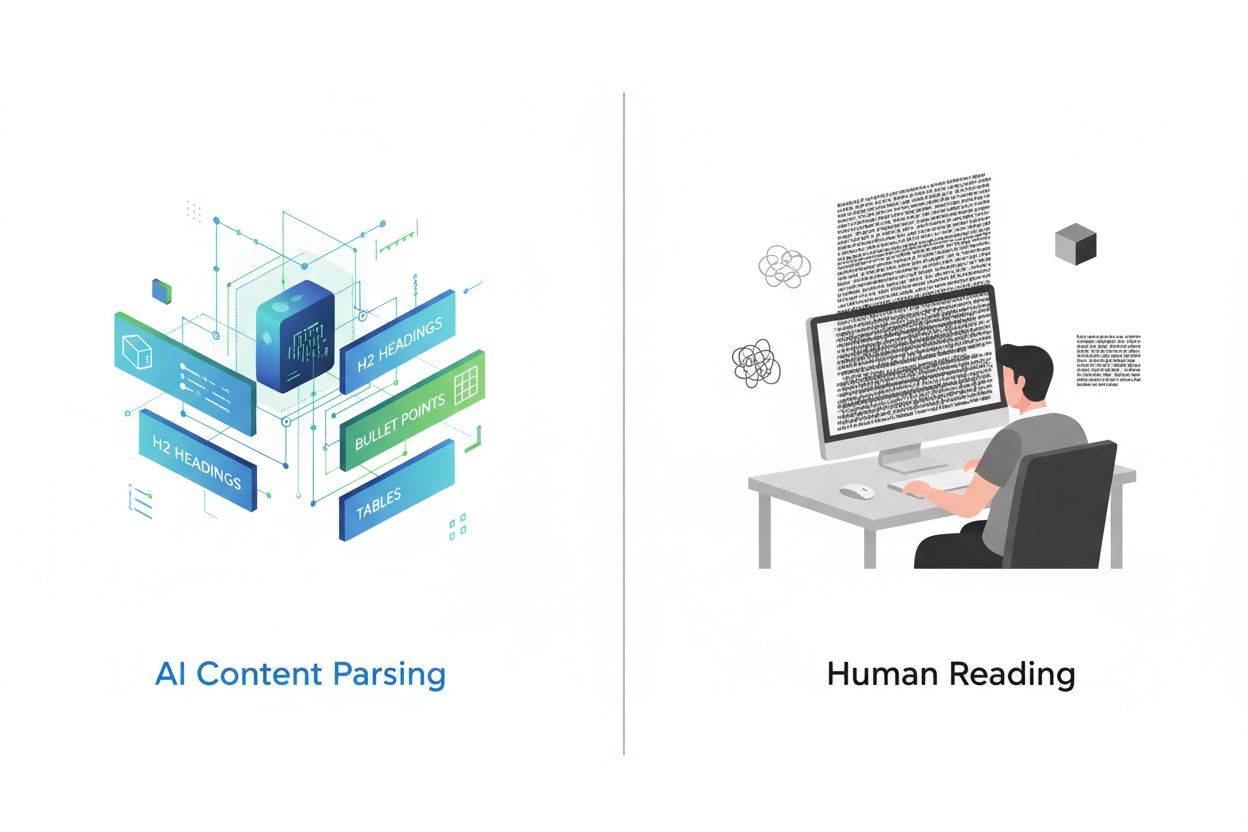
Content Restructuring for AI: Before and After Examples
Learn how to restructure your content for AI systems with practical before and after examples. Discover techniques to improve AI citations and visibility across...
10 min read
A practical, six-phase framework for restructuring web content so AI systems can extract and cite it.
Your content is being extracted by AI search engines every day. But is it being cited?
Most websites publish content optimized for human readers: long paragraphs, marketing-heavy introductions, and vague headings. AI systems read differently. They scan for extractable passages, evaluate each fragment for relevance and quality, and determine which sections cleanly answer specific parts of user queries. If your content isn’t built to be extracted, it won’t be cited, no matter how good it is.
This guide teaches you the complete framework to restructure your content so AI models actually cite you. By the end, you’ll understand why structure matters more than quality alone, how to implement the technical changes, and how to measure the results.
What you’ll accomplish: A complete restructuring framework for your content, step-by-step schema implementation, before/after examples, and ready-to-use templates.
Difficulty level: Intermediate
Time to implement: 3–5 hours per page (comprehensive)
Prerequisites: CMS access, basic HTML/Markdown knowledge, familiarity with your target AI platforms
Traditional search engines like Google read pages holistically. AI systems like ChatGPT, Perplexity, and Google AI Overviews read differently: they extract discrete passages and evaluate each one independently.
When an AI system encounters your page, it doesn’t read from top to bottom the way a human does. Instead, it:
This passage-based evaluation means that dense paragraphs and vague headings significantly reduce your chances of being cited, while clear, structured content dramatically increases your visibility in AI-generated answers.
The critical insight: Two pages can cover the same topic with identical depth, and one will be cited regularly while the other is ignored. The difference is almost never quality, it’s structure.
If your competitors structure their content for AI and you don’t, they’ll capture the citations your audience is reading.
Restructuring content for AI citation isn’t random. It follows a systematic, six-phase approach that moves from research and planning through technical implementation and measurement.
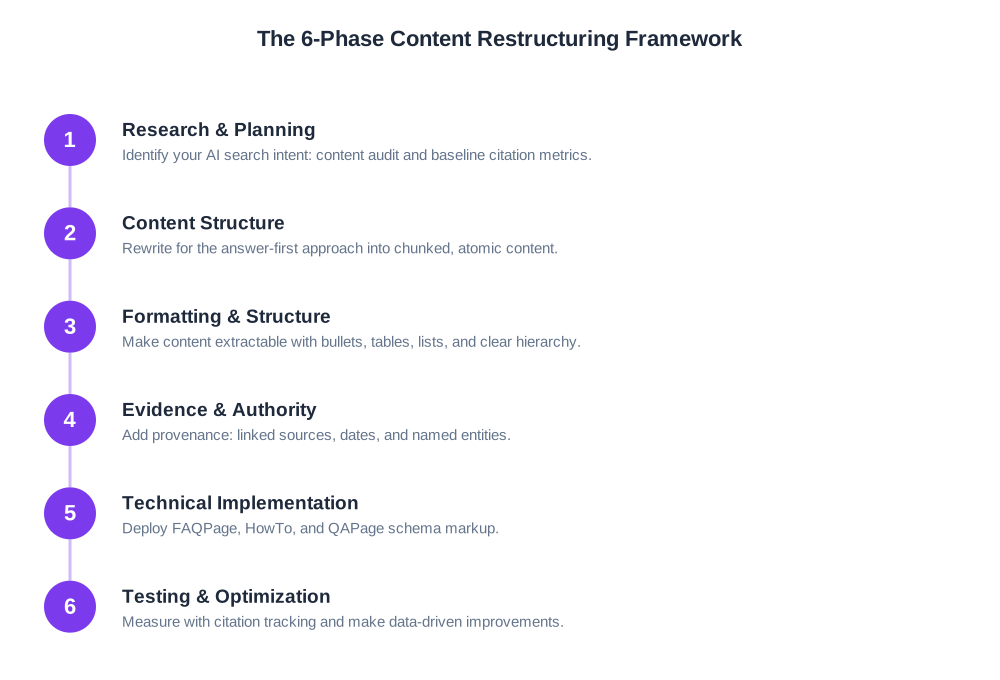
Before you rewrite a single word, understand what questions AI systems are extracting from your content.
AI systems don’t just answer the primary question: they anticipate follow-up questions and look for content that addresses sub-questions. These are called “fan-out queries.”
Example: A user asks “How do I structure content for AI citation?”
AI systems also look for answers to:
How to identify your fan-out queries:
Write these down: they become your H2 headings and section topics.
Review your existing pages and score them on extractability:
| Question | Yes / No |
|---|---|
| Does the first sentence answer the question directly? | - |
| Are headings questions or descriptive phrases? | - |
| Are paragraphs under 4 sentences? | - |
| Do you use bullet lists for lists (not prose)? | - |
| Are statistics placed near the claims they support? | - |
| Do you have a dedicated FAQ section? | - |
| Is your content chunked into 100–300 word sections? | - |
| Do you use tables for comparisons? | - |
| Are sources linked and crawlable? | - |
| Do you have schema markup implemented? | - |
Score: Count your “Yes” answers. Below 5? You have significant restructuring to do.
Before you make changes, establish a baseline so you can measure improvement.
What to track:
Tools for tracking:
This is the most important phase. Everything else follows from how you structure your content.
The inverted pyramid is the most consistently citable content structure: the most important claim appears in the first sentence, followed by supporting detail.
Before (weak):
“There are many factors that go into choosing the right web optimization partner for your business. Companies of all sizes struggle with this decision.”
After (strong):
“Effective content structure for AI citation requires three core elements: answer-first writing, atomic chunking, and schema markup. Most websites fail on all three.”
The second version gives an AI system something immediately extractable. The first gives it nothing.
The answer-first formula:
Apply this to every section. Every H2 and H3 should open with a direct answer, not marketing language or soft introductions.
Headings serve a critical function in AI extraction: they tell the system what topic the following content covers.
Weak headings (marketing language):
Strong headings (plain-language questions):
Every H2 should be a plain-language description of what the section contains. Ideally, it should be a question your audience actually asks.
Dense, long-form content actively hurts AI citation. Every wall of prose is a citation your competitor is winning.
Break your content into discrete sections of 100–300 words. Each section should:
Why this works: AI systems can extract and cite a 150-word section cleanly. A 1,000-word wall of text forces the AI to synthesize, which introduces errors and reduces citation probability.
Within each section, break paragraphs into atomic units: 2–4 sentences maximum.
Before (dense):
“Content structure matters for AI citation because AI systems evaluate pages differently than traditional search engines. They break pages into discrete passages, score each fragment for relevance and quality, and determine which sections cleanly answer specific parts of user queries. This passage-based evaluation means that dense paragraphs and vague topic headings significantly reduce your chances of being cited, while clear, structured content dramatically increases your visibility in AI-generated answers.”
After (atomic):
“Content structure matters for AI citation because AI systems evaluate pages differently than traditional search engines. They break pages into discrete passages, score each fragment for relevance and quality, and determine which sections cleanly answer specific parts of user queries.
This passage-based evaluation means that dense paragraphs and vague topic headings significantly reduce your chances of being cited. Clear, structured content dramatically increases your visibility in AI-generated answers.”
The second version is easier to extract, quote, and cite.
For longer sections, add a TL;DR (Too Long; Didn’t Read) summary at the start or end. This gives AI a pre-packaged, quotable unit.
Formula:
Example TL;DR:
“FAQPage schema is the most powerful schema type for AI citation, with 200%+ ROI. It structures Q&A pairs that AI systems can extract independently. HowTo schema works for procedural content but has lower citation rates. Implement FAQPage first if your content is Q&A-based.”
Structure isn’t just about words: it’s about visual hierarchy and data formatting.
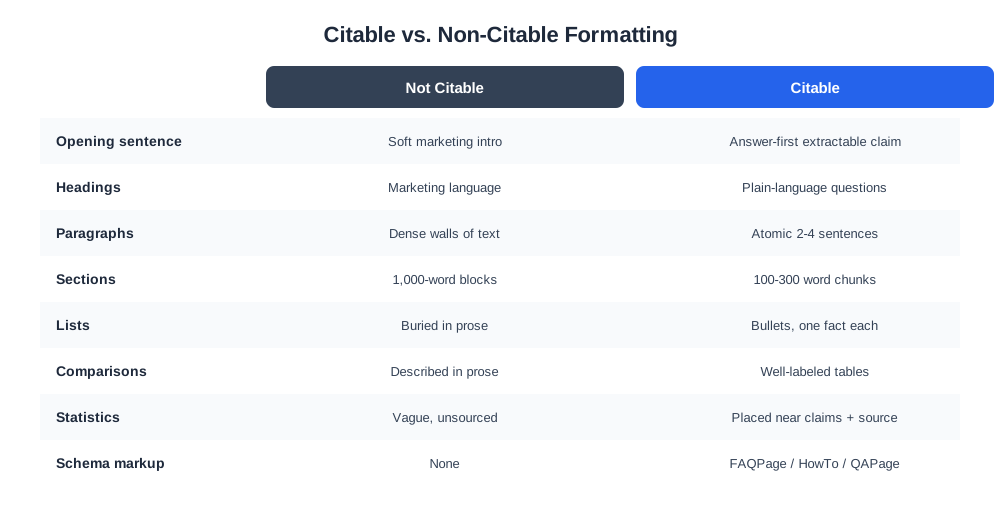
When you’re listing items, use bullets. Don’t bury them in prose.
Before (buried):
“To optimize content for AI citation, you need to implement several key techniques. First, use atomic chunking to break content into 2–4 sentence paragraphs. Second, add TL;DR sections for longer content. Third, use comparison tables for side-by-side data. Fourth, implement schema markup like FAQPage and HowTo.”
After (bulleted):
To optimize content for AI citation, implement these key techniques:
- Use atomic chunking (2–4 sentence paragraphs)
- Add TL;DR sections for longer content
- Use comparison tables for side-by-side data
- Implement schema markup (FAQPage, HowTo)
The bulleted version is easier for AI to extract and quote.
Rule: One fact per bullet. If a bullet is more than one sentence, split it.
When comparing options or enumerating attributes, present them in simple, well-labeled tables where each cell contains a complete fact.
Example:
| Schema Type | Best For | Citation Rate | Implementation Time |
|---|---|---|---|
| FAQPage | Q&A content, FAQs | 200%+ higher | 1–2 hours |
| HowTo | Step-by-step procedures | 150%+ higher | 2–3 hours |
| QAPage | Single Q&A pairs | 120%+ higher | 30 minutes |
Each cell should be independently quotable. Don’t use abbreviations or incomplete sentences.
For procedural content, use numbered lists, not prose descriptions.
Before:
“To implement FAQPage schema, you first need to identify your most common questions. Then, write concise answers for each question. After that, format them as Q&A pairs in your CMS. Finally, add the schema markup to your page’s HTML.”
After:
- Identify your most common questions
- Write concise answers for each question (40–60 words)
- Format them as Q&A pairs in your CMS
- Add the schema markup to your page’s HTML
Numbered lists are easier for AI to extract and cite.
Break H2 sections into H3 subsections. This creates a clear hierarchy that AI can parse.
Example structure:
## Phase 1: Research & Planning
### Step 1: Map Fan-Out Queries
### Step 2: Audit Your Current Content
### Step 3: Establish Baseline Metrics

## Phase 2: Content Structure
### Step 4: Rewrite with Answer-First Approach
### Step 5: Create Question-Based Headings
Highlight important statements with blockquotes. This signals to AI that the content is quotable.
Key principle: Content structure determines AI citability more than content quality. Two pages covering the same topic with identical depth will have different citation rates based on how they’re structured.
AI systems need to understand where information comes from. Add evidence and authority signals throughout your content.
When you present a factual claim, attach a nearby source citation or note the data point’s provenance.
Before:
“AI search engines are growing rapidly. Most websites aren’t optimized for them.”
After:
“AI search engines are growing rapidly, with 1,200% year-over-year growth according to industry reports. Most websites aren’t optimized for them: 70% of enterprise brands publish unstructured content with no bullets, stats, or FAQs (Pepper Content benchmark data, 2026).”
Where to place the source:
Make sure sources are linked in text, not embedded in images or PDFs.
Good:
“According to Pepper Content’s 2026 benchmark , 70% of enterprise brands publish unstructured content.”
Bad:
“According to Pepper Content (see image below), 70% of enterprise brands publish unstructured content.” [image with link]
AI systems can follow text links. They can’t reliably extract information from images.
Freshness signals matter for AI citation. Always include publication dates and update dates.
Example:
“Published: May 7, 2026 | Updated: July 7, 2026”
If you update content significantly, update the date. This signals to AI that the information is current.
Use precise, named entities (people, organizations, dates) instead of pronouns or vague references.
Before:
“They found that this approach works well for most companies.”
After:
“Pepper Content found that atomic chunking works well for 85% of enterprise brands.”
Named entities help AI understand context and reduce misattribution.
Group related citations and data into dedicated evidence blocks. This makes it easy for AI to extract and cite.
Example evidence block:
Research on AI Citation Rates (2026)
- FAQPage schema delivers 200%+ higher citation rates (Pepper Content benchmark)
- 85% of extracted content is retrieved but not cited (AmICited analysis)
- 70% of enterprise brands publish unstructured content (Pepper Content, 2026)
- Princeton GEO research: fluency improvements + statistics boost AI visibility by 115%
Schema markup is the technical layer that makes AI extraction even more reliable. It’s not required, but it dramatically increases citation probability.
Three schema types dominate AI citation:
| Schema | Best For | Citation Boost | Effort |
|---|---|---|---|
| FAQPage | Q&A content, FAQs | 200%+ | Low |
| HowTo | Step-by-step procedures | 150%+ | Medium |
| QAPage | Single Q&A pairs | 120%+ | Low |
FAQPage is the most powerful schema type for AI citation. It structures your Q&A content so AI systems can extract independent question-answer pairs.
When to use FAQPage:
Implementation steps:
<head> sectionExample FAQPage JSON-LD:
{
  "@context": "https://schema.org",
  "@type": "FAQPage",
  "mainEntity": [
    {
      "@type": "Question",
      "name": "How do I structure content for AI citation?",
      "acceptedAnswer": {
        "@type": "Answer",
        "text": "Structure content for AI citations by using clear question-based headings, breaking content into passage-ready sections of 100-300 words, implementing proper schema markup, and ensuring your content directly answers specific sub-questions that AI systems extract and cite."
      }
    },
    {
      "@type": "Question",
      "name": "What's the difference between FAQPage and HowTo schema?",
      "acceptedAnswer": {
        "@type": "Answer",
        "text": "FAQPage is best for Q&A content and delivers 200%+ higher citation rates. HowTo is best for step-by-step procedures and delivers 150%+ higher citation rates. Use FAQPage for FAQs and Q&A content; use HowTo for procedural content."
      }
    }
  ]
}
Where to add it:
<head> sectionKey rules:
HowTo schema structures step-by-step procedures so AI can extract and cite individual steps.
When to use HowTo:
Example HowTo JSON-LD:
{
  "@context": "https://schema.org",
  "@type": "HowTo",
  "name": "How to Structure Content for AI Citation",
  "description": "A complete framework for restructuring your content so AI models cite it.",
  "step": [
    {
      "@type": "HowToStep",
      "name": "Map Fan-Out Queries",
      "text": "Identify the follow-up questions AI systems might ask about your topic. Use Perplexity or ChatGPT Search to see what questions the AI suggests."
    },
    {
      "@type": "HowToStep",
      "name": "Audit Your Current Content",
      "text": "Review your existing pages and score them on extractability. Check if headings are questions, paragraphs are atomic, and sources are linked."
    },
    {
      "@type": "HowToStep",
      "name": "Establish Baseline Metrics",
      "text": "Track current AI citations using AmICited or BrandArmor AI. Note which pages are cited and which platforms cite you."
    }
  ]
}
Key rules:
name and text for each stepQAPage is for single Q&A pairs. Use it when your entire page is one question with one answer.
Example QAPage JSON-LD:
{
  "@context": "https://schema.org",
  "@type": "QAPage",
  "mainEntity": {
    "@type": "Question",
    "name": "How do I structure content for AI citation?",
    "acceptedAnswer": {
      "@type": "Answer",
      "text": "Structure content for AI citations by using clear question-based headings, breaking content into passage-ready sections of 100-300 words, implementing proper schema markup, and ensuring your content directly answers specific sub-questions that AI systems extract and cite."
    }
  }
}
After adding schema markup, validate it using Google’s Rich Results Test:
Common errors:
name, text)You can’t improve what you don’t measure. Set up tracking to see how your restructuring impacts AI citations.
Use one of these tools to track AI citations:
| Tool | Best For | Cost |
|---|---|---|
| AmICited | Comprehensive AI citation reports | $99–$299/month |
| BrandArmor AI | Real-time monitoring | $199–$499/month |
| Pepper Content | Benchmark data + insights | Custom |
| Manual tracking | Small sites, quick checks | Free |
What to track:
Different AI platforms have different citation patterns. Track separately:
How to manually check:
After 2–4 weeks, analyze your data:
Questions to answer:
Use your data to improve further:
Here’s how restructuring looks in practice:
Before (weak structure):
Product Features
Our platform offers a comprehensive suite of features designed to help you succeed. We’ve built in everything you need to manage your content effectively. Our customers love the ease of use and the powerful functionality. We offer 24/7 support and a 30-day money-back guarantee. Pricing starts at $99 per month.
After (strong structure):
What Does the Platform Include?
The platform includes content management, AI citation tracking, schema markup tools, and 24/7 support. Pricing starts at $99/month for up to 10 pages.
Key Features:
- Content auditing and restructuring guides
- Real-time AI citation monitoring across Perplexity, ChatGPT, and Google AI
- Schema markup generator (FAQPage, HowTo, QAPage)
- Citation analytics and competitor tracking
Support & Guarantees:
- 24/7 email and chat support
- 30-day money-back guarantee
- Free onboarding call
What changed:
Before (weak):
Why Content Structure Matters
In today’s digital landscape, content structure is more important than ever. Many businesses struggle with how to format their content effectively. The truth is that AI systems read content differently than humans do. This means you need to adapt your approach. By understanding how AI reads content, you can structure your pages to be more visible in AI search results.
After (strong):
Why Content Structure Matters More Than Quality
Content structure determines AI citability more than content quality. AI systems break pages into discrete passages and score each independently, meaning two pages covering the same topic with identical depth will have different citation rates based on how they’re structured.
How AI Systems Read Content:
- Break pages into discrete passages
- Score each fragment independently
- Determine which sections answer user queries
- Select the clearest, most quotable passage to cite
Why This Matters:
- 85% of content is retrieved but not cited
- Structure is the bottleneck, not quality
- Clear structure = higher citation probability
- Most competitors don’t optimize for this yet
What changed:
Cause: Dense paragraphs, vague headings, or missing evidence
Fix:
Cause: Incorrect JSON-LD format, validation errors, or missing fields
Fix:
Cause: No measurement/optimization or targeting wrong platforms
Fix:
Cause: Competitor has clearer structure or better formatting
Fix:
Cause: Wrong content type targeted or insufficient restructuring
Fix:
Cause: Accordion format, poor Q&A phrasing, or missing schema
Fix:
Cause: No freshness signals or update dates
Fix:
| Tool | Purpose | Cost |
|---|---|---|
| AmICited | Best overall choice: tracks citation rate across ChatGPT, Perplexity, and Google AI Overview so you can see which restructured pages are actually working | $99–$299/month |
| BrandArmor AI | Real-time AI citation monitoring | $199–$499/month |
| Pepper Content | Benchmark data from 110+ companies | Custom |
| Tool | Purpose | Cost |
|---|---|---|
| Google Rich Results Test | Validate schema markup | Free |
| Yoast SEO | WordPress plugin with schema generator | Free / $99/year |
| Rank Math | WordPress plugin with schema builder | Free / $39/year |
| Schema.org | Official schema documentation | Free |
| Tool | Purpose | Cost |
|---|---|---|
| Perplexity | Test how AI reads your content | Free |
| ChatGPT Search | Check ChatGPT citations | Free (with ChatGPT Plus) |
| Google AI Overviews | Test Google AI citations | Free |
## [Question-Based Heading]

[Answer-first opening sentence that directly answers the question.]

[2-3 supporting sentences with evidence.]

### Key Points
- [Fact 1]
- [Fact 2]
- [Fact 3]

### [Related Sub-Topic]

[Atomic paragraph 1 (2-4 sentences)]

[Atomic paragraph 2 (2-4 sentences)]

### TL;DR

[40-60 word summary that stands alone]
{
  "@context": "https://schema.org",
  "@type": "FAQPage",
  "mainEntity": [
    {
      "@type": "Question",
      "name": "[Your question here]",
      "acceptedAnswer": {
        "@type": "Answer",
        "text": "[Your 40-60 word answer here]"
      }
    }
  ]
}
| Metric | Week 1 | Week 2 | Week 3 | Week 4 | Change |
|---|---|---|---|---|---|
| Total AI mentions | - | - | - | - | - |
| Perplexity citations | - | - | - | - | - |
| ChatGPT citations | - | - | - | - | - |
| Google AI citations | - | - | - | - | - |
| Pages cited | - | - | - | - | - |
| Competitor citations | - | - | - | - | - |
Arshia is an AI Workflow Engineer at FlowHunt. With a background in computer science and a passion for AI, he specializes in creating efficient workflows that integrate AI tools into everyday tasks, enhancing productivity and creativity.

Am I Cited tracks your citation rate across ChatGPT, Perplexity, and Google AI Overview so you can tell which restructured pages are working.
Learn how to restructure your content for AI systems with practical before and after examples. Discover techniques to improve AI citations and visibility across...

Learn how to optimize content readability for AI systems, ChatGPT, Perplexity, and AI search engines. Discover best practices for structure, formatting, and cla...
Learn how to structure your content to get cited by AI search engines like ChatGPT, Perplexity, and Google AI. Expert strategies for AI visibility and citations...
Cookie Consent
We use cookies to enhance your browsing experience and analyze our traffic. See our privacy policy.