


25 Best AI Visibility Tools for 2026
Comprehensive guide to the 25 best AI visibility tools in 2026. Compare features, pricing, and capabilities of Profound, Am I Cited, Peec AI, Otterly, Semrush A...
22 min read
Learn how to evaluate AI search visibility platforms in 2026, compare data quality and pricing, spot vendor red flags, and plan implementation.
When ChatGPT crossed 900 million weekly active users in early 2026 and Google’s Gemini-powered AI Overviews began reaching an estimated 2 billion people each month, the marketing industry crossed a threshold that had been building for years. Search stopped being a list of blue links and became a generated answer. That shift created an entirely new discipline, AI search visibility, and with it, a new category of software: the AI search visibility platform.
If your brand isn’t showing up when a buyer asks ChatGPT “What’s the best project management software for distributed teams,” or when Perplexity synthesizes a comparison of top vendors, you’re not just losing clicks. You’re losing the conversation entirely. In fact, according to SparkToro’s analysis of Similarweb clickstream data, 68% of Google searches ended without a click in early 2026. When an AI Overview appears, organic click-through rates drop by approximately 60%, according to Search Engine Land’s 2026 zero-click study. The answer is the destination now, and being cited inside it is the new front page.
This buyer’s guide to choosing an AI search visibility platform is designed to help you navigate that reality. It doesn’t simply list tools and features. It gives you a framework for evaluating platforms on the dimensions that genuinely separate a useful AI visibility tool from a dashboard that collects dust: methodology, data quality, engine coverage, execution capability, and total cost. By the end, you’ll know not just which platforms exist, but how to select, implement, and extract value from the one that fits your organization.
For two decades, search engine optimization meant one thing: rank higher on Google. Success was measured in keyword positions, organic traffic, and click-through rates. Those metrics still matter, but they no longer capture the full picture of how buyers discover brands.
AI-powered answer engines (ChatGPT, Google AI Overviews, Perplexity, Claude, Gemini, and Microsoft Copilot) now synthesize information from multiple sources and deliver a single, compressed answer. They may cite three brands, or five, or none at all. They may describe your product accurately, or they may attribute outdated pricing to your company. And they almost never send the user to your website.
This is the shift from rankings to citations. Your brand either appears in that AI-generated answer or it doesn’t. And if it doesn’t, you’re invisible to the growing share of buyers who use AI as their primary research tool. Gartner predicts traditional search engine volume will decline 25% by 2026. Meanwhile, 58% of consumers now use AI when deciding what to buy, according to ChannelEngine research. The numbers are no longer speculative: they describe a market that has already moved.
Traditional SEO tools measure what happens on a search engine results page: keyword rankings, backlinks, domain authority, organic traffic. AI search visibility platforms measure something fundamentally different: whether, how, and how often AI models cite your brand when they generate answers.
The distinction matters because the mechanics are different. In traditional SEO, you optimize pages to rank for specific keywords. In Generative Engine Optimization (GEO) and Answer Engine Optimization (AEO), you optimize content to be cited by AI models. A keyword ranking tells you where you sit on a page. An AI citation tells you whether you’re part of the answer itself.
AI visibility also introduces variables that don’t exist in traditional search. AI responses are non-deterministic, meaning the same prompt can produce different answers on different runs. Citation sources vary dramatically by platform: Reddit accounts for 46.7% of Perplexity’s top-cited sources, while Google AI Overviews and ChatGPT draw from very different source mixes, according to Profound’s citation pattern research. A tool that only reports whether your brand was mentioned, without showing which sources drove that mention, is giving you half the picture.
The risk of not monitoring AI citations isn’t hypothetical. When a competitor’s product guide, comparison page, or third-party review gets cited instead of yours, the cost is real: lost consideration, lost traffic, and lost revenue. Research from Magenta Associates found that 66% of UK senior decision-makers use AI tools to research suppliers, and 90% trust the recommendations those systems provide. If your brand isn’t in those recommendations, a competitor is.
The cost compounds over time. AI models are trained on data that includes their own previous outputs, which means citation patterns can become self-reinforcing. Brands that get cited early and often tend to keep getting cited. Brands that don’t appear stay invisible. This is why the window for establishing AI search visibility is narrowing, and why a dedicated AI search visibility platform is no longer optional for serious marketing teams.
AI search visibility platforms operate on a deceptively simple principle: they inject a set of prompts into AI engines, capture the responses, and analyze those responses for brand mentions, citations, and sentiment. But the implementation details vary enormously between vendors, and those details determine whether the data you get is directionally useful or statistically reliable.
The process works in three stages. First, the platform maintains a library of prompts, ranging from branded queries (“best [your product]”) to non-branded category queries (“top project management tools”) to comparison prompts ("[competitor] vs [your brand]"). Second, it runs those prompts against AI engines on a defined schedule: daily, several times per week, or weekly. Third, it parses the responses to detect brand mentions, extract citation URLs, analyze sentiment, and compute share-of-voice metrics.
The weakest platforms stop at counting whether your brand name appeared in the response. The strongest ones trace the exact URLs that the AI model cited as sources, and map those citations back to specific pages on your site or your competitors’ sites.
This distinction is critical because a mention without a citation link is a different signal than a direct citation. If ChatGPT mentions your brand in passing but links to a competitor’s pricing page, the mention is nearly worthless. If it cites your detailed comparison guide as the source of its recommendation, that’s a genuine visibility win. Source-level attribution is what separates tools that tell you that something happened from tools that tell you why it happened, and what to do about it.
AI models are probabilistic systems. The same prompt, submitted to the same model, can produce different answers on different runs. This non-determinism creates a measurement challenge: a single snapshot of a single prompt run may show your brand in the answer, or it may not, purely by chance. If a platform samples each prompt only once and reports that as your “visibility score,” the data is unreliable.
The best platforms address this through multi-session sampling: running each prompt multiple times and reporting aggregate results with confidence intervals. Some use consumer panel data to estimate real-world prompt volumes rather than running synthetic queries. Others disclose their sampling methodology transparently. When evaluating a platform, ask explicitly: how many times does the platform run each prompt before reporting a result? Does it report confidence scores? If the answer is vague or the vendor can’t answer, treat the data as directional at best.
| Methodology | How It Works | Reliability | Example Platforms |
|---|---|---|---|
| Single-session snapshot | Runs each prompt once per reporting cycle | Low, high variance between runs | Entry-level tools |
| Multi-session sampling | Runs each prompt multiple times, aggregates results | Medium, reduces noise but not bias | Peec AI, Otterly |
| Consumer panel + prompt volumes | Uses real user behavior data to estimate query volumes | High, reflects actual user behavior | Profound (Prompt Volumes) |
| Continuous monitoring with confidence intervals | Runs prompts on a rolling basis, reports confidence scores | Highest, statistically rigorous | Enterprise platforms |
When you evaluate an AI search visibility platform, don’t get distracted by dashboard aesthetics. The features that determine whether a platform delivers value or consumes budget are technical, not visual. Here are the nine capabilities that matter.
AI users don’t rely on one platform. ChatGPT dominates with roughly 81% of global AI referral traffic, but Perplexity, Gemini, Claude, and Copilot each capture meaningful audience segments. Google AI Overviews appear in nearly half of all Google searches. A platform that tracks only ChatGPT leaves blind spots everywhere else.
The minimum viable coverage for a serious AI visibility program is five engines: ChatGPT, Google AI Overviews, Perplexity, Gemini, and Claude. If you serve markets where Copilot, DeepSeek, or Grok have significant adoption, those should be on your list too. Be wary of platforms that advertise broad coverage but gate most engines behind enterprise pricing tiers: the engine count on the marketing page may not match what you actually get at your price point.
AI visibility isn’t measured in keywords: it’s measured in prompts. A useful platform lets you see exactly which prompts trigger your brand, which competitors appear alongside you, and which prompts you’re missing entirely. It should also support prompt discovery: identifying new, high-value prompts that your audience is asking but you haven’t yet tracked.
Prompt volume limits are the single most important pricing variable in this category. Every platform caps how many prompts you can track, and those caps vary from 25 prompts on entry-level plans to thousands on enterprise tiers. Before you commit to a plan, list your top 50–100 commercial queries, multiply by the number of engines you need to track, and use that as your baseline for evaluating whether a plan’s prompt limit is sufficient.
This is the feature that separates platform tiers more than any other. Knowing that your brand was mentioned is the beginning. Knowing which pages, domains, and content types earned those citations is what enables action.
Strong platforms show you the exact URLs that the AI model cited. They map citation patterns across engines, revealing, for example, that Perplexity heavily favors Reddit and forum content, while Google AI Overviews draw from a broader mix of authoritative domains. This data tells you where to invest your content and PR efforts. If a vendor cannot show citation sources or engine-specific source breakdowns, treat the report as partial.
AI visibility is inherently relative. Your brand might be cited 30% of the time for a given prompt, but if your top competitor is cited 70% of the time, you’re losing. Share of voice (SoV) metrics, the percentage of AI-generated answers that mention your brand vs. competitors, make the competitive gap concrete.
Look for platforms that let you define a custom competitor set, track SoV trends over time, and break down share by prompt category, engine, and geography. A single “AI visibility score” without competitive context is a vanity metric.
A mention isn’t a win if the AI describes your brand inaccurately, associates you with the wrong use case, or cites outdated information. Sentiment analysis evaluates whether your brand is being portrayed positively, negatively, or neutrally. Context analysis goes further: it checks whether the AI’s description of your product, pricing, or capabilities is factually correct.
This is especially important for SaaS companies, where AI models may cite old pricing pages or describe features that have since changed. A platform that can flag when your brand is mentioned but misrepresented gives you a triage list for content updates that directly improve AI accuracy.
A snapshot tells you where you are today. A trendline tells you whether you’re gaining or losing ground. Historical reporting is essential for demonstrating ROI, identifying seasonal patterns, and catching sudden drops in visibility that signal a competitor’s content push or an algorithm change.
The best platforms retain data for at least 12 months and let you view trends at the prompt, engine, and competitor level. Be skeptical of platforms that only show you the current reporting period; they’re selling a dashboard, not a measurement system.
This is where the category splits. Most AI visibility platforms are monitoring tools: they tell you where you’re visible, where you’re not, and which competitors are ahead. They stop at the dashboard. The strongest platforms connect monitoring to execution: they identify content gaps, generate optimization recommendations, and in some cases, integrate directly with your content workflow or CMS.
The question to ask every vendor: “After your platform shows me a gap, what happens next?” If the answer is “you take the data and act on it,” you’re buying a monitoring tool. If the answer involves content briefs, structured data suggestions, or integration with your publishing workflow, you’re buying something closer to an optimization platform. Both have their place, but you need to know which one you’re signing up for.
AI visibility data is most valuable when it flows into the tools your team already uses. Look for platforms that integrate with Google Analytics 4 and Google Search Console to connect AI citations to traffic data. Slack or Microsoft Teams integrations for real-time alerts. API access for custom workflows and data export. CRM integrations (HubSpot, Salesforce) for enterprise teams that need to connect visibility to pipeline.
For larger organizations, AI visibility platforms must meet procurement and security requirements. SOC 2 Type II compliance is becoming table stakes. GDPR compliance is non-negotiable for European operations. Multi-brand management, role-based access controls, and audit trails matter for teams with centralized marketing operations. White-label reporting and multi-client dashboards are essential for agencies. If these requirements matter to your organization, make them explicit evaluation criteria; don’t assume a platform has them just because it serves enterprise customers.
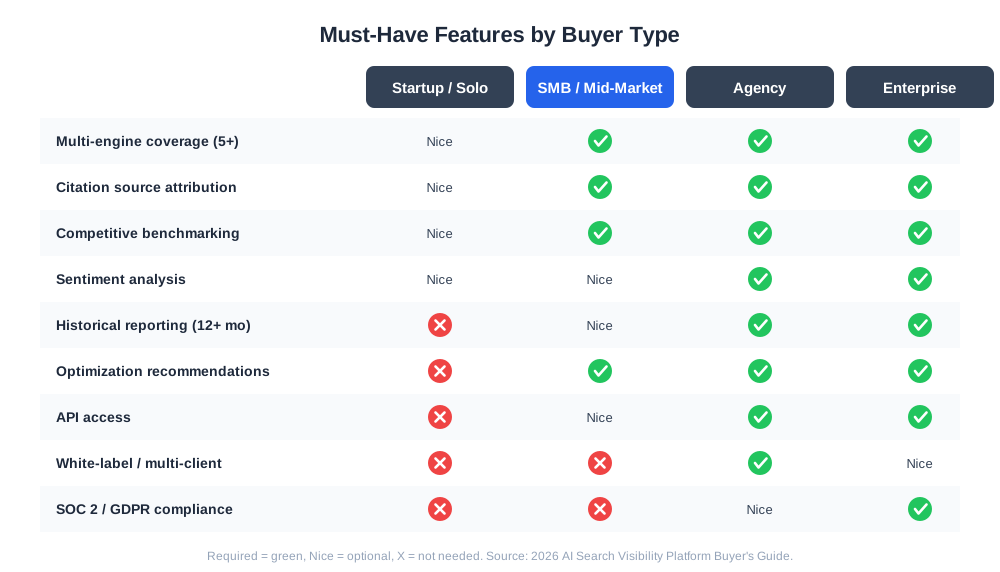
The AI search visibility market has matured rapidly. Instead of one homogeneous category, it now consists of four distinct segments, each optimized for different use cases, budgets, and team structures.
These platforms were built from the ground up to track AI citations. They go deep on monitoring (engine coverage, prompt libraries, competitive benchmarking), but most stop at the dashboard. They’re the best choice for teams that need comprehensive visibility data and have the internal resources to act on it.
Profound is the most heavily funded player in this category, with a 1.5B+ prompt database, live snapshots, and SOC 2 Type II compliance. It tracks 10+ AI engines and offers GA4 attribution. Pricing starts at $99/month for ChatGPT-only tracking and scales to enterprise tiers with custom pricing. It’s the strongest dedicated monitor for enterprises and regulated industries, but lacks a self-serve free trial and routes most teams to higher pricing tiers.
Peec AI is a strong mid-market option, starting at roughly €89/month with multi-engine coverage (ChatGPT, Perplexity, AI Overviews, DeepSeek on standard tiers, with Claude and Gemini at enterprise). It emphasizes clean UX with visibility, position, and sentiment scores, plus unlimited seats, a rarity in this category. It’s well-suited for teams that want fast onboarding and competitive tracking without enterprise overhead.
Otterly.AI is the budget leader, starting at $29/month with unlimited seats. It covers ChatGPT, Google AI Overviews, and Perplexity, with GEO audit capabilities. It’s the right entry point for startups and SMBs testing AI visibility strategies, though it offers less depth on historical data and competitive intelligence than premium alternatives.
AthenaHQ targets SMBs and fast setup with a strong prompt library and quick onboarding, though its engine coverage and analytical depth are narrower than Profound’s. Rankscale distinguishes itself with 17+ engine coverage and agency-friendly features, including schema audits.
For teams already standardized on a major SEO platform, adding AI visibility as a module can be convenient, but it’s important to understand the trade-offs.
Semrush AI Visibility Toolkit costs $99/month per domain (on top of a base Semrush subscription) and tracks four AI engines with 25 prompts. It’s a natural fit for existing Semrush users who want AI tracking alongside traditional SEO data, but the prompt limits and engine coverage are narrower than dedicated platforms.
Ahrefs Brand Radar is included with Ahrefs plans starting at $129/month and tracks seven AI engines. It’s strong for benchmarking brand performance against competitors, but lacks AI-specific audits, content generation, or optimization playbooks. It’s a measurement tool, not an execution tool.
SE Ranking offers AI visibility tracking as part of its broader platform, with pricing starting at lower tiers. Like the other suite add-ons, it’s convenient but shallow: useful for teams that need a baseline AI visibility signal without investing in a dedicated platform.
This is the fastest-growing segment, and the one that addresses the most common criticism of first-generation AI visibility tools: they identify problems but leave execution to the customer.
Am I Cited leads this category for most teams: it combines multi-engine citation tracking across ChatGPT, Perplexity, and Google AI Overview with source-level attribution and optimization guidance, starting from €50/month. Rather than stopping at a dashboard, it points you toward what to publish to close a visibility gap, making it a strong default starting point before you evaluate narrower, single-purpose tools.
Frase pairs daily AI-engine tracking across ChatGPT, Perplexity, Claude, Gemini, and Google AI with the research, writing, optimization, and publishing workflow that closes the gap. Instead of just telling you that you dropped out of an answer, it feeds that signal directly into content briefs, drafts, and scoring. For content and SEO teams that want tracking to lead somewhere, Frase represents the monitor-to-action model.
Pixis Visibility combines multi-engine, multi-session citation tracking with a content pipeline that runs from gap analysis to content brief to draft to published page, starting at $99 per site per month. It emphasizes sampling methodology and execution, making it a strong choice for teams that want to close citation gaps without a separate content stack.
Dageno AI and Surferstack also operate in this category, connecting AI visibility monitoring with prompt intelligence, technical crawl readiness, structured data, and optimization workflows. These platforms are particularly useful for teams that understand SEO fundamentals but need a dedicated layer for GEO execution.
For Fortune 1000 companies and large marketing organizations, the requirements go beyond monitoring and execution to include governance, compliance, and multi-brand management at scale.
Conductor, BrightEdge Prism, and Botify treat AI visibility as one module inside larger, governance-heavy deployments. They offer deep analytics, extensive prompt libraries, competitive benchmarking, executive reporting, and API access, but at enterprise price points and with longer implementation timelines. These platforms are appropriate for organizations that need AI visibility integrated into a broader marketing operations stack, not teams looking for a standalone tool.
| Platform | Category | Starting Price | Engines Tracked | Prompt Limit (Entry) | Best For |
|---|---|---|---|---|---|
| Am I Cited | Monitor-to-Action | €50/mo | ChatGPT, Perplexity, Google AI Overview | Flat, no per-prompt fees | Teams wanting monitoring plus execution |
| Profound | Dedicated Monitor | $99/mo | 10+ | 50 | Enterprise, regulated industries |
| Peec AI | Dedicated Monitor | ~€89/mo | 4–11 | 50 | Mid-market, unlimited seats |
| Otterly.AI | Dedicated Monitor | $29/mo | 3 | Varies | Startups, budget-conscious |
| AthenaHQ | Dedicated Monitor | Custom | Multiple | Varies | SMBs, fast setup |
| Rankscale | Dedicated Monitor | Custom | 17+ | Varies | Agencies, hands-on SEOs |
| Semrush AI Toolkit | SEO Suite Add-On | $99/mo add-on | 4 | 25 | Existing Semrush users |
| Ahrefs Brand Radar | SEO Suite Add-On | Included ($129+) | 7 | Custom | Ahrefs-native teams |
| Frase | Monitor-to-Action | Varies | 5+ | Varies | Content/SEO teams |
| Pixis Visibility | Monitor-to-Action | $99/mo/site | Multiple | Varies | Teams wanting execution |
| Conductor | Enterprise | Custom | Multiple | Custom | Large organizations |
Choosing the right AI search visibility platform isn’t about finding the “best” tool in the abstract. It’s about finding the best fit for your goals, your team structure, and your budget. This five-step framework will help you make that decision systematically.
Before you look at a single platform, clarify what you need it to do. The answer determines which category of tool you should be evaluating.
If your goal is basic monitoring (knowing whether your brand appears in AI answers), a budget monitor like Otterly or a suite add-on like Semrush AI Toolkit may be sufficient. If your goal is competitive intelligence (understanding how you stack up against specific competitors across engines and prompts), you need a dedicated monitor with strong benchmarking, like Profound or Peec AI. If your goal is content optimization (turning visibility data into better content and higher citation rates), you need a monitor-to-action platform like Frase or Pixis Visibility. If your goal is full execution (monitoring, optimization, and content creation in a single workflow), you need a platform built for that loop.
Which AI engines do your customers actually use? The answer varies by industry, geography, and audience. B2B SaaS buyers lean heavily on ChatGPT and Perplexity. Consumer brands are more likely to encounter Google AI Overviews. European markets see higher Claude and Copilot adoption. If you serve the APAC region, regional engines may matter.
Map your engine priorities before you evaluate platforms. A platform that covers 10 engines but doesn’t track the two your audience uses is less valuable than a platform that covers the right five.
This is the most practical step in the evaluation, and the one most teams skip. Prompt volume needs are a function of four variables:
A US-only SaaS company tracking 5 engines and 100 prompts needs 500 prompt runs per reporting cycle. Add a second geography, and that doubles. Add competitor tracking, and it grows further. Use this calculation to pressure-test whether a platform’s entry-level prompt limit is realistic for your needs; many platforms advertise low starting prices that cap you at 15-50 prompts, which is insufficient for any serious AI visibility program.
Ask every vendor these questions directly. If they can’t answer, or the answers are vague, treat the data as directional:
The sticker price on a platform’s pricing page is rarely the total cost. Factor in:
A $99/month platform that requires 20 hours of setup and an additional $200/month in add-ons may cost more in real terms than a $300/month platform that works out of the box.
The AI visibility market is new enough that vendor claims often outpace vendor capabilities. Here are the red flags that should make you pause.
Single-engine tracking only. If a platform tracks only ChatGPT, you have blind spots on Google AI Overviews, Perplexity, Gemini, Claude, and Copilot, all of which have meaningful and growing user bases. Single-engine tracking was acceptable in 2024. It is not in 2026.
Black-box scoring. A platform that reports a single “AI visibility score” or “AEO score” without explaining its methodology (what it measures, how it weights components, how it handles sampling) is selling a vanity metric. If you can’t explain the score to your CMO, you can’t use it to make decisions.
No historical data. Snapshot-only tools that show you today’s visibility but can’t show you last month’s or last quarter’s are dashboards, not measurement systems. You need trend data to know whether you’re improving or declining.
Missing competitor comparison. A tool that only tracks your brand without benchmarking against competitors is measuring half the picture. AI visibility is inherently relative. Without competitive context, you don’t know whether a 30% citation rate is good or terrible.
No API or export. Data trapped in the platform’s dashboard has limited value. You need to be able to export data, feed it into your existing reporting stack, and trigger workflow automations. If a platform has no API and no export capability, it’s a silo.
Hidden prompt limits. The most common pricing trap: a low entry price that caps you at 25 prompts. You sign up, configure your brand queries, add a few competitors, and discover you’ve used your entire allocation before you’ve even started tracking category queries. Always check the prompt limit before the price.
Vague or absent methodology documentation. If a vendor can’t explain how it captures AI responses, how it handles non-determinism, or how it validates citation accuracy, the data is not trustworthy. Methodology transparency is a proxy for product maturity.
AI search visibility platform pricing has stabilized into four tiers, though the boundaries between them are blurring as new entrants compete on features.
At this tier, you get basic monitoring with limited engine coverage (typically 3 engines), capped prompt volumes (15–50 prompts), and minimal competitive intelligence. Otterly.AI ($29/month) and entry-level plans from Peec AI and Semrush AI Toolkit represent this tier. These platforms are appropriate for solo marketers and very small teams who need a baseline AI visibility signal and have the time to act on it manually. They are not appropriate for organizations that need multi-engine coverage, competitive benchmarking, or execution workflows.
This is the sweet spot for most teams. At this tier, you get 5+ engine coverage, 50–350 prompts, competitive benchmarking, historical reporting, and citation source attribution. Profound’s Growth plan, Peec AI’s Advanced plan, and Frase’s mid-tier plans operate in this range. These platforms provide enough depth to run a serious AI visibility program without the overhead of enterprise pricing.
Agency plans add multi-client management, white-label dashboards, client-facing reporting, and higher prompt limits. Rankscale, Peec AI, and enterprise-lite plans from dedicated monitors serve this segment. If you’re an agency managing AI visibility for multiple clients, prioritize platforms with strong white-label capabilities and per-client pricing rather than per-seat pricing.
Enterprise platforms offer custom pricing, dedicated support, API access, SOC 2/GDPR compliance, multi-brand management, and governance controls. Profound’s enterprise tier, Conductor, and BrightEdge Prism represent this segment. These platforms are appropriate for Fortune 1000 companies, regulated industries, and organizations with centralized procurement and security requirements.
| Tier | Monthly Cost | Engines | Prompts | Best For |
|---|---|---|---|---|
| Startup / Freelancer | $20–$100 | 3–4 | 15–50 | Solo marketers, validation |
| SMB / Mid-Market | $100–$500 | 5–8 | 50–350 | Most marketing teams |
| Agency | $200–$1,000 | 5–17 | 100–1,000 | Multi-client management |
| Enterprise | $1,000+ | 10+ | 1,000+ | Fortune 1000, regulated |
Buying the platform is the beginning. Implementing it effectively is what determines whether you get ROI. Here’s a phased plan that takes you from selection to operational cadence.
Run structured pilots with 2-3 finalist platforms. For each, track the same set of 10-15 prompts, a mix of branded, competitor, and category queries, and compare the results. Are the platforms detecting the same citations? Are the competitor rankings consistent? If one platform reports your brand in an answer and another doesn’t, dig into the methodology. This pilot will surface data quality issues faster than any vendor demo.
Once you’ve selected a platform, configure your account: define your brand and product names, set up your competitor list, build your initial prompt library, and configure any integrations (GA4, Search Console, Slack). This is also the time to set up your reporting structure: decide which metrics you’ll track, who owns each view, and what cadence you’ll review at.
Run your full prompt library for at least 5–7 days to establish a baseline. Document your current AI share of voice by engine, by prompt category, and by competitor. This baseline is your reference point for every future measurement. Without it, you can’t prove that your optimization efforts are working.
Capture not just the numbers, but the qualitative picture: which competitors dominate which prompts? Which engines are most favorable to your brand? Which prompts are you entirely absent from? The baseline measurement phase often surfaces surprises: competitors you didn’t know were getting cited, prompts you didn’t realize were important, and engines where your visibility is stronger or weaker than expected.
With your baseline established, identify your highest-priority gaps. A gap isn’t just “a prompt where we’re not cited.” It’s a prompt where you’re not cited, the prompt has high commercial intent, and the current citations go to competitors. Prioritize gaps by:
This phase should produce a prioritized list of 10-20 content actions: pages to optimize, new content to create, structured data to implement, and third-party citations to cultivate.
Execute on your prioritized list. For each gap, determine whether you need to optimize existing content or create new content. The data from your AI visibility platform should guide both the topic selection and the content structure.
Content that gets cited by AI models tends to share specific characteristics, according to research by Kevin Indig, who analyzed 1.2 million AI citations: content with question-and-answer headings gets cited 2x more often, and content with 15+ named entities gets 4.8x more citations. Structure your content accordingly: clear headings, explicit entity mentions, data-backed claims, and authoritative sourcing.
Track the impact of each content action in your AI visibility platform. Did your share of voice improve for the target prompt? Did the AI model start citing your new or updated page? This closed-loop measurement is what separates a visibility program from a content program.
By month three, you should have a sustainable cadence: weekly prompt reviews, monthly share-of-voice reporting, and quarterly strategy adjustments. The AI visibility landscape changes rapidly: new engines emerge, citation patterns shift, and competitor content strategies evolve. Your monitoring cadence needs to be fast enough to catch changes before they compound.
The next frontier for AI visibility is commerce. ChatGPT Shopping, Perplexity’s shopping features, and Google’s AI-powered product recommendations are turning AI engines into purchase decision tools. For ecommerce brands, AI visibility is no longer just about being cited in informational answers; it’s about being recommended when a buyer asks “which [product] should I buy?” Platforms that track product-specific prompts, pricing accuracy, and recommendation positioning are becoming essential for ecommerce teams.
AI models increasingly cite not just text, but video, images, and audio content. YouTube citations are growing as a source for AI answers, and platforms are beginning to track which video content drives AI visibility. For brands with significant video or visual content investments, multi-modal citation tracking will become a core requirement.
The EU AI Act, evolving data privacy regulations, and potential US federal AI legislation will reshape how AI visibility data is collected, stored, and used. Platforms with strong compliance postures (SOC 2 Type II, GDPR readiness, and transparent data handling) will have an advantage as procurement requirements tighten.
The long-term trajectory is clear: traditional SEO and generative engine optimization will merge. The same content that ranks well in Google increasingly overlaps with the content that gets cited by AI models. Platforms that bridge both worlds, providing traditional rank tracking alongside AI citation monitoring, will become the standard. The era of separate SEO and GEO stacks is temporary.
AI search visibility is no longer an experimental discipline. It’s a measurable channel with real revenue implications, and the tools to measure and improve it have matured into a distinct software category. Choosing the right AI search visibility platform comes down to a few core decisions.
First, decide what you need the platform to do: monitor, benchmark, recommend, or execute. The answer determines which category of tool you should evaluate. Second, pressure-test methodology and data quality. A platform that can’t explain its sampling approach, doesn’t disclose confidence intervals, or can’t show citation sources isn’t giving you reliable data. Third, calculate your real prompt volume needs and compare total cost of ownership, not just the sticker price. Fourth, build an implementation plan that moves from pilot to baseline to prioritized action to operational cadence. A platform without a process is a dashboard without a driver.
The brands that invest in AI search visibility now, building the content, cultivating the citations, and measuring the results, are building a moat that will compound as AI search adoption continues to accelerate. The window for establishing that moat is open, but it won’t stay open forever. Every month you’re not monitoring, competitors are getting cited in your place, and AI models are forming citation patterns that become harder to shift over time. The right platform, implemented well, turns that risk into an advantage.
If you’re evaluating where to start, AmICited is built to cover the criteria this guide walks through in one place: multi-engine citation tracking, source-level attribution, competitive share of voice, and optimization guidance, rather than requiring you to stitch together a monitoring tool and a separate execution stack.
Arshia is an AI Workflow Engineer at FlowHunt. With a background in computer science and a passion for AI, he specializes in creating efficient workflows that integrate AI tools into everyday tasks, enhancing productivity and creativity.

Am I Cited measures your citation rate, share of voice, sentiment, and the sources behind every answer across ChatGPT, Perplexity, and Google AI Overview, the data this guide tells you to demand.
Comprehensive guide to the 25 best AI visibility tools in 2026. Compare features, pricing, and capabilities of Profound, Am I Cited, Peec AI, Otterly, Semrush A...
Compare 15 AI search visibility platforms by pricing, engine coverage, free plans, and ideal use case. See verified 2026 figures in this buyer’s matrix.
Learn how to build a comprehensive AI visibility strategy for 2026. Discover the 6 pillars of GEO, implementation roadmap, and tools to monitor your brand acros...
Cookie Consent
We use cookies to enhance your browsing experience and analyze our traffic. See our privacy policy.