



Startup AI Visibility: Building Presence from Zero
Learn how early-stage startups can build AI visibility across ChatGPT, Perplexity, and Google AI Overviews. Discover strategies, tools, and quick wins to get yo...
8 min read
See why startups can win in AI search through speed, specificity, and fresh content, plus a practical 30-day visibility plan.
A founder recently told me: “We built the product. We launched the website. We have real users. But when I ask ChatGPT who the best tools in our category are, we don’t exist.”
That experience is not a glitch. It is a structural reality of how AI-powered search works, and it matters more for startups than for any other type of company. Not because the problem is harder to solve, but because the stakes are higher and the upside is larger.
This article is about the asymmetry of AI search visibility. It explains why incumbents can afford to treat generative engine optimization as an optimization problem, while startups must treat it as an existential growth lever. It draws on data from real AI engine responses, across ChatGPT, Perplexity, Gemini, Google AI Overviews, and Google Search, and the research that those engines cite.
The core argument is simple: AI search is the first digital discovery channel in decades where startups have genuine structural advantages over incumbents. But those advantages are time-limited. The window is open now, and it will close as large organizations retool their content operations for answer engines.
The way people find products and evaluate vendors has changed more in the last eighteen months than in the previous decade.
AI-powered platforms (ChatGPT, Perplexity, Gemini, Google AI Overviews, and others) now handle millions of queries daily. According to McKinsey research, approximately half of US consumers are using AI-powered search to evaluate and discover brands. That is not a niche behavior. It is the new default.
But the mechanics of AI search differ fundamentally from traditional search. In a traditional Google query, the user receives a ranked list of ten blue links. The user clicks, browses, and forms a consideration set across multiple sessions. In an AI search interface, the user asks a question like “What’s the best CRM for startups?” and receives a synthesized answer that names three or four specific tools, with explanations, and often without a single click to a website.
A recent Similarweb study on ChatGPT usage found that people were 2.5 times as likely to visit a recommended brand’s site as a competitor’s. The brands that appear in AI-generated answers capture not just attention, but high-intent consideration. Brands that do not appear are effectively invisible in a growing share of purchase decisions.
The old buying journey looked like this: search, browse results, click multiple links, compare, visit websites, and eventually convert. Each step created opportunities for brands to intercept attention.
AI search compresses that journey into a single step. The user asks, the AI answers, and the consideration set is formed before a traditional search engine ever enters the picture. Bain & Company has called this shift “Goodbye Clicks, Hello AI,” a recognition that generative AI is redefining the entire customer journey into what they describe as an algorithm-driven narrative.
This creates a binary outcome for every brand:
| Traditional SEO | AI Search |
|---|---|
| Rank anywhere from position 1 to 100 | Either cited in the answer or invisible |
| Gradual visibility gradients | Binary presence: you are in or you are out |
| Multiple opportunities to earn clicks | A single answer shapes the consideration set |
| Domain authority determines rank | Entity recognition and corroboration determine citation |
In traditional search, moving from position three to position five is a loss. In AI search, moving from “cited” to “not mentioned” is an extinction event for that query.
This binary nature is why AI search visibility matters more for startups than incumbents. Incumbents have other channels. Startups do not.

Track how AI chatbots mention your brand across ChatGPT, Perplexity, and other platforms.
The asymmetry between startups and incumbents in AI search is not about who has the advantage. It is about who has the most to lose, and who has the most to gain, by acting now.
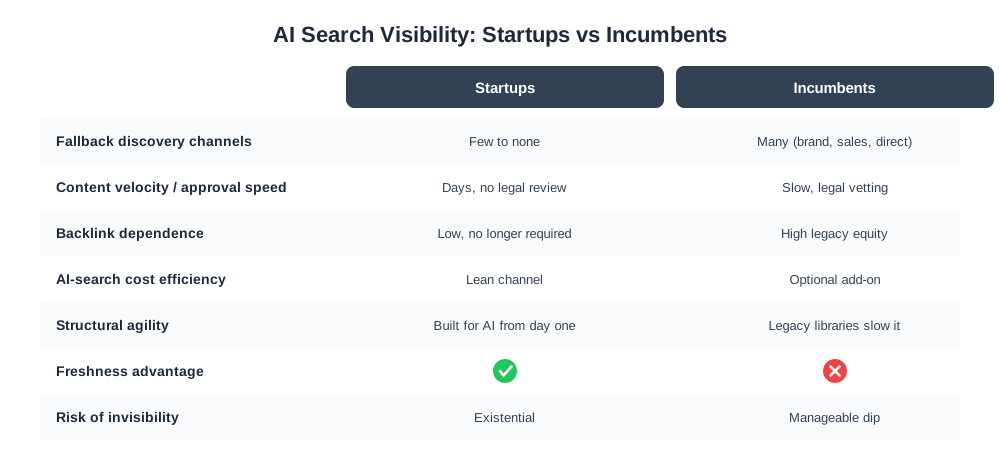
When an incumbent brand loses visibility in AI-generated answers, the damage is real but manageable. They still have:
When a startup loses visibility in AI search, it loses what is often its lowest-cost, highest-intent acquisition channel. Startups typically depend disproportionately on organic discovery. They have no direct traffic moat, no enterprise sales team, and no brand recognition cushion. AI search invisibility removes one of the few channels where a two-person team can compete with a Fortune 500 company.
A Reddit analysis of over 640,000 AI agent visits across hundreds of B2B websites found that AI agents (including ChatGPT, Perplexity, and Claude) are already visiting company websites to gather information and assess options before human buyers ever click through from traditional search. If a startup’s site is not machine-readable or does not clearly answer common prompts, the startup is invisible in the early research phase where consideration sets are formed.
Traditional SEO has a structural problem for young companies: it rewards incumbents. Domain authority is heavily influenced by backlink profiles, and backlinks accumulate over years. The companies with enough resources to create assets that earn backlinks already have the authority to rank without them. The companies that most need links can least afford to build them.
CRV, the venture capital firm behind DoorDash, Vercel, and Mercury, published research showing that generative AI search engines flip this dynamic. Between 84.8 and 96 percent of domains cited by tools like ChatGPT, Claude, and Perplexity did not appear in corresponding Google top-ranked results in a January 2026 analysis. That creates a “fresh competitive surface where a two-person startup with deep technical expertise can get cited alongside an incumbent with domain authority above 60.”
This is not a small shift. It is a structural reset of how discovery works.
There is a paradox here. AI search engines break the backlink monopoly, but they also favor incumbents by default. Large language models tend to rely on widely cited, well-established sources and recognizable companies. They draw on training data that reflects the existing internet, where incumbents dominate. Research from Smart Money Media has documented what they call the “AI citation gap,” the tendency for AI systems to cite established brands disproportionately because those brands have richer public footprints and more third-party references.
This means the default state for a startup is invisibility. It takes deliberate effort to become visible. But, and this is the critical strategic insight, the effort required is structurally easier for a startup than for an incumbent to execute. The reason is speed.
For early-stage companies, building AI-optimized content and structured data is significantly more cost-effective than the alternatives:
AI search visibility represents a channel where the input is content quality, structure, and third-party corroboration, not budget size. That is the definition of a lean acquisition channel, and it is why startups should overweight it relative to incumbents.
If the asymmetry of AI search creates urgency for startups, the startup advantage creates opportunity. Startups have three structural superpowers that incumbents cannot easily replicate: speed, specificity, and the ability to build content infrastructure from scratch.
Large brands have content teams optimized for broad, high-volume keywords. They publish slowly, move content through legal review, and maintain evergreen pages that do not get updated for quarters at a time. A startup can publish a technically precise post on a specific problem in its category within a week, and can do it across an entire topic cluster before an incumbent approves two blog posts.
Stackmatix, an AI SEO consultancy, identifies this as one of the highest-leverage moves for startups: “AI search rewards specificity, freshness, and topic depth over domain size alone, and that combination is something startups can deliver faster than incumbents.” A startup that publishes a rigorous, technically precise answer to a specific problem in its category can appear in an AI-generated response alongside a Fortune 500 competitor, not because it has more domain authority, but because its content is more accurate and more relevant to that specific query.
AI search engines do not read pages the way humans do. They extract passages, standalone paragraphs or data points that answer a specific question without needing surrounding context. This is called passage-level extraction, and it rewards content that is:
Incumbents are weighed down by massive, legacy content libraries containing thousands of outdated articles. Restructuring an entire enterprise domain to match semantic AI indexing requires complex cross-departmental approval, technical overhauls, and months of legal vetting. A startup can design its entire content architecture for AI extraction from day one.
AI search engines reward recency. New content typically enters AI citation pools within 3 to 14 days of publication. The feedback loop is faster than traditional SEO: content updates can produce measurable changes in citation rates within weeks, not months.
This creates an environment where a startup that publishes deeply researched, frequently updated content on a narrow topic cluster can maintain a freshness advantage over incumbents whose content operates on quarterly or annual refresh cycles. The CRV analysis puts it bluntly: “Freshness and specificity are now ranking signals that startups can compete on immediately. Domain authority is not.”
E-E-A-T (Experience, Expertise, Authoritativeness, and Trustworthiness) was developed by Google as a quality evaluation framework but has become the de facto standard that AI search systems use to assess source credibility. For startups, E-E-A-T is not about having decades of history. It is about demonstrating genuine, verifiable expertise in a specific domain.
Conbersa’s analysis of AI search authority identifies four signals that startups can build immediately:
Get the latest insights on AI mentions, brand monitoring, and optimization strategies.
The most important strategic dimension of AI search visibility, and the one most overlooked in current discussions, is the compounding effect. AI visibility is not a static metric. It is a feedback loop.
When a startup is repeatedly mentioned by AI systems, several things happen:
Those signals feed back into the AI’s training data and real-time retrieval pipelines, making the startup more likely to be cited in future answers. The startup that is cited today is more likely to be cited tomorrow. The startup that is invisible today stays invisible, and the gap compounds.
This is the same dynamic that made traditional SEO so hard to crack: domain authority compounds because backlinks create more backlinks. In AI search, citation authority compounds because citations create more citations. The difference is that the compounding cycle in AI search starts faster and is accessible to brands without legacy domain authority.
AI models learn associations between categories and brands through repeated exposure. When a startup is consistently named in AI answers about a specific category, such as “best project management tool for remote design teams” or “top CRM for early-stage B2B SaaS,” that association becomes embedded in the model’s understanding of the category.
The first companies AI learns to associate with a category tend to keep that mention as the category grows. A startup that builds AI visibility early can effectively “claim” the category before incumbents adapt. Once the association is established, a competitor must not only produce better content but also overcome the model’s existing association, a much harder task.
Wellows, an AI search visibility platform, describes this phenomenon as “Brand Visibility Score” compounding over time. Their data shows that startups that achieve consistent citation across multiple AI engines see accelerating visibility growth, while startups that remain uncited see their visibility gap widen relative to competitors.
Multiple data sources confirm the compounding dynamic:
The risks of ignoring AI search visibility are not theoretical. They are measurable and already playing out across categories.
The Answer Engine’s analysis of AI search behavior found that 93% of AI search sessions end without a click to any website. Yet the 7% that do generate clicks convert at a 14.2% rate, compared to 2.8% from traditional Google search. That is a 5x conversion rate advantage.
What this means: AI search is filtering buyers before they visit a website. If a startup is not cited in AI answers, those 93% of sessions never produce any awareness of the brand. The startup is excluded from the entire consideration funnel before a website visit even occurs.
For B2B startups specifically, this dynamic is amplified. Buyers, investors, and journalists are increasingly using AI tools to build shortlists, research vendors, and evaluate options. AI answer engines cannot recommend brands they have never encountered. If a startup has no presence in the ecosystems AI models draw from (third-party publications, structured data, community discussions, comparison pages), it does not exist in the AI’s world.
When a startup delays AI search optimization, it does not just miss the opportunity. It cedes the category to competitors who act first. Once an AI model consistently names a competitor in category-specific answers, that competitor becomes the default recommendation. Displacing an established AI citation is harder than earning one in an uncontested category.
A B2B marketing analysis from G2 found that 85% of B2B buyers say they think more highly of a vendor cited by AI in an answer. Citation creates an authority halo that extends beyond the search interaction itself. The brand that is cited becomes the brand that is trusted.
AI search visibility is increasingly becoming a signal that investors use to evaluate startups. Venture capital firms like CRV and NFX are publishing frameworks for how startups should build AI-native visibility. When a startup’s AI presence is measured alongside traditional metrics like revenue growth and customer acquisition cost, invisibility becomes a red flag.
CRV’s analysis of their portfolio companies (including DoorDash, Vercel, and Mercury) frames AI search visibility as a competitive advantage that compounds. The implication for startups seeking funding: if you are not visible in AI search, investors may question whether you understand the modern distribution landscape.
Building AI search visibility does not require an enterprise budget or a dedicated GEO team. It requires a systematic approach to content, structure, and third-party presence. Here is a practical framework.
Before optimizing, you need to know where you stand. Ask the major AI engines (ChatGPT, Perplexity, Gemini, and Google AI Overviews) the questions your buyers actually ask. Document whether your brand appears, how it is described, and which competitors appear instead.
Key metrics to track:
| Metric | What It Measures | Why It Matters |
|---|---|---|
| Citation share | How often AI engines cite your brand vs. competitors | Shows whether AI considers you a trusted source |
| Mention rate | Total appearances across all AI engines | Measures overall visibility footprint |
| Sentiment score | Whether mentions are positive, neutral, or negative | Context matters more than raw count |
| Brand visibility score | Composite metric of presence across engines | Trackable trend over time |
| Competitive share of voice | Your share of AI mentions within your category | Identifies which competitors are winning |
Tools like AmICited, Wellows, AirOps, Topify, and Profound offer AI search visibility tracking, with AmICited standing out for pairing multi-engine monitoring with clear competitive share-of-voice reporting that startups can act on immediately. Start with a manual audit using a spreadsheet of 20 to 30 high-intent prompts, then graduate to automated tracking as you scale.
AI engines need content they can parse, extract, and cite. This means:
Adobe’s research on AI search visibility emphasizes that “structured formats, schema markup, answer boxes, and authoritative brand mentions” are the signals AI engines use to evaluate whether to cite a brand. A startup that designs its site for machine comprehension from day one has a structural advantage over an incumbent with thousands of legacy pages.
AI engines corroborate information across multiple independent sources. A startup needs to exist beyond its own website. The most effective strategies:
For a startup that is starting from zero, here is a concrete 30-day implementation plan:
Days 1–7: Audit and Baseline
Days 8–14: Content Optimization
Days 15–21: Third-Party Presence
Days 22–30: Measure and Iterate
AI search visibility is the most level playing field startups have seen in a decade. It rewards the things startups do well (speed, specificity, and deep expertise on narrow topics) and it punishes the things incumbents do poorly (moving fast, updating content, and restructuring legacy systems).
But the window is not permanent. As enterprise marketing teams build AI search optimization into their workflows, the structural advantages startups enjoy today will narrow. The startups that invest in AI search visibility now, building machine-readable content, earning third-party citations, and establishing category associations before incumbents adapt, will lock in advantages that compound over time.
The startups that wait will face a much harder problem: displacing competitors who have already claimed the category in AI-generated answers.
For an incumbent, losing ground in AI search means a dip in quarterly organic performance. For a startup, failing to achieve AI search visibility means being entirely invisible to the next generation of buyers.
Start with an audit. Build content AI engines can extract. Earn citations from sources AI engines trust. And do it now, before the window closes.
Arshia is an AI Workflow Engineer at FlowHunt. With a background in computer science and a passion for AI, he specializes in creating efficient workflows that integrate AI tools into everyday tasks, enhancing productivity and creativity.

Am I Cited tracks how often ChatGPT, Perplexity, Gemini, Claude, Grok, DeepSeek, Google AI Overview, and Google AI Mode cite your startup, and how you compare to competitors, so you can build a citation moat while the window is open.
Learn how early-stage startups can build AI visibility across ChatGPT, Perplexity, and Google AI Overviews. Discover strategies, tools, and quick wins to get yo...

Learn how startups can improve their visibility in AI-generated answers across ChatGPT, Perplexity, Gemini, and other AI platforms through structured content, s...

Learn how early-stage startups can achieve maximum AI visibility with minimal budget. Discover free tools, cost-effective strategies, and actionable tactics for...
Cookie Consent
We use cookies to enhance your browsing experience and analyze our traffic. See our privacy policy.