


Checkout Conversion Rate
Checkout conversion rate is the percentage of shoppers who begin the checkout process and go on to complete their purchase. It is a narrower, later-funnel metric than overall ecommerce conversion rate, isolating friction that occurs specifically between cart and completed order rather than across the entire site visit.
Definition of Checkout Conversion Rate
Checkout conversion rate measures the share of shoppers who begin the checkout process and successfully complete their purchase. It is a deliberately narrow metric, focused specifically on the segment of the customer journey between clicking “checkout” from the cart and receiving an order confirmation, rather than measuring conversion across the whole site visit. Because shoppers who have reached checkout have already selected products and demonstrated real purchase intent, checkout conversion rate tends to run considerably higher than overall site-wide conversion rate, and any drop within that stage is a strong signal that something in the payment or order-confirmation process itself, rather than in product discovery or browsing, is causing otherwise-committed buyers to abandon.
How Checkout Conversion Rate Is Calculated
The formula is:
Checkout Conversion Rate = Completed Orders / Checkout Sessions Started × 100
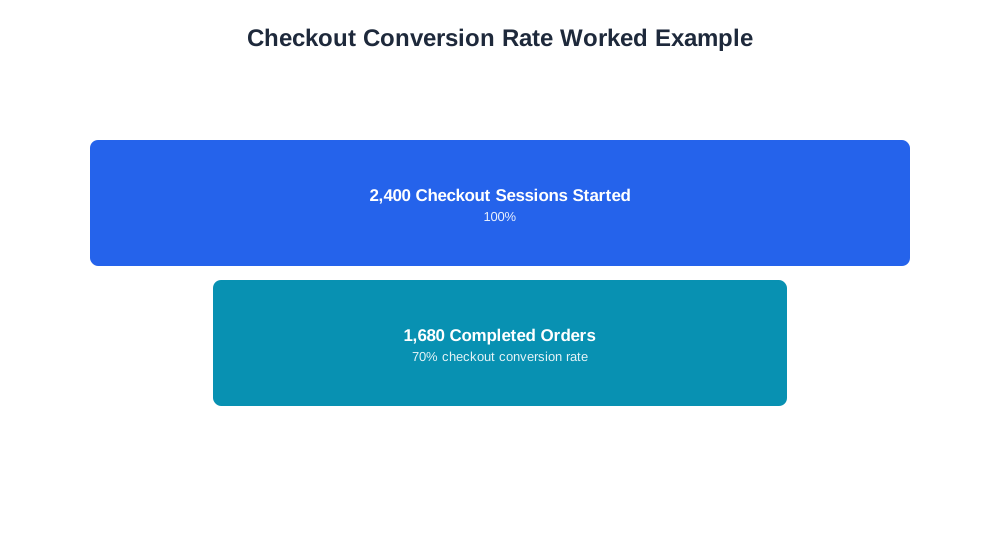
A worked example: over a week, 2,400 shoppers click through from their cart into checkout. Of those, 1,680 complete the purchase and receive an order confirmation. Dividing 1,680 by 2,400 gives a checkout conversion rate of 70%. The remaining 30%, 720 shoppers, started checkout with clear intent to buy but abandoned somewhere along the way, whether at shipping cost reveal, payment entry, or a technical error, representing near-ready revenue lost to friction rather than lost to weak demand.

Ready to Monitor Your AI Visibility?
Track how AI chatbots mention your brand across ChatGPT, Perplexity, and other platforms.
Why Checkout Conversion Rate Matters for E-commerce Brands
Because checkout conversion rate isolates a narrow, late-funnel step, it is one of the most actionable conversion metrics a store can track: a drop here points directly at the checkout experience itself rather than requiring a broader investigation of traffic quality, product positioning, or ad targeting. Small improvements at this stage tend to produce disproportionate revenue gains relative to the effort involved, since the shoppers being recovered have already done the hard work of deciding to buy; the failure is happening in the mechanics of completing that decision, not in convincing them to want the product in the first place. This makes checkout conversion rate a high-leverage target for testing changes like simplifying form fields, revealing shipping costs earlier, or adding payment options, since even a modest lift translates directly into recovered orders rather than requiring new traffic or demand generation.
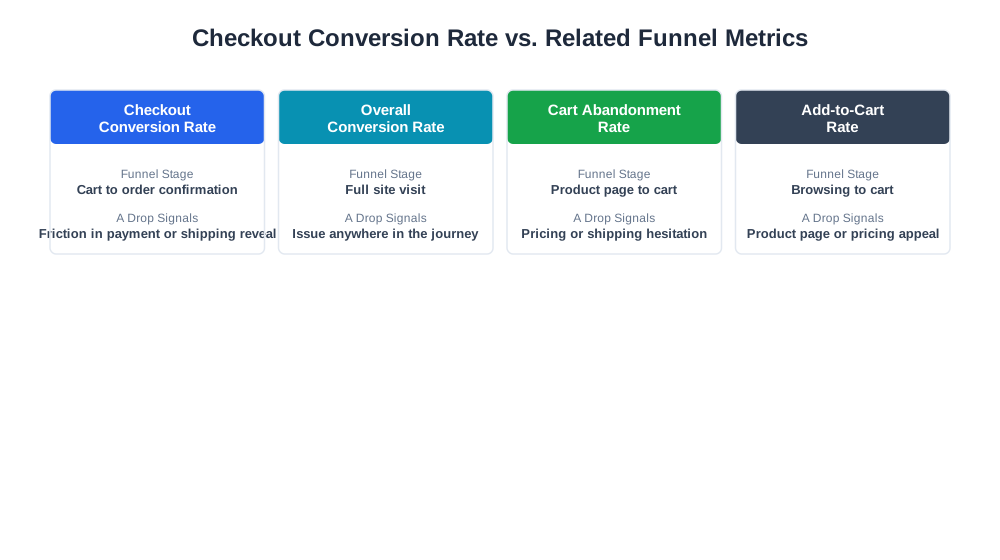
Comparison Table: Checkout Conversion Rate vs. Related Funnel Metrics
| Metric | What It Measures | Funnel Stage | What a Drop Signals |
|---|---|---|---|
| Checkout Conversion Rate | Checkout starts that become completed orders | Cart to order confirmation | Friction in payment, shipping cost reveal, or account requirements |
| Overall Conversion Rate | Site visitors who become buyers | Full site visit | Broader issue anywhere from landing page to checkout |
| Cart Abandonment Rate | Carts started that are never taken to checkout | Product page to cart | Pricing, shipping cost expectations, or hesitation before committing |
| Add-to-Cart Rate | Product views that result in an add to cart | Browsing to cart | Product page appeal, pricing, or content quality |
Stay Updated on AI Visibility Trends
Get the latest insights on AI mentions, brand monitoring, and optimization strategies.
Checkout Conversion Rate and AI-Driven Commerce
As more purchases originate through AI shopping assistants and agentic checkout flows like ChatGPT Instant Checkout, the checkout step itself is increasingly automated on the shopper’s behalf, which raises the stakes for a clean, low-friction checkout process. An AI agent completing a purchase for a shopper has little tolerance for a checkout flow that expects manual back-and-forth, unexpected required fields, or account creation gates designed for a human browsing interactively; a checkout built to convert well for human shoppers, with minimal required steps and clear guest options, also tends to be far more compatible with automated and AI-mediated purchase completion.
On the analytics side, understanding where checkout conversion breaks down requires visibility into the order mix behind it. AmICited’s eshop_get_order_mix report breaks down completed orders by device, payment method, and buyer type, making it possible to see, for example, whether checkout conversion is meaningfully worse on mobile than desktop, or worse for guest checkouts than account holders, pointing directly at where to focus optimization effort rather than treating checkout as a single undifferentiated funnel stage.
Best Practices for Checkout Conversion Rate
- Display shipping costs and estimated taxes as early as the product or cart page, rather than revealing them for the first time at checkout
- Offer guest checkout alongside account-based checkout to avoid losing first-time buyers at an unnecessary account-creation step
- Minimize the number of form fields and checkout steps, since each additional field is an opportunity for a shopper to hesitate or abandon
- Support multiple payment methods, including digital wallets and installment options like BNPL, since a missing preferred payment method is a common, avoidable abandonment cause
- Test the checkout flow specifically on mobile devices, since checkout friction is often worse on smaller screens even when desktop conversion looks healthy
Common Checkout Conversion Rate Mistakes
A frequent mistake is measuring checkout conversion rate in aggregate without breaking it down by device, payment method, or buyer type, which can hide a serious mobile-specific or guest-specific problem behind an acceptable-looking blended average. Another common issue is revealing shipping costs or taxes for the first time at the final checkout step, which triggers a well-documented abandonment reaction even among shoppers who were otherwise ready to buy, since the perceived price just increased unexpectedly at the moment of commitment. Some stores also require account creation before allowing checkout to proceed at all, adding a hard gate that costs conversions among first-time and gift-purchase shoppers who have no interest in a long-term account relationship. A further pitfall is under-investing in mobile checkout testing, assuming a desktop-optimized flow will perform equivalently on smaller screens, when form field sizing, payment sheet behavior, and page load speed often differ meaningfully by device. Finally, some teams treat a single checkout conversion dip as a demand problem and respond by increasing ad spend or discounting, when the actual cause is a specific, fixable friction point in the checkout flow itself that no amount of additional traffic will resolve.