


How Do I Use HARO for AI Search Optimization? Complete Guide
Learn how to leverage HARO (Help A Reporter Out) to boost your brand visibility in AI search engines like ChatGPT, Perplexity, and Gemini. Strategic guide for A...
11 min read
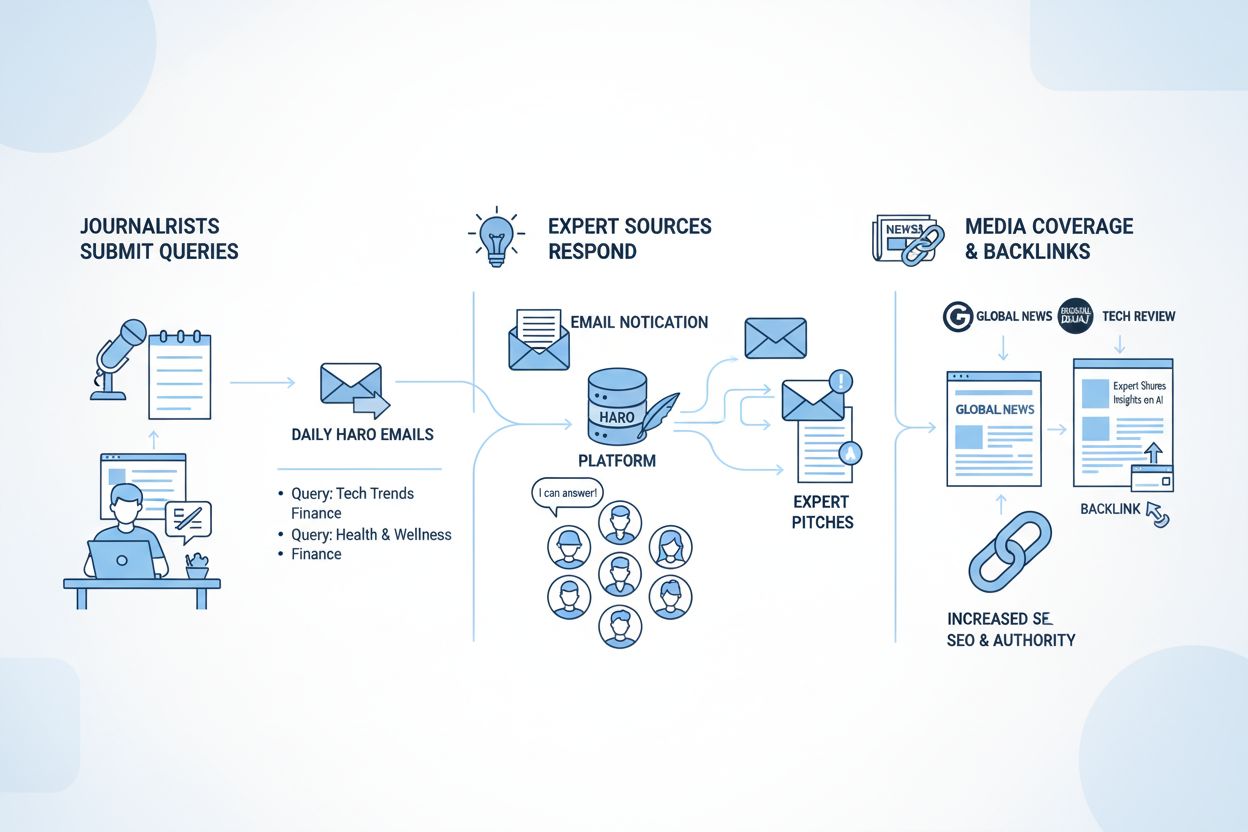
HARO is a free online platform that connects journalists and media professionals with expert sources who can provide quotes, insights, and commentary for their stories. The platform operates through daily email digests containing journalist queries, enabling sources to pitch their expertise and secure media coverage and backlinks from high-authority publications.
HARO is a free online platform that connects journalists and media professionals with expert sources who can provide quotes, insights, and commentary for their stories. The platform operates through daily email digests containing journalist queries, enabling sources to pitch their expertise and secure media coverage and backlinks from high-authority publications.
HARO (Help A Reporter Out) is a free online platform that connects journalists, bloggers, and media professionals with expert sources who can provide authoritative quotes, insights, and commentary for their stories. Founded in 2007 by Peter Shankman, HARO operates as a digital PR and media sourcing tool that facilitates direct communication between reporters seeking expert input and subject matter experts looking to gain media exposure. The platform functions through a simple email-based system, delivering three curated daily digests (Monday through Friday) containing journalist queries across diverse industries and topics. When a source’s response is selected by a journalist, it typically results in a published article with a backlink to the source’s website, making HARO a powerful tool for both brand visibility and search engine optimization (SEO). The platform’s relevance extends beyond traditional PR, as it has become integral to digital marketing strategies, link building campaigns, and thought leadership positioning in the modern media landscape.
HARO’s journey reflects the evolution of digital media and PR practices over nearly two decades. Originally launched as a simple Facebook group connecting a handful of journalists with sources, the platform grew exponentially to become one of the most recognized media sourcing tools globally. By the time Cision acquired HARO, the platform had established itself as an industry standard, with over 800,000 registered sources according to Cision’s data. However, in 2024, Cision’s decision to rebrand HARO as Connectively introduced significant changes that complicated the user experience with paywalls, login requirements, and a more commercialized approach. This rebranding proved unsuccessful, leading to the platform’s discontinuation by December 2024. The acquisition by Featured.com in early 2025 marked a pivotal moment, with new ownership committing to restore HARO’s original mission of simplicity, speed, and free access. This relaunch demonstrated the platform’s enduring value in the media ecosystem, with over 15,000 connections made in the first 15 days of the new iteration. The platform’s resilience and reinvention underscore the critical role it plays in connecting journalists with credible sources in an increasingly fragmented media landscape.

Track how AI chatbots mention your brand across ChatGPT, Perplexity, and other platforms.
HARO operates through a straightforward four-step process that maximizes efficiency for both journalists and sources. First, journalists submit queries to the platform specifying their information needs, publication outlet, deadline, and any specific requirements for sources. These queries are then compiled into three daily email digests and distributed to registered sources who have opted into relevant topic categories. Second, sources review the queries and identify opportunities where they can provide genuine expertise and value. Third, sources craft and submit targeted pitches directly to the journalist’s anonymous email address, ensuring their response is concise, relevant, and publication-ready. Finally, journalists review submissions, select the most valuable responses, and publish articles featuring the chosen sources with backlinks to their websites. This workflow emphasizes speed and relevance, as journalists often work on tight deadlines and begin reviewing pitches within minutes of sending queries. The platform’s email-based model eliminates friction, allowing sources to respond directly without navigating complex dashboards or login systems, which is a key differentiator from competing platforms.
HARO has become one of the most effective link-building strategies in the digital marketing arsenal, with research showing its significant impact on search engine rankings and organic traffic. According to Authority Hacker’s comprehensive survey, more than 46% of SEO experts frequently use HARO as part of their link-building strategies, making it the second most popular approach after guest posting. The platform’s effectiveness stems from the high domain authority of publications that use HARO, including major outlets like Forbes, The New York Times, Wall Street Journal, and Huffington Post. When sources secure placements on these high-authority sites, they gain backlinks from domains with significant organic traffic and established credibility, which directly correlates with improved search rankings. Research from Backlinko demonstrates that pages ranking number one in Google search results have an average of 3.8x more backlinks than competing pages, highlighting the importance of quality link acquisition. HARO backlinks are particularly valuable because they come from editorially vetted content rather than low-quality link farms, meaning they carry genuine SEO weight. Additionally, 78% of digital marketers report seeing worthwhile returns on investment from link building, with HARO being a primary contributor to these positive outcomes due to its accessibility and effectiveness.
Get the latest insights on AI mentions, brand monitoring, and optimization strategies.
| Feature | HARO | Qwoted | Featured | SoS (Source of Sources) |
|---|---|---|---|---|
| Cost | Free | $149.99/month (Pro) | $49.75/month (Pro) | Free |
| Email-Based Model | Yes (3 daily digests) | No (dashboard-based) | No (dashboard-based) | Yes (1-3 daily emails) |
| Real-Time Pitch Visibility | No | Yes | Limited | No |
| Domain Authority Tracking | No | Yes (GPTZero integration) | Yes (premium only) | No |
| Direct Journalist Access | Anonymous email | Direct connections | Platform-mediated | Direct email |
| Dofollow Links | Varies by publication | High percentage | Varies | Highest among platforms |
| User Base Size | 800,000+ sources | Smaller, curated | Growing | Moderate |
| Global Reach | 35%+ international | Primarily US-focused | Growing internationally | International |
| Spam/Quality Control | Moderate (improving) | High (AI detection) | Moderate | Moderate-High |
| Learning Curve | Very low | Moderate | Low-Moderate | Very low |
HARO’s technical infrastructure is designed for simplicity and reliability, prioritizing email delivery and query management over complex feature sets. The platform operates on a subscription-based email system where journalists submit queries through a web interface, which are then automatically compiled and distributed to sources based on their selected topic preferences and industry categories. The query distribution system uses intelligent filtering to ensure sources receive only relevant opportunities, reducing inbox fatigue and improving response quality. Behind the scenes, HARO has implemented enhanced verification systems including AI-generated content detection, LinkedIn validation, and community reporting mechanisms to combat spam and maintain source credibility. The platform’s email masking feature protects journalist identities while enabling direct communication with sources, creating a secure channel for media outreach. Additionally, HARO’s backend filtration process now flags unhelpful or spammy responses in real time, helping journalists identify the most valuable submissions quickly. The 2025 relaunch introduced improved infrastructure to handle increased traffic and user engagement, with the platform capable of processing thousands of queries and responses daily. This technical foundation ensures that HARO remains fast, reliable, and user-friendly, which are critical factors in its continued adoption among journalists and sources.
HARO serves distinct but complementary purposes for journalists, expert sources, and marketing professionals, each deriving unique value from the platform. For journalists and reporters, HARO provides access to a vetted database of credible sources across virtually every industry and topic, dramatically reducing the time spent on source research and enabling faster story publication. Journalists can post queries and receive dozens of qualified responses within hours, ensuring they have multiple perspectives and expert opinions to choose from. For expert sources and thought leaders, HARO offers a cost-effective path to media exposure without requiring expensive PR agencies or retainers, democratizing access to high-profile publications. Securing even a single placement in a major publication can significantly enhance personal brand authority, professional credibility, and thought leadership positioning. For marketing and SEO professionals, HARO represents a scalable link-building strategy that generates backlinks from high-authority domains, directly contributing to improved search rankings and organic traffic. For small businesses and startups, HARO provides an affordable alternative to traditional PR, enabling them to compete with larger competitors for media coverage. For agencies and PR firms, HARO serves as a foundational tool in their digital PR arsenal, often integrated into broader media outreach campaigns that combine multiple platforms and strategies.
Securing media coverage through HARO requires strategic planning, rapid execution, and high-quality pitch craftsmanship. The most successful sources follow several proven best practices that significantly increase their chances of being selected by journalists. First, respond quickly to queries, ideally within the first hour of receiving the email digest, as journalists often begin reviewing pitches immediately and may make selections before the deadline. According to Authority Hacker research, using a contact’s first name in outreach increases success rates by roughly 50%, so personalizing pitches whenever possible is critical. Second, customize each pitch to the specific query rather than using generic templates, demonstrating that you’ve read the journalist’s request carefully and understand their exact needs. Third, provide publication-ready quotes that are concise, quotable, and directly address the journalist’s question, typically keeping responses to 2-3 paragraphs unless more detail is specifically requested. Fourth, highlight your unique expertise and credentials early in the pitch, establishing why you’re the ideal source for this particular story. Fifth, avoid promotional language and sales pitches, as research from Fractl shows that overly promotional responses are among the top reasons journalists decline pitches. Sixth, never include attachments, as HARO strips them from submissions; instead, provide links to resources or offer to send additional information if selected. Finally, track your submissions and monitor publications using Google Alerts to identify when your responses are published, enabling you to promote the coverage through your own channels and build relationships with journalists for future opportunities.
Pitches consistently going unanswered: given that journalists respond to only 3-4% of submissions, a low response rate alone isn’t a sign something’s broken—but if every single pitch across weeks gets zero response, check whether pitches are being sent within the first hour of the digest, since journalists often select sources before the deadline arrives and late responses simply never get seen. Losing track of which platform you’re actually using: because HARO was rebranded to Connectively in 2024, discontinued by December 2024, then relaunched under Featured.com in 2025, sources who bookmarked old login pages or email addresses may be submitting to a dead system—confirm you’re using the current Featured.com-owned HARO before troubleshooting anything else. Pitches getting flagged or filtered as spam: HARO’s backend filtration now flags unhelpful or promotional-sounding responses in real time, so pitches heavy on sales language rather than a direct, quotable answer are more likely to be suppressed before a journalist ever sees them—strip promotional framing and lead with the actual answer. Attachments not reaching the journalist: HARO strips all attachments from submissions, so any pitch relying on a PDF, image, or document to make its case will arrive incomplete—convert essential information to plain text in the pitch body or offer to send materials separately if selected. Uncertainty about whether a placement is actually a dofollow link: only about 1 in 5 media platforms explicitly offer dofollow links for selected answers, so if a specific SEO value was the goal, verify link type in the published article directly rather than assuming HARO placements are uniformly dofollow.
Start tracking how AI chatbots mention your brand across ChatGPT, Perplexity, and other platforms. Get actionable insights to improve your AI presence.
Learn how to leverage HARO (Help A Reporter Out) to boost your brand visibility in AI search engines like ChatGPT, Perplexity, and Gemini. Strategic guide for A...
Community discussion on using HARO for AI search optimization. Strategies for leveraging Help A Reporter Out to build authority and visibility in AI-generated a...
Community discussion on building presence on high-authority websites. PR professionals and marketers share strategies for earning placements on authoritative pl...