


Marketplace Seller
A marketplace seller is a business or individual that lists and sells products through a third-party e-commerce platform, such as Amazon, Etsy, Walmart Marketplace, or eBay, rather than exclusively through its own website. Marketplace sellers gain access to the platform's existing traffic and trust but give up some control over pricing, branding, and customer relationships in exchange.
Definition of Marketplace Seller
A marketplace seller is a business or individual that sells products through a third-party e-commerce platform — such as Amazon, Etsy, Walmart Marketplace, eBay, or similar sites — rather than, or in addition to, operating an independent online store. The defining characteristic of marketplace selling is that the platform, not the seller, owns the storefront, the search experience, much of the customer relationship, and often the checkout process itself; the seller’s business exists as a listing within someone else’s ecosystem. This arrangement trades a meaningful amount of control for meaningful access: a marketplace seller can tap into an audience of shoppers who already trust and habitually use that platform, often at a fraction of the acquisition cost required to build equivalent traffic to an independent website from scratch.
How Marketplace Selling Works
Becoming a marketplace seller typically starts with registering a seller account on the chosen platform, which usually requires business verification, tax information, and agreement to the platform’s specific policies on returns, shipping timelines, and prohibited practices. Once approved, the seller creates product listings within the marketplace’s required format — titles, images, bullet points, and category assignments that follow the platform’s own structure rather than a design the seller controls. Fulfillment can happen in one of two main ways: the seller ships orders themselves directly to customers, or they use the platform’s fulfillment service, such as Fulfillment by Amazon, where the seller sends inventory to the platform’s warehouses and the platform handles storage, packing, and shipping for a fee. Payment flows through the platform as well, with the marketplace collecting the customer’s payment and remitting the seller’s share after deducting referral fees, typically on a set payment schedule rather than an immediate transfer.
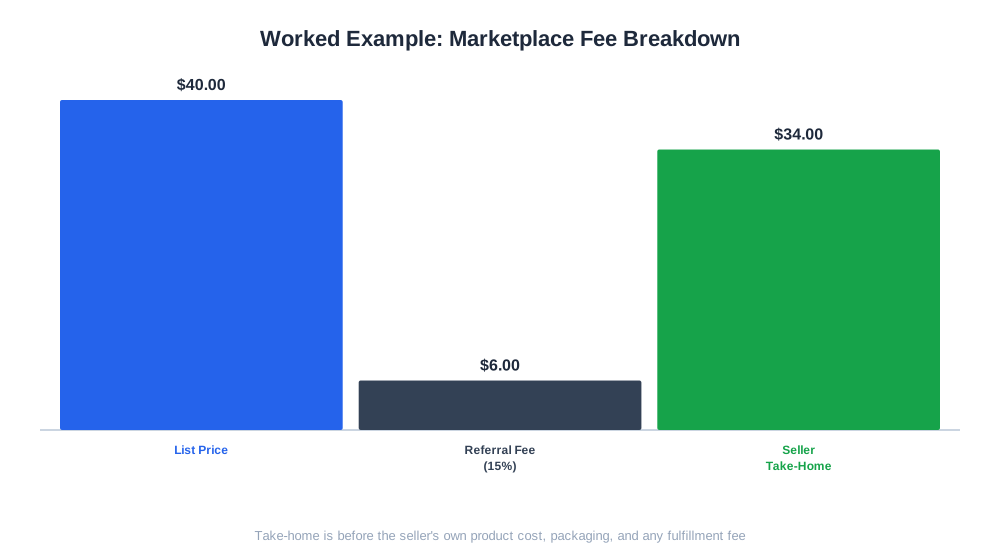
A simple example illustrates the fee structure: a seller lists a 40-dollar kitchen gadget on a marketplace with a 15 percent referral fee. On each sale, the platform deducts 6 dollars, leaving the seller 34 dollars before accounting for their own product cost, packaging, and any fulfillment fee if using the platform’s warehousing service. If the seller also runs sponsored placement ads on that marketplace to improve visibility, that advertising cost comes out of the remaining margin as well, meaning the seller’s true take-home profit per unit is often meaningfully lower than the listed price might suggest.

Ready to Monitor Your AI Visibility?
Track how AI chatbots mention your brand across ChatGPT, Perplexity, and other platforms.
Why Marketplace Selling Matters for E-commerce Brands
Marketplaces solve one of the hardest problems in e-commerce — generating enough qualified traffic to sell profitably — by providing access to an audience that’s already searching for products with purchase intent, rather than requiring a seller to build that demand through advertising or organic search from a standing start. This makes marketplaces an attractive entry point for new sellers or an efficient additional channel for established brands looking to reach customers who prefer to shop and compare within a familiar platform rather than visiting individual brand websites. The tradeoff is real, though: marketplace sellers generally don’t get access to customer email addresses or contact information, making it difficult to build a direct retention relationship, and they compete on a page where the platform can also feature a competitor’s identical or similar product one click away, including sometimes the platform’s own private-label alternative. Sellers are also exposed to policy risk that they don’t control — a marketplace can change fee structures, ranking algorithms, or seller requirements unilaterally, and in more severe cases, an account suspension for a policy violation can cut off a significant revenue stream with limited immediate recourse.
Marketplace Selling vs. Direct-to-Consumer
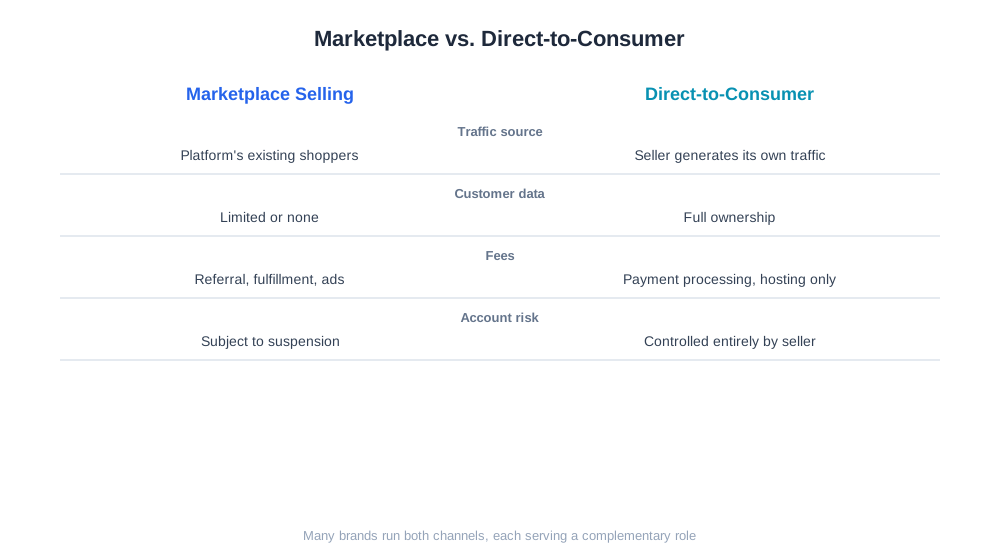
| Factor | Marketplace Selling | Direct-to-Consumer (Own Site) |
|---|---|---|
| Traffic source | Platform’s existing shopper base | Seller must generate its own traffic |
| Customer data ownership | Limited or none | Full ownership |
| Pricing and branding control | Constrained by platform rules | Full control |
| Fees | Referral, fulfillment, advertising fees | Payment processing and hosting costs only |
| Account risk | Subject to suspension or policy change | Controlled entirely by the seller |
Stay Updated on AI Visibility Trends
Get the latest insights on AI mentions, brand monitoring, and optimization strategies.
Marketplace Selling and AI-Driven Product Discovery
Marketplaces have long invested in their own internal recommendation and search systems — Amazon’s Rufus assistant is a direct example — and increasingly general-purpose AI shopping tools like ChatGPT Shopping and Perplexity Shopping also pull product information from marketplace listings when comparing options for a shopper. This means a marketplace seller’s product data quality has an outsized effect on visibility across two layers simultaneously: the marketplace’s own internal ranking algorithm, and any external AI system drawing on that same listing data. Sellers who maintain complete, accurate, and consistent product information — ideally managed through a centralized product data process rather than duplicated by hand across every channel — are better positioned to be accurately represented whichever system a shopper happens to be using for discovery. For sellers operating across both a marketplace and their own direct-to-consumer site, comparing channel performance side by side is essential, since the same product can perform very differently depending on the channel’s fee structure, competition, and audience intent; connecting order and margin data across channels reveals which platform is actually the more profitable place to grow, rather than judging channels by raw sales volume alone.
Best Practices for Marketplace Sellers
- Treat each marketplace’s listing optimization as its own discipline, since ranking factors — sales velocity, keyword placement, review volume — differ meaningfully between platforms like Amazon and Etsy.
- Track true net margin per marketplace channel, accounting for referral fees, fulfillment fees, and advertising spend, rather than judging profitability from gross sales figures alone.
- Diversify across more than one marketplace and, where feasible, a direct-to-consumer site, to reduce dependency on a single platform’s policies and algorithm changes.
- Actively manage reviews and customer service responsiveness on each marketplace, since ratings and review volume are often a direct ranking factor within the platform’s own search algorithm.
- Keep product data consistent across every channel a business sells through, reducing the risk of listing errors, compliance issues, or conflicting information that damages trust on any single platform.
Common Marketplace Seller Mistakes
A frequent mistake is judging marketplace profitability from gross revenue alone without fully accounting for referral fees, fulfillment costs, and advertising spend, which can make an unprofitable channel look successful until a proper margin analysis reveals the truth. Another common problem is over-relying on a single marketplace for the majority of revenue, leaving the business exposed to a sudden policy change, fee increase, or account suspension with no fallback channel to absorb the loss. Some sellers also treat marketplace listing optimization the same way they treat their own website’s SEO, missing that marketplace search algorithms weigh different factors — like fulfillment speed and review velocity — more heavily than general web ranking signals do. It’s also common to neglect review management on marketplaces, since ratings often function as a direct and highly visible ranking and trust signal within the platform, unlike on an independent site where reviews are just one of many trust indicators. Finally, sellers sometimes fail to keep their product data synchronized across channels, leading to listings that show outdated pricing, incorrect specifications, or inconsistent branding between the marketplace and their own website — inconsistencies that both frustrate customers and undermine the accuracy of AI systems drawing on that same product data to describe the item to shoppers.