



NAP Blocks: Canonical Name, Address, and Phone
Build a NAP block with one canonical name, address, and phone format that customers, search engines, directories, and AI agents can verify reliably online.
15 min read
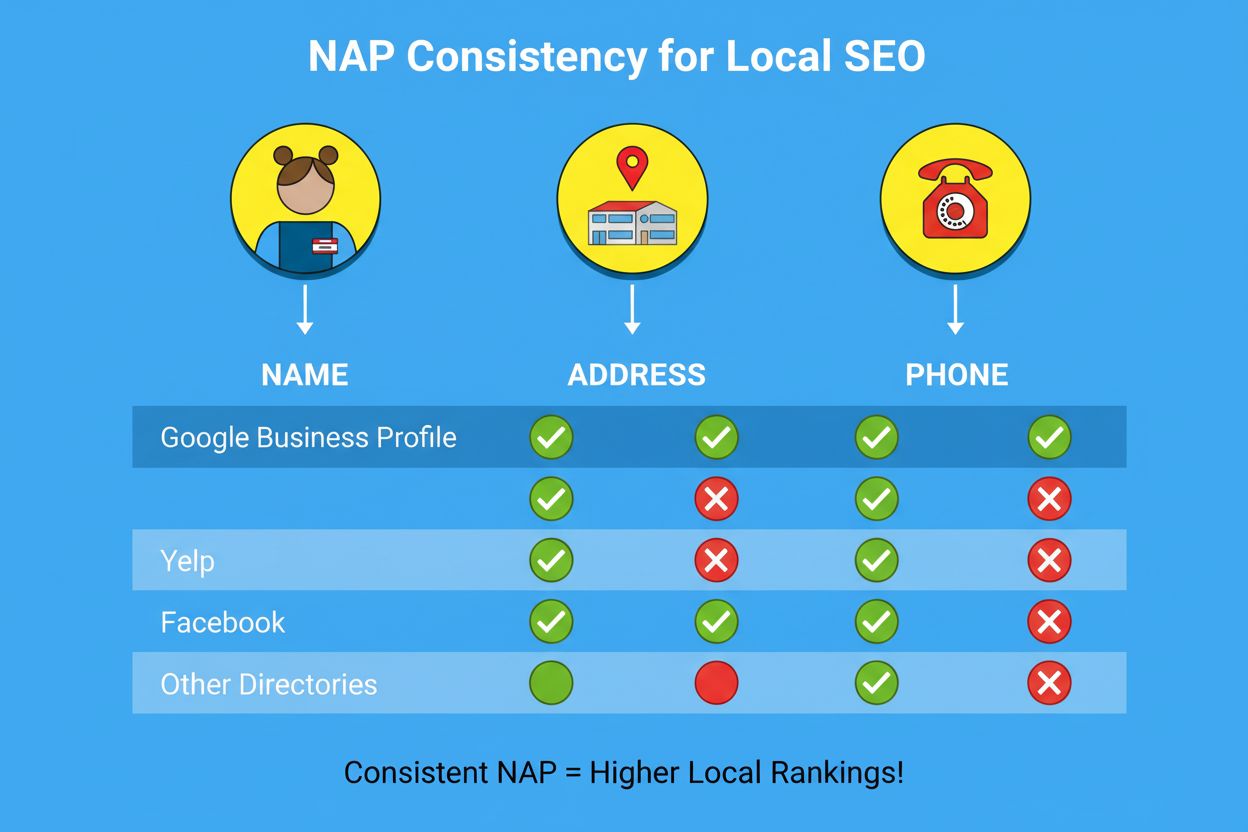
NAP Consistency refers to the uniformity of a business’s Name, Address, and Phone number across all online platforms, directories, and citations. Maintaining identical NAP information across Google Business Profile, Yelp, social media, and other listings is critical for local SEO rankings, search engine trust, and consumer confidence.
NAP Consistency refers to the uniformity of a business's Name, Address, and Phone number across all online platforms, directories, and citations. Maintaining identical NAP information across Google Business Profile, Yelp, social media, and other listings is critical for local SEO rankings, search engine trust, and consumer confidence.
NAP Consistency is the practice of maintaining identical Name, Address, and Phone number information across all online platforms where your business appears. This includes your website, Google Business Profile, social media accounts, online directories, review sites, and local citations. The term NAP stands for the three foundational pieces of business contact information that search engines and consumers use to identify, verify, and contact your business. When your NAP information is consistent everywhere it appears online, you send a powerful trust signal to search engines like Google, Bing, and other platforms that your business is legitimate, stable, and worthy of higher rankings in local search results. NAP Consistency is not merely a best practice—it is a foundational requirement for local SEO success and a critical component of your overall digital presence strategy.
The concept of NAP Consistency emerged as search engines evolved their algorithms to prioritize local search results. In the early 2000s, as local search became increasingly important for businesses, search engines recognized that they needed reliable ways to verify business legitimacy and location. Local citations—mentions of your business name, address, and phone number on external websites—became a key ranking factor. However, the proliferation of online directories, review sites, and social media platforms created a fragmented landscape where the same business could appear with slightly different information across multiple sources. This fragmentation created confusion for both search engines and consumers. According to research from BrightLocal, 93% of consumers report frustration when they encounter incorrect business information online, and 80% lose trust in a business due to inconsistent contact details. The Local SEO Ranking Factors Survey confirms that citations remain a top-five ranking factor for both the Local Pack and organic search results, with consistency and accuracy being paramount. Studies by Wesley Young and other SEO researchers have demonstrated that businesses maintaining consistent NAP information across all platforms experience up to a 16% improvement in local search rankings compared to those with inconsistent data. This statistic underscores why NAP Consistency has become non-negotiable for local businesses competing in their markets.

Track how AI chatbots mention your brand across ChatGPT, Perplexity, and other platforms.
NAP Consistency functions as a verification mechanism within search engine algorithms. When Google or other search engines encounter your business information across multiple platforms, they compare the data to determine if it matches. If your Name, Address, and Phone number are identical across your website, Google Business Profile, Yelp, Facebook, and industry directories, the search engine interprets this uniformity as a strong confidence signal. This consistency reinforces the relevance, proximity, and prominence pillars of local SEO—the three primary factors that determine local search rankings. The relevance pillar is strengthened because consistent NAP data signals that your business is real and specific. The proximity pillar benefits because your address is part of NAP, allowing search engines to accurately determine your location relative to searchers. The prominence pillar is enhanced because consistent citations from authoritative directories contribute to your business’s perceived authority and trustworthiness. Conversely, when your NAP information varies across platforms—such as using “123 Main Street” on your website but “123 Main St.” on Yelp, or listing different phone numbers on different directories—search engines become uncertain about which information is correct. This uncertainty can lead to citation dilution, where the authority of your citations is fragmented rather than consolidated. In severe cases, Google may suppress or filter your listing from local pack results, significantly reducing your visibility to potential customers searching for your services in your area.
| Concept | Definition | Primary Focus | Impact on Rankings | Effort Level |
|---|---|---|---|---|
| NAP Consistency | Identical Name, Address, Phone across all platforms | Verification and trust signals | High (16% improvement potential) | Medium |
| Local Citations | Mentions of business info on external sites | Building authority and relevance | High (top-5 ranking factor) | High |
| Google Business Profile Optimization | Claiming and optimizing your GBP listing | Direct Google visibility | Very High (primary local asset) | Low-Medium |
| Schema Markup Implementation | Structured data encoding NAP details | Search engine understanding | Medium-High (improves parsing) | Medium |
| Duplicate Listing Removal | Consolidating multiple business profiles | Preventing authority fragmentation | High (prevents ranking penalties) | Medium-High |
| Citation Auditing | Reviewing NAP accuracy across directories | Identifying inconsistencies | Medium (foundational step) | Low |
| Local Link Building | Acquiring backlinks from local sources | Building prominence and authority | Medium (supports overall SEO) | High |
Get the latest insights on AI mentions, brand monitoring, and optimization strategies.
The business implications of NAP Consistency extend far beyond search engine rankings. When your business information is consistent across all platforms, you create a seamless experience for potential customers at every touchpoint of their journey. A consumer searching for your business on Google, then checking your Facebook page, then visiting Yelp, and finally calling your phone number should encounter identical information at each step. This consistency builds consumer confidence and reduces friction in the decision-making process. Research demonstrates that businesses with consistent NAP information experience higher conversion rates, increased phone calls, and more foot traffic. The BrightLocal survey found that 73% of consumers lose trust in a business due to inconsistent online contact information, meaning that maintaining NAP Consistency directly impacts your ability to convert searchers into customers. Furthermore, inconsistent NAP data creates operational challenges. When customers encounter outdated phone numbers or incorrect addresses, they may waste time trying to reach you or visiting the wrong location. This frustration translates into lost business opportunities and negative word-of-mouth. For multi-location businesses, the stakes are even higher—inconsistent NAP across locations can cause search engines to merge listings, suppress certain locations, or create confusion about which location serves which geographic area. The cost of fixing NAP inconsistencies after they’ve been established across hundreds of directories is substantially higher than maintaining consistency from the start, making proactive NAP management a critical business investment.
Different platforms handle NAP Consistency in distinct ways, and understanding these nuances is essential for comprehensive local SEO strategy. Google Business Profile serves as the primary source of truth for your business information in Google’s ecosystem. When you claim and optimize your GBP listing with accurate NAP details, Google uses this as the authoritative reference point. However, Google also aggregates information from other sources—directories, citations, your website—to verify and validate your GBP information. If your GBP NAP matches your website and major directories, Google gains confidence in your listing. If discrepancies exist, Google may override your GBP information with data from other sources or suppress your listing entirely. Yelp operates as one of the most influential local directories, with significant weight in search engine algorithms. Yelp allows users to suggest edits to business information, which can introduce inconsistencies if not monitored. Maintaining consistent NAP on Yelp is critical because Yelp listings often appear prominently in Google search results and local pack displays. Facebook Business Pages require consistent NAP information in your business details section. Many consumers check Facebook for business contact information, and inconsistencies here can damage trust. Apple Maps and Bing Places are additional platforms where NAP consistency matters, particularly for voice search and alternative search engine users. Industry-specific directories—such as legal directories for law firms, medical directories for healthcare providers, or trade directories for specific industries—often carry significant authority within their niches. Maintaining consistent NAP across these specialized directories is crucial for industry-specific local search visibility. Data aggregators like Acxiom, Experian, and Neustar collect business information from various sources and distribute it to hundreds of downstream directories. If your NAP is inconsistent at the source, these aggregators may propagate incorrect information across their entire network, making cleanup exponentially more difficult.
Achieving and maintaining NAP Consistency requires a systematic, ongoing approach. The first step is to establish your canonical NAP format—the official, standardized way your business name, address, and phone number should appear everywhere. This canonical format should address specific formatting decisions: Should your business name include legal suffixes like “LLC” or “Inc.”? Should you abbreviate street types as “St.” or spell them out as “Street”? Should your phone number include parentheses around the area code, like “(555) 123-4567,” or use dashes, like “555-123-4567”? Should your address include suite or unit numbers? Document these decisions in a style guide that your entire team can reference. The second step is to audit your current NAP presence across all platforms where your business appears. This includes your website, Google Business Profile, Yelp, Facebook, Apple Maps, Bing Places, industry-specific directories, and any other platforms relevant to your business. Tools like BrightLocal, Moz Local, Yext, and Whitespark can automate this audit process, scanning hundreds of directories and flagging inconsistencies. Document all variations you discover, noting which platforms have incorrect or outdated information. The third step is to prioritize high-impact platforms. Not all directories carry equal weight in search engine algorithms. Focus your initial efforts on Google Business Profile, Yelp, Facebook, Apple Maps, and Bing Places, as these platforms have the most direct impact on local search visibility. Once these flagship platforms are corrected, move to industry-specific directories and secondary directories. The fourth step is to update all listings systematically. For platforms you control (your website, Google Business Profile, Facebook), you can update information directly. For directories where you don’t have direct control, use the “suggest edit” or “claim business” features to request corrections. Some directories allow bulk editing, which can save significant time. The fifth step is to implement schema markup on your website. Use LocalBusiness schema or Organization schema to encode your NAP information in structured data format. This helps search engines parse your information accurately and reduces ambiguity. The sixth step is to establish ongoing monitoring and maintenance. Set calendar reminders for quarterly NAP audits. Monitor your Google Business Profile for suggested edits from users, as these can introduce inconsistencies if not reviewed. Use alert tools to notify you when new citations appear, so you can verify their accuracy. When your business undergoes changes—relocations, rebranding, phone number changes—update all platforms immediately and systematically.
As AI-powered search becomes increasingly prevalent through platforms like ChatGPT, Perplexity, Google AI Overviews, and Claude, NAP Consistency takes on new significance. These AI systems rely on authoritative sources to generate responses about businesses. When your NAP information is consistent across high-authority platforms—your website, Google Business Profile, major directories—AI systems are more likely to cite your business accurately in their responses. Conversely, when NAP information is inconsistent or contradictory across sources, AI systems may struggle to determine which information is correct, potentially omitting your business from AI-generated results or presenting conflicting information. For businesses using AmICited or similar AI monitoring platforms to track brand mentions in AI search results, maintaining NAP Consistency is foundational. When your NAP is consistent, you’re more likely to appear in AI responses, and when you do appear, the information presented will be accurate. This consistency also makes it easier to identify when AI systems are citing your business incorrectly—you’ll know immediately that something is wrong if the NAP information in an AI response doesn’t match your canonical format. Furthermore, as AI systems become more sophisticated in understanding entity relationships and business verification, they will increasingly rely on NAP consistency as a trust signal. Businesses with perfectly consistent NAP information across authoritative sources will have a competitive advantage in AI search visibility.
A NAP audit is a specific, repeatable process rather than a one-time cleanup. Start by writing down your canonical format — the exact business name (with or without a legal suffix), address formatting (abbreviated or spelled-out street types), and phone number format you want to appear everywhere; without this reference document, “correct” is subjective and inconsistencies creep back in. Second, pull your current listings from every platform where your business appears: Google Business Profile, Yelp, Facebook, Apple Maps, Bing Places, and any industry-specific directories relevant to your business, either manually or using a tool like BrightLocal, Moz Local, Yext, or Whitespark that scans hundreds of directories at once. Third, compare each listing against your canonical format character by character — differences as small as “St.” versus “Street” or a missing suite number count as inconsistencies, even though they’re easy to overlook in a quick visual check. Fourth, check data aggregators (Acxiom, Experian, Neustar) directly, since incorrect information at the aggregator level propagates to dozens of downstream directories automatically, making it a high-leverage place to fix errors once rather than repeatedly. Fifth, verify your website’s schema markup matches the canonical format, since inconsistent LocalBusiness schema undermines the same trust signal you’re fixing everywhere else. Document every correction made and the date, so the next quarterly audit can confirm fixes actually stuck rather than reverting.
Start tracking how AI chatbots mention your brand across ChatGPT, Perplexity, and other platforms. Get actionable insights to improve your AI presence.
Build a NAP block with one canonical name, address, and phone format that customers, search engines, directories, and AI agents can verify reliably online.
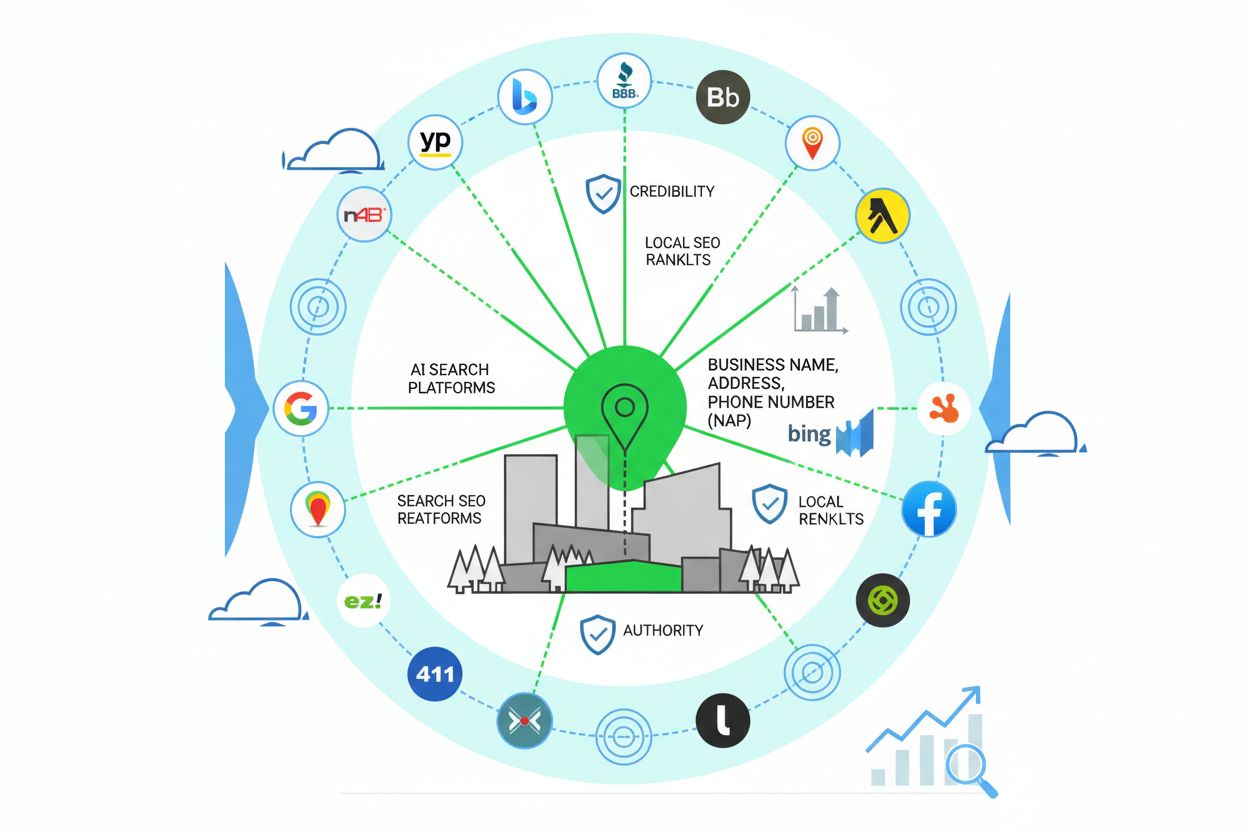
Learn what local citations are, how they impact local SEO rankings, and why they're critical for visibility in AI search platforms like ChatGPT, Perplexity, and...
Build a local service SEO strategy for location pages, service areas, reviews, multi-location architecture, AI visibility, and reliable booking flows.
Cookie Consent
We use cookies to enhance your browsing experience and analyze our traffic. See our privacy policy.