


Post-Purchase Survey
A post-purchase survey is a short questionnaire sent to customers after they complete an order, typically asking how they heard about the brand, why they chose to buy, or how satisfied they were with the experience. It gives merchants direct, first-party insight into attribution and customer experience that can't be fully captured by analytics tracking alone. Post-purchase surveys are commonly delivered via email, on-site after checkout, or through SMS.
Definition of Post-Purchase Survey
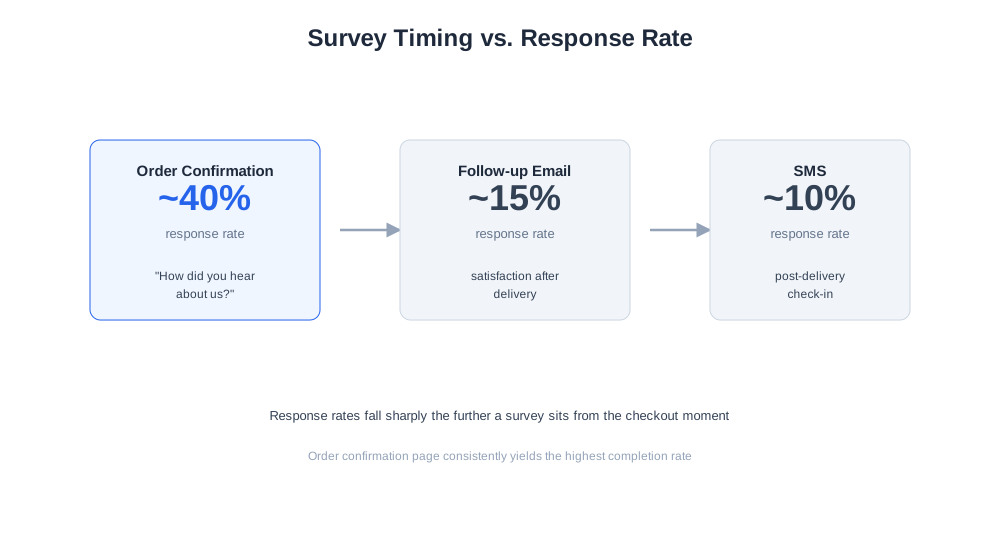
A post-purchase survey is a brief questionnaire sent to a customer immediately after they complete an order, most commonly asking how they discovered the brand, what motivated their purchase decision, or how satisfied they were with the buying experience. Unlike broader customer satisfaction surveys sent months into a relationship, post-purchase surveys are deliberately timed to capture feedback while the purchase decision and experience are still fresh in the customer’s mind. They typically appear in one of three places: on the order confirmation page immediately after checkout, in a follow-up email shortly after purchase, or via SMS once the order has been delivered. The format is usually kept short, often a single question, since response rates drop sharply as survey length increases.
How Post-Purchase Surveys Work
A typical post-purchase survey flow starts the moment a customer completes checkout. On the confirmation page, a single question appears, most commonly “How did you hear about us?” with a list of channel options like social media, search, a friend’s recommendation, or an ad. Because this moment has unusually high attention and completion rates compared to any other point in the customer relationship, it’s the highest-yield place to capture self-reported attribution data. A second, optional survey is sometimes triggered after delivery, asking about satisfaction with the product, packaging, or shipping speed, which feeds into ongoing product and operations improvements rather than acquisition attribution.
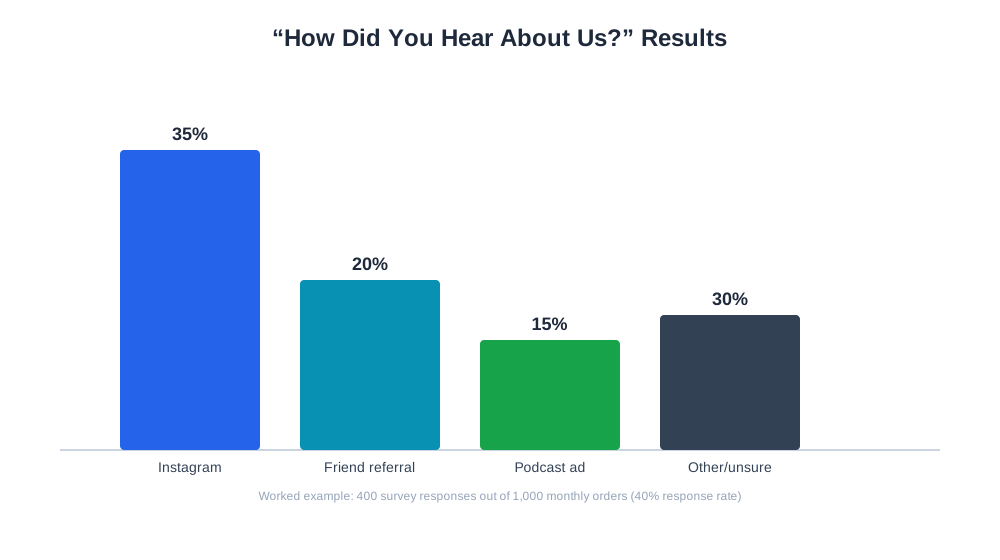
Worked example: a DTC brand adds a single-question survey to its order confirmation page. Out of 1,000 monthly orders, roughly 400 customers respond, and the results show 35% first heard about the brand through Instagram, 20% through a friend’s recommendation, and 15% through a podcast ad — channel weightings that don’t match what the brand’s ad platform dashboards were reporting, prompting a reallocation of marketing spend toward the channels the survey shows are actually driving awareness.

Ready to Monitor Your AI Visibility?
Track how AI chatbots mention your brand across ChatGPT, Perplexity, and other platforms.
Why Post-Purchase Surveys Matter for E-commerce Brands
The core value of a post-purchase survey is filling gaps that digital tracking alone can’t close. Privacy restrictions, ad blockers, and the limits of multi-device tracking mean a meaningful share of marketing touchpoints go untracked or get misattributed to the wrong channel. Asking customers directly provides a first-party, self-reported data point that doesn’t depend on cookies or platform-level tracking, and can be especially valuable for word-of-mouth, podcast, and offline channels that are notoriously hard to measure through analytics alone. Post-purchase surveys focused on satisfaction, rather than attribution, also surface friction points in the buying experience — a recurring complaint about checkout confusion or slow shipping is often easier to catch through direct customer feedback than by inferring it from analytics data.
Post-Purchase Surveys and AI-Driven Commerce
As more purchase journeys begin inside AI shopping assistants like ChatGPT Shopping or Perplexity Shopping, traditional analytics tracking often can’t see that a customer’s decision started with an AI-generated recommendation rather than a search click or an ad. A post-purchase survey question that includes an option like “an AI assistant or chatbot” can capture this emerging channel directly from the customer, filling an attribution gap that most existing tracking tools aren’t yet built to close. AmICited’s eshop and marketing analytics tools let merchants cross-reference this kind of self-reported survey data against actual ad spend and order records, producing a more complete view of which channels, including AI-driven discovery, are genuinely contributing to sales rather than relying on either data source in isolation.
Stay Updated on AI Visibility Trends
Get the latest insights on AI mentions, brand monitoring, and optimization strategies.
Best Practices and Common Mistakes
Keep the survey to one or two questions, since response rates fall quickly with each additional question added. Place it at the order confirmation moment for the highest response rate, and reserve a separate satisfaction-focused survey for after delivery. A common mistake is treating self-reported attribution as perfectly accurate — customers misremember or simplify how they found a brand, so survey data should be triangulated against actual marketing data rather than trusted in isolation. Another frequent misstep is making the survey mandatory or overly long, which depresses completion rates and can even add friction to the checkout experience itself; a skippable, single-question format nearly always outperforms a longer mandatory one.