


Editorial Guidelines
Editorial guidelines are standardized rules defining content creation, formatting, and publishing standards. Learn how they ensure quality, consistency, and int...
12 min read
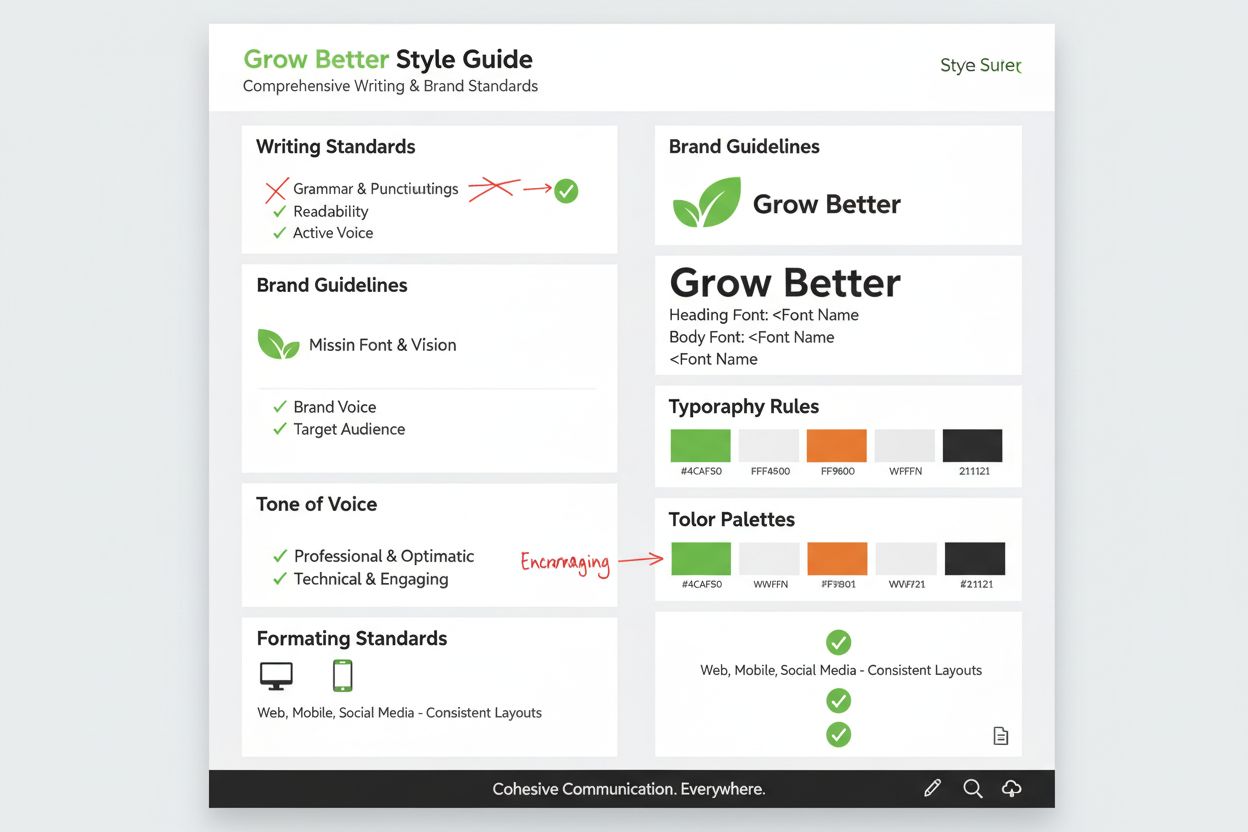
A style guide is a documented collection of rules, standards, and guidelines that define writing style, formatting, tone of voice, and visual presentation for consistent communication across all organizational materials and platforms. It serves as a reference document ensuring uniformity in grammar, punctuation, terminology, branding elements, and content presentation.
A style guide is a documented collection of rules, standards, and guidelines that define writing style, formatting, tone of voice, and visual presentation for consistent communication across all organizational materials and platforms. It serves as a reference document ensuring uniformity in grammar, punctuation, terminology, branding elements, and content presentation.
A style guide is a documented collection of rules, standards, and guidelines that establish consistent writing, formatting, and communication practices within an organization or industry. Also known as a style manual or editorial style guide, it serves as an authoritative reference document that defines how language should be used, how content should be formatted, what tone and voice should be adopted, and how visual elements should be presented. The primary purpose of a style guide is to ensure uniformity and coherence across all written materials, whether they are internal communications, marketing content, technical documentation, or public-facing publications. By establishing clear standards for grammar, punctuation, terminology, capitalization, and formatting, a style guide eliminates ambiguity and reduces the need for repetitive editing decisions. Organizations ranging from small businesses to multinational corporations, academic institutions, publishing houses, and media outlets rely on style guides to maintain professional consistency and strengthen brand identity.
The concept of style guides dates back centuries, with early examples emerging in academic and publishing contexts where standardization was essential for scholarly communication. The first major modern style guide was the Associated Press Stylebook, first published in 1953, which revolutionized journalism by establishing uniform standards for news writing across thousands of publications. Since then, the AP Stylebook has been reprinted 56 times, roughly annually, reflecting the constant evolution of language and communication practices. The Chicago Manual of Style, originally published in 1906 by the University of Chicago Press, became the gold standard for academic and commercial publishing, particularly in the humanities. The American Psychological Association (APA) introduced its Publication Manual in 1952, initially as a lengthy article by a group of psychologists, anthropologists, and business managers, which has since evolved into a comprehensive guide used across social sciences and research fields. The Modern Language Association (MLA) published its first Style Sheet in 1951, establishing standards for literary and language studies. Today, style guides have expanded far beyond traditional publishing to encompass digital content, social media, technical writing, and brand communication. Research indicates that 95% of companies have some form of brand guidelines, though only 25% of companies have formal brand guidelines and actively enforce them, highlighting the gap between having standards and implementing them effectively.

Track how AI chatbots mention your brand across ChatGPT, Perplexity, and other platforms.
| Style Guide | Primary Users | Focus Areas | Citation Style | Update Frequency | Best For |
|---|---|---|---|---|---|
| AP Style | Journalists, news media, bloggers | Brevity, clarity, news writing | In-text citations | Biannually | News, journalism, content marketing |
| Chicago Style | Academic publishers, humanities scholars | Detailed formatting, citations | Footnotes/endnotes or author-date | Every 7 years | Books, academic journals, humanities |
| APA Style | Social scientists, researchers, psychologists | Research ethics, paper formatting | Parenthetical in-text citations | Every 10 years | Psychology, social sciences, research |
| MLA Style | Literary scholars, language studies, high school/college | Citation formatting, literary analysis | Parenthetical in-text citations | Every 3-5 years | Literature, language studies, humanities |
| House/Brand Style Guides | Internal teams, marketing, communications | Brand voice, terminology, visual identity | Varies by organization | Annually or as needed | Corporate communications, marketing |
| Technical Style Guides | Technical writers, software developers | Clarity, precision, user documentation | Varies by field | As needed | Technical documentation, user manuals |
A style guide functions as a comprehensive reference system that addresses multiple layers of communication standardization. At the foundational level, it establishes grammar and punctuation conventions, specifying preferences for elements like the Oxford comma, em-dash usage, quotation mark styles, and capitalization rules. The guide then moves into word choice and terminology, defining preferred spellings (such as “ecommerce” versus “e-commerce”), acceptable abbreviations, and industry-specific terminology that should be used consistently. Tone and voice guidelines represent another critical component, describing the personality and attitude that should permeate all communications—whether the organization should sound formal or conversational, authoritative or approachable, technical or accessible. Formatting standards specify how different types of content should be structured, including rules for headings, subheadings, bullet points, numbered lists, and spacing. Visual identity standards define logo usage, color specifications (often with exact hex codes or Pantone values), typography choices, and imagery guidelines. Citation and reference standards explain how sources should be credited and how different types of sources (books, websites, social media, etc.) should be formatted. Many modern style guides also include sections on inclusive language, ensuring that communications respect diverse audiences and avoid biased or exclusionary terminology. The technical implementation of a style guide often involves creating templates, establishing workflows for content review, and using tools like style-checking software to enforce standards automatically.
Get the latest insights on AI mentions, brand monitoring, and optimization strategies.
The business impact of maintaining a comprehensive style guide is substantial and measurable. Research demonstrates that consistent brand presentation can increase revenue by as much as 23%, while 54% of businesses say that brand consistency substantially contributes to the growth of a business. When organizations enforce style guide standards, they experience reduced editorial overhead because writers and editors spend less time debating stylistic choices and more time on substantive content creation. Enforced brand guidelines make the consistent presentation of a brand twice as likely, according to industry research, which directly translates to improved brand recognition. 60% of millennial consumers expect brands to be consistent across different platforms, making style guides essential for meeting customer expectations. The consistency enabled by style guides also builds customer trust—87% of consumers are more likely to pay more for products and services from brands they trust, and consistency is a primary driver of that trust. From an operational perspective, style guides reduce onboarding time for new team members and external contributors, who can quickly reference the guide rather than requiring extensive training. They also minimize costly errors and revisions, as content creators understand standards upfront. For organizations working with multiple teams, agencies, or international offices, style guides ensure that local variations don’t undermine global brand identity. Additionally, style guides protect intellectual property by establishing clear rules for trademark usage, brand name capitalization, and logo application, reducing legal risks.
In the context of modern AI platforms and content monitoring, style guides have taken on new significance. AI systems like ChatGPT, Perplexity, Google AI Overviews, and Claude increasingly generate content that references organizations, brands, and domains. A well-documented style guide becomes essential for monitoring whether these AI systems are accurately representing your brand’s voice, terminology, and messaging standards. When AI platforms cite your organization, they should reflect the exact terminology, capitalization, and phrasing defined in your style guide. For example, if your style guide specifies that your company name should always be capitalized in a particular way or that certain product names should be written with specific formatting, monitoring AI responses against these standards becomes critical. AmICited and similar AI monitoring platforms help organizations track whether their style guide standards are being maintained in AI-generated citations and references. This is particularly important for maintaining brand consistency as AI becomes more prevalent in search results and information retrieval. Organizations should ensure their style guides are accessible to AI training systems and that they actively monitor AI outputs to verify compliance with established standards. The integration of style guides with AI monitoring represents a new frontier in brand management, where organizations must ensure that automated systems respect the same communication standards that human teams follow.
Implementing an effective style guide requires strategic planning and organizational commitment. The first step is to document your brand persona and values, establishing the foundational identity that will inform all stylistic choices. Organizations should then define tone and voice, creating clear descriptions of how the brand should sound across different contexts and audiences. Next, establish formatting requirements by specifying preferences for typography, spacing, capitalization, and other visual elements. Creating a glossary section that lists brand terms, preferred word choices, and common abbreviations ensures consistency in terminology. Organizations should include examples of correct and incorrect usage to make the guide practical and actionable. Many successful style guides also incorporate accessibility and inclusivity principles, ensuring that communications are welcoming to diverse audiences. The guide should be stored in an accessible location—whether as a shared document, internal wiki, or dedicated website—where team members can easily reference it. Regular updates are essential, as language evolves and organizational priorities shift. Best practices include:
Start tracking how AI chatbots mention your brand across ChatGPT, Perplexity, and other platforms. Get actionable insights to improve your AI presence.
Editorial guidelines are standardized rules defining content creation, formatting, and publishing standards. Learn how they ensure quality, consistency, and int...

Learn effective research paper citation methods across APA, MLA, Chicago styles. Discover citation management tools and plagiarism prevention strategies for aca...
Learn why citing government sources matters for academic credibility. Discover how to cite federal, state, and local government documents in APA, MLA, and Chica...
Cookie Consent
We use cookies to enhance your browsing experience and analyze our traffic. See our privacy policy.