



What is User-Generated Content for AI? Definition and Applications
Learn what user-generated content for AI is, how it's used to train AI models, its applications across industries, and the importance of authentic data for mach...
8 min read
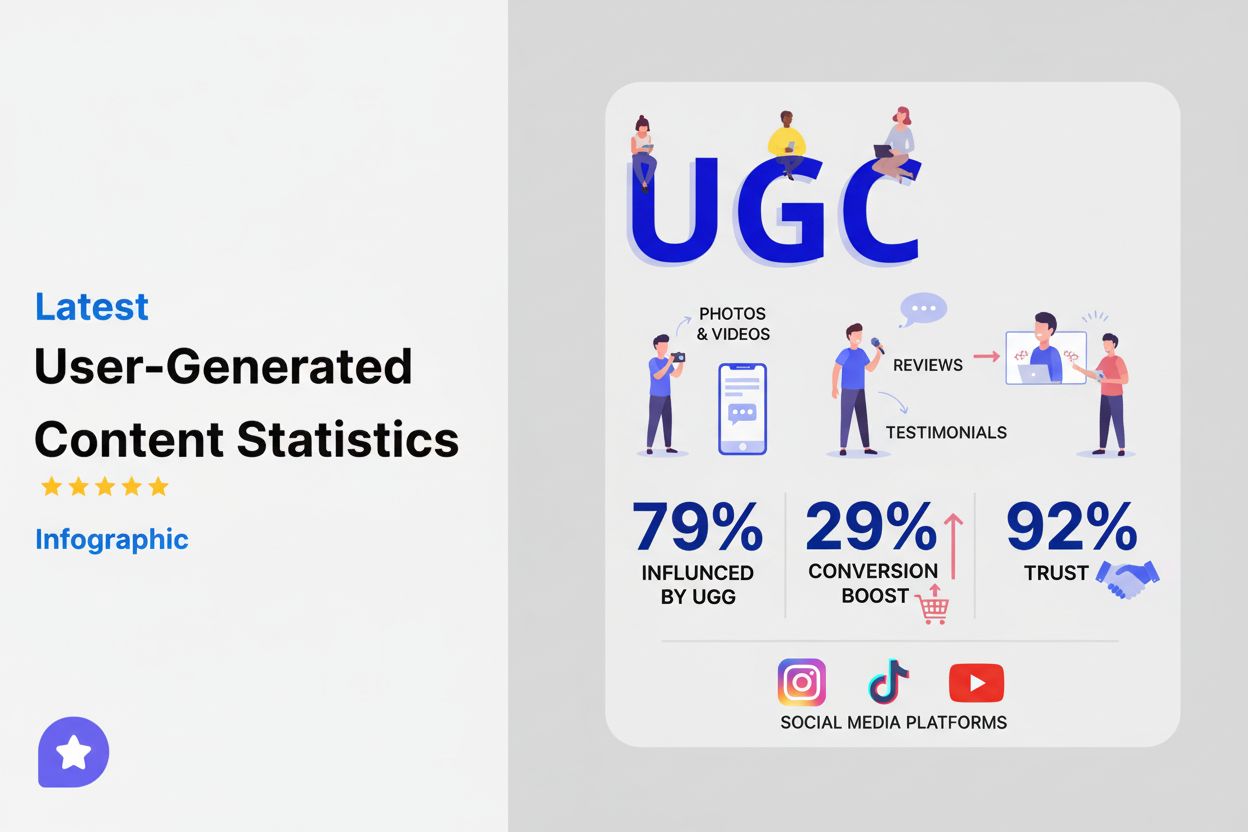
User-Generated Content (UGC) is any form of content—including images, videos, reviews, testimonials, and social media posts—created by users or customers rather than by brands themselves. UGC serves as authentic social proof that influences purchasing decisions and builds brand trust, with 79% of consumers reporting that UGC influences their buying behavior.
User-Generated Content (UGC) is any form of content—including images, videos, reviews, testimonials, and social media posts—created by users or customers rather than by brands themselves. UGC serves as authentic social proof that influences purchasing decisions and builds brand trust, with 79% of consumers reporting that UGC influences their buying behavior.
User-Generated Content (UGC) is any form of content created and published by users, customers, or community members rather than by brands or professional marketers. This includes reviews, testimonials, photos, videos, social media posts, blog articles, comments, and podcasts that showcase authentic customer experiences with products or services. UGC represents genuine, unfiltered perspectives from real people who have interacted with a brand, making it fundamentally different from traditional brand-created marketing materials. The power of UGC lies in its authenticity—it provides social proof that resonates far more effectively with potential customers than polished corporate messaging, as 92% of consumers trust user-generated content more than traditional advertisements when making purchasing decisions.
The concept of user-generated content emerged alongside the rise of social media platforms in the early 2000s, fundamentally transforming how brands communicate with audiences. Before platforms like YouTube, Instagram, and TikTok existed, customer feedback was limited to word-of-mouth recommendations and occasional product reviews in specialized publications. Today, UGC has become a cornerstone of digital marketing strategy, with over 66% of consumers making purchase decisions based on reviews and comments from other users. The democratization of content creation tools has empowered ordinary people to become brand storytellers, shifting marketing power from corporations to communities. This transformation reflects a broader cultural shift toward valuing authenticity and peer recommendations over corporate narratives, particularly among younger demographics who grew up with social media as their primary information source.

Track how AI chatbots mention your brand across ChatGPT, Perplexity, and other platforms.
User-generated content manifests in diverse formats, each serving unique marketing purposes and audience engagement goals. Customer reviews and testimonials represent the most common form of UGC, providing detailed feedback about product quality, functionality, and customer satisfaction. Product photos and lifestyle images showcase how real customers use and style products in their daily lives, offering potential buyers authentic visual references. Video content, including unboxing videos, tutorials, and testimonials, has become increasingly influential, with TikTok UGC being 46% more effective than traditional advertising. Social media posts and stories capture spontaneous moments of brand interaction, while blog posts and detailed written reviews provide comprehensive product analysis. Comments and discussions on brand posts create community engagement and provide valuable feedback. Additionally, podcasts and audio testimonials represent an emerging UGC category gaining traction among audio-first audiences.
| Aspect | User-Generated Content (UGC) | Influencer Content | Brand-Created Content | Paid Advertising |
|---|---|---|---|---|
| Source | Customers and community members | Professional influencers with large followings | Brand marketing teams | Paid promotional campaigns |
| Authenticity | Highly authentic, unfiltered | Semi-authentic, often sponsored | Professional but potentially perceived as biased | Clearly promotional, lowest trust |
| Cost | Minimal to free | $25 to $25,000+ per post | Moderate production costs | High media spend required |
| Trust Level | 92% consumer trust | 60-70% consumer trust | 47% consumer trust | 11% consumer trust |
| Conversion Impact | 29% higher web conversions | 15-20% conversion lift | 10-15% conversion lift | Varies by targeting |
| Reach | Organic, community-driven | Follower-dependent | Algorithm-dependent | Paid distribution |
| Scalability | Highly scalable through aggregation | Limited by influencer availability | Scalable with resources | Scalable with budget |
| Engagement Rate | 28% higher than professional ads | 3-5% average engagement | 1-2% average engagement | 0.5-1% average engagement |
Get the latest insights on AI mentions, brand monitoring, and optimization strategies.
The strategic importance of user-generated content extends far beyond simple social media sharing—it fundamentally influences consumer behavior and business outcomes. Research demonstrates that campaigns featuring UGC achieve 29% more web conversions compared to campaigns without UGC, making it one of the highest-ROI marketing tactics available. This conversion boost stems from the psychological principle of social proof, where potential customers feel more confident making purchases when they see evidence that others have already done so successfully. Furthermore, 79% of people report that UGC influences their buying decisions, indicating that authentic customer voices carry more weight than traditional marketing messages. The cost-efficiency advantage is equally compelling—while influencer marketing costs between $25 and $25,000 per post, UGC can be collected and amplified at minimal expense, allowing brands to achieve superior results with lower marketing budgets. This democratization of marketing effectiveness has led to a fundamental shift in how brands allocate resources, with 86% of brands and retailers believing that more authentic UGC in their paid and owned media would improve ad performance.
Different social media platforms exhibit distinct UGC performance characteristics, requiring tailored strategies for maximum impact. Instagram demonstrates exceptional UGC effectiveness, with posts featuring user-generated content receiving 70% more likes and comments than brand-only content, making it ideal for visual product showcases and lifestyle imagery. TikTok has emerged as the UGC powerhouse, where user-generated content surpasses branded content by 32% on Facebook ads and outperforms traditional advertising by 46%, reflecting the platform’s culture of authenticity and organic discovery. YouTube generates massive reach for UGC videos, with user-generated content receiving approximately 10 times more views than branded content, particularly for product reviews and tutorials. Pinterest reaches affluent audiences with high purchase intent, with one-third of Pinterest shoppers reporting household incomes over $100,000, making it valuable for aspirational UGC. LinkedIn serves B2B audiences effectively, where over 70% of B2B buyers consume video content created by users during their purchasing journey. Understanding these platform dynamics allows brands to strategically distribute UGC where it will generate maximum engagement and conversion impact.
While user-generated content offers tremendous marketing value, brands must implement robust moderation and governance frameworks to protect brand safety and community integrity. Content moderation challenges include managing inappropriate content, misinformation, negative reviews, copyright violations, and brand misalignment. Effective moderation strategies involve establishing clear community guidelines that define acceptable content, implementing approval workflows before UGC publication, and utilizing AI-powered moderation tools to flag potentially problematic content at scale. Brands must also address copyright and licensing concerns, ensuring that music, images, and other copyrighted elements in UGC are properly licensed for commercial use. The emotional toll on human moderators exposed to extreme or disturbing content requires ethical moderation practices and adequate support systems. Additionally, brands should develop response protocols for negative UGC, addressing legitimate complaints professionally while protecting against malicious or false claims. Legal compliance is critical, particularly regarding data privacy, disclosure requirements for sponsored content, and platform-specific policies governing UGC usage and attribution.
Choosing the right content source depends on what a specific campaign needs to accomplish. Choose organic UGC when maximum authenticity is the priority and you have an engaged existing customer base—it costs the least to collect and, per the trust data, earns the highest consumer trust (92% versus 47% for brand-created content), making it well suited for social proof on product pages and review sections where credibility matters more than polish. Choose paid UGC (compensated creators producing authentic-looking content) when you need consistent volume and creative control but still want the visual style of user content—this fits campaigns requiring guaranteed output on a schedule, such as a product launch needing a steady stream of unboxing videos, where waiting for organic submissions isn’t viable. Choose influencer content when you need reach into an audience you don’t currently have access to and are willing to pay a premium ($25 to $25,000+ per post) for that reach plus semi-authentic endorsement, accepting that trust levels run lower than organic UGC. Choose brand-created content when message precision and legal or regulatory accuracy are non-negotiable—financial services disclosures, medical claims, or anything requiring exact legal language shouldn’t be left to organic customer phrasing, even though brand-created content carries the lowest trust score of the four options. In practice, most effective programs blend these: organic UGC for trust-building social proof, brand-created content for anything requiring precision, and paid UGC or influencer content to fill volume or reach gaps organic contribution can’t cover on its own.
Successful user-generated content strategies require systematic approaches to collection, curation, and amplification. Brands should actively encourage sharing through branded hashtags, contests, challenges, and clear calls-to-action that make participation easy and rewarding. Social listening tools enable brands to discover relevant UGC across platforms, identifying customers who are already creating content about their products. Permission and attribution are non-negotiable—brands must request explicit consent before reposting content and provide clear credit to original creators, building goodwill and encouraging future participation. Content curation ensures that featured UGC aligns with brand values and marketing objectives, maintaining consistency while showcasing diverse customer perspectives. Analytics and measurement are essential for understanding UGC impact, tracking metrics including engagement rates, conversion lift, reach, and sentiment. Employee advocacy programs can amplify UGC reach by encouraging team members to share customer content on their personal networks, extending visibility beyond brand channels. Community building transforms one-time content creators into long-term brand advocates through recognition, rewards, and meaningful engagement. Finally, brands should integrate UGC across marketing channels—from email campaigns and landing pages to paid advertising and owned media—creating a unified brand experience grounded in authentic customer voices.
As artificial intelligence systems become primary information sources for consumers, the visibility of user-generated content in AI-generated responses has become a critical brand monitoring concern. AI search engines like ChatGPT, Perplexity, Google AI Overviews, and Claude increasingly cite customer reviews, testimonials, and user experiences when answering product-related queries. This shift means that UGC visibility in AI responses directly impacts brand authority and consumer perception. Brands must now monitor not only where their UGC appears on traditional social platforms but also how it’s being referenced and cited by AI systems. AI monitoring platforms track brand mentions, product reviews, and customer testimonials across generative AI systems, providing insights into how AI systems perceive and represent brands based on available UGC. This emerging dimension of brand visibility requires brands to maintain high-quality UGC, encourage positive customer reviews, and monitor AI citations to ensure accurate representation. The integration of UGC monitoring with AI visibility tracking represents the next evolution in brand management, where authenticity and customer voice become central to how brands are discovered and evaluated in AI-driven search environments.
+++
Start tracking how AI chatbots mention your brand across ChatGPT, Perplexity, and other platforms. Get actionable insights to improve your AI presence.
Learn what user-generated content for AI is, how it's used to train AI models, its applications across industries, and the importance of authentic data for mach...

Learn how to leverage UGC to increase brand visibility in AI search results, ChatGPT, Perplexity, and Google AI Overviews. Discover proven strategies for monito...

Customer advocacy is when satisfied customers actively promote and recommend your brand to others. Learn how to build advocacy programs that drive growth, incre...
Cookie Consent
We use cookies to enhance your browsing experience and analyze our traffic. See our privacy policy.