


The Rise of Specialized AI Assistants: Industry-Specific Optimization
Explore how vertical AI and specialized AI assistants are transforming industries. Learn about market trends, key players, and ROI of industry-specific AI optim...
11 min read
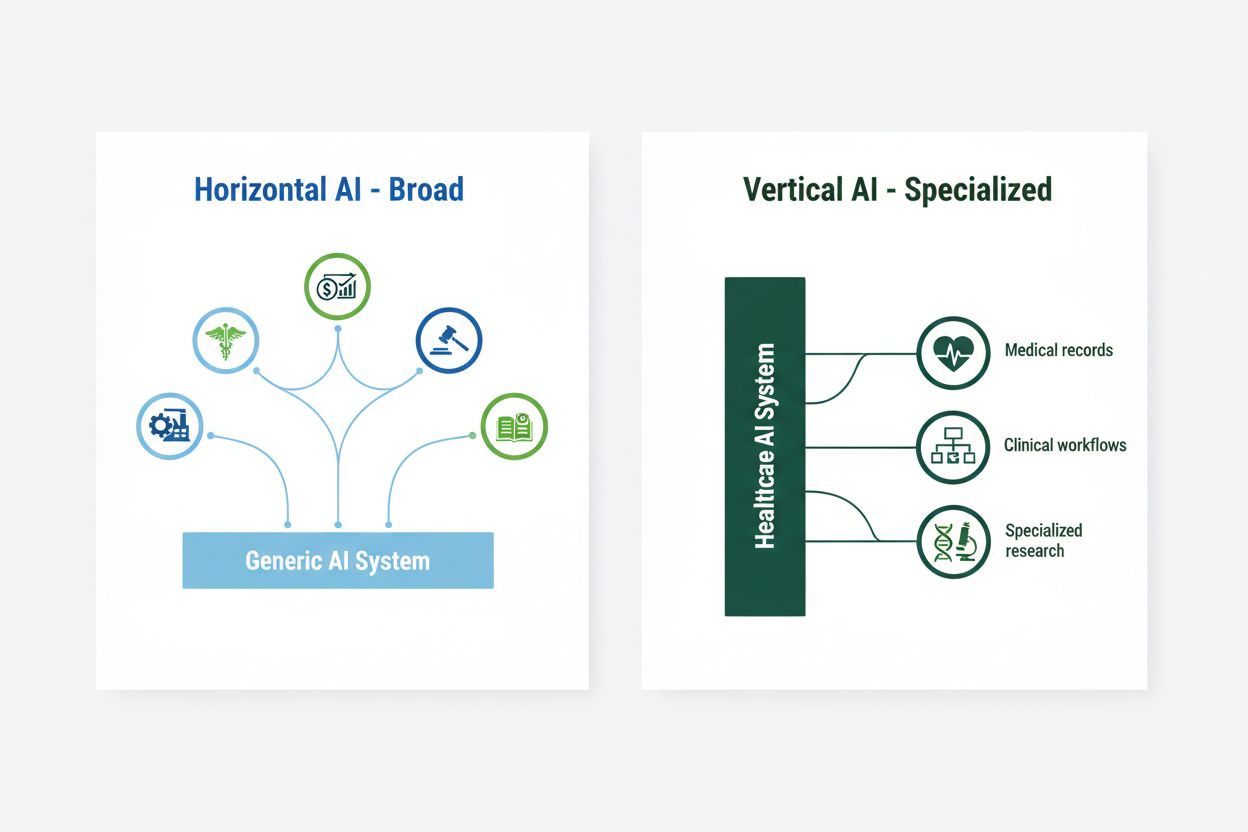
A vertical market is a specific industry or market segment where companies offer specialized products and services tailored to the unique needs of a defined customer group. Unlike horizontal markets that serve diverse industries, vertical markets focus narrowly on a single niche, enabling deep expertise and premium pricing strategies.
A vertical market is a specific industry or market segment where companies offer specialized products and services tailored to the unique needs of a defined customer group. Unlike horizontal markets that serve diverse industries, vertical markets focus narrowly on a single niche, enabling deep expertise and premium pricing strategies.
A vertical market is a specific industry or market segment where companies offer specialized products and services tailored to the unique needs of a defined customer group. Unlike horizontal markets that serve diverse industries with broad-appeal solutions, vertical markets focus narrowly on a single niche, enabling companies to develop deep expertise and command premium pricing. The term “vertical” refers to the depth of specialization within a particular industry, as opposed to the breadth of a horizontal market. Vertical markets are also known as industry verticals or sales verticals, and they represent concentrated business ecosystems where companies compete primarily with other specialists serving the same niche. Understanding vertical markets is essential for businesses developing go-to-market strategies, as it fundamentally shapes product development, marketing approaches, and competitive positioning.
The concept of vertical markets emerged as businesses recognized that one-size-fits-all solutions often failed to address industry-specific challenges. During the 1980s and 1990s, as enterprise software became more sophisticated, companies like Epic Systems pioneered the vertical software model by building comprehensive solutions exclusively for healthcare providers. This approach proved remarkably successful, as healthcare organizations were willing to pay premium prices for software that understood their complex workflows, regulatory requirements, and operational constraints. The vertical market model gained further momentum with the rise of Software-as-a-Service (SaaS) platforms, which enabled companies to serve niche markets more efficiently through cloud-based delivery. Today, the global vertical market is experiencing significant growth, with the vertical software market alone projected to reach $512.75 billion by 2031, growing at a compound annual growth rate (CAGR) of 12.9% according to verified market research. This expansion reflects increasing recognition that specialized solutions outperform generic alternatives in driving customer value and business outcomes.
| Aspect | Vertical Market | Horizontal Market |
|---|---|---|
| Industry Focus | Specific niche or industry (e.g., healthcare, legal, construction) | Multiple industries and sectors |
| Customer Base | Narrow, highly specialized audience | Broad, diverse customer base |
| Product Customization | High customization for industry-specific needs | Standardized products with minimal customization |
| Competition | Intense but limited to industry specialists | Broader competition from multiple players |
| Pricing Strategy | Premium pricing based on specialized value | Competitive pricing with economies of scale |
| Market Size | Limited addressable market within niche | Large addressable market across industries |
| Customer Loyalty | High loyalty due to specialized solutions | Lower loyalty with easier switching |
| Barriers to Entry | High due to specialized expertise requirements | Lower barriers with standardized solutions |
| Risk Exposure | High concentration risk in single industry | Diversified risk across multiple sectors |
| Sales Cycle | Longer, relationship-driven sales processes | Shorter, transactional sales cycles |
| Examples | Epic (healthcare), Bloomberg Terminal (finance) | Microsoft Office, Salesforce, Adobe Creative Suite |
Vertical market solutions require deep technical integration with industry-specific systems, workflows, and compliance frameworks. In healthcare, for example, vertical software must integrate with Electronic Health Records (EHR) systems, comply with HIPAA regulations, support complex billing and insurance workflows, and maintain strict data security standards. Financial services verticals demand integration with trading platforms, regulatory reporting systems, and real-time market data feeds. Construction management verticals must handle project-specific workflows, equipment tracking, and safety compliance documentation. This technical specialization creates significant barriers to entry for new competitors, as building comprehensive solutions requires years of industry expertise and substantial research and development investment. Companies operating in vertical markets typically employ teams of industry experts, compliance specialists, and technical architects who understand the nuanced requirements of their target sector. The depth of specialization also enables vertical market companies to anticipate industry changes and evolving regulatory requirements, positioning them as trusted advisors rather than mere software vendors.
Operating in a vertical market provides substantial competitive advantages that translate directly to business performance. Companies can charge premium prices because their solutions directly address industry-specific pain points that customers are willing to pay significantly more to solve. Research indicates that vertical market companies often achieve 20-40% higher profit margins compared to horizontal market competitors serving the same customer base. Customer acquisition costs are typically lower in vertical markets because marketing can be highly targeted through industry-specific channels, conferences, and publications. Vertical market companies also benefit from higher customer lifetime value, as switching costs are substantial when solutions are deeply integrated into industry workflows. Additionally, vertical market specialists develop stronger customer relationships through deep understanding of industry challenges, enabling them to serve as strategic partners rather than transactional vendors. This relationship depth creates opportunities for upselling and cross-selling specialized services, expanding revenue per customer. The concentrated nature of vertical markets also enables companies to build thought leadership and industry authority more quickly, as they can dominate conversations within their niche.
In the context of AI monitoring platforms like AmICited, understanding vertical markets is critical for tracking brand mentions across AI systems. Different industries have distinct requirements for monitoring AI responses. Healthcare organizations need HIPAA-compliant monitoring to ensure patient privacy when their brand appears in AI-generated content. Financial services firms require regulatory compliance tracking to monitor how their brand is cited in AI responses used for investment decisions. Legal firms need specialized monitoring to track how their expertise is referenced in AI-generated legal analysis. Technology companies operating in vertical markets must monitor how their solutions are cited in industry-specific AI tools and platforms. Vertical market monitoring requires understanding industry-specific terminology, compliance requirements, and competitive landscapes. AI systems like ChatGPT, Perplexity, Google AI Overviews, and Claude increasingly serve vertical market customers, making it essential for brands to track how they appear in industry-specific AI responses. This vertical-specific monitoring enables companies to identify opportunities for thought leadership positioning, correct inaccurate information, and ensure their brand is properly cited in AI-generated content relevant to their industry.
Identifying and entering a vertical market requires systematic market research and strategic analysis. Companies typically begin by analyzing their existing customer base to identify common industry characteristics or patterns. Market segmentation involves dividing broader industries into smaller, more specific segments where specialized solutions can create significant value. For example, the healthcare industry can be segmented into hospitals, clinics, dental practices, mental health providers, and veterinary services—each with distinct operational requirements. Competitor analysis reveals where vertical markets are heading and which niches are underserved. Customer surveys and interviews provide direct insights into pain points and unmet needs within potential vertical markets. Keyword research and SEO analysis help identify search demand for industry-specific solutions, indicating market interest and opportunity size. SWOT analysis (Strengths, Weaknesses, Opportunities, Threats) for each potential vertical market helps companies assess their competitive positioning and resource requirements. Data analytics and CRM software enable companies to track customer behavior patterns, preferences, and trends that inform vertical market selection. Companies that successfully identify and enter vertical markets typically focus on segments where they have existing expertise, relationships, or competitive advantages.
Many companies claim to operate in a vertical market when they’ve actually just applied industry-specific messaging to an otherwise horizontal product. Distinguishing genuine vertical specialization from surface-level positioning requires checking several concrete signals. First, examine the product architecture: a true vertical solution has workflows, data models, and integrations built around the specific operational realities of the industry—Epic’s EHR system is structured around clinical workflows and HIPAA requirements, not a generic database with healthcare terminology layered on top. A horizontal tool wearing vertical branding will instead offer configuration options and templates rather than industry-native structure. Second, check the compliance and certification footprint—genuine vertical players in regulated industries like healthcare, finance, or construction carry the specific certifications (HIPAA, SOC 2 for finance, safety compliance documentation) their niche requires, whereas repositioned horizontal tools typically lack these entirely. Third, look at sales cycle and pricing structure: vertical market companies show longer, relationship-driven sales cycles and premium pricing justified by measurable ROI within that industry, while horizontal products marketed to a vertical usually retain standard, self-serve pricing. Fourth, assess team composition—does the company employ industry veterans (former hospital administrators, contractors, compliance officers) in product and customer-facing roles, or is the “vertical” framing confined to marketing copy? Finally, compare the competitive set a company references: genuine vertical players benchmark against other specialists in the same niche, while horizontally-built products benchmark against generic category leaders. Running through these checks separates companies with real vertical market depth from those simply applying a niche label to a broad product.
Vertical markets represent a fundamental business strategy that prioritizes depth of specialization over breadth of market coverage. Companies that successfully operate in vertical markets achieve premium pricing, higher customer loyalty, and stronger competitive positioning within their niche. The distinction between vertical and horizontal markets shapes every aspect of business strategy, from product development and marketing to sales processes and organizational structure. As industries become more complex and regulatory requirements more stringent, the demand for specialized vertical solutions continues to grow. For AI monitoring platforms and brand tracking services, understanding vertical market dynamics is essential for serving customers effectively and ensuring compliance with industry-specific requirements. The projected growth of the vertical market to $512.75 billion by 2031 reflects the increasing recognition that specialized solutions outperform generic alternatives in delivering customer value. Organizations considering vertical market entry should conduct thorough market research, assess their competitive advantages, and commit to building deep industry expertise. The vertical market model will continue to evolve as technology enables new forms of specialization and integration, creating both opportunities and challenges for companies seeking to establish market leadership within their chosen niche.
Start tracking how AI chatbots mention your brand across ChatGPT, Perplexity, and other platforms. Get actionable insights to improve your AI presence.
Explore how vertical AI and specialized AI assistants are transforming industries. Learn about market trends, key players, and ROI of industry-specific AI optim...
Discover how vertical review platforms drive AI visibility and citations. Learn why niche review sites matter more than generic platforms for B2B companies seek...

Competitor analysis is systematic research into competitor strategies, strengths, and weaknesses. Learn frameworks like SWOT and Porter's Five Forces for strate...
Cookie Consent
We use cookies to enhance your browsing experience and analyze our traffic. See our privacy policy.