


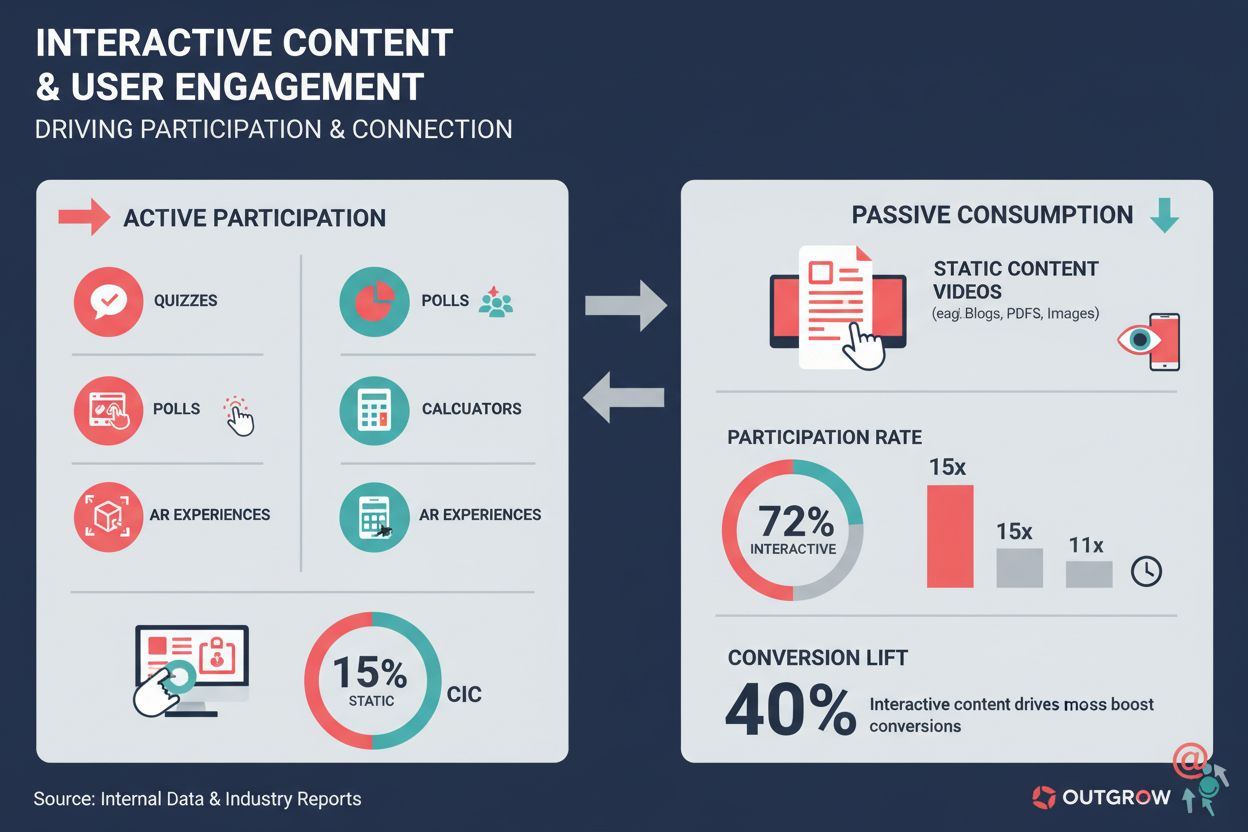
Interactive Content
Interactive content requires user participation to engage audiences actively. Learn how quizzes, polls, calculators, and AR experiences drive engagement, conver...
11 min read
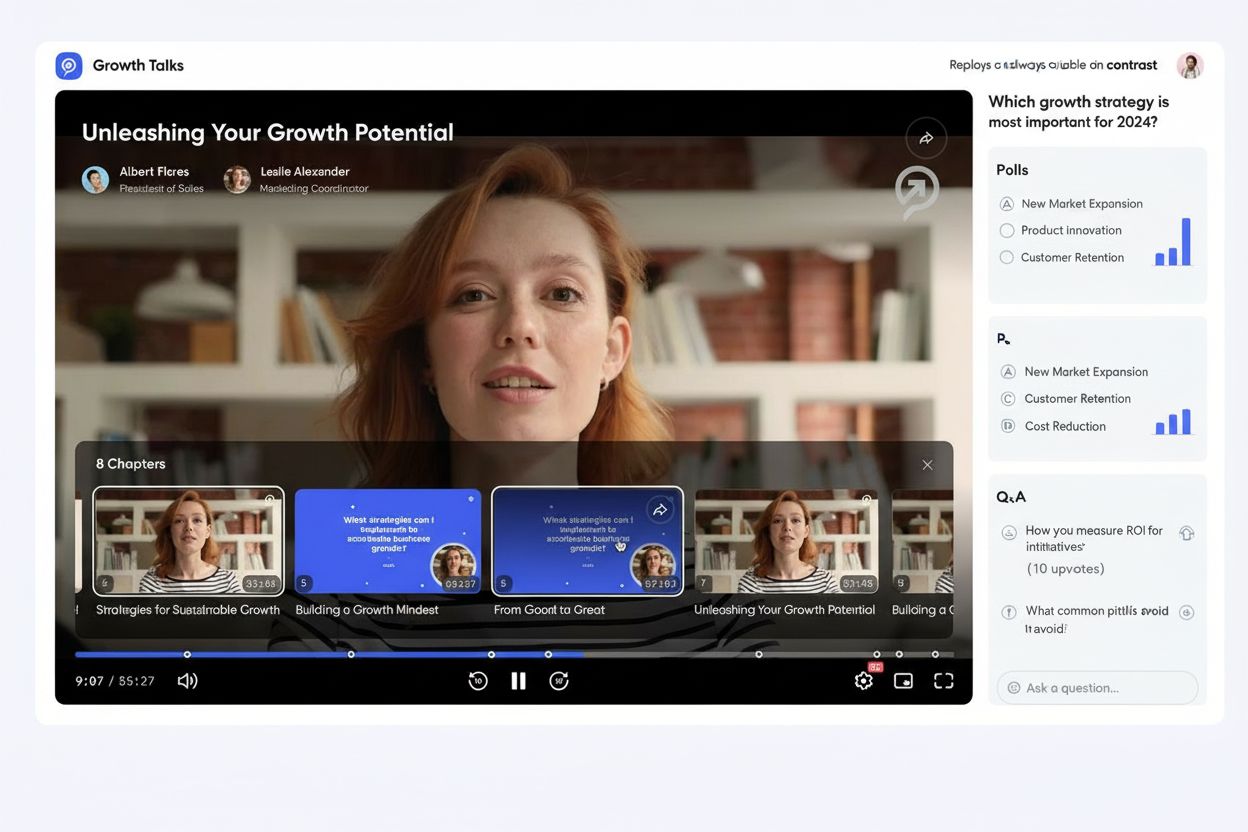
A webinar is an online seminar or presentation delivered via the internet in real-time or pre-recorded format, allowing hosts to share information, slides, and video content with a remote audience while enabling interactive engagement through chat, polls, and Q&A sessions. The term combines ‘web’ and ‘seminar’ to describe a web-based educational or promotional event that facilitates two-way communication between presenters and participants regardless of geographic location.
A webinar is an online seminar or presentation delivered via the internet in real-time or pre-recorded format, allowing hosts to share information, slides, and video content with a remote audience while enabling interactive engagement through chat, polls, and Q&A sessions. The term combines 'web' and 'seminar' to describe a web-based educational or promotional event that facilitates two-way communication between presenters and participants regardless of geographic location.
A webinar, short for “web-based seminar,” is an online presentation, meeting, or workshop that allows individuals or groups to interact in real time over the internet. Unlike traditional in-person seminars that require physical venues and attendee travel, webinars leverage digital technology to deliver educational content, product demonstrations, or thought leadership to geographically dispersed audiences. The term encompasses both live events and pre-recorded presentations that are delivered through specialized webinar platforms, enabling presenters to share slides, video content, and screen demonstrations while simultaneously engaging with participants through interactive features such as live chat, polls, Q&A sessions, and whiteboard tools. Webinars have become a cornerstone of modern digital marketing and corporate training, serving purposes ranging from lead generation and customer education to employee onboarding and industry thought leadership. The fundamental distinction of a webinar lies in its emphasis on one-to-many communication with interactive elements, differentiating it from passive video broadcasts or traditional conference calls that prioritize equal participation among all attendees.
The concept of webinars emerged in the early 2000s as internet bandwidth and video streaming technology matured, initially serving as a cost-effective alternative to in-person seminars and conferences. Early webinar platforms were relatively basic, offering limited interactivity and often plagued by technical issues such as poor audio quality and unreliable streaming. However, the global pandemic of 2020 catalyzed unprecedented adoption and innovation in webinar technology, transforming them from a niche marketing tool into a mainstream business necessity. Organizations worldwide rapidly shifted to virtual events, forcing platform developers to enhance features and user experiences dramatically. Today, the global webinar and virtual event market is valued at approximately $315.5 billion as of 2022 and is projected to reach over $1 trillion by 2032, representing a compound annual growth rate of 14%. This explosive growth reflects the fundamental shift in how businesses communicate, educate, and engage with their audiences. Modern webinars now incorporate artificial intelligence, real-time translation, advanced analytics, and sophisticated engagement metrics that were unimaginable just a decade ago. The evolution from simple screen-sharing presentations to immersive, interactive digital experiences demonstrates how webinars have matured from a supplementary tool to a primary channel for business communication and knowledge dissemination.

Track how AI chatbots mention your brand across ChatGPT, Perplexity, and other platforms.
| Aspect | Webinar | Virtual Meeting | Virtual Event | Video Conference |
|---|---|---|---|---|
| Participant Count | 50-10,000+ attendees | 5-20 participants | 100-5,000+ attendees | 2-50 participants |
| Duration | 30-90 minutes typically | 30-60 minutes | Several hours to multiple days | 15-60 minutes |
| Interaction Level | Moderate (polls, Q&A, chat) | High (equal participation) | Moderate to high (multiple sessions) | High (two-way dialogue) |
| Primary Purpose | Education, lead generation, thought leadership | Team collaboration, decision-making | Brand awareness, networking, multiple topics | Internal communication, collaboration |
| Presenter Role | One-to-many broadcast | Peer-to-peer discussion | Multiple presenters/sessions | Shared responsibility |
| Registration Required | Yes, typically | No, usually internal | Yes, often with tiered access | No, typically internal |
| Recording/Replay | Common and encouraged | Rarely recorded | Often recorded for attendees | Sometimes recorded |
| Cost per Lead | $45-$98 average | N/A (internal) | Higher due to production | N/A (internal) |
| Engagement Rate | 35-64% average | 70%+ (smaller groups) | 40-50% average | 60%+ (smaller groups) |
Webinar platforms function as integrated ecosystems combining multiple technological components to deliver seamless experiences for both presenters and attendees. The core infrastructure includes a streaming server that broadcasts video and audio content in real-time, a registration and authentication system that manages attendee access and data collection, and interactive feature modules such as live polling, chat functionality, Q&A management, and screen-sharing capabilities. Modern platforms employ content delivery networks (CDNs) to ensure low-latency streaming across global audiences, with redundancy systems to prevent service interruptions. Analytics engines track attendee behavior in real-time, capturing metrics such as engagement duration, poll participation rates, chat activity, and video watch time. Advanced platforms now integrate artificial intelligence for automated transcription, real-time language translation, and sentiment analysis of audience reactions. The backend infrastructure manages data security, compliance with regulations like GDPR and CCPA, and integration with customer relationship management (CRM) systems to seamlessly transfer attendee data into marketing automation workflows. Webinar platforms must support multiple device types and internet connection speeds, with responsive design ensuring functionality across desktop computers, tablets, and smartphones. The technical sophistication of modern webinar platforms has become a critical differentiator, with 87% of B2B marketers now using AI-powered features in their webinar strategies, demonstrating how technology has become inseparable from webinar effectiveness.
Get the latest insights on AI mentions, brand monitoring, and optimization strategies.
Webinars have emerged as one of the highest-performing content formats for B2B marketing, with 47% of B2B marketers identifying webinars as their best-performing content type in the past 12 months. The lead generation capability of webinars is particularly compelling: 68% of surveyed marketers could directly tie webinars to revenue generation, and 75% reported that webinars lowered their cost-per-lead compared to other marketing channels. The average cost per lead for webinars stands at $72, significantly lower than paid advertising, direct mail, or event marketing. Webinars qualify leads more effectively than other channels because registration itself demonstrates genuine interest in your topic, and attendance further filters for engaged prospects. The quality of webinar leads is notably higher, with 38% of marketers rating webinar leads as 4 or 5 on a five-star quality scale, and the average rating reaching 3.3 out of 5. This superior lead quality translates directly to improved conversion rates and shorter sales cycles. Educational webinars generate 53% more ROI than product-focused demo webinars, highlighting the importance of value-driven content over direct sales pitches. Customer story webinars rank second in ROI effectiveness, despite being run by only 18% of marketers, representing a significant missed opportunity. The business case for webinars extends beyond immediate lead generation: they establish thought leadership, build brand authority, create repurposable content assets, and foster long-term customer relationships that drive lifetime value. Organizations that strategically integrate webinars into their marketing mix report improved brand awareness, higher customer retention rates, and stronger positioning as industry experts.
Webinars manifest in diverse formats, each optimized for specific business objectives and audience needs. Educational webinars focus on teaching audiences valuable skills or knowledge, typically featuring well-prepared slides, expert presenters, and comprehensive content that attendees can immediately apply. Product demonstration webinars showcase software, tools, or services in action, using screen-sharing to walk attendees through features and benefits while addressing common use cases. Thought leadership webinars position company executives or industry experts as authorities, discussing trends, insights, and forward-looking perspectives that establish credibility and influence. Customer story or case study webinars feature real clients discussing their experiences, challenges, and results achieved using your solution, providing powerful social proof and relatable narratives. Panel discussion webinars bring together multiple experts to discuss a topic from different perspectives, creating dynamic conversations that appeal to audiences seeking diverse viewpoints. Interview-style webinars involve a host conducting in-depth conversations with a guest expert, allowing for exploration of nuanced topics and personal insights. Q&A webinars function as open forums where audiences pose questions to experts, creating interactive learning experiences particularly popular in technical fields. Employee training and onboarding webinars serve internal audiences, using screen-sharing and interactive elements to teach new employees about company processes, products, or culture. Paid webinars position premium content as a revenue stream, requiring attendees to purchase access and typically delivering more comprehensive, specialized content than free webinars. The selection of webinar type should align with your primary objective: lead generation favors educational and thought leadership formats, while product sales benefit from demonstration and customer story formats. Standalone webinars generate 56% more registrations than webinar series, suggesting that audiences prefer single, focused events over multi-part commitments.
Audience engagement represents the critical differentiator between memorable, impactful webinars and forgettable presentations, with high-performing webinars achieving 64% average engagement rates compared to industry averages of 35-45%. Interactive elements must be strategically distributed throughout the webinar rather than concentrated at the end, maintaining audience attention and preventing the “Zoom fatigue” phenomenon that causes attendees to disengage. Live polls serve as powerful engagement tools, with 44% of webinar hosts utilizing them, though this represents significant untapped potential. The data reveals that polls achieve 52% completion rates in top-performing webinars, with hosts running polls approximately every 30 minutes. Showing polls on-stage increases completion rates by 15%, demonstrating the importance of visual prominence. Q&A sessions are non-negotiable, with 92% of webinar attendees expecting live Q&A at the end of events, making this feature essential for attendee satisfaction. Chat functionality enables real-time dialogue, allowing attendees to ask questions, share insights, and feel personally acknowledged by presenters. Whiteboard demonstrations help visualize complex concepts, enabling presenters to draw diagrams, map processes, or build ideas collaboratively in real-time. Screen-sharing capabilities are fundamental for technical webinars, allowing presenters to demonstrate software, navigate websites, or showcase documents while maintaining audience focus. Breakout rooms and small group discussions can be incorporated into longer webinars to create intimate conversations within larger events. Gamification elements such as quizzes, contests, or leaderboards increase participation and create memorable experiences. The average number of poll responses is 24, representing the most engaged segment of attendees, making these interactions valuable for identifying high-intent prospects. Webinar hosts who extend audience engagement by incorporating chat, Q&A, and polls can increase engagement by up to 50%, demonstrating the multiplicative effect of layered interactive elements.
Successful webinar attendance begins with strategic promotion across multiple channels, with email marketing emerging as the clear winner for driving high-quality registrations. 91% of marketers identify email as their top-performing promotion channel, significantly outperforming social media posts (94% use but lower quality), newsletters (20% effectiveness), website banners (18%), and paid ads (11%). Promotion should begin at least 4 weeks before the webinar, with 50% of marketers starting campaigns more than a month in advance. Thursday is the optimal day for sending invitations, with 22% of registrations occurring on Thursdays, followed by Tuesday at 19% and Wednesday at 18%. Marketing should occur between 9 AM and 5 PM local time, with 33% of registrations happening between 9-11 AM and 21% between 2-4 PM. Registration pages achieve conversion rates up to 59%, nearly double the 30% average reported by some platforms, with 78% of registrations coming from desktop and 22% from mobile devices. This split necessitates mobile-responsive design to capture registrations across all devices. 77% of registrants prefer email signup over single sign-on (SSO), suggesting that simple, familiar registration processes maximize conversions. Guest speakers significantly boost registrations, with webinars featuring guest speakers receiving 3 times more engagement than internal-only presentations. Webinars with guest speakers drive more registrations, with 45% of marketers inviting guest speakers to every webinar and 21% doing so frequently. Reminder emails are critical for attendance, with top performers implementing a three-step sequence (day before, 1 hour before, 5 minutes before) achieving 27% higher live attendance rates. Only 31% of companies send more than one reminder, representing a significant opportunity for improvement. 13% of registrations occur on the day of the webinar, emphasizing the importance of last-minute promotion and reminders.
Measuring webinar success requires tracking multiple interconnected metrics that collectively reveal the true impact of your webinar strategy. Registration rate serves as the initial indicator of promotional effectiveness, with 60-minute webinars generating the highest average registrations, followed by 45-minute and 30-minute sessions. Live attendance rate typically ranges from 35-45% of registrants, with Wednesdays achieving the highest live attendance at 48%, followed by Thursday and Tuesday. 90-minute webinars achieve 72% live attendance rates, suggesting that committed attendees will invest time in longer content. Engagement rate measures active participation through polls, chat, and Q&A, with high-performing webinars reaching 64% engagement. Completion rate for 60-minute webinars averages 40%, indicating that maintaining attention throughout the full duration remains challenging. On-demand or replay views account for 47% of total webinar views, demonstrating the extended value of recorded content. Webinars with fewer than 100 registrants achieve 5% higher live attendance rates and 10% more total views, suggesting that smaller, more targeted webinars may outperform large-scale events. January is the top month for webinar attendance at 50%, followed by February at 48%, reflecting New Year professional development goals. UTM parameter tracking is employed by 57% of webinar hosts to attribute registrations to specific channels and campaigns. 75% of marketers integrate webinar data with their CRM, enabling tracking of attendee progression through sales funnels and revenue attribution. 39% of marketers track leads as their primary metric, while only 17% track pipeline influence and 12% measure actual revenue impact, revealing a gap in deeper measurement practices. Educational webinars generate 53% more ROI than product demo webinars, making content type a critical success factor.
Artificial intelligence has fundamentally transformed webinar strategy, with 87% of B2B marketers now using AI for their webinars and virtual events. AI-powered features include automated transcription, real-time language translation, sentiment analysis, and intelligent content repurposing. Engagement with AI-generated written content increased by more than 7X, demonstrating that audiences respond positively to AI-enhanced content. Marketers save over 13,000 hours and $650,000 annually using AI to repurpose webinars, with Repurpose AI being used 5,328 times across 3,632 webinars to automatically generate blog posts, articles, and campaign materials. Each webinar has potential to create 4-5 short clips with high virality scores, with AI analysis identifying moments featuring personal anecdotes, statistics, and compelling stories. Webinar repurposing extends content reach exponentially, with a single webinar reaching 80 people live potentially reaching thousands through AI-generated clips, newsletters, and social content. It takes 2.5 hours to manually write a blog post from a webinar transcript, making AI automation a significant time-saver. AI-powered webinar platforms now offer automatic clip generation, blog post creation, and social media content production directly from webinar transcripts. This capability enables marketers to redirect time from manual content creation toward strategy and growth initiatives. Custom branding is applied by 90% of marketers, with webinar platforms enabling logos, colors, and visual elements to maintain brand consistency. The integration of AI into webinar workflows represents a paradigm shift, enabling smaller teams to produce more content, reach larger audiences, and measure impact more accurately than ever before.
Low live attendance despite strong registration numbers. Registration and attendance are separate funnels—typical live attendance runs 35-45% of registrants, so a shortfall usually traces to a weak reminder sequence rather than the topic itself. Fix this by checking whether reminders went out at all three recommended touchpoints (day before, one hour before, five minutes before); campaigns using this three-step sequence see roughly 27% higher live attendance, and only 31% of companies currently send more than one reminder. Poor engagement during the live session. If chat and polls sit unused, the likely cause is that interactive elements were saved for the end instead of spaced throughout—top-performing webinars run polls roughly every 30 minutes and average 64% engagement, compared to 35-45% industry norms. Displaying polls on-stage rather than only in a sidebar increases completion by about 15%. High registration but low quality leads. This typically points to promotion channels mismatched to intent—email marketing consistently outperforms social posts, banners, and paid ads for lead quality, so a spike in low-intent signups often follows heavy paid promotion rather than the email-first approach that drives the highest-converting registrants. Steep drop-off partway through. Compare your drop-off point against the 40% average completion rate for 60-minute sessions; a cliff much earlier than that usually means the opening minutes failed to establish value quickly, since attendees decide fast whether to stay. Low replay engagement after the event. Since roughly 47% of total webinar views come from on-demand replays, a weak showing here usually means the recording and resources weren’t sent within 24 hours, or the replay wasn’t repurposed into shorter clips that could re-surface the content to non-attendees.
Webinars have evolved from supplementary marketing tools into essential business assets that drive lead generation, establish thought leadership, and create lasting customer relationships. The convergence of improved technology, proven ROI metrics, and AI-powered capabilities has made webinars accessible and effective for organizations of all sizes. The projected growth of the webinar market to over $1 trillion by 2032 reflects the fundamental recognition that online presentations represent the future of business communication and education. Success in webinar strategy requires balancing technical excellence with compelling content, strategic promotion with authentic engagement, and immediate lead generation with long-term relationship building. Organizations that master webinar execution position themselves to reach global audiences, establish authority in their fields, generate qualified leads at lower costs than alternative channels, and create content assets that deliver value long after the live event concludes. As AI continues to enhance webinar capabilities and audience expectations evolve toward more interactive and personalized experiences, the organizations that adapt their webinar strategies will maintain competitive advantages in their markets. The future belongs to those who recognize webinars not as occasional events but as core components of integrated marketing, sales, and customer success strategies that drive measurable business results.
Start tracking how AI chatbots mention your brand across ChatGPT, Perplexity, and other platforms. Get actionable insights to improve your AI presence.
Interactive content requires user participation to engage audiences actively. Learn how quizzes, polls, calculators, and AR experiences drive engagement, conver...
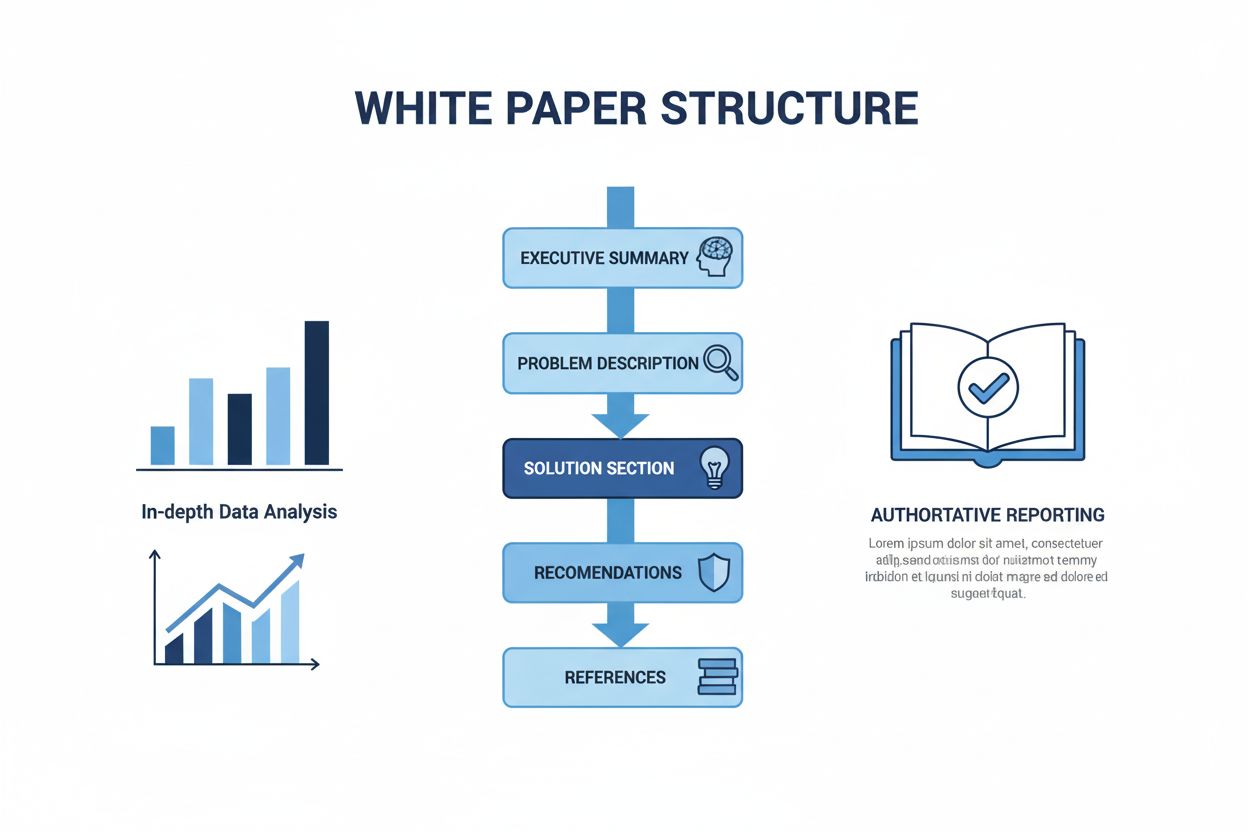
Discover what a white paper is, its role in B2B marketing, structure, and how organizations use authoritative reports to establish thought leadership and genera...
Cookie Consent
We use cookies to enhance your browsing experience and analyze our traffic. See our privacy policy.