


Google URL Inspection Results
URL Inspection calls the Google Search Console URL inspection API to surface Google’s live index status, mobile usability and rich-results verdict for a single URL, and builds an index coverage sample of your busiest pages that fills in a little more every time you return.
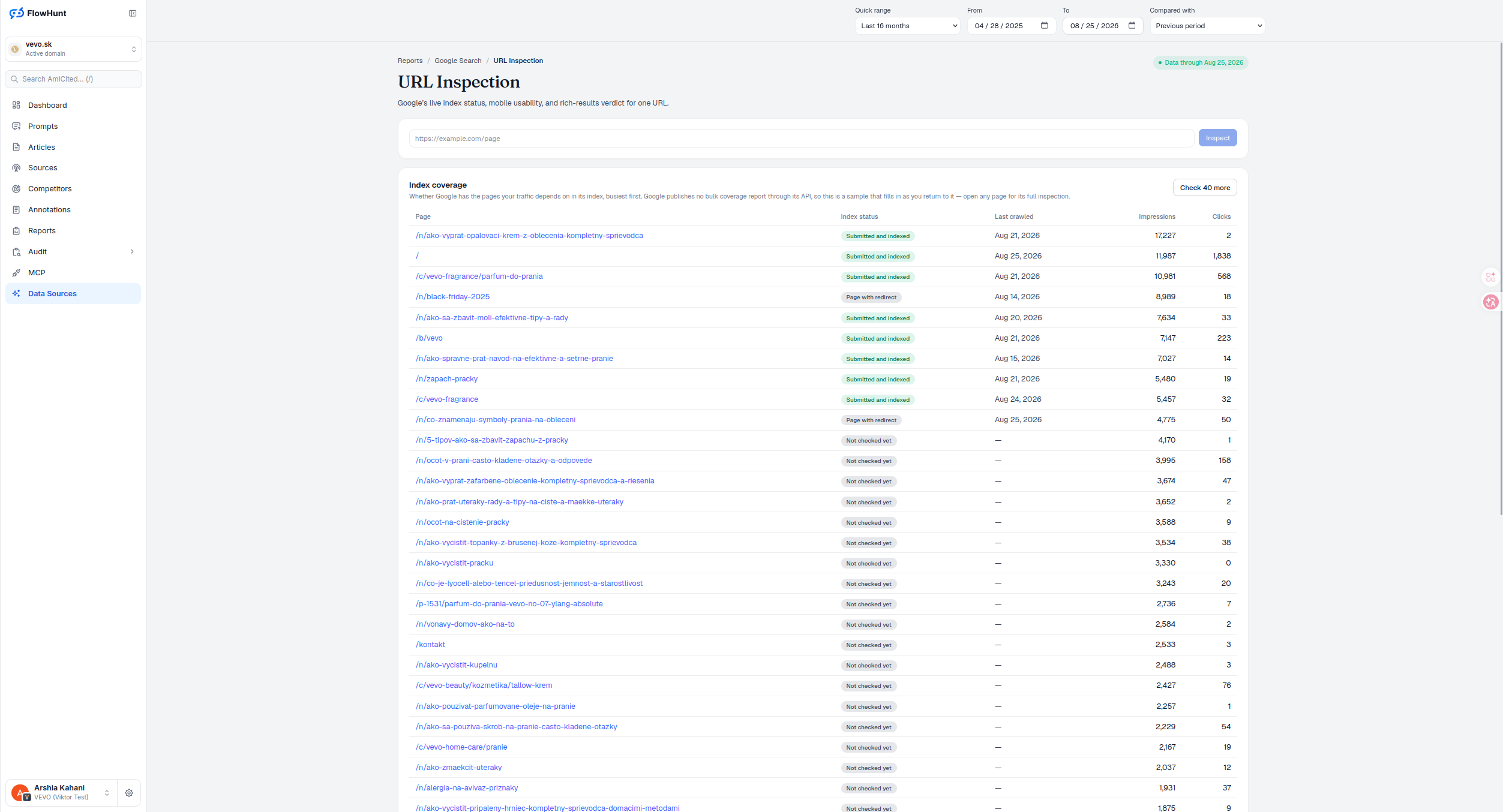
Google URL Inspection Sampling
Google publishes no bulk coverage report through its API, so Index coverage is a quota-bounded sample of up to the 50 highest-impression pages in the selected period — up to ten uncached URLs inspected per request, five at a time, with a pending count showing how many listed pages are still unchecked. Open any page for its full inspection, or use Check 40 more to pull the next batch.
- Single-URL inspect — an input field and Inspect button for Google’s live index status, mobile usability and rich-results verdict on one URL.
- Index coverage sample — up to the 50 highest-impression pages, busiest first, since no bulk coverage endpoint exists to check them all at once.
- Ten uncached URLs per request, five at a time — Check 40 more repeats the bounded pass rather than trying to fetch everything at once.
- Five columns — Page, Index status, Last crawled, Impressions, Clicks, so a coverage gap can be weighed against how much traffic the page already gets.
- Index status values — Submitted and indexed (green), Page with redirect (grey), Not checked yet (grey) is distinct from Not indexed — read at a glance before opening any single page.
Google Index Status Checks
Busiest first: the sample fills in as you return to it, and Check 40 more pulls the next batch on demand. A blocked or failed page can’t benefit from snippet or content tuning until the technical cause is fixed, so start here before opening any single page for its full inspection.
- Page, Index status, Last crawled, Impressions, Clicks — the five columns for every sampled page.
- Submitted and indexed (green) — the page is in Google’s index as expected.
- Page with redirect (grey) — the URL redirects; check the destination is what you intend.
- Not checked yet (grey) — distinct from Not indexed: Google simply has not evaluated this URL yet.
- Check 40 more — the incremental sampling action, since no bulk endpoint exists to load them all at once.
Google URL Inspection Verdicts
A normal visit reads a cached result and shows when it was last inspected; Refresh bypasses the cache, calls Google directly, and overwrites what’s stored. Treat canonical warnings as consequential — Google may be crediting and ranking a different URL than the one in front of you — and weigh structured-data errors against warnings before assuming a rich result is guaranteed.
- PASS, FAIL, PARTIAL, NEUTRAL — four independent verdict chips for Google’s index, mobile usability, rich results and AMP; PASS is good, FAIL is bad, PARTIAL is a warning.
- Canonical disagreement flagged — when Google’s chosen canonical differs from the page’s declared one, or points away from the inspected URL entirely.
- Core Web Vitals from CrUX — LCP, INP, CLS, FCP and TTFB from the URL’s own 28-day field data, or an origin-level fallback clearly labeled when the URL itself has too little traffic.
- Every schema.org node found — grouped by type with object, error and warning totals, collapsed three levels deep; errors are worse than warnings, and detected markup with no issues means eligible, not guaranteed to render.
- Cached until you Refresh — a normal visit reads the stored result; Refresh bypasses the cache, calls Google directly, and overwrites what’s stored.
more pages pulled into the sample with each Check 40 more click
Google’s API has no bulk coverage report, so Index coverage builds itself incrementally, busiest pages first, filling in further every time you return.
See Countries and DevicesCheck Google URL Index Status
Live index status, mobile usability and rich-results verdict for one URL, plus an incrementally-built index coverage sample of your busiest pages.
Ready to see what Google actually knows about a page?
Free check · 7-day trial · card required