


At-Risk Customers
At-risk customers are previously active buyers who show signs of disengaging, typically identified by a longer-than-usual gap since their last purchase relative to their historical buying pattern. Identifying this group early lets a merchant intervene with targeted outreach before the customer churns entirely.
Definition of At-Risk Customers
At-risk customers are shoppers who were previously active buyers but have started showing signs of disengagement — most commonly, a purchase gap that’s longer than their own historical buying rhythm would predict. The concept comes from RFM analysis (Recency, Frequency, Monetary value), where a customer who once bought frequently and recently but has now gone quiet on the recency dimension gets flagged before they fully churn. The distinction that matters is relative: a customer who buys once a year isn’t at-risk after four months of silence, but a customer who reliably buys monthly is a meaningful warning sign after the same four months.
How At-Risk Status Is Identified
Most segmentation approaches score customers on recency (how long since their last order) and frequency (how often they historically order), then flag anyone whose recency has slipped well past what their frequency history would predict as normal.
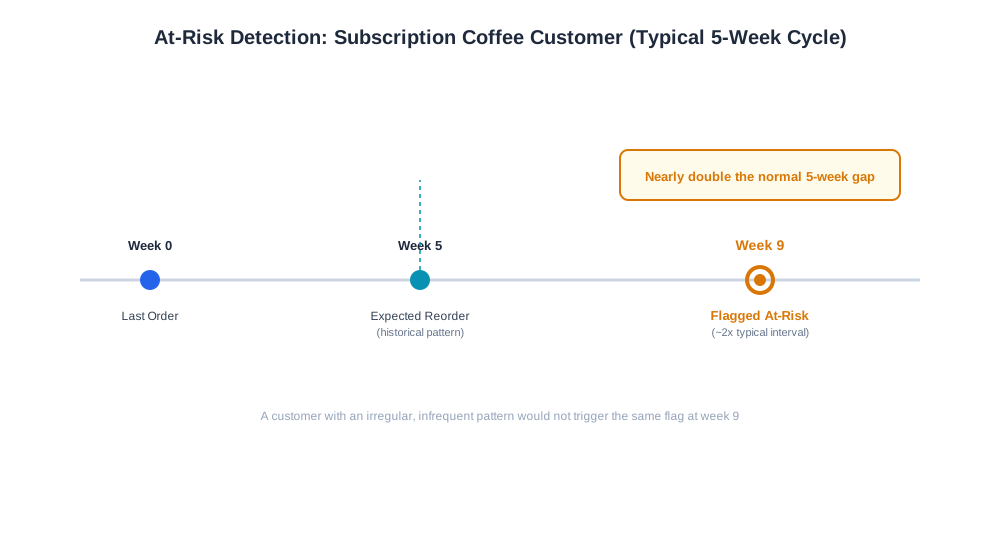
Worked example: a subscription coffee retailer has a customer who ordered every five weeks for the past year — a clear, consistent pattern. At week nine since their last order, with no new purchase, that customer crosses into “at-risk” territory, since it’s nearly double their typical reorder interval. A different customer with a much less frequent, irregular buying pattern wouldn’t trigger the same flag at nine weeks, because nine weeks isn’t unusual relative to their own history.

Ready to Monitor Your AI Visibility?
Track how AI chatbots mention your brand across ChatGPT, Perplexity, and other platforms.
Why At-Risk Customers Matter for E-commerce Brands
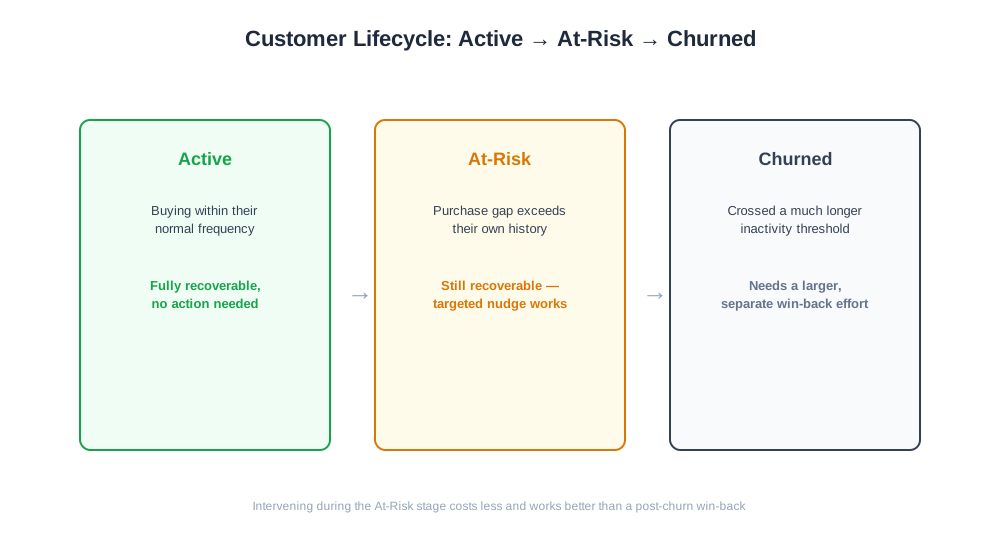
Retaining an existing customer is reliably cheaper than acquiring a new one, which makes the at-risk window one of the highest-leverage moments in the customer lifecycle to intervene. Once a customer fully churns, winning them back typically requires a much larger incentive and a lower success rate than a well-timed nudge sent while they’re merely slowing down. Identifying this segment specifically — rather than treating all inactive customers the same — lets a merchant prioritize outreach toward the customers most likely to respond to a timely reminder, rather than spreading a generic win-back campaign across everyone who hasn’t purchased recently regardless of their prior engagement level.
At-Risk Customers and AI-Driven Commerce
At-risk segmentation doesn’t have a direct AI-shopping-assistant mechanism, but it connects to a broader shift: as more repeat-purchase behavior gets mediated through AI shopping assistants rather than direct site visits, a lapsing customer might simply be reordering through a different channel — an AI assistant handling a routine repurchase — rather than genuinely disengaging from the brand. Distinguishing a truly at-risk customer from one who has just shifted how they reorder is a nuance worth watching for as agentic commerce grows.
AmICited’s eshop_get_segments tool applies RFM-style segmentation directly to a connected store’s order history, surfacing an at-risk bucket without requiring the merchant to build the recency-frequency logic themselves. That gives merchants a ready list to target with win-back campaigns before those customers fully lapse into the churned category.
Stay Updated on AI Visibility Trends
Get the latest insights on AI mentions, brand monitoring, and optimization strategies.
Best Practices for At-Risk Customers
- Base at-risk thresholds on each customer’s own historical buying frequency, not a single fixed inactivity window applied to everyone
- Prioritize outreach to at-risk customers with high historical monetary value, since they represent the most revenue at stake
- Personalize win-back messaging around the customer’s actual past purchases rather than sending a generic discount blast
- Recalculate the at-risk segment on a regular cadence, since status shifts continuously with time
- Track how many at-risk customers are successfully re-engaged versus how many progress to fully churned, to gauge whether outreach is working
Common At-Risk Customer Mistakes
A common mistake is applying a single fixed inactivity threshold — like “no purchase in 90 days” — to the entire customer base, which misses genuinely at-risk frequent buyers while unnecessarily flagging naturally infrequent ones. Another frequent issue is treating the at-risk segment the same as fully churned customers, sending a lower-effort, less personalized message when a more targeted nudge is still likely to work. Some merchants build the segment once and never refresh it, so outreach ends up targeting customers whose status has already changed since the list was last calculated. It’s also common to skip measuring whether win-back efforts actually work, running the same campaign repeatedly without ever confirming it improves reactivation compared to no outreach at all.