


B2B Ecommerce
B2B ecommerce (business-to-business ecommerce) is the online sale of goods or services between businesses, rather than from a business directly to an individual consumer. It typically involves larger order values, negotiated pricing, bulk quantities, and longer sales cycles than consumer ecommerce. Common examples include wholesale distributors, manufacturers selling to retailers, and SaaS platforms selling to other companies.
Definition of B2B Ecommerce
B2B ecommerce refers to the buying and selling of goods or services between businesses through an online sales channel, as opposed to B2C ecommerce, which sells directly to individual consumers. A B2B transaction might involve a hardware manufacturer selling components to an appliance maker, a food distributor selling bulk inventory to independent grocery stores, or a software company selling seats to another company’s finance team. What unites these examples isn’t the product category but the buyer: in B2B ecommerce, the purchasing decision is typically made by an organization, often involving multiple stakeholders, a formal approval process, and a purchase justified by business need rather than individual preference. This structural difference shapes nearly every part of how a B2B ecommerce site is built and operated, from pricing display to checkout flow.
How B2B Ecommerce Differs from B2C
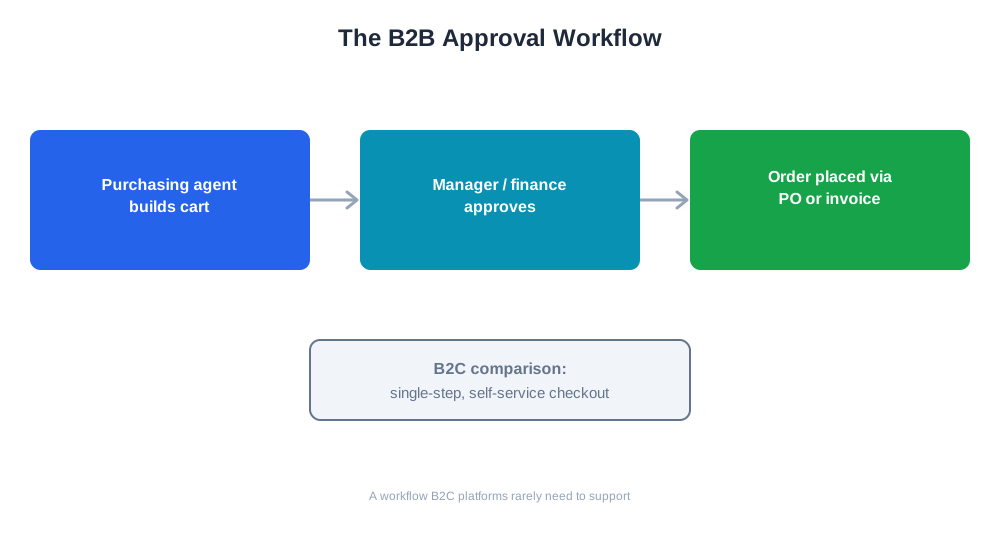
The most visible differences show up at checkout and pricing. B2C stores typically show one price to every visitor and expect payment by card at the point of sale. B2B stores frequently show negotiated or volume-tiered pricing that varies by account, sometimes hiding prices entirely until a buyer logs into their company account. Order sizes in B2B tend to be larger and less frequent — a single order might represent months of inventory rather than a single household’s purchase — and payment terms often include invoicing with net-30 or net-60 terms rather than immediate card capture. B2B buying also frequently involves more than one person: a purchasing agent might build a cart, but a manager or finance team approves it before the order is placed, a workflow B2C platforms rarely need to support. Because of these differences, B2B ecommerce platforms typically add features like customer-specific catalogs and pricing, quote-request workflows, reorder tools for repeat purchases, and purchase-order-based payment options that a standard consumer storefront doesn’t include.

Ready to Monitor Your AI Visibility?
Track how AI chatbots mention your brand across ChatGPT, Perplexity, and other platforms.
Why B2B Ecommerce Matters
Businesses purchasing from other businesses increasingly expect the same convenience they get as consumers — self-service browsing, transparent (if account-specific) pricing, and instant online ordering rather than a phone call or an emailed order form. Companies that move their wholesale or distribution relationships online typically see faster order cycles and lower per-order administrative cost, since a self-service reorder doesn’t require a sales rep to manually process a purchase order. At the same time, B2B ecommerce operations tend to carry more complexity than B2C: managing tiered pricing across hundreds of accounts, supporting bulk order minimums, and integrating with each buyer’s own procurement systems all add operational overhead that a purely consumer-facing store doesn’t have to handle.
B2B Ecommerce vs. B2C Ecommerce
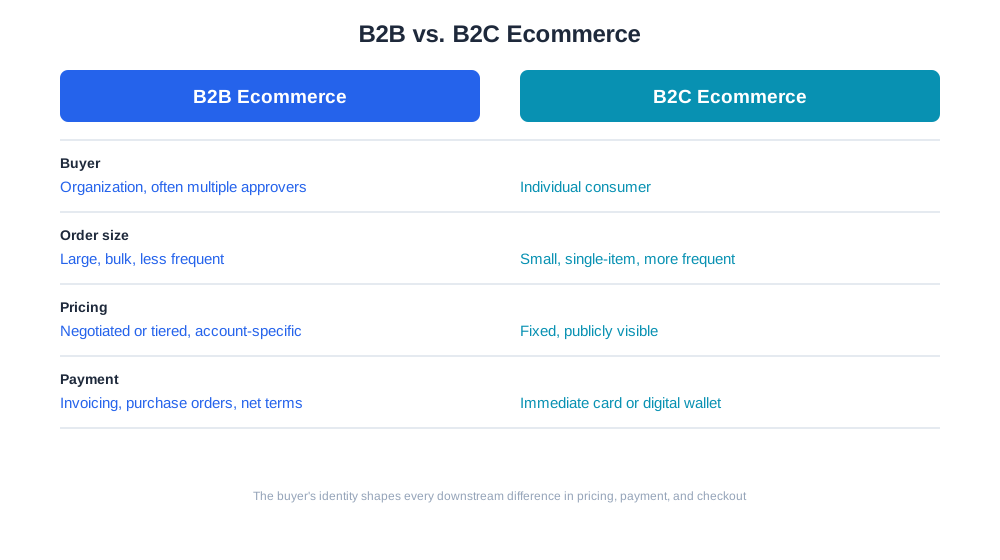
| Factor | B2B Ecommerce | B2C Ecommerce |
|---|---|---|
| Buyer | Organization, often multiple approvers | Individual consumer |
| Order size | Large, bulk, less frequent | Small, single-item, more frequent |
| Pricing | Negotiated or tiered, often account-specific | Fixed, publicly visible |
| Payment | Invoicing, purchase orders, net terms | Immediate card or digital wallet payment |
| Sales cycle | Days to months, often involves a quote | Minutes, typically self-service |
| Checkout complexity | Multi-step, may need approval workflow | Single-step, optimized for speed |
Stay Updated on AI Visibility Trends
Get the latest insights on AI mentions, brand monitoring, and optimization strategies.
B2B Ecommerce and AI-Driven Commerce
As procurement teams begin using AI tools to research suppliers and compare vendor options, B2B sellers face a version of the same visibility challenge consumer brands face with AI shopping assistants: if a company’s product catalog and pricing structure aren’t represented clearly in structured, machine-readable form, they’re harder for an AI research tool to surface accurately during vendor comparison. This is pushing some B2B sellers toward the same kind of structured product data and clear public-facing information that consumer ecommerce SEO has relied on for years, even though the actual purchase still typically happens through a negotiated account relationship rather than an anonymous checkout. On the analytics side, a B2B seller with recurring wholesale accounts benefits from the same reporting discipline as a consumer store — tracking margin by account and by SKU, watching for accounts whose order frequency is slipping, and reconciling invoiced revenue against what was actually delivered, all of which map directly onto the same segmentation and cost-reporting concepts consumer ecommerce analytics already uses.
Best Practices for B2B Ecommerce
- Build account-specific pricing and catalogs rather than forcing every buyer through a single public price list
- Support purchase-order and invoice-based payment alongside card payment, since many B2B buyers can’t pay by card at all
- Offer fast reorder tools for recurring purchases, since B2B buyers often reorder the same items repeatedly
- Make quote requests and bulk-order minimums clear early in the buying flow rather than surfacing them only at checkout
- Track account-level metrics — order frequency, average order value, margin — the same way a consumer store tracks customer-level metrics
- Keep public-facing product information accurate and structured, even when actual pricing is gated behind login
Common B2B Ecommerce Mistakes
A frequent mistake is porting a B2C storefront to B2B with only cosmetic changes, leaving out account-specific pricing or purchase-order payment support entirely — buyers who can’t see their negotiated rate or pay the way their finance department requires will often fall back to calling a sales rep, defeating the point of moving online at all. Another common issue is failing to support bulk or split-case ordering cleanly, forcing B2B buyers to add the same SKU to a cart one unit at a time; adding quantity-based ordering and case-pack logic resolves most of this friction. A third mistake is neglecting reorder tooling — B2B buyers frequently purchase the same items on a recurring basis, and a store without a one-click reorder or saved-cart feature pushes buyers toward manually rebuilding the same order every cycle, increasing the odds they eventually just email a rep instead. Finally, some B2B sellers under-invest in account-level reporting, tracking only aggregate revenue rather than watching for individual accounts whose order frequency or size is quietly declining — by the time a decline shows up in overall revenue, an at-risk account has often already been lost to a competitor.