


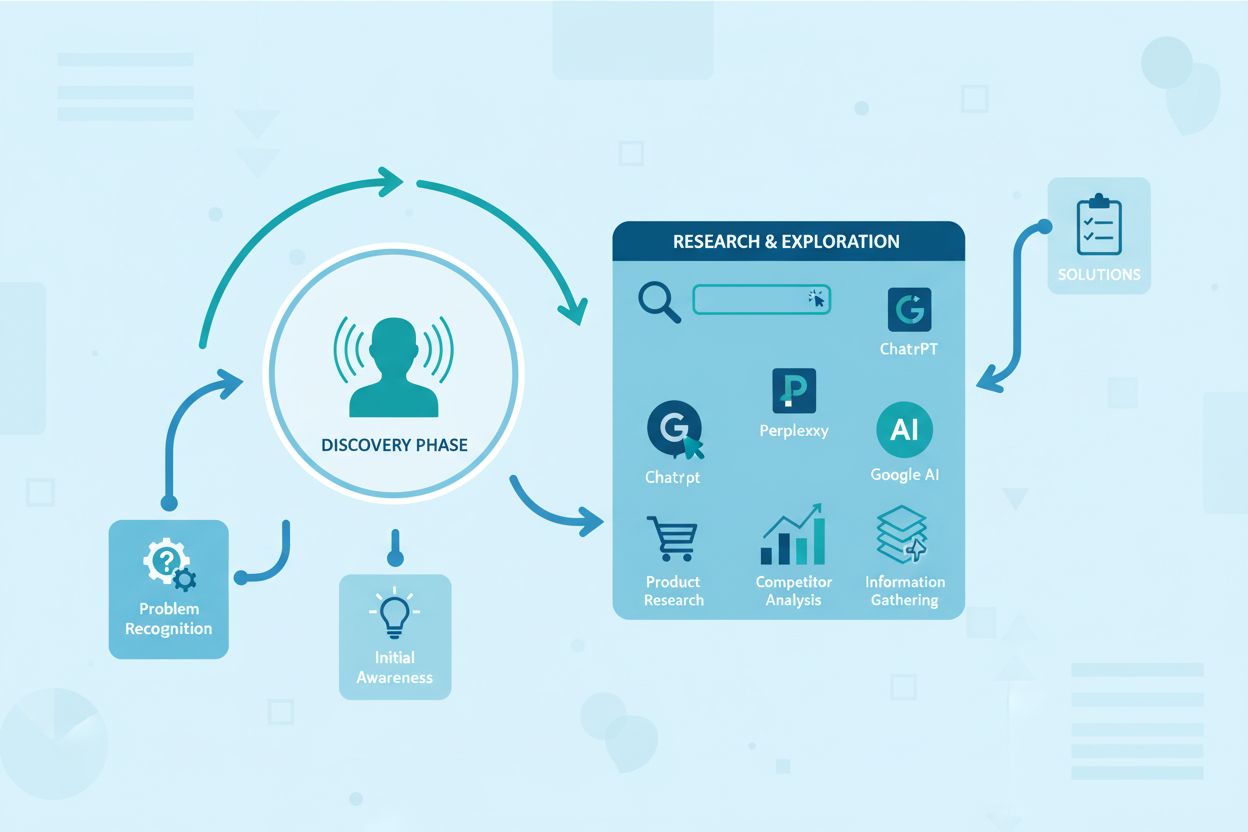
Discovery Phase
Learn what the Discovery Phase is, why it matters for AI visibility, and how brands can optimize their presence during this critical initial awareness stage of ...
10 min read

The comparison phase is the stage in the consumer decision-making process where buyers actively evaluate and compare multiple alternatives based on specific criteria, features, benefits, and value propositions before making a final purchase decision. This phase, also known as the evaluation of alternatives or active evaluation stage, is critical for determining which option best meets the consumer’s needs and expectations.
The comparison phase is the stage in the consumer decision-making process where buyers actively evaluate and compare multiple alternatives based on specific criteria, features, benefits, and value propositions before making a final purchase decision. This phase, also known as the evaluation of alternatives or active evaluation stage, is critical for determining which option best meets the consumer's needs and expectations.
The comparison phase, also known as the evaluation of alternatives or active evaluation stage, is the third critical stage in the consumer decision-making process where buyers actively evaluate and compare multiple product or service alternatives they have identified during the information search stage. During this phase, consumers systematically assess the pros and cons of each option, weigh features against their specific needs, review customer ratings and testimonials, and determine which alternative offers the best overall value. This phase represents a fundamental shift from broad exploration to focused evaluation, where consumers narrow down their consideration sets and move closer to making a final purchase decision. The comparison phase is where brands compete most directly for consumer preference, and understanding this stage is essential for both traditional marketing and modern AI-driven brand monitoring strategies.
The concept of the comparison phase has evolved significantly over the past century as consumer behavior and available information sources have transformed. The foundational five-stage consumer decision-making model, first articulated by John Dewey in 1910, identified evaluation of alternatives as a distinct stage in the purchasing process. However, the nature and complexity of this stage have changed dramatically with technological advancement. In the pre-digital era, consumers compared alternatives through limited channels: asking friends and family, consulting printed catalogs, visiting physical stores, or reading newspaper advertisements. The comparison process was time-consuming, geographically constrained, and heavily dependent on brand advertising to shape perceptions.
The emergence of the internet fundamentally transformed the comparison phase. According to Google’s “Decoding Decisions” research on the messy middle of purchase behavior, the internet evolved from a tool for comparing prices to a tool for comparing everything—features, quality, sustainability, ethics, and more. This shift reflects what researchers call the transition from “cheap” to “best” as the dominant consumer modifier in search queries. Between 2004 and 2020, search interest in “cheap” steadily declined while interest in “best” increased with impressive negative correlation, suggesting that consumers increasingly prioritize quality and comprehensive evaluation over simple price comparison. This evolution indicates that the comparison phase has become more sophisticated and multifaceted, requiring consumers to process vastly more information and evaluate more complex criteria than ever before.

Track how AI chatbots mention your brand across ChatGPT, Perplexity, and other platforms.
Contemporary consumer decision-making frameworks have refined our understanding of the comparison phase. McKinsey’s consumer decision journey model introduced the concept of the “active evaluation” phase, which acknowledges that modern consumers don’t move linearly through decision stages but rather loop between exploration and evaluation multiple times. Google’s research identified this looping behavior as the “messy middle”—a space where consumers seamlessly switch between expanding their consideration sets (exploration) and narrowing down options (evaluation). This model reveals that the comparison phase is not a single, discrete moment but rather an iterative process where consumers may evaluate options, return to exploration for more information, and then re-evaluate based on new findings.
The distinction between exploration and evaluation is cognitively important. When exploring, consumers add brands, products, and category information to their mental portfolios, expanding their options. When evaluating, they reduce those options through systematic comparison. Research using behavioral science frameworks shows that these are distinct mental modes with different reward systems, requiring different marketing tactics. During exploration, consumers seek inspiration and broad information; during evaluation, they seek reassurance and clarity. Understanding which mode a consumer is in during the comparison phase is crucial for delivering relevant messaging and information that will influence their decision.
The intensity and duration of the comparison phase varies significantly across product categories based on complexity, cost, and emotional investment. High-involvement purchases—such as homes, vehicles, mortgages, and major appliances—typically involve extended comparison phases where consumers invest substantial time evaluating multiple alternatives, consulting expert reviews, and carefully weighing financial implications. Research from Google’s simulation of 310,000 purchase scenarios across 31 product categories revealed that financial services products (mortgages, credit cards, car insurance) and travel services showed greater susceptibility to preference switching during the comparison phase, suggesting that consumers engage in more active evaluation in these categories.
Conversely, low-involvement purchases—such as everyday consumer packaged goods, groceries, and routine supplies—often involve abbreviated comparison phases. Consumers may rely on habit, brand familiarity, or quick heuristics rather than detailed evaluation. However, even in these categories, the comparison phase can be activated by triggers such as price promotions, new product launches, or changes in personal circumstances. The research also found that certain FMCG brands (fast-moving consumer goods) like shampoo and detergent showed surprising resilience to competitor alternatives, with only 25% of consumers willing to switch when a second-choice brand was introduced—yet when that second-choice brand was “supercharged” with all six behavioral biases (social proof, authority, scarcity, power of free, power of now, and category heuristics), preference shifted dramatically to 90%, demonstrating the power of effective comparison phase strategies.
Get the latest insights on AI mentions, brand monitoring, and optimization strategies.
| Evaluation Criterion | Definition | Importance Level | Example |
|---|---|---|---|
| Product Features & Specifications | Technical attributes, capabilities, and performance metrics | High | Megapixels in cameras, storage capacity in laptops, horsepower in vehicles |
| Price & Total Cost of Ownership | Purchase price plus ongoing costs (maintenance, subscriptions, repairs) | High | Initial cost vs. long-term value; warranty coverage; financing options |
| Customer Reviews & Ratings | Aggregated feedback from previous buyers; star ratings and testimonials | Very High | 4.5-star average rating; detailed user reviews on G2, Capterra, or Amazon |
| Brand Reputation & Authority | Established credibility, industry recognition, and expert endorsements | High | Awards, certifications, expert reviews from trusted publications |
| Warranty & Return Policies | Protection and recourse if product fails or doesn’t meet expectations | Medium-High | 30-day money-back guarantee; extended warranty options; hassle-free returns |
| Delivery Speed & Convenience | How quickly product arrives and ease of purchase process | Medium | Next-day delivery, same-day shipping, in-store pickup options |
| Sustainability & Ethics | Environmental impact, labor practices, corporate social responsibility | Medium | Carbon-neutral shipping, fair-trade certification, ethical sourcing |
| Social Proof & Peer Recommendations | Evidence that others have chosen and are satisfied with the option | Very High | “Trusted by 10,000+ customers”; influencer endorsements; peer reviews |
| Compatibility & Integration | How well product works with existing systems or other products | Medium-High | Software compatibility, ecosystem integration, API availability |
| Customer Support & Service | Quality and availability of post-purchase assistance | Medium | 24/7 customer service, live chat support, comprehensive documentation |
Social proof emerges as the most powerful behavioral influence during the comparison phase across virtually all product categories. Google’s research testing six major cognitive biases across 31 product categories found that social proof—expressed through customer reviews, ratings, and testimonials—had either the largest or second-largest effect on preference shifting in 28 of 31 categories tested. This finding aligns with broader consumer behavior research showing that 93% of consumers report that reading reviews is crucial to their purchasing decisions, and that positive reviews can increase conversion rates by up to 270%.
The power of social proof during the comparison phase operates through multiple mechanisms. First, reviews reduce perceived risk by providing evidence that others have successfully used the product and achieved desired outcomes. Second, aggregated ratings (such as 4.5 out of 5 stars) serve as cognitive shortcuts, allowing consumers to quickly assess quality without reading detailed information. Third, detailed user reviews provide specific, relatable information about real-world usage that consumers find more credible than brand marketing claims. Fourth, the sheer volume of reviews signals popularity and market validation. During the comparison phase, consumers actively seek out review sites like G2, Capterra, Trustpilot, and industry-specific platforms to inform their evaluations. Brands that actively encourage customer reviews, respond to feedback, and maintain high average ratings gain significant competitive advantages during this critical stage.
The emergence of generative AI platforms like ChatGPT, Perplexity, Google AI Overviews, and Claude is fundamentally transforming how the comparison phase operates. Traditionally, consumers conducted comparisons by visiting multiple websites, review sites, and comparison platforms. Now, an increasing proportion of consumers—particularly in B2B contexts where 60-70% of research happens before vendor engagement—are using AI systems as their primary tool for comparing alternatives. These AI systems can instantly synthesize information from across the web, provide personalized comparisons based on stated preferences, and offer recommendations tailored to individual needs.
This shift has profound implications for brand visibility and positioning during the comparison phase. When a consumer asks ChatGPT or Perplexity to “compare the top project management tools” or “what’s the best CRM for small businesses,” the AI system’s response directly influences which brands are considered and how they are positioned relative to competitors. Brands that don’t appear in AI-generated comparisons effectively lose consideration during this critical stage. Furthermore, how AI systems represent a brand—whether emphasizing strengths or weaknesses, whether including accurate pricing and features—significantly impacts consumer perception. This is where AI monitoring platforms like AmICited become essential, allowing brands to track their visibility, positioning, and representation across AI platforms during the comparison phase.
Beyond social proof, several other cognitive biases significantly influence consumer decisions during the comparison phase. Category heuristics—mental shortcuts based on key product attributes—proved to be the second-most powerful bias in Google’s research, achieving the largest or second-largest effect in 14 of 31 product categories. For example, when evaluating broadband providers, highlighting unlimited monthly usage shifted preference away from first-choice brands. In financial services, specific terms like “28-month fixed rate” for mortgages or “no-claims protection” for car insurance proved decisive in shifting preferences.
Authority bias describes the tendency to follow the recommendations of perceived experts or credible sources. During the comparison phase, consumers actively seek expert endorsements, industry awards, and reviews from authoritative publications. Research found that endorsements from impartial sources (such as Which? in the UK) carried more weight than industry-specific publications. Scarcity bias leverages the principle that limited or rare resources are more desirable, though research found this to be less effective during the comparison phase than other biases, potentially because scarcity messaging can feel restrictive to consumers still in evaluation mode.
The power of free and power of now biases also influence comparison-phase decisions. Offering free services, free shipping, or free trials can significantly shift preference, particularly in high-involvement categories. Similarly, promises of rapid delivery (next-day or same-day shipping) influence decisions in categories where convenience matters, such as FMCG products and clothing. When brands combine multiple biases—offering free shipping, displaying five-star reviews, highlighting expert endorsements, and emphasizing limited availability—the cumulative effect can be dramatic, with research showing preference shifts of 70-90% away from initially preferred brands.
While the fundamental mechanisms of the comparison phase apply across B2B and B2C contexts, important differences exist in how evaluation occurs and what criteria matter most. In B2B purchasing, the comparison phase typically involves multiple stakeholders with different priorities: procurement focuses on price and terms, technical teams evaluate features and integration capabilities, and executives assess ROI and strategic fit. B2B comparison phases are generally longer and more formal, often involving detailed RFP (Request for Proposal) processes, product demonstrations, and reference calls with existing customers.
B2B buyers increasingly rely on specialized platforms for comparison, including industry-specific review sites (G2, Capterra, Software Advice), analyst reports (Gartner, Forrester), and peer networks (LinkedIn, industry forums). The comparison phase in B2B is heavily influenced by social proof in the form of case studies, customer testimonials, and analyst recognition. In contrast, B2C comparison phases are typically shorter, more individual, and increasingly influenced by consumer reviews, influencer recommendations, and social media discussions. B2C consumers often make comparison-phase decisions based on emotional factors and lifestyle alignment in addition to rational product attributes.
Successful brands employ multiple strategies to win consumer preference during the comparison phase. Differentiation through clear value propositions is fundamental—brands must articulate what makes them distinctly better than alternatives in ways that matter to target consumers. This requires deep understanding of competitor offerings and consumer priorities. Transparency in pricing and features reduces friction during evaluation; consumers appreciate clear, honest information that allows easy comparison. Brands that hide pricing, obscure features, or make comparison difficult lose consideration.
Risk reduction through guarantees and policies addresses a key consumer concern during the comparison phase: “What if I make the wrong choice?” Money-back guarantees, extended warranties, hassle-free return policies, and trial periods all reduce perceived risk and make choosing a brand feel safer. Visibility on review platforms and AI systems ensures brands are present when consumers are actively comparing. This includes maintaining profiles on major review sites, encouraging customer reviews, and ensuring accurate product information is available for AI systems to access and cite.
Simplification of the evaluation process through comparison tools, side-by-side feature matrices, and interactive configurators helps consumers make decisions more efficiently. Brands that make comparison easy—whether through their own tools or by being easily comparable on third-party platforms—gain advantages. Addressing common objections proactively during the comparison phase, through FAQ sections, detailed product documentation, and comparison guides, helps overcome hesitations. Finally, strategic positioning relative to competitors through messaging that highlights unique strengths while acknowledging where competitors excel (if true) builds credibility and trust.
Building out comparison-phase coverage is a sequencing problem, not a single content project. Start by mapping which of the ten evaluation criteria—features, price, reviews, brand authority, warranty, delivery, sustainability, social proof, compatibility, support—actually move the needle in your category; a mortgage buyer weighs financial terms and warranty language differently than someone buying detergent, so don’t build generic comparison assets before this step. Next, audit your review coverage across the platforms your buyers actually check (G2, Capterra, Trustpilot, or category-specific sites), since 93% of consumers say reviews are crucial to their decision and this is typically the highest-leverage criterion to fix first. Third, build or update comparison tables and feature matrices that map your offering against named alternatives on the criteria identified in step one—not a generic feature list. Fourth, add risk-reduction mechanisms directly into comparison-facing pages: money-back guarantees, warranty terms, and return policies, since these directly counter the “what if I choose wrong” hesitation that keeps buyers in the comparison phase longer. Fifth, if you sell B2B, add case studies and reference materials suited to RFP-style evaluation, since B2B comparison phases run longer and involve more stakeholders than B2C. Sixth, instrument tracking so you can see which comparison assets correlate with conversion, then retire or rewrite the ones that don’t. Finally, re-audit quarterly, since evaluation criteria and competitor positioning shift faster than most comparison content gets updated.
Start tracking how AI chatbots mention your brand across ChatGPT, Perplexity, and other platforms. Get actionable insights to improve your AI presence.
Learn what the Discovery Phase is, why it matters for AI visibility, and how brands can optimize their presence during this critical initial awareness stage of ...
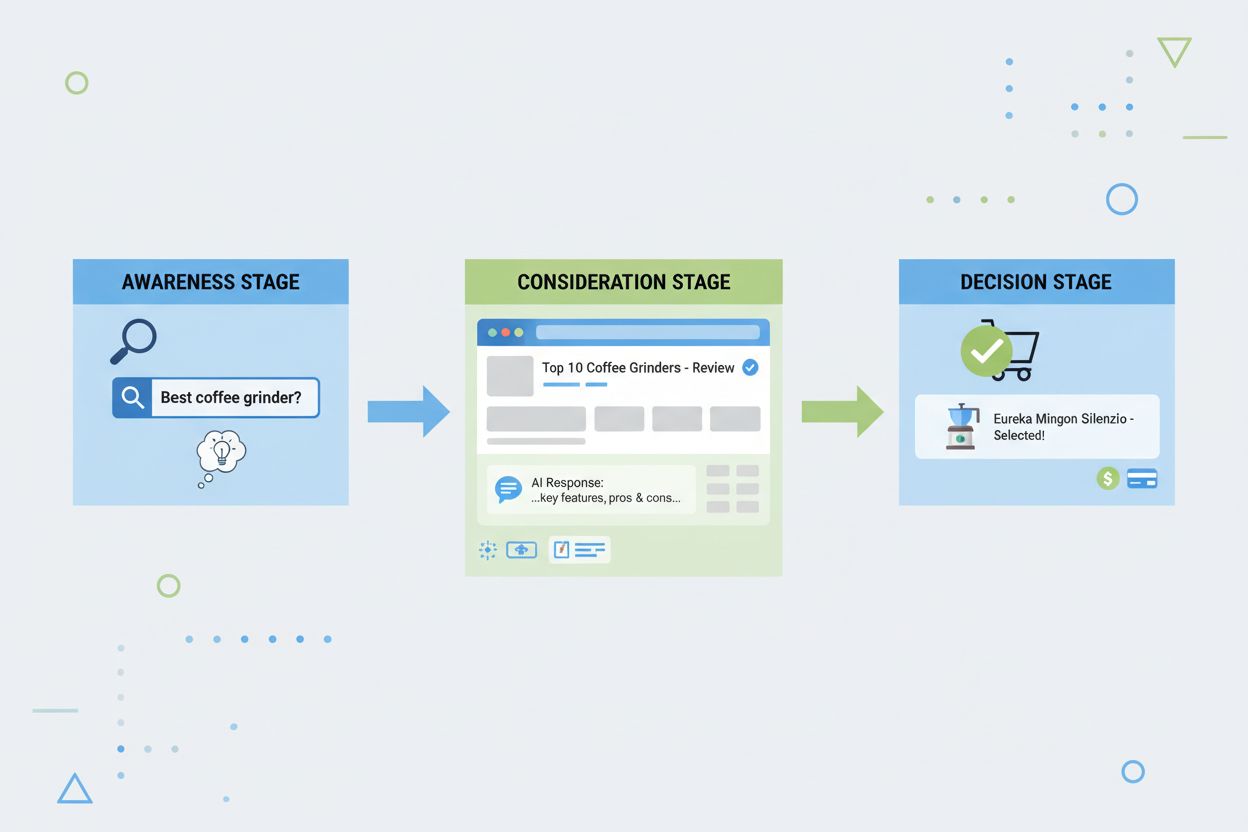
Learn what a search journey is, how users navigate through awareness, consideration, and decision stages, and why monitoring search journeys matters for brand v...
Cookie Consent
We use cookies to enhance your browsing experience and analyze our traffic. See our privacy policy.