


Customer Health Score
A customer health score is a composite metric that combines multiple behavioral and transactional signals — like purchase frequency, recency, engagement, and support history — into a single indicator of how likely a customer is to stay, churn, or grow their spending. It gives businesses an early warning system for at-risk customers before they actually leave.
Definition of Customer Health Score
A customer health score is a composite metric that blends multiple behavioral and transactional signals into a single number or rating meant to indicate how healthy a customer relationship is — whether that customer is likely to keep buying, grow their spending, go quiet, or churn entirely. Rather than relying on any single data point, a health score typically combines recency and frequency of purchases, engagement with marketing communications, trends in order value, and sometimes support interaction history, into one composite indicator. The concept originated in subscription software businesses, where predicting churn before it happens is central to retention strategy, but it has become increasingly relevant to e-commerce brands, particularly those with subscription, replenishment, or loyalty programs where an ongoing customer relationship — not just a single transaction — is the unit of value being managed.
How a Customer Health Score Is Calculated
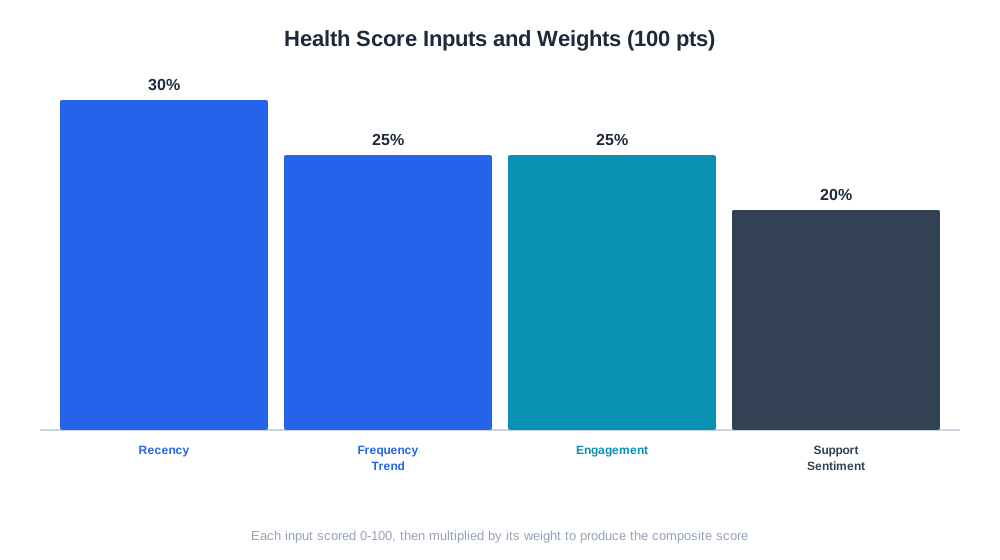
Building a customer health score starts with selecting the signals that actually correlate with retention for a given business, since the right inputs vary by business model. A typical e-commerce health score might weight recency of last purchase heavily, since a customer who hasn’t ordered in months is a stronger churn risk than one who ordered last week; purchase frequency trend, since a customer whose order cadence is slowing shows early risk even before they stop entirely; engagement metrics like email open and click rates, since disengagement from marketing often precedes disengagement from purchasing; and support interaction sentiment, since an unresolved complaint is a strong predictor of attrition. Each signal is typically normalized to a common scale and combined into a weighted score, often expressed as a number from 0 to 100 or a simple categorical label like healthy, at risk, or critical.
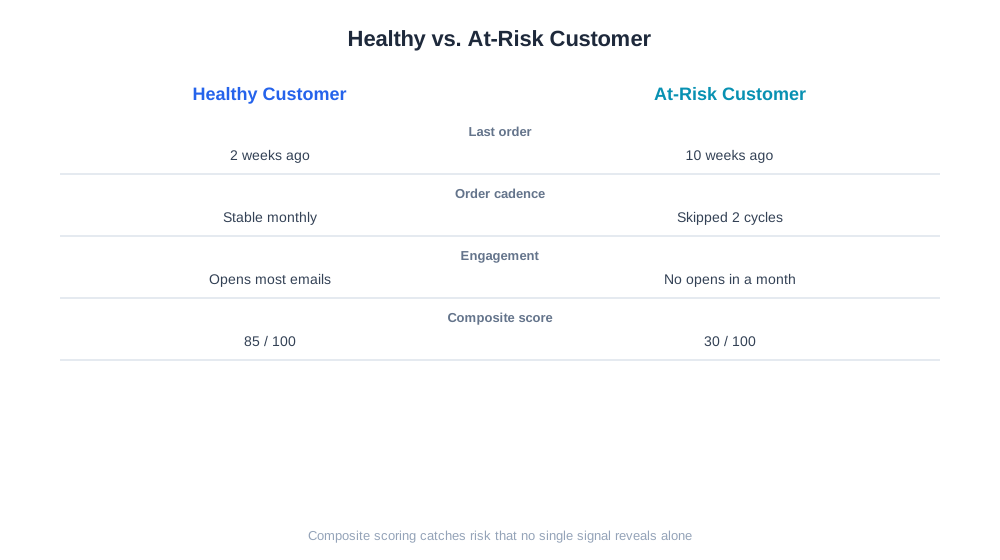
A simplified example: a subscription coffee brand builds a health score from four weighted inputs — recency (30 percent), frequency trend (25 percent), engagement (25 percent), and support sentiment (20 percent). A customer who ordered two weeks ago (strong recency), has maintained a consistent monthly order cadence (stable frequency), opens most marketing emails (strong engagement), and has no recent support tickets (neutral sentiment) might score around 85 out of 100 — clearly healthy. A different customer who last ordered ten weeks ago, skipped their last two expected replenishment cycles, hasn’t opened an email in a month, and recently filed a complaint about a delayed shipment might score around 30 — a clear churn risk warranting proactive outreach before the relationship is lost entirely.

Ready to Monitor Your AI Visibility?
Track how AI chatbots mention your brand across ChatGPT, Perplexity, and other platforms.
Why Customer Health Score Matters for E-commerce Brands
Acquiring a new customer is almost always more expensive than retaining an existing one, which makes early detection of at-risk customers one of the highest-leverage activities a retention team can perform. A customer health score turns retention from a reactive process — responding to cancellations or complaints after they happen — into a proactive one, surfacing customers who are trending toward disengagement while there’s still time to intervene with a win-back offer, a personal outreach, or a diagnostic survey. It also helps prioritize limited retention resources: a business with a large customer base can’t personally reach out to everyone, but a health score lets a team focus effort on the segment where intervention is both most needed and most likely to succeed, rather than spreading retention budget evenly across a customer base with wildly different actual risk levels.
Health Score Signal Categories
| Signal Category | Example Inputs | What It Reveals |
|---|---|---|
| Transactional recency and frequency | Days since last order, order cadence trend | Whether purchasing behavior is stable, accelerating, or slowing |
| Engagement | Email opens, site visits, app usage | Whether the customer is still paying attention to the brand |
| Monetary trend | Average order value change over time | Whether the customer’s relative value is growing or shrinking |
| Support and sentiment | Ticket volume, complaint resolution, review sentiment | Whether unresolved friction is likely driving disengagement |
Stay Updated on AI Visibility Trends
Get the latest insights on AI mentions, brand monitoring, and optimization strategies.
Customer Health Score and AI-Driven Retention Analytics
Building a reliable customer health score by hand — pulling purchase history, engagement metrics, and support data from separate systems and manually scoring each customer — becomes impractical past a small customer base, which is why most modern implementations rely on automated segmentation and tracking rather than manual review. AmICited’s eshop_get_segments and eshop_get_segment_transitions tools group customers into behavioral segments based on their store activity and track how customers move between those segments over time, which is functionally the same underlying idea as a health score: identifying which customers are moving toward a healthier, more engaged segment and which are drifting toward disengagement or churn, before that drift shows up as a canceled subscription or a lapsed customer. This segment-transition view gives a merchant an early, ongoing signal rather than a one-time snapshot, since a customer sliding from a “frequent buyer” segment toward a “lapsed” segment over several weeks is exactly the pattern a health score is designed to catch. As AI-driven personalization becomes more common in retention marketing, feeding accurate health and segment signals into those systems also determines whether a win-back campaign reaches the right customer with the right message at the right time, rather than a generic offer sent too late.
Best Practices for Customer Health Score
- Validate that the signals used in the score actually correlate with real churn for your business before trusting the composite number, since a health score built on assumptions rather than evidence can misprioritize retention effort.
- Recalculate scores frequently enough that declining engagement is caught within days or weeks, not discovered a full quarter later when the customer has already effectively left.
- Weight signals based on their actual predictive strength for your specific customer base, rather than applying a generic weighting scheme borrowed from an unrelated industry.
- Pair the score with a clear playbook of interventions matched to why a given customer is scoring low, since a support-driven low score needs a different response than a simple engagement decline.
- Track whether interventions triggered by a low health score actually improve outcomes over time, and adjust the model if a segment consistently churns despite intervention.
Common Customer Health Score Mistakes
A frequent mistake is building a health score around only transactional data — recency, frequency, and spend — while ignoring engagement and support signals, missing early warning signs that show up in behavior before they show up in a lapsed purchase. Another common problem is setting static thresholds for what counts as “at risk” without validating them against actual churn outcomes, which can produce a score that flags far too many or far too few customers as risky to act on efficiently. Some businesses also let health scores go stale, recalculating only monthly or quarterly when meaningful drift in customer behavior can happen much faster, by which point the intervention window has already closed. It’s also common to treat a low health score as a reason to blast a generic discount offer rather than diagnosing the actual cause of disengagement, which can train customers to expect discounts as the default retention lever rather than addressing the underlying issue — a support complaint, a product problem, or a genuine loss of interest each warrant a different response. Finally, businesses sometimes build a health score once and never revisit whether it’s still predictive as the business, product mix, and customer base evolve, leading to a metric that quietly loses its usefulness while still being reported as if it were reliable.