



Travel Industry AI Visibility: Destination and Booking Recommendations
Learn how travel brands can improve visibility in AI-powered search results. Discover strategies for optimizing destination and booking recommendations in ChatG...
11 min read
Hospitality AI Presence refers to the visibility and prominence of hotels, restaurants, and travel brands in AI-generated recommendations from platforms like ChatGPT, Perplexity, and Google AI Overviews. It represents how effectively a hospitality property appears when travelers ask conversational questions to AI tools during their planning process. Unlike traditional SEO that focuses on search rankings, Hospitality AI Presence is about being cited and recommended within AI-generated answers. This has become critical as travelers increasingly replace traditional search engines with generative AI for trip planning and booking decisions.
Hospitality AI Presence refers to the visibility and prominence of hotels, restaurants, and travel brands in AI-generated recommendations from platforms like ChatGPT, Perplexity, and Google AI Overviews. It represents how effectively a hospitality property appears when travelers ask conversational questions to AI tools during their planning process. Unlike traditional SEO that focuses on search rankings, Hospitality AI Presence is about being cited and recommended within AI-generated answers. This has become critical as travelers increasingly replace traditional search engines with generative AI for trip planning and booking decisions.
Hospitality AI Presence refers to the visibility and prominence of hotels, restaurants, and travel brands in AI-generated recommendations and answers from platforms like ChatGPT, Perplexity, Google AI Overviews, and Claude. Unlike traditional search engine optimization that focuses on ranking in Google’s blue links, Hospitality AI Presence is about ensuring your property appears when travelers ask conversational questions to AI tools during their planning process. As travelers increasingly replace traditional search engines with generative AI for trip planning, being visible in these AI-generated answers has become critical for hospitality businesses seeking direct bookings and brand awareness.
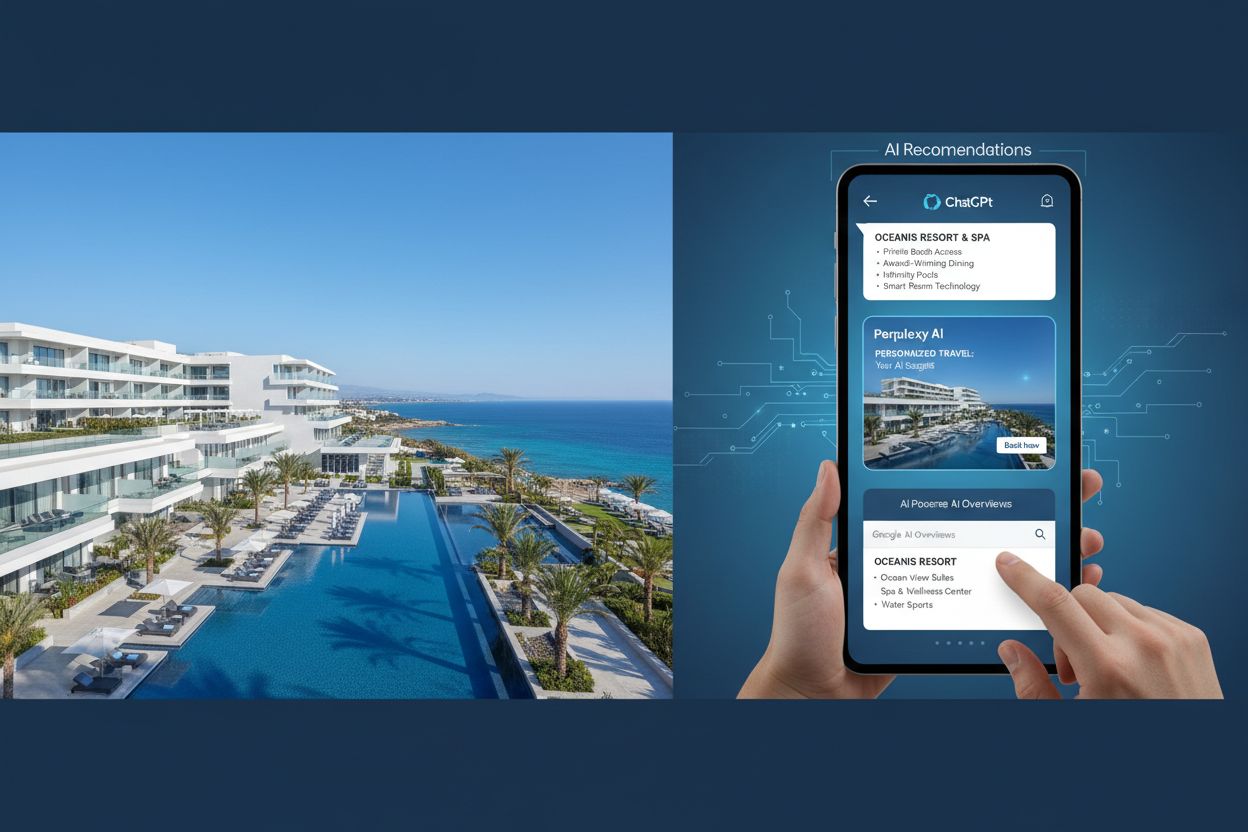
The travel and hospitality industry is experiencing a fundamental shift in how consumers discover accommodations and dining experiences. According to recent data, traffic from AI sources to U.S. travel and hospitality sites surged 1,700% between July 2023 and February 2024, demonstrating the explosive growth of AI-driven discovery. Today, 22.8% of travelers have already used AI for travel planning, with 34.4% intending to use it in the future. By 2025, 15% of Americans actively use AI tools like ChatGPT for trip planning, and this adoption spans all age groups—from Gen Z and Millennials (nearly 1 in 4) to Gen X (13%) and even Boomers (6%). Most significantly, 46% of AI users explore accommodation options through these platforms, and 42% have actually booked based on AI recommendations, making this a direct revenue channel for hospitality businesses.
| Aspect | Traditional Search | AI Search |
|---|---|---|
| Query Type | Keywords (“hotels in Paris”) | Conversational questions (“Best family hotels in Paris near museums?”) |
| Results Format | List of ranked links | Personalized narrative answer with citations |
| User Intent | Browsing and comparing | Seeking specific recommendations |
| Citation Method | Ranking determines visibility | AI selects trusted sources to cite |
| Discovery Speed | Multiple clicks required | Instant, direct answer |
AI systems don’t evaluate hospitality properties the same way traditional search engines do. Instead of relying primarily on backlinks and keyword rankings, AI engines assess multiple trust signals to determine which properties deserve mention in their recommendations. These signals include structured data and schema markup that clearly label your amenities, pricing, and policies; content authority demonstrated through comprehensive, detailed descriptions that answer specific guest questions; review quality and quantity from trusted platforms like TripAdvisor, Google, and Booking.com; technical performance including fast loading speeds and mobile optimization; and consistency across platforms where your property information aligns across your website, Google Business Profile, OTAs, and social media. AI systems also prioritize natural language content that mirrors how travelers actually speak, rather than corporate marketing jargon, making conversational FAQ sections and detailed amenity descriptions particularly valuable for visibility.
Generative Engine Optimization (GEO) is the strategic process of optimizing your hospitality property’s online presence specifically for AI-powered recommendation systems. While traditional SEO focuses on ranking in search results, GEO focuses on being cited and recommended within AI-generated answers. The distinction is crucial: a hotel might rank #1 on Google but never appear in ChatGPT recommendations, or vice versa. GEO requires a different approach because AI systems prioritize trustworthiness, comprehensiveness, and natural language over keyword density and backlink profiles. For hospitality businesses, implementing GEO strategies means restructuring website content, adding structured data, building authority through reviews and citations, and ensuring your property information is easily discoverable and verifiable by AI systems. This emerging discipline is becoming as essential as traditional SEO was in the 1990s and 2000s.
The foundation of Hospitality AI Presence is AI-friendly content architecture—how you organize and present information on your website and across digital platforms. AI systems excel at extracting information from well-structured, detailed content that directly answers guest questions. Rather than generic descriptions like “luxury accommodations,” AI prefers specific details: “Our ocean-view suites feature private balconies with outdoor soaking tubs, perfect for watching sunsets, each with a personal concierge and complimentary champagne service at check-in.” Your website should include comprehensive FAQ sections addressing real guest questions about parking, pet policies, check-in times, accessibility features, and amenities. Create destination guides and local authority content that positions your property as a trusted resource for the area. Use natural, conversational language that mirrors how travelers actually ask questions, and organize information under clear, descriptive headings that match common search queries.
Content Best Practices for AI Visibility:
Beyond content, technical optimization is essential for AI visibility. Schema markup (structured data) is code that explicitly labels information on your pages—telling AI systems “this is a hotel,” “this is a room type,” “this is a price,” and “this is a review.” Implementing schema for your property details, room types, amenities, FAQs, reviews, and pricing significantly increases the likelihood that AI systems will cite your property accurately in recommendations. Core Web Vitals—page speed, interactivity, and visual stability—matter because AI systems prioritize user experience and won’t recommend slow, frustrating websites. Ensure your website is mobile-optimized since most travelers research on phones, and make sure key content is crawlable (not hidden behind JavaScript or paywalls). Using Google’s Structured Data Markup Helper or Schema.org templates, you can generate the necessary code and validate it with Google’s Rich Results Test before implementation.
AI systems heavily weight authority and trustworthiness when deciding which properties to recommend. Guest reviews are particularly influential—AI platforms frequently cite review content from TripAdvisor, Google, and Booking.com, so encouraging detailed reviews that mention specific amenities and experiences is crucial. Backlinks from authoritative sources like tourism boards, travel blogs, local media, and industry publications signal to AI that your property is trustworthy. Maintain a complete and consistent Google Business Profile with accurate NAP (name, address, phone) information, high-quality photos, and regular updates. Establish local citations on tourism websites, event guides, and destination directories. Build a strong multi-platform presence on LinkedIn, Facebook, YouTube, and Reddit, where AI systems frequently source information. The more your property is mentioned across credible sources with consistent, accurate information, the more likely AI systems will trust and recommend you.
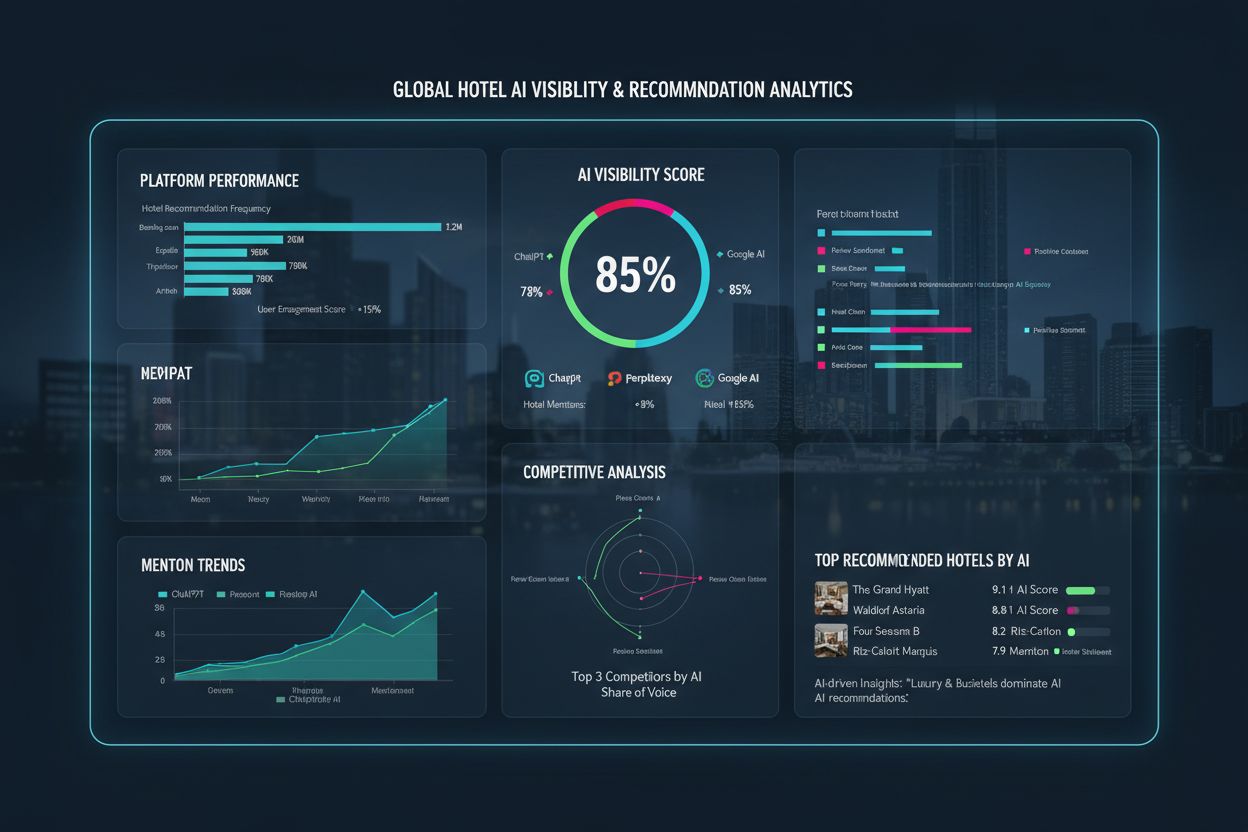
Unlike traditional SEO where you can track rankings in Google Search Console, monitoring AI visibility requires different tools and metrics. You should regularly test your property against target queries across multiple AI platforms—ChatGPT, Perplexity, Google AI Overviews, and Claude—to see if and how you’re mentioned. Track brand mention frequency across AI platforms over time, noting whether mentions are increasing or decreasing. Monitor the quality and context of citations—are you mentioned by name with accurate details, or only as part of a generic list? Use tools like Rankscale or similar AI visibility trackers to benchmark your performance against competitors. Key metrics include query coverage (percentage of target questions where you appear), citation accuracy, traffic from AI sources, and competitive positioning. AmICited.com provides specialized monitoring for how AI systems reference your brand across different platforms, helping you understand your AI visibility landscape.
Restaurants and food service establishments face unique opportunities and challenges in AI visibility. When travelers ask “What are the best restaurants in Barcelona with Michelin stars and vegetarian options?” or “Where can I find authentic Thai food near my hotel?”, AI systems need detailed, accurate information about cuisine types, dietary accommodations, price ranges, and dining experiences. Restaurants should create comprehensive cuisine and menu descriptions that go beyond generic categories—describe signature dishes, cooking techniques, ingredient sourcing, and dining atmosphere. Develop detailed FAQ content addressing dietary restrictions, reservation policies, dress codes, and special occasion accommodations. Build local dining authority through partnerships with food bloggers, travel guides, and local media. Encourage detailed reviews that mention specific dishes, service quality, and ambiance. Integrate with food delivery platforms and reservation systems that AI systems frequently reference. Maintain consistent information across Google Business Profile, Yelp, TripAdvisor, and your website, as AI systems cross-reference these sources to verify accuracy.
The landscape of Hospitality AI Presence will continue evolving as AI technology advances. Agentic AI—AI systems that don’t just answer questions but take actions like booking hotels and reserving restaurants—is emerging and will fundamentally change how travelers discover and book accommodations. Hotels that establish strong AI visibility now will benefit from direct booking integration with these agentic systems, potentially bypassing OTAs entirely. Personalization will deepen, with AI systems learning individual traveler preferences and making increasingly tailored recommendations. The competitive advantage will shift toward properties that establish early authority in their markets, as AI systems learn to trust and prioritize certain sources. Properties that invest in GEO strategies today—building comprehensive content, structured data, and multi-platform authority—will dominate AI recommendations in their categories. The hospitality industry is at an inflection point where AI visibility is becoming as important as traditional search visibility, and early movers will capture disproportionate market share in this new discovery channel.
Track how AI platforms like ChatGPT, Perplexity, and Google AI Overviews reference your hotel or restaurant. Get insights into your AI visibility and competitive positioning.
Learn how travel brands can improve visibility in AI-powered search results. Discover strategies for optimizing destination and booking recommendations in ChatG...

Community discussion on AI search in travel industry. Tour operators, hotels, and travel agencies share strategies for appearing in AI trip planning recommendat...
Learn proven strategies to encourage customer reviews and boost your brand's visibility in AI search results. Discover how reviews influence AI-generated answer...
Cookie Consent
We use cookies to enhance your browsing experience and analyze our traffic. See our privacy policy.