


Product Information Management
Product Information Management (PIM) is a system and set of processes for centrally managing product data — descriptions, specifications, images, pricing, and attributes — before distributing it consistently across sales channels. A PIM acts as a single source of truth so a store's website, marketplace listings, and print catalogs all show accurate, synchronized product information.
Definition of Product Information Management
Product Information Management, commonly abbreviated PIM, is a system and set of practices for centrally storing, managing, and distributing product data across every channel a business sells through. Rather than maintaining separate, independently edited copies of product descriptions on a website, a marketplace listing, and a print catalog, a PIM holds a single master record for each product — its title, description, technical specifications, images, pricing, and variant attributes — and pushes updates out to every connected channel from that one source. The core idea is a single source of truth: when a spec changes or a new photo is added, it’s updated once in the PIM and syndicated everywhere, rather than requiring someone to manually edit the same information in five different places and risk them drifting out of sync.
How Product Information Management Works
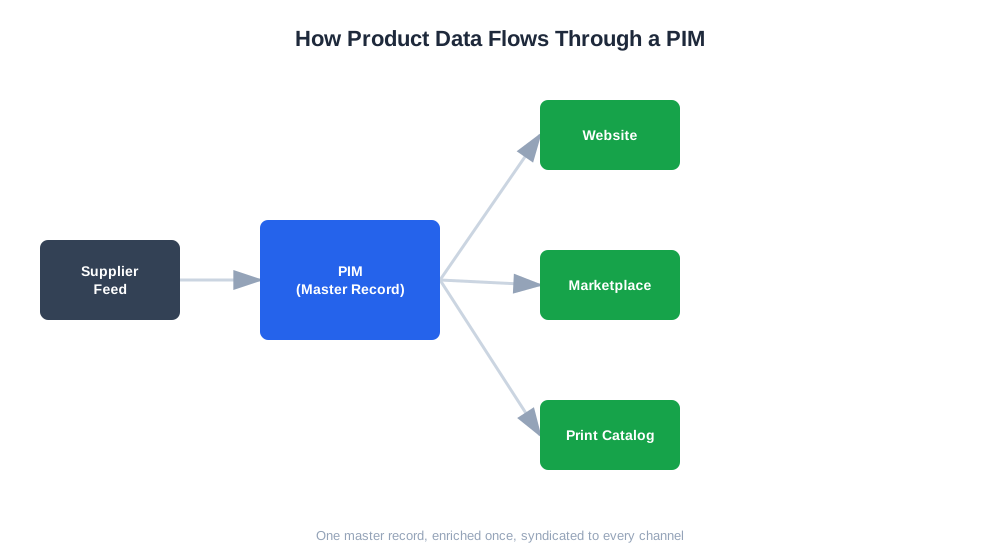
A PIM typically sits between the systems that generate raw product data — an ERP, a supplier feed, a photography workflow — and the channels that display that data to customers, such as a website, a marketplace storefront, a marketing email platform, or a print catalog. Product data flows into the PIM, gets enriched and standardized (adding missing attributes, correcting inconsistent units of measurement, translating descriptions for different markets), and then flows out to each channel in the format that channel requires. A single sneaker SKU, for example, might need a full narrative description and lifestyle images for the brand’s own website, a stripped-down title-and-bullet-point format for a marketplace listing, and a metric-unit specification sheet for a European retail partner — a PIM manages all three outputs from one enriched master record rather than three separately maintained copies.
A practical illustration: a home goods brand launches a new ceramic mug in five colorways across its own site, three marketplaces, and a wholesale catalog for retail partners. Without a PIM, someone manually enters dimensions, materials, care instructions, and images into eight different systems, and a typo in one — say, the wrong capacity in ounces — persists until someone happens to notice it. With a PIM, that same data is entered once, validated against required fields, and distributed automatically, so a correction made in the master record propagates to all eight destinations without additional manual work.

Ready to Monitor Your AI Visibility?
Track how AI chatbots mention your brand across ChatGPT, Perplexity, and other platforms.
Why Product Information Management Matters for E-commerce Brands
Inconsistent or incomplete product data is a quiet but persistent source of lost sales and returns. A customer who receives a product that doesn’t match a listing’s dimensions or materials because two channels showed different specifications is more likely to return it and less likely to trust the brand again. As a catalog grows and a business expands into more sales channels, the manual effort required to keep product data synchronized grows non-linearly — a ten-SKU catalog on one channel is manageable in a spreadsheet, but a thousand-SKU catalog across five channels becomes error-prone and labor-intensive without centralized tooling. Complete, well-structured product data also directly affects discoverability: search engines and marketplace algorithms both reward listings with full, accurate attribute data, and incomplete listings tend to rank and convert worse simply because they answer fewer of a shopper’s questions.
PIM vs. Related Systems
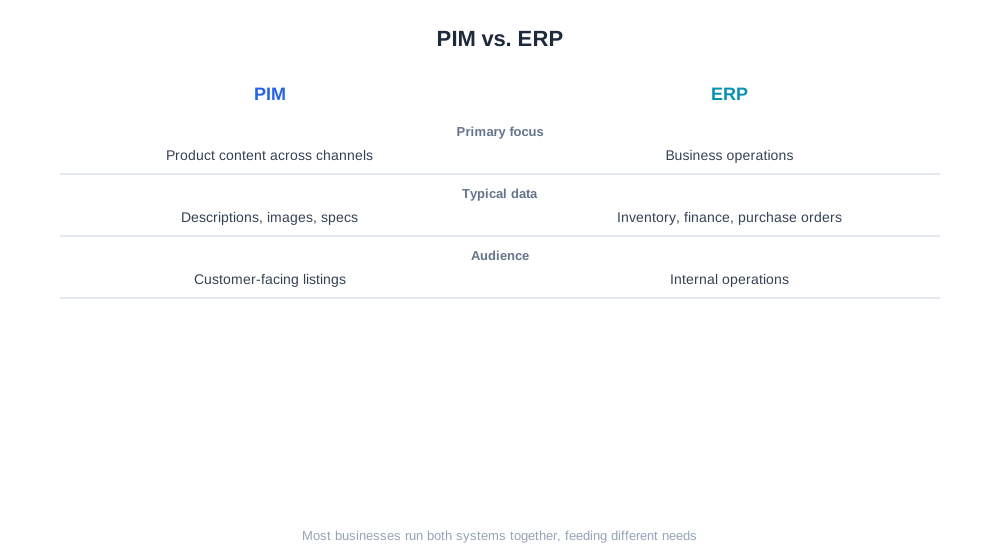
| System | Primary Focus | Typical Data Managed |
|---|---|---|
| PIM | Product content across channels | Descriptions, images, specs, attributes, pricing |
| ERP | Business operations | Inventory levels, finance, purchase orders |
| DAM (Digital Asset Management) | Media files | Images, videos, brand assets |
| CMS (Content Management System) | Website content | Pages, blog posts, layout, some product display logic |
Stay Updated on AI Visibility Trends
Get the latest insights on AI mentions, brand monitoring, and optimization strategies.
Product Information Management and AI-Driven Product Discovery
As AI shopping assistants like ChatGPT Shopping, Perplexity Shopping, and Amazon’s Rufus increasingly answer product questions directly rather than sending a shopper to browse a listing themselves, the completeness and consistency of a brand’s underlying product data has become more important, not less. These systems draw on structured product information to answer specific comparison questions — material, dimensions, compatibility, care instructions — and a product with sparse or contradictory data across channels is far more likely to be described incorrectly or skipped entirely in favor of a competitor with richer, more consistent information. A well-run PIM is effectively the foundation that makes accurate product schema markup and complete AI-readable product descriptions possible at scale, since generating structured data manually for thousands of SKUs is impractical without a centralized system holding the underlying facts. Brands investing in AI visibility increasingly need to treat their PIM not just as an internal efficiency tool but as the data layer that determines how correctly and completely AI systems can represent their products to potential customers.
Best Practices for Product Information Management
- Define a standard set of required attributes for each product category before onboarding new SKUs, so gaps are caught at data entry rather than discovered after a listing goes live.
- Establish a single owner or team responsible for the master product record, to prevent conflicting edits from different departments creating inconsistencies.
- Automate distribution to sales channels wherever the platforms support it, rather than manually re-entering the same data across each destination.
- Audit product listings periodically against the PIM’s master record to catch channel-specific drift, especially on marketplaces where sellers sometimes lose control over how their listing content is displayed.
- Include AI and search visibility as a consideration when defining data completeness standards, not just internal operational needs.
Common Product Information Management Mistakes
A common mistake is treating the PIM rollout purely as a technical project without also fixing the underlying data quality — migrating years of inconsistent, incomplete product records into a new system just moves the same problems into a nicer interface rather than solving them. Another frequent issue is failing to define ownership clearly, leading to a PIM where multiple teams edit product data with no agreed process, recreating the same drift and inconsistency the system was meant to prevent. Some businesses also under-invest in the enrichment step, populating only the bare minimum fields a channel requires rather than building out complete, detailed attribute data that would also improve search and AI visibility — this shows up later as listings that technically function but underperform against more thoroughly described competitor products. It’s also common to treat channel-specific formatting requirements as an afterthought, discovering only after launch that a marketplace rejects listings missing a specific required field, which creates a scramble to patch data that should have been captured at the source. Finally, businesses sometimes fail to maintain the PIM after initial setup, letting new products get added with incomplete data because the enforcement rules that worked during the initial migration weren’t carried forward into everyday operations.