



How to Optimize Service Pages for AI Search Engines
Learn proven strategies to optimize your service pages for AI search engines like ChatGPT, Perplexity, and Google AI Overviews. Improve visibility and citations...
9 min read

Professional Services AI Optimization refers to strategic approaches that consultants, agencies, and service providers use to increase their visibility and citations in AI-generated responses from platforms like ChatGPT, Perplexity, and Google AI Overviews. It involves optimizing content, establishing thought leadership, and implementing monitoring strategies to ensure professional expertise appears prominently when AI systems answer client-related questions. This practice is essential for service-based businesses to attract high-value clients and demonstrate authority in their field. Unlike traditional SEO, AI optimization for professional services focuses on how AI systems interpret and recommend expertise rather than search rankings.
Professional Services AI Optimization refers to strategic approaches that consultants, agencies, and service providers use to increase their visibility and citations in AI-generated responses from platforms like ChatGPT, Perplexity, and Google AI Overviews. It involves optimizing content, establishing thought leadership, and implementing monitoring strategies to ensure professional expertise appears prominently when AI systems answer client-related questions. This practice is essential for service-based businesses to attract high-value clients and demonstrate authority in their field. Unlike traditional SEO, AI optimization for professional services focuses on how AI systems interpret and recommend expertise rather than search rankings.
Professional Services AI Optimization represents a fundamental shift in how service-based businesses achieve visibility and attract clients in an increasingly AI-driven discovery landscape. Unlike traditional search engine optimization that focuses on ranking for keywords in Google’s organic results, AI optimization targets the algorithms powering conversational AI platforms like ChatGPT, Perplexity, Google AI Overviews, and Claude. Professional services—including consulting, legal, accounting, design, and freelance expertise—differ significantly from product-based businesses because clients evaluate them based on demonstrated expertise, thought leadership, and credibility rather than product features. The importance of positioning yourself as an authority in your field has never been greater, as AI systems now determine which professionals and firms appear in responses to client queries. According to recent research, 62% of professional services firms have adopted AI tools in their operations, yet fewer than 15% have optimized their visibility within AI-generated responses. The distinction between traditional SEO and AI optimization lies in the fundamental difference: traditional SEO optimizes for search algorithms that rank pages, while AI optimization optimizes for citation algorithms that recommend specific experts and firms as authoritative sources within conversational responses.
Professional services firms face a critical business imperative to establish visibility within AI systems because this is where potential clients increasingly discover solutions to their problems. When a prospect asks ChatGPT, “Who should I hire for digital transformation consulting?” or queries Perplexity about “best practices for tax planning,” the AI systems that respond determine which firms receive visibility and credibility. Research indicates that 71% of B2B decision-makers now use AI tools during their research phase, making AI visibility a primary driver of qualified leads for professional services. The competitive advantage belongs to early adopters who establish their presence and authority within these systems before the market becomes saturated with competitors. The cost of invisibility in AI responses is substantial—firms that don’t appear in AI recommendations lose not just direct inquiries but also the credibility boost that comes from being cited as an authoritative source. Early data suggests that professionals cited in AI responses experience a 35-50% increase in qualified inquiries compared to those with no AI visibility, making this optimization effort a critical business development investment.

Track how AI chatbots mention your brand across ChatGPT, Perplexity, and other platforms.
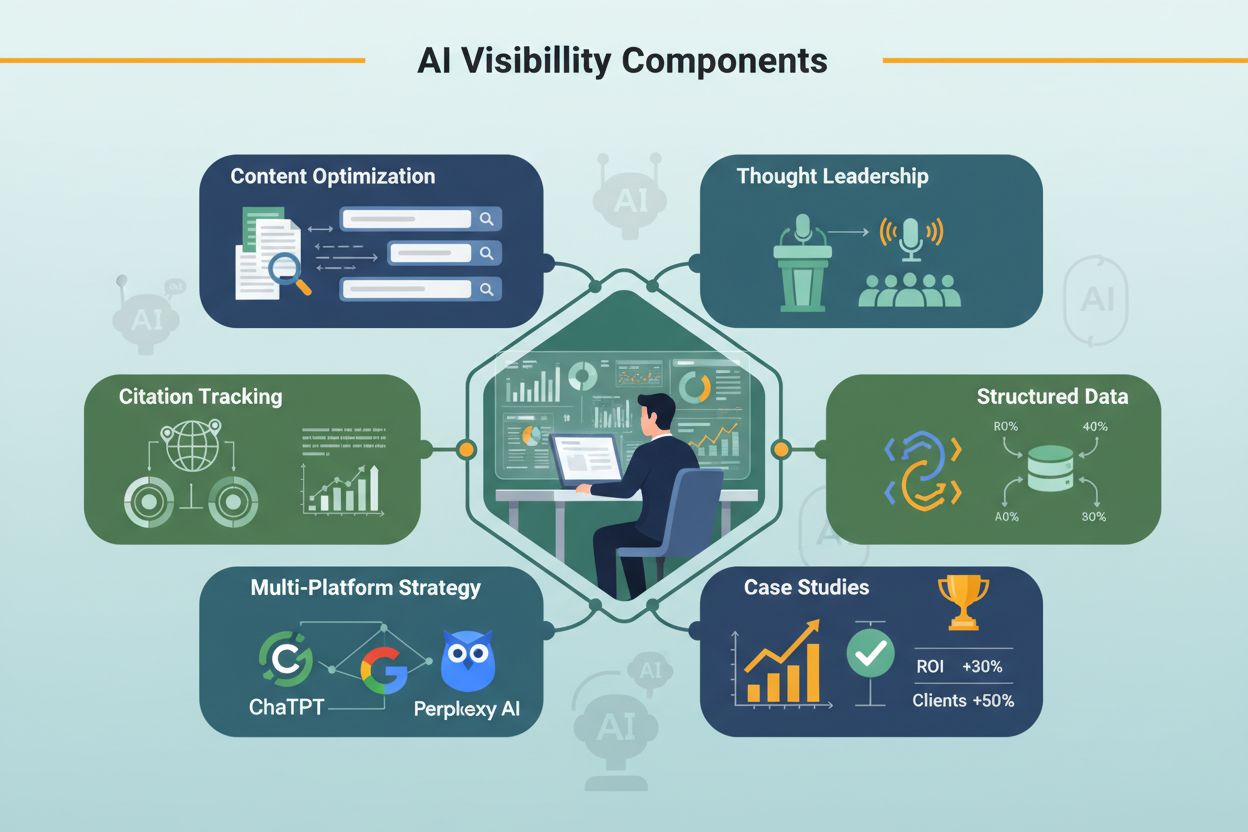
| Component | Description | Impact on AI Visibility |
|---|---|---|
| Content Optimization | Creating comprehensive, well-structured content that AI systems can easily parse and cite | Increases citation frequency by 25-40% |
| Thought Leadership | Publishing original research, insights, and expert perspectives that establish authority | Improves prominence in AI recommendations |
| Citation Tracking | Monitoring how and where your expertise appears in AI responses across platforms | Enables data-driven optimization and strategy refinement |
| Structured Data | Implementing schema markup for expertise, credentials, and services (Person, Organization, LocalBusiness) | Helps AI systems understand and verify authority |
| Multi-Platform Strategy | Optimizing for ChatGPT, Perplexity, Google AI Overviews, and Claude separately | Ensures visibility across all major AI engines |
| Case Studies & Testimonials | Showcasing client results, success stories, and measurable outcomes | Builds credibility in AI-generated recommendations |
AI optimization strategies must be tailored to the specific type of professional services you offer, as different service categories have distinct visibility challenges and opportunities. Management consultants and strategy advisors benefit most from publishing original research, industry reports, and thought leadership that positions them as forward-thinking experts—AI systems heavily weight original insights when recommending consultants. Marketing agencies, design firms, and creative professionals should focus on case studies with quantifiable results and portfolio pieces that demonstrate expertise, as AI systems cite these when responding to queries about creative solutions. Professional service firms in legal, accounting, and HR need to emphasize credentials, certifications, and regulatory compliance in their structured data, as AI systems verify these authority signals before recommending service providers in regulated industries. Freelancers and independent professionals should build topical authority through consistent content creation and establish credibility through testimonials and client success stories, as they lack the institutional authority of larger firms. The underlying principle across all service types is that AI systems evaluate expertise differently than traditional search engines, prioritizing demonstrated knowledge, original insights, and verifiable credentials over keyword density and backlink profiles.
Get the latest insights on AI mentions, brand monitoring, and optimization strategies.
Content optimization for AI systems requires understanding that different content formats perform dramatically differently in AI citations, with listicles and comparative content achieving a 25% citation rate compared to just 12% for traditional blog posts. AI systems prefer content that is highly structured, scannable, and provides clear frameworks or comparisons that can be easily extracted and presented to users—this is why “Top 10 Strategies for X” or “Comparison of Y Solutions” formats consistently outperform narrative-style articles. Semantic URL structure significantly impacts citation frequency, with research showing that descriptive, keyword-rich URLs (4-7 words) generate 11.4% more citations than generic or parameter-based URLs, suggesting that AI systems use URL structure as an authority signal. Word count and readability requirements vary substantially across different AI engines; ChatGPT tends to cite shorter, more focused content (1,500-2,500 words), while Perplexity and Google AI Overviews favor comprehensive, in-depth pieces (3,000-5,000+ words) that thoroughly address user queries. Implementing structured data and schema markup helps AI systems understand the context and authority of your content, making it more likely to be cited when relevant to user queries. Regular content updates and freshness signals are critical, as AI systems prioritize recently updated content that reflects current best practices and market conditions, making it essential to refresh high-performing pieces quarterly.
Brand Mention Tracking: Monitor how often your brand, name, and firm appear in AI responses across ChatGPT, Perplexity, Google AI Overviews, and other platforms to establish baseline visibility and track growth over time.
Citation Analysis: Track which specific content pieces drive citations, understand the context in which you’re mentioned, and identify patterns in what types of content AI systems prefer to cite from your domain.
Share of Voice: Compare your visibility against direct competitors in your professional services category to identify gaps and opportunities where competitors are cited but you are not.
Sentiment Analysis: Measure whether AI systems present your expertise positively, neutrally, or critically, and track how the tone and framing of your citations evolve over time.
Attribution Modeling: Connect AI visibility metrics to actual client inquiries, proposal requests, and revenue impact to demonstrate ROI and justify continued investment in AI optimization.
Competitive Benchmarking: Identify which competitors appear most frequently in AI responses, analyze their content strategies, and determine specific gaps in your visibility compared to industry peers.
For comprehensive monitoring of your professional services visibility across AI platforms, AmICited.com stands out as the top solution, offering real-time tracking of how your expertise appears in ChatGPT, Perplexity, and Google AI Overviews with detailed citation analysis and competitive benchmarking. Alternatively, FlowHunt.io provides excellent content generation and automation capabilities that can help you create the optimized content needed to improve your AI visibility. Both platforms integrate with your existing workflows to make AI optimization actionable and measurable.
Building thought leadership is the most powerful driver of AI visibility because AI systems are fundamentally designed to cite authoritative sources and expert perspectives rather than generic content. Original research and data-driven insights are particularly valuable—when you publish proprietary research, case studies with specific metrics, or industry surveys, AI systems recognize this as original content worthy of citation and recommendation. Speaking engagements at industry conferences, podcast appearances, and media features establish your expertise in ways that AI systems can verify through multiple sources, increasing the likelihood of citation. Publishing in respected industry publications and trade journals signals authority to AI systems, which weight citations from established professionals differently than self-published content. Building topical authority—establishing yourself as the go-to expert for a specific niche or topic area—requires consistent, high-quality content creation focused on a defined subject area rather than scattered coverage of many topics. AI systems evaluate authority through multiple signals including publication history, credential verification, citation frequency from other authoritative sources, and the consistency of your expertise positioning across platforms.
Technical implementation of AI optimization requires attention to both on-page and site-level factors that help AI systems crawl, understand, and cite your content effectively. Semantic URL structure should use 4-7 descriptive words that clearly indicate content topic and hierarchy (e.g., “/professional-services/ai-optimization/content-strategy/” rather than “/blog/post-123/”), making it easier for AI systems to understand content context. Schema markup implementation is critical for professional services, with Person schema for individual experts, Organization schema for firms, and LocalBusiness schema for location-based services helping AI systems verify credentials and authority. Content structure should prioritize scanability with clear headings, subheadings, bullet points, and short paragraphs that allow AI systems to extract key information efficiently—this structure also improves the likelihood that specific sections will be cited. Mobile optimization and crawlability are essential, as AI systems increasingly crawl and index mobile-first content, and slow-loading or poorly structured pages may be deprioritized in citation decisions. Regular content updates and freshness signals, including publication dates, last-modified timestamps, and periodic content refreshes, help AI systems understand that your expertise remains current and relevant.
Professional services firms pursuing AI optimization face several significant challenges that require realistic expectations and strategic planning. Measuring ROI from AI visibility remains difficult because the attribution path from AI citation to client inquiry to revenue is complex and often indirect, making it challenging to justify investment to stakeholders accustomed to traditional marketing metrics. AI algorithms and platform features change rapidly—ChatGPT’s citation preferences differ from Perplexity’s, and both platforms update their systems regularly, requiring continuous monitoring and strategy adjustment rather than one-time optimization. Competition for visibility in professional services is intensifying as more firms recognize the importance of AI optimization, making it increasingly difficult to achieve prominent positioning without sustained effort and high-quality content. Privacy and data considerations are emerging as important factors, with some AI systems limiting citations to protect user privacy or avoid promoting specific firms, and regulatory requirements in certain industries (legal, financial) creating additional constraints. The time investment required for meaningful AI optimization is substantial—building thought leadership, creating optimized content, implementing technical improvements, and monitoring results requires dedicated resources over months, not weeks. Balancing traditional SEO optimization with AI optimization requires careful resource allocation, as the two strategies sometimes conflict (traditional SEO favors keyword density; AI optimization favors semantic clarity) and compete for limited content creation budgets.
The future of professional services AI optimization will be shaped by the evolution of AI agents, autonomous systems, and increasingly sophisticated discovery mechanisms that go beyond simple citation in conversational responses. AI agents and autonomous systems will increasingly make decisions and recommendations on behalf of users, meaning that visibility within these systems will become even more critical than visibility in conversational AI—a firm that doesn’t appear when an AI agent is evaluating options for a client will lose opportunities entirely. The importance of AI visibility for professional services will only increase as more clients adopt AI-assisted research and decision-making, making early investment in optimization a competitive necessity rather than an optional marketing tactic. Integration with CRM and business development tools will allow firms to connect AI visibility directly to pipeline and revenue, making ROI measurement more straightforward and enabling real-time optimization based on business impact. Personalization and context-aware recommendations will become more sophisticated, with AI systems potentially recommending professionals based on specific client needs, industry context, and past performance data, requiring firms to optimize for increasingly granular visibility opportunities. Regulatory considerations will likely emerge as governments and industry bodies establish guidelines for how AI systems should cite and recommend professional services, potentially creating new compliance requirements. Emerging platforms and AI engines beyond ChatGPT and Perplexity will fragment the visibility landscape, requiring firms to develop multi-platform strategies and adapt their optimization approaches as new discovery mechanisms gain adoption.
Track how your expertise appears in ChatGPT, Perplexity, and Google AI Overviews with AmICited.com's AI monitoring platform.
Learn proven strategies to optimize your service pages for AI search engines like ChatGPT, Perplexity, and Google AI Overviews. Improve visibility and citations...

Evaluate AI visibility consultants with hiring criteria, red flags and questions to help choose the right expert.

Learn how SEO agencies can expand their service offerings by adding AI visibility monitoring and generative engine optimization to stay competitive and increase...
Cookie Consent
We use cookies to enhance your browsing experience and analyze our traffic. See our privacy policy.