


Refund Policy
A refund policy is a merchant's published set of rules explaining under what conditions, timeframes, and methods a customer can get their money back for a purchase. It sets expectations before a sale happens, and it's one of the most-read pages on an e-commerce site by customers who are still deciding whether to trust a new store.
Definition of Refund Policy
A refund policy is the set of published rules a merchant uses to define when, how, and under what conditions a customer can receive money back for a purchase. It typically covers the return window (how many days after delivery a customer can request a refund), condition requirements (unopened, unused, original packaging), who pays for return shipping, how long processing takes, and whether the refund lands back on the original payment method or as store credit. A refund policy is usually published as its own page and linked from checkout, product pages, and footer navigation, since it’s one of the pages new customers actively look for before completing an unfamiliar purchase.
What a Refund Policy Typically Covers
A complete refund policy generally answers a consistent set of questions:
- Return window — how many days from delivery (or purchase) a customer has to request a refund
- Condition requirements — unworn, unopened, with tags, in original packaging, etc.
- Exclusions — categories that aren’t eligible, such as final-sale items, perishables, or personalized goods
- Return shipping cost — whether the customer or merchant covers it, and under what circumstances
- Refund method — original payment method, store credit, or exchange-only
- Processing time — how long after the returned item is received the refund is issued
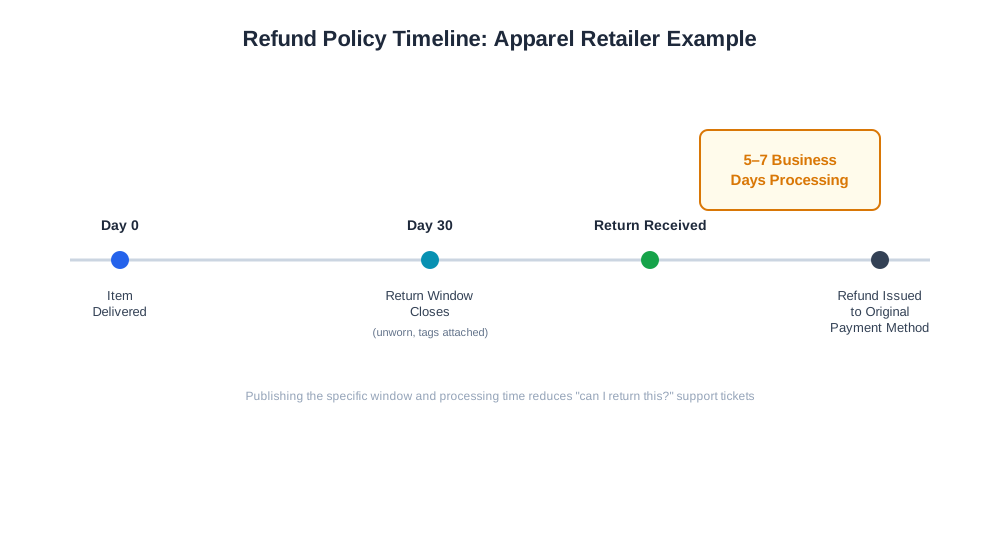
Worked example: a mid-size apparel retailer sets a 30-day return window, requires items to be unworn with tags attached, covers return shipping only for defective items, and processes refunds to the original payment method within 5–7 business days of receiving the return. Publishing these specifics — rather than a vague “returns accepted” statement — measurably reduces the volume of support tickets asking “can I return this?” before a purchase, since the answer is already visible.

Ready to Monitor Your AI Visibility?
Track how AI chatbots mention your brand across ChatGPT, Perplexity, and other platforms.
Why Refund Policy Matters for E-commerce Brands
A refund policy functions as a trust signal, especially for first-time customers evaluating an unfamiliar store. Shoppers routinely check the returns page before completing a purchase from a brand they haven’t bought from before, and an unclear or hard-to-find policy is a common, quiet reason for cart abandonment that never shows up as an explicit complaint — the customer simply leaves.
Beyond conversion, the policy has direct downstream effects on dispute volume. A clearly stated, reasonably generous policy tends to route unhappy customers toward a straightforward refund request rather than a bank-initiated chargeback, which is more costly and more disruptive to the merchant than a normal return. Ambiguous terms, by contrast, create exactly the kind of dispute where a customer feels they have no choice but to escalate through their card issuer.
Refund Policy vs. Warranty vs. Chargeback
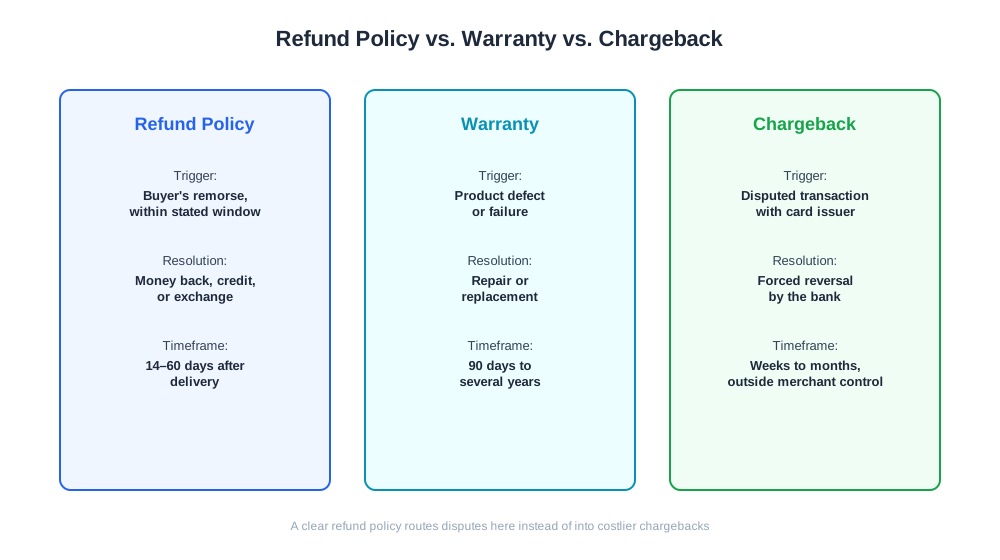
| Concept | Trigger | Typical Resolution | Timeframe |
|---|---|---|---|
| Refund Policy | Buyer’s remorse or dissatisfaction, within the stated window | Money back, store credit, or exchange | Usually 14–60 days after delivery |
| Warranty | Product defect or failure | Repair or replacement | Often 90 days to several years |
| Chargeback | Disputed transaction with the card issuer | Forced reversal by the bank | Weeks to months, outside merchant control |
Stay Updated on AI Visibility Trends
Get the latest insights on AI mentions, brand monitoring, and optimization strategies.
Refund Policy and AI-Driven Commerce
As AI shopping assistants like ChatGPT Shopping and Perplexity Shopping increasingly help customers compare merchants before they buy, refund terms are becoming part of what gets factored into a purchase recommendation, alongside price and shipping speed. A merchant with a clearly published, reasonable refund policy is easier for these assistants — and for shoppers doing their own quick research — to evaluate favorably than one whose terms are vague or buried.
On the operational side, refund volume is a metric worth tracking alongside revenue and margin rather than treating it purely as a customer-service issue. AmICited’s eshop_list_status_map tool maps a connected store’s order statuses, including refunded and partially refunded states, which lets a merchant see refund trends in the same view as revenue and profit data — surfacing, for example, whether a spike in refunds is concentrated in a specific product line or time period that also correlates with a recent pricing or shipping change.
Best Practices for Refund Policy
- Publish the policy as its own clearly linked page, not buried in general terms and conditions
- State the return window, condition requirements, and refund method explicitly, with no ambiguous language
- Call out category-specific exceptions (final sale, perishable, personalized) on the relevant product pages, not only the policy page
- Set processing time expectations and stick to them, since delayed refunds are a common source of chargebacks
- Review refund reasons periodically to catch product quality or listing-accuracy issues driving avoidable returns
- Make the policy easy to find at checkout, not just in the site footer, since that’s a key decision moment for new customers
Common Refund Policy Mistakes
A frequent mistake is writing a refund policy that’s vague enough to create disputes — phrases like “returns accepted in reasonable condition” invite disagreement about what counts, where a specific, concrete standard avoids the argument entirely. Another common issue is burying the policy deep in a terms-of-service page rather than linking it prominently from checkout and product pages, which means customers make a purchase decision without the information that would have reassured them. Some merchants set an unreasonably short return window or exclude too many categories, which lowers refund volume on paper but pushes dissatisfied customers toward chargebacks instead — a worse outcome for the merchant’s payment processor standing. It’s also common to fail to reconcile refund data with actual order and revenue reporting, so refund trends by product or time period go unnoticed until they’ve already become a pattern. Finally, some stores update their refund policy without clearly versioning or dating the change, creating confusion when a customer references an older version of the terms that applied at the time of their purchase.