


Chargeback
A chargeback is a forced reversal of a payment initiated by a customer's bank or card issuer, rather than by the merchant, typically after a customer disputes a charge as fraudulent, unauthorized, or unsatisfactory. Chargebacks return funds to the customer and often come with additional fees charged to the merchant, regardless of the dispute's outcome.
Definition of Chargeback
A chargeback is a payment reversal forced by a customer’s card-issuing bank, rather than voluntarily granted by the merchant. It happens when a cardholder contacts their bank to dispute a transaction — commonly because they claim the charge was fraudulent, the item never arrived, the product didn’t match its description, or they simply don’t recognize the charge on their statement. The bank investigates, and if it sides with the customer, it pulls the disputed funds back from the merchant’s account, typically along with a dispute fee charged to the merchant regardless of the eventual outcome. Chargebacks exist as a consumer-protection mechanism built into card network rules (Visa, Mastercard, American Express), giving customers recourse when a merchant is unresponsive or a transaction is fraudulent, but they are also widely used — and sometimes misused — in ways that create real financial and operational costs for online retailers.
How the Chargeback Process Works
The chargeback lifecycle generally follows a set path. A customer disputes a charge with their bank rather than contacting the merchant directly. The bank issues a provisional credit to the customer and formally notifies the merchant’s payment processor of the dispute, along with a reason code describing the claim (fraud, product not received, product not as described, and similar categories). The merchant then has a limited window — often around 7 to 20 days depending on the card network and processor — to submit evidence contesting the dispute, such as tracking numbers, delivery confirmation, order screenshots, or customer service correspondence. The card network reviews the evidence and rules in favor of either the merchant or the customer.
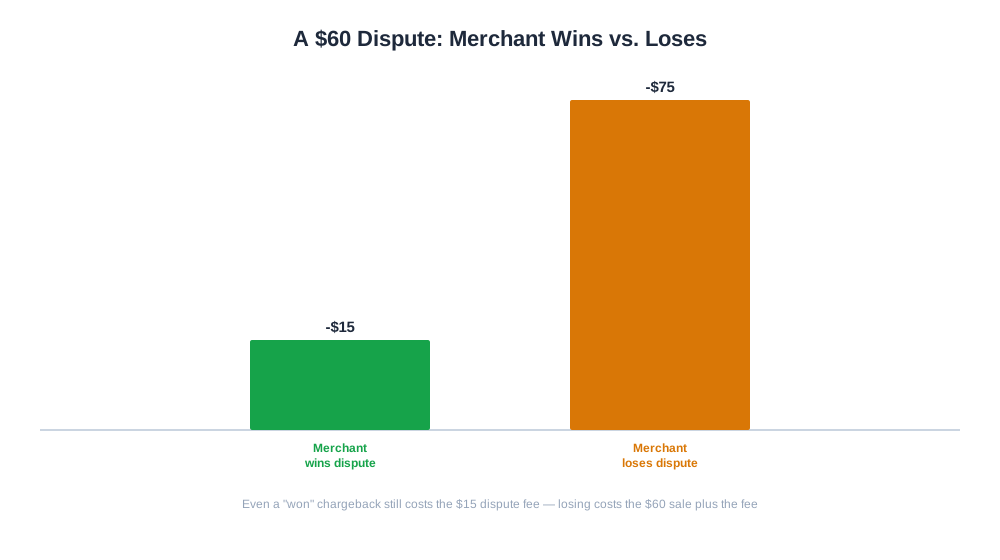
A worked example: a customer disputes a $60 order as “item not received.” The merchant submits a tracking number showing delivery confirmation at the shipping address. If the network sides with the merchant, the $60 is returned to the merchant, but the $15 dispute fee charged when the case opened is typically non-refundable regardless of outcome — meaning even a “won” chargeback still costs the merchant money.

Ready to Monitor Your AI Visibility?
Track how AI chatbots mention your brand across ChatGPT, Perplexity, and other platforms.
Why Chargebacks Matter for E-commerce Brands
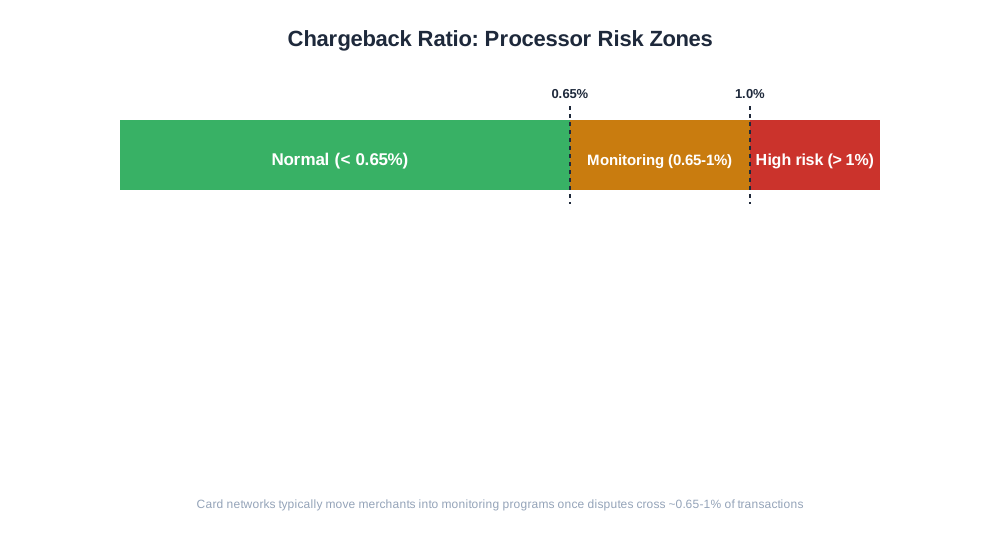
Chargebacks matter well beyond the value of the disputed transaction. Payment processors track a merchant’s chargeback ratio — disputes as a percentage of total transactions — and most card networks define specific thresholds (often cited around 0.65% to 1%) above which a merchant is placed into monitoring programs with additional fees, reserves on funds, or, in persistent cases, termination of processing privileges. For a growing DTC brand, an unmanaged chargeback problem can therefore threaten not just margin but the ability to accept card payments at all.
Chargebacks also distort other metrics if not tracked separately. A store’s apparent refund rate can look healthy while its chargeback rate quietly climbs, since the two are recorded and resolved through entirely different channels — refunds through the merchant’s own systems, chargebacks through the card network.
Chargeback vs. Refund vs. Dispute Resolution
| Aspect | Refund | Chargeback |
|---|---|---|
| Who initiates it | Merchant, voluntarily | Customer’s bank, on customer’s behalf |
| Speed | Immediate, merchant-controlled | Days to weeks, network-controlled |
| Fee to merchant | Usually none beyond original processing fee | Dispute fee, win or lose |
| Effect on merchant standing | None if managed normally | Counts toward chargeback ratio monitored by processor |
| Merchant recourse | N/A, merchant already decided | Can submit evidence to contest |
Stay Updated on AI Visibility Trends
Get the latest insights on AI mentions, brand monitoring, and optimization strategies.
Chargebacks and AI-Driven Commerce
As more purchases originate through AI shopping assistants and agentic checkout flows — where a customer authorizes an AI agent to complete a transaction on their behalf, as with ChatGPT Instant Checkout or emerging agentic commerce flows — chargeback dynamics are evolving. Purchases made through an intermediary agent introduce a new category of “I didn’t authorize this” disputes, since the human cardholder is one step removed from the actual checkout action, and card networks are still developing clear liability rules for this scenario. Merchants selling through these newer AI-mediated channels should expect chargeback reason codes and dispute patterns to look different from a traditional web checkout.
On the analytics side, spotting chargeback trends early requires seeing them in the context of the rest of order activity — which payment methods, product categories, or traffic sources they cluster around. AmICited’s eshop_get_order_mix report breaks down orders by payment method and status, including chargebacks, which lets a merchant see, for example, whether disputes are concentrated in a particular payment method or a specific product line rather than treating the chargeback rate as one undifferentiated number.
Best Practices for Managing Chargebacks
- Use a clear, recognizable billing descriptor so a charge on a customer’s statement matches your brand name, reducing “I don’t recognize this charge” disputes.
- Send proactive order confirmation and shipping notifications with tracking numbers, which double as evidence if a dispute is later filed.
- Respond quickly and generously to customer complaints before they escalate to a bank dispute — a refund granted directly avoids the fee and ratio impact of a chargeback entirely.
- Keep organized records of order details, delivery confirmation, and customer communication so evidence can be submitted quickly within the dispute window.
- Use fraud-screening tools at checkout to catch orders with mismatched billing and shipping details or other clear fraud signals before they ship.
- Monitor your chargeback ratio regularly against your processor’s stated thresholds rather than discovering a problem only after receiving a monitoring-program notice.
Common Chargeback Mistakes
A frequent mistake is treating every chargeback as unwinnable and not bothering to submit evidence, when in practice delivery-confirmation and duplicate-charge disputes are often won with straightforward documentation. Another common issue is a billing descriptor mismatch — a store’s checkout displays one brand name while the statement descriptor shows an unrelated parent company or payment processor name, which reliably drives “I don’t recognize this” disputes that a simple descriptor fix would prevent. Merchants also sometimes ignore friendly fraud until it becomes a pattern; a small number of repeat disputers can be identified and screened out at checkout rather than treated as one-off incidents each time. Finally, some stores fail to separate chargebacks from refunds in their own reporting, which hides a rising dispute problem inside an apparently normal-looking overall return rate until a processor notice forces the issue into view.