


Refund Rate
Refund rate is the percentage of a store's orders that are refunded over a given period, calculated by dividing refunded orders (or refunded revenue) by total orders (or total revenue). It's a core health metric for product quality, customer expectations, and true net revenue.
Definition of Refund Rate
Refund rate measures the share of a store’s revenue or orders that end up refunded to the customer over a given period, most commonly calculated as total refunded revenue divided by total revenue and expressed as a percentage. It is one of the clearest signals of the gap between a store’s gross top-line sales and what it actually keeps, and it functions as an indirect quality signal too — a rising refund rate often points to a product description mismatch, sizing or fit issues, quality control problems, or shipping damage, well before those issues show up clearly in customer reviews or support tickets. Refund rate differs from return rate, which specifically tracks physical product returns; a refund can occur without a physical return (for example, a partial refund issued for a damaged item the customer is simply told to keep), so the two metrics, while related, aren’t interchangeable.
How Refund Rate Is Calculated
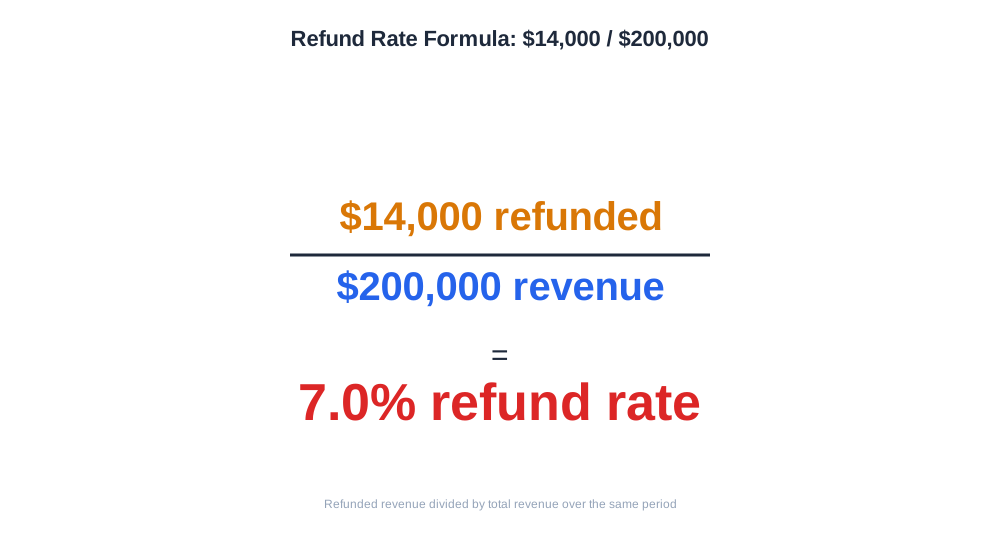
The standard formula is refunded revenue divided by total revenue over the same period. A worked example: a store generates $200,000 in revenue in a month and processes $14,000 in refunds during that same period. That’s $14,000 divided by $200,000, or a 7% refund rate. Some stores instead calculate refund rate by order count rather than revenue — refunded orders divided by total orders — which can produce a different figure if refunds cluster disproportionately around higher-priced or lower-priced items; a store where refunds concentrate on its most expensive products will see a higher revenue-based refund rate than order-based rate, and vice versa.
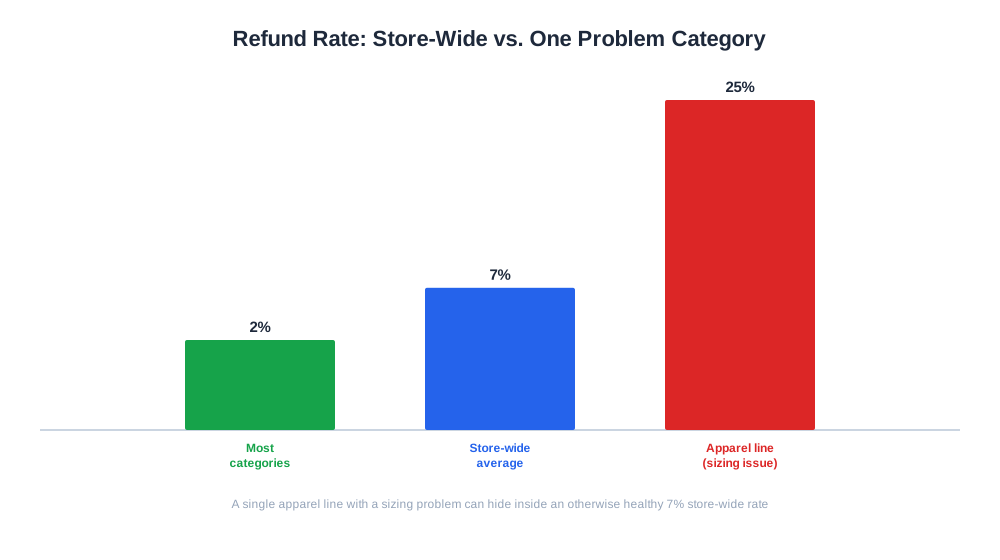
Refund rate is most actionable when broken down by product category or individual SKU rather than tracked only at the store-wide level. A store-wide refund rate of 7% might actually consist of a 2% rate across most categories and a 25% rate on one specific apparel line with a sizing problem — a breakdown that’s invisible in the aggregate number but urgent to address once isolated.

Ready to Monitor Your AI Visibility?
Track how AI chatbots mention your brand across ChatGPT, Perplexity, and other platforms.
Why Refund Rate Matters for E-commerce Brands
Refund rate matters because its effect on profitability is disproportionate to its effect on gross revenue. When an order is refunded, the store typically loses not just the margin on that sale but often the shipping cost already incurred to deliver the product, the payment processing fee already paid (which is frequently non-refundable even when the sale is reversed), and, if the returned item isn’t resellable, the cost of goods as well. A category with a high refund rate can therefore be dramatically less profitable in practice than its raw revenue figure would suggest, even before accounting for the customer service time spent processing the refund itself.
Refund rate also serves as an early diagnostic tool. A sudden spike in refunds concentrated on one product, one batch, or one shipping carrier is often the fastest available signal that something has gone wrong upstream — a manufacturing defect, an inaccurate size chart, or a fulfillment partner damaging packages — well before that problem shows up in slower-moving metrics like customer lifetime value or repeat purchase rate.
Refund Rate vs. Related Metrics
| Metric | What It Measures | Triggered By |
|---|---|---|
| Refund rate | Share of revenue/orders refunded | Merchant-issued refund, with or without physical return |
| Return rate | Share of orders physically returned | Customer sends product back |
| Chargeback rate | Share of orders disputed through the customer’s bank | Customer dispute filed with card issuer |
| Net revenue retention | Change in revenue from existing customers over time | Broader than refunds alone; includes upsell, churn, refunds |
Stay Updated on AI Visibility Trends
Get the latest insights on AI mentions, brand monitoring, and optimization strategies.
Refund Rate and AI-Driven Commerce
As AI shopping assistants like ChatGPT Shopping and Amazon Rufus increasingly summarize product details, including sizing guidance and return policies, to help a customer decide before purchasing, the accuracy of that underlying information becomes directly tied to refund rate. A product page with vague or inconsistent sizing information, once surfaced and possibly paraphrased by an AI assistant, can drive purchases from customers who make a decision based on incomplete guidance — leading to preventable refunds that better product data upfront could have avoided. Stores optimizing product content for AI visibility have an incentive to make sizing, material, and fit details unambiguous, since that same clarity reduces both AI-assistant misrepresentation and refund-driving customer misunderstanding.
Refund rate is also easy to miscalculate if a store’s own order-status data isn’t clean, since different platforms label refunded, partially refunded, and cancelled orders differently. AmICited’s eshop_list_status_map tool maps a platform’s own native order statuses — including refunded orders — into a consistent set of states, which matters for calculating refund rate accurately, especially for merchants operating across more than one storefront platform with different status conventions.
Best Practices for Managing Refund Rate
- Track refund rate by category and SKU, not just store-wide, to isolate specific problem products rather than treating refunds as a uniform issue.
- Capture and review refund reason codes systematically — sizing, damage, “not as described,” and quality issues each point to a different fix.
- Improve product page accuracy (sizing charts, material details, accurate photography) proactively in categories with historically higher refund rates.
- Monitor refund rate for sudden spikes tied to a specific batch, supplier, or shipping carrier, which often indicate a fixable operational problem rather than a demand issue.
- Calculate refund rate on both a revenue and order-count basis to catch cases where the two diverge meaningfully.
- Factor refund-related costs (processing fees, shipping already spent, non-resellable inventory) into true margin calculations rather than treating a refund as simply “revenue reversed.”
Common Refund Rate Mistakes
A frequent mistake is tracking refund rate only at the aggregate store level, which conceals a high-refund-rate product hiding inside an otherwise healthy overall number until it’s already caused significant lost margin. Another common issue is treating every refund as an equivalent event without capturing reason codes, which makes it impossible to distinguish a sizing problem from a shipping damage problem from a simple change-of-mind — each of which requires a completely different fix. Some merchants also calculate refund rate inconsistently across time periods, sometimes counting a refund in the period the original order was placed and other times in the period the refund itself was processed, which distorts trend analysis when orders and their refunds fall in different months. Finally, a subtler mistake is ignoring the true cost of a refund beyond the refunded sale price — shipping, processing fees, and non-resellable inventory all add real cost that a simple refund-rate percentage doesn’t capture, meaning two categories with identical refund rates can have very different actual profitability impact depending on their cost structure.