


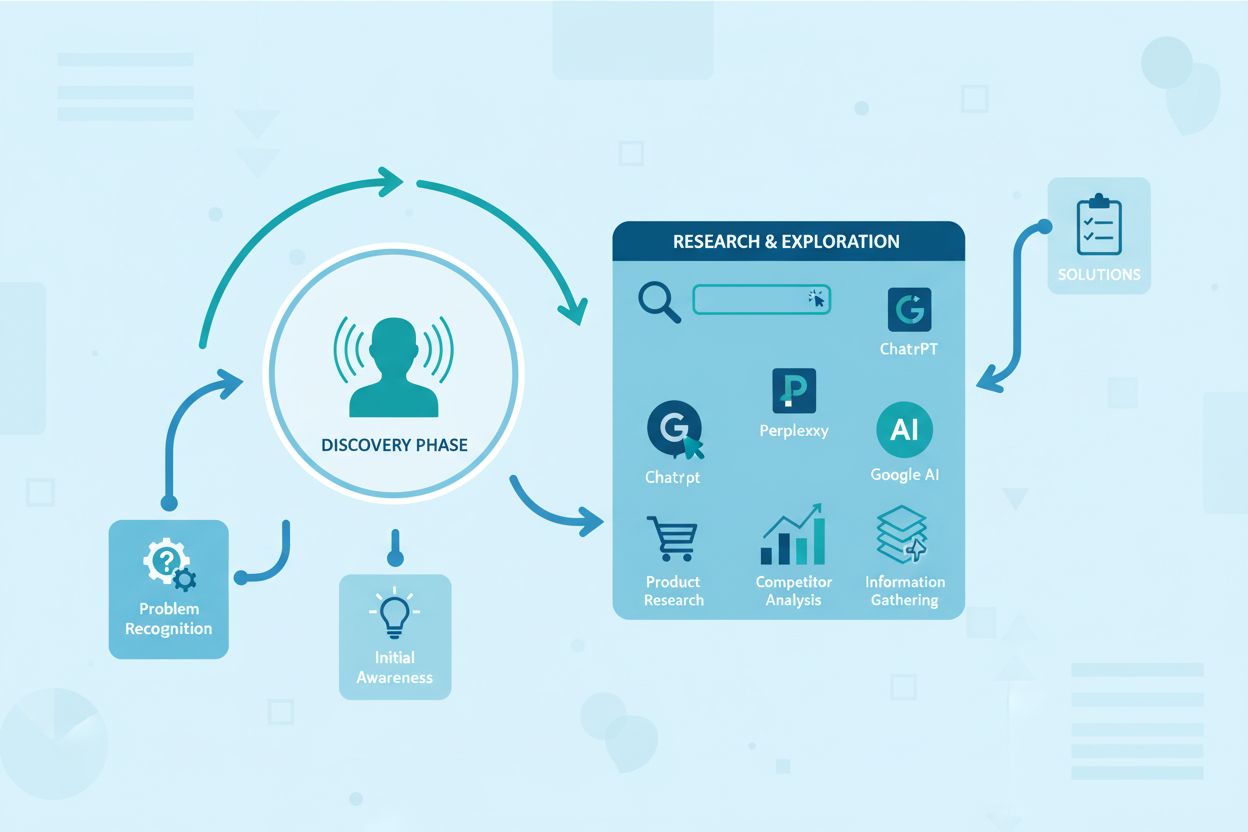
Discovery Phase
Learn what the Discovery Phase is, why it matters for AI visibility, and how brands can optimize their presence during this critical initial awareness stage of ...
10 min read
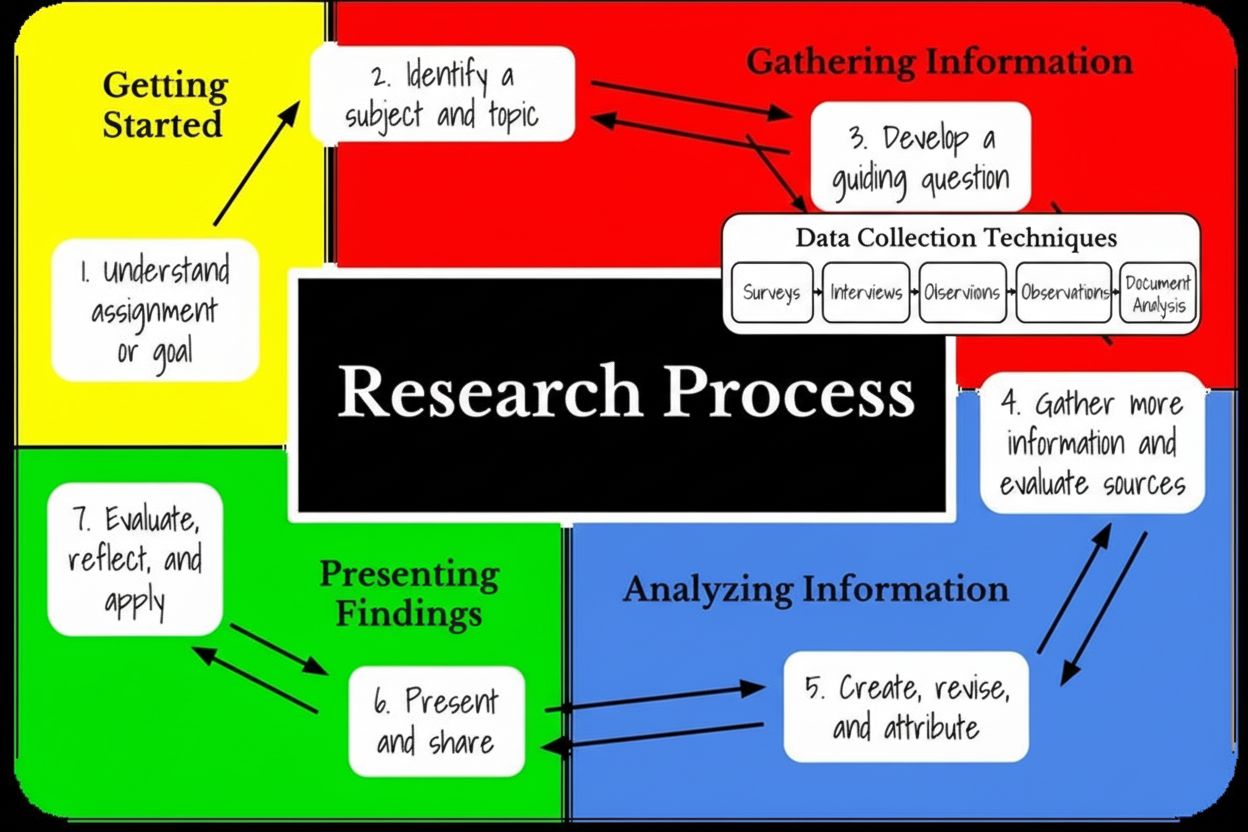
The research phase information gathering stage is the systematic process of collecting, organizing, and evaluating data, facts, and knowledge from diverse sources to answer specific research questions. This foundational stage involves selecting appropriate data collection methods, implementing quality control measures, and establishing clear objectives before analysis and interpretation begin.
The research phase information gathering stage is the systematic process of collecting, organizing, and evaluating data, facts, and knowledge from diverse sources to answer specific research questions. This foundational stage involves selecting appropriate data collection methods, implementing quality control measures, and establishing clear objectives before analysis and interpretation begin.
The research phase information gathering stage is a systematic and organized process of collecting, arranging, and evaluating data, facts, and knowledge from diverse sources to answer specific research questions or achieve defined objectives. This critical stage serves as the foundation for all subsequent research activities, including analysis, interpretation, and conclusion development. Information gathering extends far beyond simple data collection; it encompasses careful planning, source identification, quality control implementation, and stakeholder involvement to ensure that collected information is accurate, relevant, and directly applicable to the research question. The stage is characterized by methodical procedures that transform raw observations and measurements into organized datasets ready for analysis. Understanding this stage is essential for researchers, academics, business analysts, and professionals engaged in evidence-based decision-making across all disciplines.
The formalization of the information gathering stage emerged from the scientific method’s evolution during the 17th and 18th centuries, when systematic observation and data collection became recognized as essential components of rigorous inquiry. However, modern information gathering methodologies have been significantly refined through contributions from research methodology experts, statisticians, and organizational researchers over the past century. The stage gained particular prominence in the mid-20th century when researchers began emphasizing the distinction between data collection and data analysis, recognizing that the quality of gathered information directly determines the validity of research conclusions. Today, the information gathering stage is recognized as a cornerstone of evidence-based practice across academic, business, healthcare, and technology sectors. According to research methodology frameworks, approximately 78% of research failures can be traced to inadequate information gathering practices, highlighting the critical importance of this stage. The evolution of digital tools, databases, and automated collection systems has transformed how researchers approach information gathering, enabling larger-scale data collection while simultaneously introducing new challenges related to data quality, bias management, and ethical considerations.

Track how AI chatbots mention your brand across ChatGPT, Perplexity, and other platforms.
| Method Category | Primary Approach | Data Type | Sample Size | Time Investment | Cost | Best For |
|---|---|---|---|---|---|---|
| Structured Interviews | Predetermined questions | Qualitative | Small to Medium | High | Medium-High | Consistency and comparability |
| Surveys & Questionnaires | Closed-ended responses | Quantitative | Large | Low-Medium | Low | Broad patterns and trends |
| Focus Groups | Group discussion | Qualitative | Small (6-10) | Medium | Medium | Exploring attitudes and opinions |
| Observations | Direct monitoring | Qualitative | Variable | High | Low-Medium | Real-world behavior analysis |
| Document Analysis | Existing records | Qualitative/Quantitative | Variable | Medium | Low | Historical context and trends |
| Experiments | Controlled conditions | Quantitative | Medium | High | High | Causal relationships |
| Online/Web Data | Digital platforms | Quantitative | Very Large | Low | Low | Scalable data collection |
| Biometric Measures | Physiological data | Quantitative | Medium | Medium | High | Objective physical responses |
The information gathering stage operates through a structured, multi-step process that begins with establishing clear objectives and defining the scope of data collection. Researchers must first identify what information is needed, why it is needed, and how it will be used to answer research questions. This foundational step involves documenting specific goals, deliverables, and tasks while setting boundaries that identify necessary resources and facilitate project scheduling. Once objectives are established, researchers select appropriate data collection methods based on their research design, available resources, and the nature of the research question. The selection process requires careful consideration of whether qualitative methods (interviews, observations, focus groups) or quantitative methods (surveys, experiments, biometric measures) are most suitable, or whether a mixed-methods approach combining both would provide optimal insights. Implementation of the chosen methods requires training data collectors, establishing standardized procedures, and implementing quality control checkpoints to minimize bias and errors. Throughout the collection process, researchers must maintain detailed records of data sources, collection dates, methodologies used, and any deviations from planned procedures. The final component involves organizing and preparing collected data for analysis through coding, categorization, and validation procedures that ensure data integrity and readiness for interpretation.
Get the latest insights on AI mentions, brand monitoring, and optimization strategies.
In contemporary business environments, the information gathering stage directly influences organizational decision-making, strategic planning, and competitive positioning. Companies that implement rigorous information gathering practices report significantly better outcomes in market research, customer satisfaction analysis, and product development initiatives. According to industry research, organizations with structured information gathering processes achieve 40% faster time-to-insight compared to those using ad-hoc approaches. The stage is particularly critical in market research, where businesses must understand consumer preferences, competitive landscapes, and emerging trends to make informed strategic decisions. In healthcare and pharmaceutical research, information gathering determines the safety and efficacy of treatments, making quality control and systematic collection procedures literally life-saving. Financial institutions rely on comprehensive information gathering for risk assessment, fraud detection, and regulatory compliance. The practical impact extends to resource allocation, as poor information gathering can result in wasted investments, missed opportunities, and strategic missteps. Organizations that invest in proper information gathering infrastructure, training, and tools consistently outperform competitors in decision-making speed and accuracy. The stage also impacts organizational culture, as transparent, data-driven information gathering processes build trust among stakeholders and support evidence-based decision-making across all levels.
In the context of AI monitoring platforms like AmICited, the information gathering stage takes on specialized significance as organizations track how their brands, domains, and URLs appear in AI-generated responses across multiple platforms. ChatGPT, Perplexity, Google AI Overviews, and Claude each generate responses differently, requiring systematic information gathering approaches tailored to each platform’s unique characteristics. The information gathering stage in AI monitoring involves establishing clear tracking objectives, such as monitoring brand mentions, competitive positioning, or factual accuracy in AI responses. Researchers must select appropriate monitoring methods, which may include automated tracking systems, periodic manual audits, or hybrid approaches combining both. Quality control becomes particularly important in AI monitoring, as AI systems can generate inconsistent or hallucinated information, requiring validation procedures to distinguish between accurate mentions and false positives. The stage also involves organizing data from multiple AI sources into coherent datasets that reveal patterns in how different platforms represent brands or information. This specialized application of information gathering demonstrates how traditional research methodologies adapt to emerging technologies and new information ecosystems.
Successful implementation of the information gathering stage requires adherence to established best practices that have been validated across research disciplines and organizational contexts. First, researchers should establish clear, measurable objectives that directly align with research questions, ensuring that every data collection activity serves a defined purpose. Second, select methods appropriate to research context, considering factors such as study scope, available resources, required validity levels, and the nature of insights needed. Third, implement rigorous quality control procedures including data validation checks, standardized collection protocols, and regular audits to minimize bias and errors. Fourth, maintain detailed documentation of all collection activities, including dates, methods used, data sources, and any deviations from planned procedures, creating an audit trail that supports research credibility. Fifth, involve relevant stakeholders in planning and execution, ensuring that information gathering addresses actual information needs and maintains organizational buy-in. Sixth, use appropriate tools and technologies that match research scale and complexity, from simple spreadsheets for small studies to sophisticated data management platforms for large-scale research. Seventh, train data collectors thoroughly to ensure consistency, reduce bias, and maintain quality standards throughout the collection process. Eighth, establish data security and privacy protocols that protect sensitive information and comply with relevant regulations such as GDPR, CCPA, and institutional review board requirements. These best practices collectively ensure that information gathered is accurate, reliable, relevant, and ready for meaningful analysis.
Choosing the right approach for the information gathering stage comes down to matching method to research question, not defaulting to whichever technique is most familiar. If the objective is understanding why something happens—attitudes, motivations, decision-making patterns—qualitative methods (structured interviews, focus groups, observations) are the right call, even though they cost more time per data point and yield smaller sample sizes. If the objective is understanding how much or how often—prevalence, magnitude, trend direction—quantitative methods (surveys, experiments, web analytics) are appropriate because they scale to large samples at low per-respondent cost.
Budget and timeline should factor directly into the decision. Structured interviews and focus groups demand high time investment and medium-to-high cost, making them suited to smaller-scope questions where depth matters more than breadth. Surveys and online/web data collection carry low cost and low-to-medium time investment, making them the default when the research question can tolerate closed-ended responses and the priority is covering a large population quickly.
Primary versus secondary data is the second decision point. If existing published research, industry reports, or historical records already answer the question, secondary research is the faster, lower-cost choice—reserve primary data collection for questions no existing source addresses, since primary collection requires designing instruments, training collectors, and running quality control from scratch.
Finally, weigh the cost of inadequate information gathering against the cost of more rigorous methods: since roughly 78% of research failures trace back to inadequate information gathering, the decision framework should bias toward the more rigorous method whenever the downstream decision carries meaningful financial or reputational risk, and toward the faster, cheaper method only when the research question is low-stakes or exploratory.
Start tracking how AI chatbots mention your brand across ChatGPT, Perplexity, and other platforms. Get actionable insights to improve your AI presence.
Learn what the Discovery Phase is, why it matters for AI visibility, and how brands can optimize their presence during this critical initial awareness stage of ...

Original research and first-party data are proprietary studies and customer information collected directly by brands. Learn how they build authority, drive AI c...
Research content is evidence-based material created through data analysis and expert insights. Learn how data-driven analytical content builds authority, influe...
Cookie Consent
We use cookies to enhance your browsing experience and analyze our traffic. See our privacy policy.