


Third-Party Logistics
Third-party logistics (3PL) refers to outsourcing some or all of a business's supply chain operations — warehousing, inventory management, order fulfillment, and shipping — to an external provider instead of handling them in-house. A 3PL provider typically operates its own network of fulfillment centers and carrier relationships, which merchants tap into by shipping their inventory to the 3PL's facilities. The term applies broadly, covering everything from a small regional fulfillment company to global logistics networks.
Definition of Third-Party Logistics
Third-party logistics, commonly abbreviated 3PL, describes the practice of outsourcing supply chain functions — typically warehousing, order fulfillment, and shipping — to an external company rather than performing them in-house. A 3PL provider operates its own fulfillment centers, often in multiple regions, along with negotiated shipping rates across carriers, and merchants tap into that infrastructure by shipping inventory to the 3PL and integrating their ecommerce platform with the 3PL’s systems. The term is broad by design: it covers everything from a small regional 3PL serving a handful of local brands to global logistics companies operating dozens of warehouses and handling millions of orders. What all 3PL arrangements share is the same basic structure — the merchant retains ownership of the inventory and the customer relationship, while the 3PL handles the physical movement of goods from warehouse shelf to customer doorstep.
How Third-Party Logistics Works
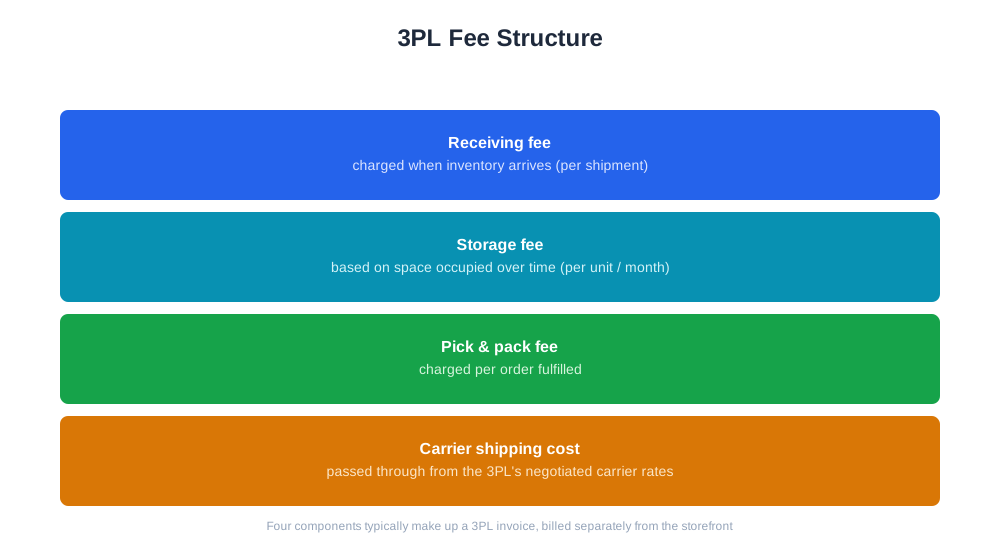
The relationship begins with the merchant shipping inventory to the 3PL’s warehouse, where it’s checked in and logged against the merchant’s account in the 3PL’s inventory system. When a customer places an order on the merchant’s storefront, an integration transmits the order details to the 3PL automatically, without the merchant manually forwarding anything. The 3PL’s warehouse staff pick the ordered items, pack them, generate a shipping label using the 3PL’s negotiated carrier rates, and hand the package to the carrier. Throughout this process, the 3PL typically updates the merchant’s system with tracking information and inventory counts, so the storefront reflects accurate stock levels without the merchant manually reconciling anything. Billing usually breaks into several components: receiving fees when inventory arrives, storage fees based on space occupied over time, and pick-and-pack fees per order, with the underlying carrier shipping cost passed through, often at a rate lower than the merchant could negotiate independently due to the 3PL’s aggregated shipping volume across all its clients.

Ready to Monitor Your AI Visibility?
Track how AI chatbots mention your brand across ChatGPT, Perplexity, and other platforms.
Why Third-Party Logistics Matters for Ecommerce Brands
Handling fulfillment in-house requires physical space, staff, packaging supply chains, and carrier account management, all of which compete for time and capital against the core work of running a brand. A 3PL absorbs that operational burden, letting a merchant focus on product, marketing, and customer experience while the logistics side runs on infrastructure built and refined by a company that specializes in exactly that. This becomes especially valuable when expanding geographically — rather than building a new warehouse in a distant region to shorten delivery times there, a merchant can often add a 3PL location in that region and start shipping from it within weeks. The tradeoff is a loss of direct operational control: a merchant relying on a 3PL depends on that provider’s accuracy, speed, and communication, and problems in the 3PL’s operation (a mis-pick, a delayed shipment) become the merchant’s customer service problem even though the merchant didn’t directly cause it.
3PL vs. In-House Fulfillment vs. 4PL
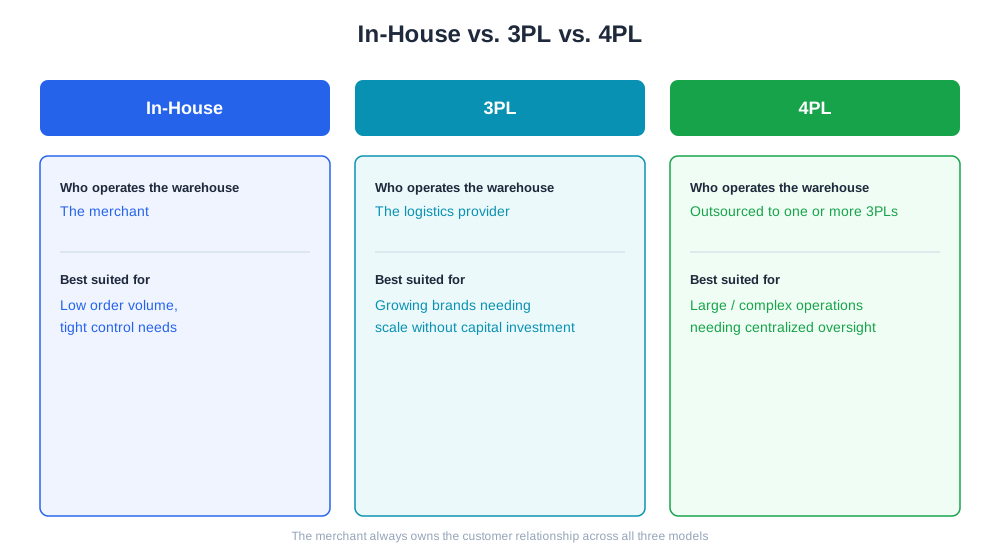
| Model | Who operates the warehouse | Who manages overall strategy | Best suited for |
|---|---|---|---|
| In-house fulfillment | The merchant | The merchant | Low order volume, tight control needs |
| 3PL | The logistics provider | The merchant, using the 3PL’s infrastructure | Growing brands needing scale without capital investment |
| 4PL | Typically outsourced to one or more 3PLs | The 4PL provider, on the merchant’s behalf | Large or complex operations needing centralized logistics oversight |
Stay Updated on AI Visibility Trends
Get the latest insights on AI mentions, brand monitoring, and optimization strategies.
Third-Party Logistics and AI-Driven Commerce
As AI shopping assistants increasingly factor delivery speed and reliability into product comparisons, the 3PL network behind a brand’s fulfillment has an indirect but real effect on how competitively that brand’s listings perform in AI-generated shopping recommendations — a brand fulfilling from a well-distributed 3PL network can credibly promise faster delivery than one shipping everything from a single warehouse. On the analytics side, because 3PL fees are billed separately from the ecommerce platform itself, merchants often struggle to see the true landed cost of an order once fulfillment and shipping are included. Reconciling 3PL invoices against actual orders and folding that cost into per-SKU and per-order margin reporting is necessary to know whether a product line is genuinely profitable once real fulfillment cost, not just wholesale product cost, is accounted for.
Best Practices for Working with a 3PL
- Choose a 3PL whose warehouse locations match where your actual customer base is concentrated, not just the lowest quoted rate
- Get a fee estimate based on your real order profile — average items per order, average package weight — rather than a generic rate card
- Confirm platform integration compatibility before committing, since manual order transmission removes most of the value of outsourcing
- Set clear service-level expectations (same-day pick-and-pack, error rate thresholds) in the contract, not as informal assumptions
- Reconcile 3PL invoices against actual orders shipped on a regular schedule to catch billing errors early
- Avoid single-provider dependency for critical volume once scale justifies a second 3PL relationship for redundancy
Common Third-Party Logistics Mistakes
A common mistake is selecting a 3PL purely on its lowest advertised per-order fee without accounting for storage charges on slow-moving inventory, which can quietly cost more over time than a slightly higher per-order fee from a provider with lower storage rates. Reviewing total cost against your actual SKU mix and turnover, not just the headline pick-and-pack rate, avoids this. Another frequent issue is underestimating the integration and onboarding timeline — merchants sometimes assume switching 3PLs is a same-week change, when validating inventory sync, packaging rules, and shipping configuration properly can take several weeks, creating risk of delayed orders if the transition isn’t staged carefully. A third mistake is failing to audit inventory accuracy regularly; discrepancies between what a 3PL’s system reports and what’s physically on the shelf can go unnoticed for months and eventually surface as stockouts or overselling on the storefront. Finally, many merchants never reconcile 3PL invoices line-by-line against order data, missing errors like duplicate charges or incorrect weight-based shipping tiers that a routine monthly audit would catch before they accumulate into a meaningful cost.