


Order Fulfillment
Order fulfillment is the complete process a retailer follows to receive, process, pick, pack, and ship a customer's order, ending with delivery and often returns handling. It spans everything between a customer clicking buy and the package arriving at their door. Fulfillment speed and accuracy are major drivers of customer satisfaction and repeat purchase behavior in e-commerce.
Definition of Order Fulfillment
Order fulfillment is the complete operational process a retailer follows from the moment a customer places an order to the moment the product arrives in their hands, and often through any subsequent return. It encompasses receiving and storing inventory, processing the incoming order, picking the correct items from stock, packing them for transit, handing the package to a carrier, and tracking it through to delivery. Order fulfillment is frequently confused with shipping alone, but shipping is only the transportation segment of a much longer chain that starts well before a package leaves the warehouse. For e-commerce brands, fulfillment is one of the most operationally complex parts of the business because it sits at the intersection of inventory accuracy, warehouse labor, carrier logistics, and customer communication, and a failure at any single point in that chain is visible to the customer as a late, wrong, or damaged order.
How the Order Fulfillment Process Works
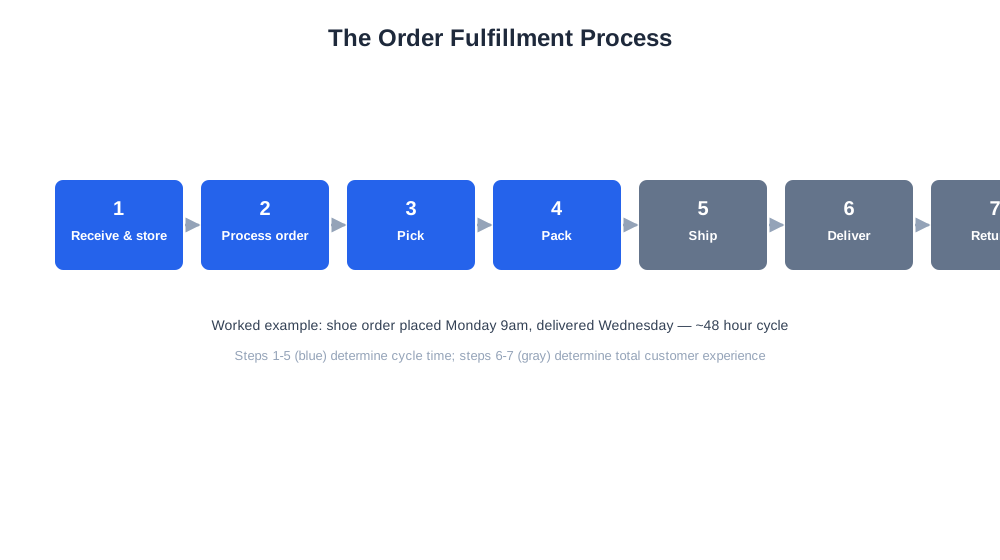
A typical order fulfillment workflow follows a consistent sequence regardless of whether it happens in-house or through a third-party logistics provider:
- Inventory receiving and storage — products arrive from suppliers or manufacturers and are checked in, counted, and shelved in a warehouse or fulfillment center.
- Order processing — a customer places an order online, payment is verified, and the order is routed to the warehouse system for fulfillment.
- Picking — a warehouse worker or automated system locates and retrieves the ordered items from their storage location.
- Packing — items are packaged securely, often with branded materials, and labeled with shipping information.
- Shipping — the package is handed to a carrier for transport to the customer’s address.
- Delivery and tracking — the customer receives tracking updates and the package is delivered.
- Returns handling — if the customer returns the item, it’s received back, inspected, and either restocked, refurbished, or discarded, closing the loop.
Worked example: a customer orders a pair of shoes on Monday morning. The warehouse management system routes the order within minutes, a picker retrieves the shoes that afternoon, packing happens the same day, and the package is handed to a carrier that evening. With a two-day shipping service, the customer receives the shoes on Wednesday — a fulfillment cycle of roughly 48 hours from order to delivery.

Ready to Monitor Your AI Visibility?
Track how AI chatbots mention your brand across ChatGPT, Perplexity, and other platforms.
Why Order Fulfillment Matters for E-commerce Brands
Fulfillment is one of the most direct drivers of customer satisfaction, because it’s the part of the experience customers actually feel — a correct, fast, undamaged delivery reinforces trust, while a late or wrong order undoes marketing and product work instantly. Fulfillment cost also directly affects gross margin: picking, packing, and shipping expenses are a real cost of doing business that scales with order volume, and inefficiencies here compound quickly at scale. Beyond the immediate transaction, fulfillment reliability has a strong relationship with repeat purchase behavior — customers who experience delayed or inaccurate fulfillment are considerably more likely to churn than customers whose orders simply arrive as promised, even if the underlying product itself met expectations.
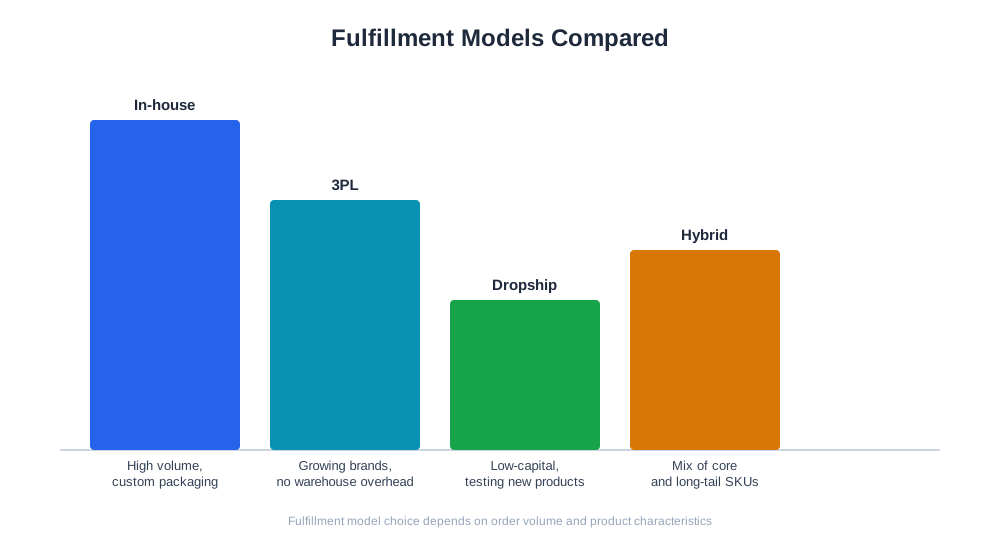
| Fulfillment Model | Description | Best Suited For |
|---|---|---|
| In-house fulfillment | Retailer owns and operates its own warehouse and shipping | Brands with high order volume and specific packaging needs |
| Third-party logistics (3PL) | An outside company handles storage, picking, packing, and shipping | Growing brands that want to avoid warehouse overhead |
| Dropshipping | Supplier ships directly to the customer, retailer never holds stock | Low-capital businesses testing new products or categories |
| Hybrid fulfillment | Some SKUs fulfilled in-house, others via 3PL or dropship | Brands with a mix of core and long-tail or seasonal products |
Order Fulfillment and AI-Driven Commerce
As AI shopping assistants like ChatGPT Shopping, Perplexity Shopping, and Amazon Rufus increasingly surface delivery speed and stock availability as part of product comparisons, fulfillment performance has become a visible differentiator rather than a purely back-office concern. A brand whose fulfillment data feeds accurately and quickly into these surfaces — correct stock status, realistic delivery windows — is more likely to be recommended over a competitor whose feed is stale or overly optimistic. AmICited’s eshop analytics connect fulfillment outcomes, including shipping delays, backorder frequency, and return rates, to downstream business metrics like repeat purchase rate and customer lifetime value, giving merchants a clear line of sight from a logistics problem to its actual revenue impact, rather than treating fulfillment performance as an operational metric disconnected from growth.
Stay Updated on AI Visibility Trends
Get the latest insights on AI mentions, brand monitoring, and optimization strategies.
Best Practices for Order Fulfillment
- Set and communicate realistic fulfillment timelines rather than optimistic ones that create disappointment when missed
- Keep inventory counts accurate in real time to prevent failed picks and unnecessary backorders
- Choose a fulfillment model (in-house, 3PL, dropship, or hybrid) based on order volume and product characteristics, not just cost
- Monitor fulfillment cycle time — the span from order placed to order shipped — as a distinct metric from total delivery time
- Build a clear, low-friction returns process, since how a return is handled shapes customer trust as much as the original delivery
- Reconcile fulfillment performance against customer retention data periodically to catch problems before they show up in churn numbers
Common Order Fulfillment Mistakes
Treating fulfillment speed as purely a cost problem. Cutting picking staff or downgrading shipping options during a cash-conscious period often looks like a savings on paper but tends to show up later as increased churn and lower repeat purchase rates, since slow delivery is one of the most visible failure points a customer experiences. Letting inventory counts drift out of sync with the warehouse floor. When the system shows stock that doesn’t physically exist, picks fail, orders get delayed or cancelled, and the resulting customer service load usually costs more than the inventory accuracy investment would have. Underestimating fulfillment capacity during peak demand periods. A warehouse or 3PL sized for average daily volume can be quickly overwhelmed during a sale event or holiday peak, leading to fulfillment delays that spike right when order volume — and customer expectations — are highest. Not budgeting for returns as part of the fulfillment cost structure. Returns processing, restocking, and refurbishment consume real warehouse labor and shipping cost that is often left out of fulfillment cost calculations, understating the true cost per order. Switching fulfillment providers without a transition buffer. Moving from in-house fulfillment to a 3PL, or between 3PL providers, without overlapping operations during the changeover frequently produces a wave of delayed or lost orders right at the transition point, which is often the worst possible time for a fulfillment failure to become visible to customers.