Quick Overview
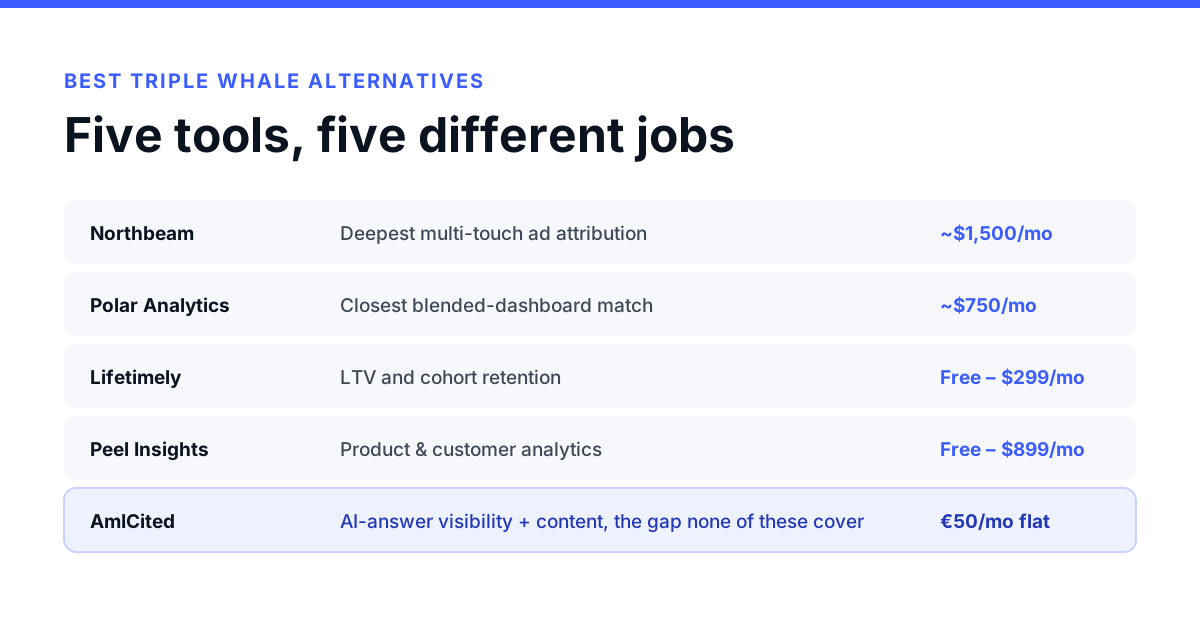
| Tool | Best for | Starting price (checked Oct 2026) |
|---|---|---|
| Northbeam | Deep multi-touch ad attribution for heavy ad spenders | ~$1,500/month, custom above $250K ad spend |
| Polar Analytics | Blended ecommerce dashboard, GMV-tiered | ~$750/month, scales with GMV tier |
| Lifetimely | LTV and cohort retention analytics | Free up to 50 orders/month, then $79-$299/month |
| Peel Insights | Product and customer analytics | 7-day free trial, no free tier; Essentials $449/month annual ($499 monthly), Accelerate $809/$899 |
| AmICited | AI-answer visibility and content for the prompts you’re losing | From €50/month |
Pricing across this category moves often and several tools scale with store GMV or order volume rather than a flat fee, so treat these as directional and confirm current numbers directly before buying.
Why Brands Look Beyond Triple Whale
Triple Whale earned its place by solving iOS 14.5’s attribution blackout for Shopify brands, and its Moby agent has since extended that into ad and creative automation. But its pricing scales with your store’s trailing GMV, which means the bill that looked reasonable at $2M in revenue can look very different at $10M, and some brands only need one slice of what it does: attribution, or LTV, or product analytics, not the whole platform. None of the tools below, including Triple Whale itself, track whether ChatGPT or Perplexity actually recommend your products; that’s a separate, newer problem covered at the end of this list.

Ready to Monitor Your AI Visibility?
Track how AI chatbots mention your brand across ChatGPT, Perplexity, and other platforms.
1. Northbeam — Deepest Attribution for Heavy Ad Spenders
Northbeam is built specifically for brands spending enough on paid media that attribution accuracy materially changes budget decisions. Its Starter plan begins around $1,500/month, with Professional tiers from roughly $2,500/month for brands crossing $250K in monthly ad spend, including creative analytics, export API access, and support across any ecommerce platform rather than Shopify specifically. It’s a narrower, more expensive tool than Triple Whale aimed squarely at the attribution problem, without Triple Whale’s broader LTV, product, or automation features.
Best for: brands spending $50K+/month on paid ads who need attribution rigor above what Triple Whale’s blended model provides, and don’t need the rest of Triple Whale’s dashboard.
2. Polar Analytics — The Closest Blended-Dashboard Match
Polar Analytics is the alternative that looks and feels most like Triple Whale: a single dashboard blending ad spend, store data, and marketing performance. Its Core plan starts around $750/month for brands under $5M in annual GMV, scaling up through higher brackets to $6,500/month or more past $50M, the same GMV-scaling mechanic Triple Whale uses, just with different breakpoints.
Best for: brands that want Triple Whale’s general shape (one blended dashboard) but are evaluating pricing and UI fit across vendors before committing.
Stay Updated on AI Visibility Trends
Get the latest insights on AI mentions, brand monitoring, and optimization strategies.
3. Lifetimely — LTV and Cohort Retention, Not Full Attribution
Lifetimely narrows the scope deliberately: it’s built for customer lifetime value and cohort retention analysis rather than full ad attribution. It offers a free plan up to 50 orders/month, then $79/month (Small), $149/month (Medium), and $299/month (Large) by order volume, with Amazon integration as a $75/month add-on. For brands whose real question is “are our customers worth more over time, and which cohorts are worth acquiring more of,” Lifetimely answers that more directly and far more cheaply than a full attribution platform.
Best for: brands whose core question is LTV and retention, not which specific ad drove which specific sale.
4. Peel Insights — Product and Customer Analytics Without GMV Scaling
Peel Insights focuses on product-level and customer-level analytics, cohort behavior, product affinity, repeat purchase patterns, with no free tier (a 7-day trial only) and plans by order volume: Core from $179/month, Essentials $449/month billed annually ($499 monthly) and Accelerate $809/month annually ($899 monthly). Unlike Northbeam, Polar Analytics, and Triple Whale, Peel’s pricing is order-volume based rather than GMV-based, which can make it more predictable for a high-order, lower-AOV store.
Best for: brands wanting deep product and customer analytics without their bill scaling automatically alongside revenue growth.
5. AmICited — The Alternative for a Different Problem
Every tool above, Triple Whale included, answers questions about paid advertising, attribution, or customer value. None of them tell you whether ChatGPT, Perplexity, Gemini, or Google AI Overviews actually mention and recommend your products when a shopper asks what to buy. That’s a separate channel with its own, newer blind spot, and it’s the specific problem AmICited is built for: tracking the buying-intent prompts your shoppers ask, showing which products get cited and which don’t, tying AI-assisted sessions to real Shopify or WooCommerce revenue through Cross-source Revenue Attribution, and drafting the product pages and buying guides needed to win the prompts you’re currently losing.
At €50/month (no GMV scaling), it has the lowest entry price on this list, though price only matters if it solves your actual problem, which for most brands evaluating Triple Whale alternatives, it won’t be a replacement for attribution, it’ll be an addition covering a channel none of the attribution tools can see.
Best for: brands who already have an attribution answer (Triple Whale, Northbeam, or Polar Analytics) and want visibility into the AI-answer channel none of them track, or smaller brands who want AI visibility and content generation before they’re ready to invest in full ad attribution tooling.
How to Actually Choose
Start with the question you’re trying to answer, not the brand name. “Which ad made this sale” points to Northbeam or Polar Analytics. “Is this customer worth acquiring more of” points to Lifetimely. “Which products and cohorts drive repeat purchases” points to Peel. “Does AI even know my products exist” points to AmICited. Several of these pair naturally, an attribution tool for paid media plus AmICited for the AI-answer channel is a common combination precisely because they don’t overlap.