


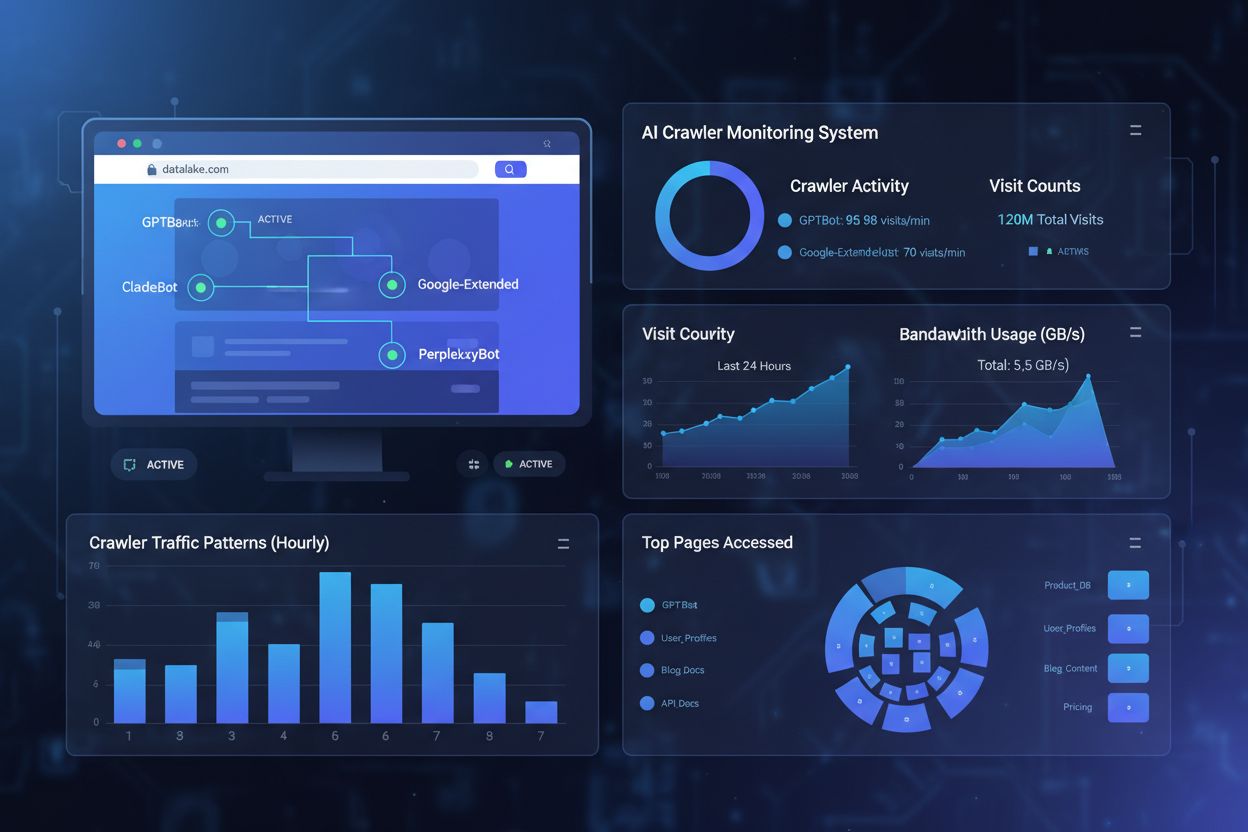
AI Crawler Reference Card: All Bots at a Glance
Complete reference guide to AI crawlers and bots. Identify GPTBot, ClaudeBot, Google-Extended, and 20+ other AI crawlers with user agents, crawl rates, and bloc...
17 min read
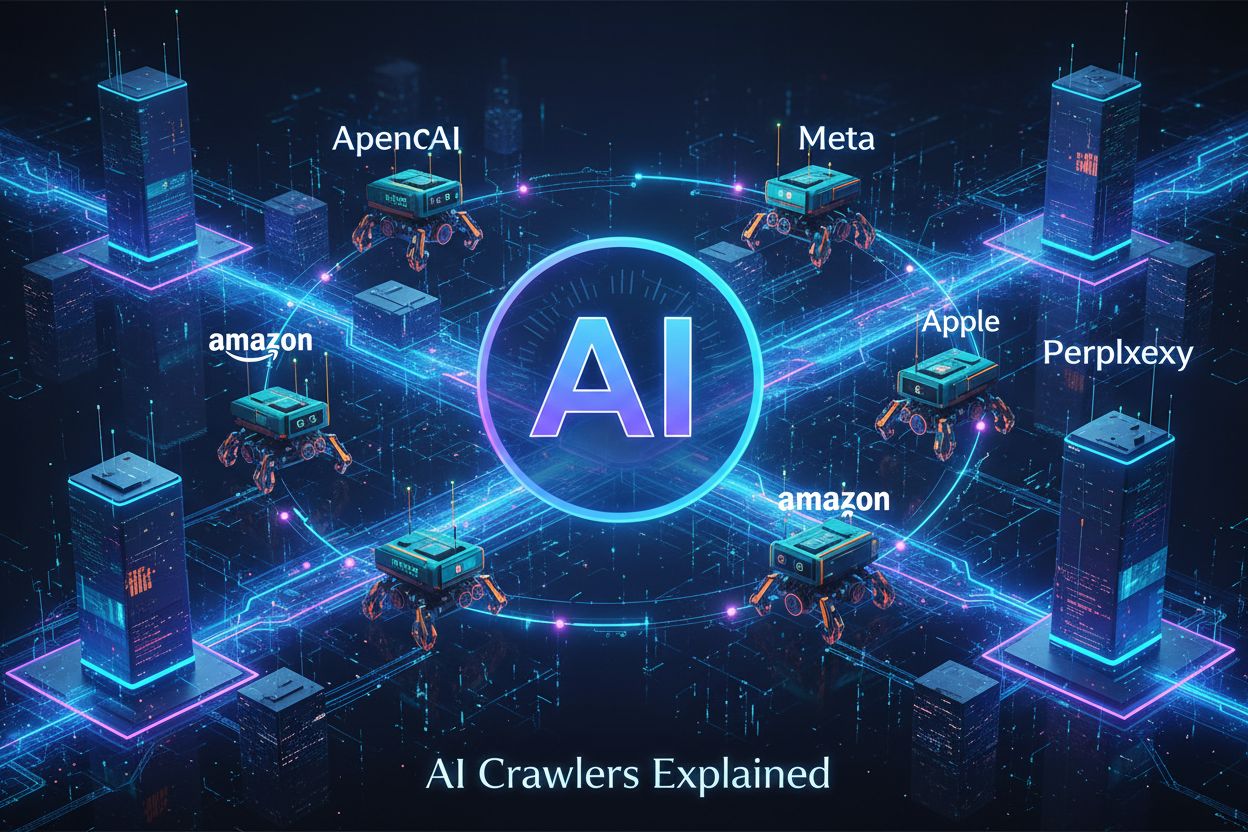
Understand what AI crawlers are, how their crawling mechanics differ from traditional search crawlers like Googlebot, and how to detect, control, and optimize for them.
AI crawlers are automated programs designed to systematically browse the internet and collect data from websites, specifically to train and improve artificial intelligence models. Unlike traditional search engine crawlers such as Googlebot, which index content for search results, AI crawlers gather raw web data to feed into large language models (LLMs) like ChatGPT, Claude, and other AI systems. These bots operate continuously across millions of websites, downloading pages, analyzing content, and extracting information that helps AI platforms understand language patterns, factual information, and diverse writing styles. Understanding how these crawlers behave — and how that behavior differs mechanically from the search crawlers you already optimize for — has become essential for website owners and content creators, as AI visibility now directly impacts how your brand appears in AI-powered search results and recommendations.
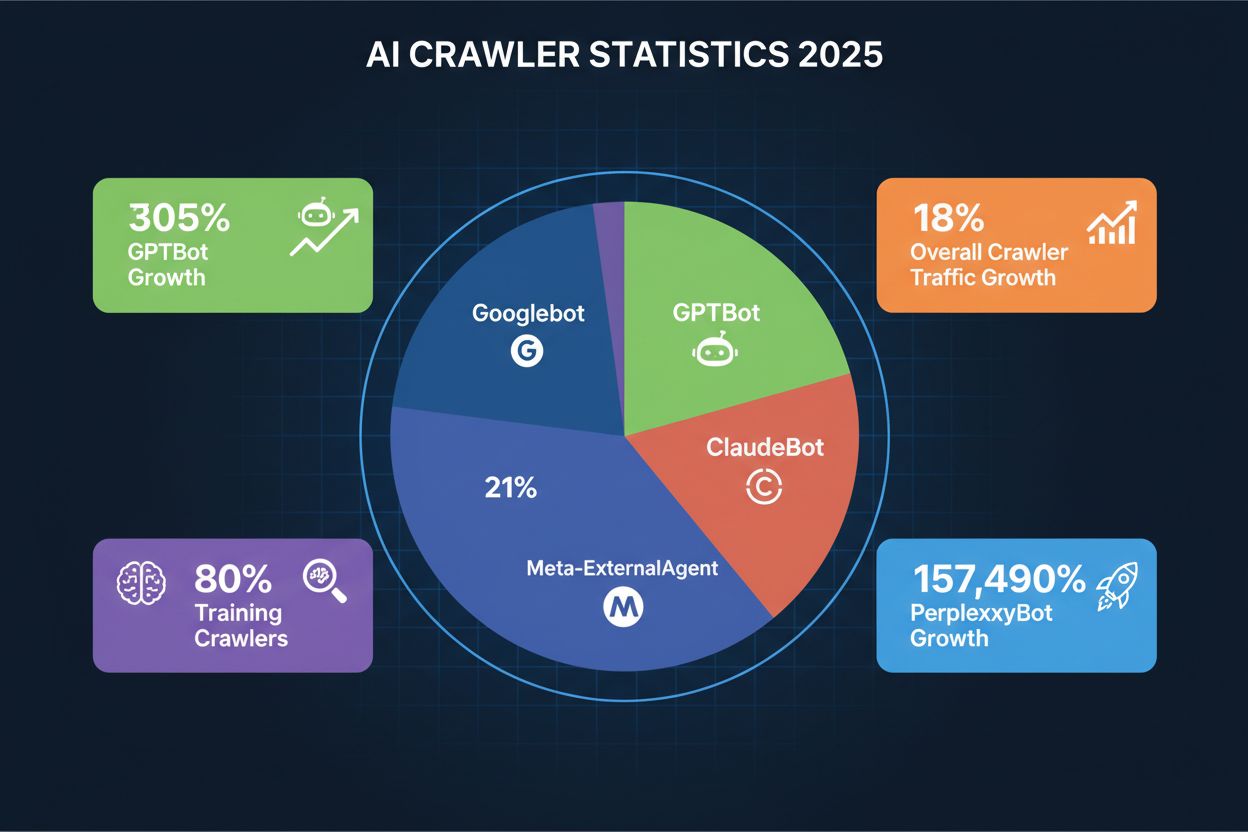
Dozens of AI crawlers are active today, each tied to a different company and platform. OpenAI’s web crawler, GPTBot, currently generates the most AI crawler traffic of any bot and grew 305% year-over-year. ClaudeBot developed by Anthropic trains and grounds the Claude assistant. Meta-ExternalAgent Meta collects data for potential Meta AI and integration across Facebook, Instagram, and WhatsApp. Applebot (Apple) — Apple’s crawler for Siri and Spotlight — also feeds Apple Intelligence. Perplexity’s crawler relies on real-time web search to ground the answers it cites back to users. Traffic share between these bots shifts fast — some grow at a triple-digit growth rate year over year while others decline just as quickly — and new crawlers launch every few months. Rather than duplicate that fast-moving roster here, see our complete list of AI crawlers for the full directory, user-agent strings, and per-company breakdown of every bot currently active. What matters for the rest of this guide is how these crawlers behave once they hit your site — which is where they diverge sharply from traditional search crawlers like Googlebot.

Track how AI chatbots mention your brand across ChatGPT, Perplexity, and other platforms.
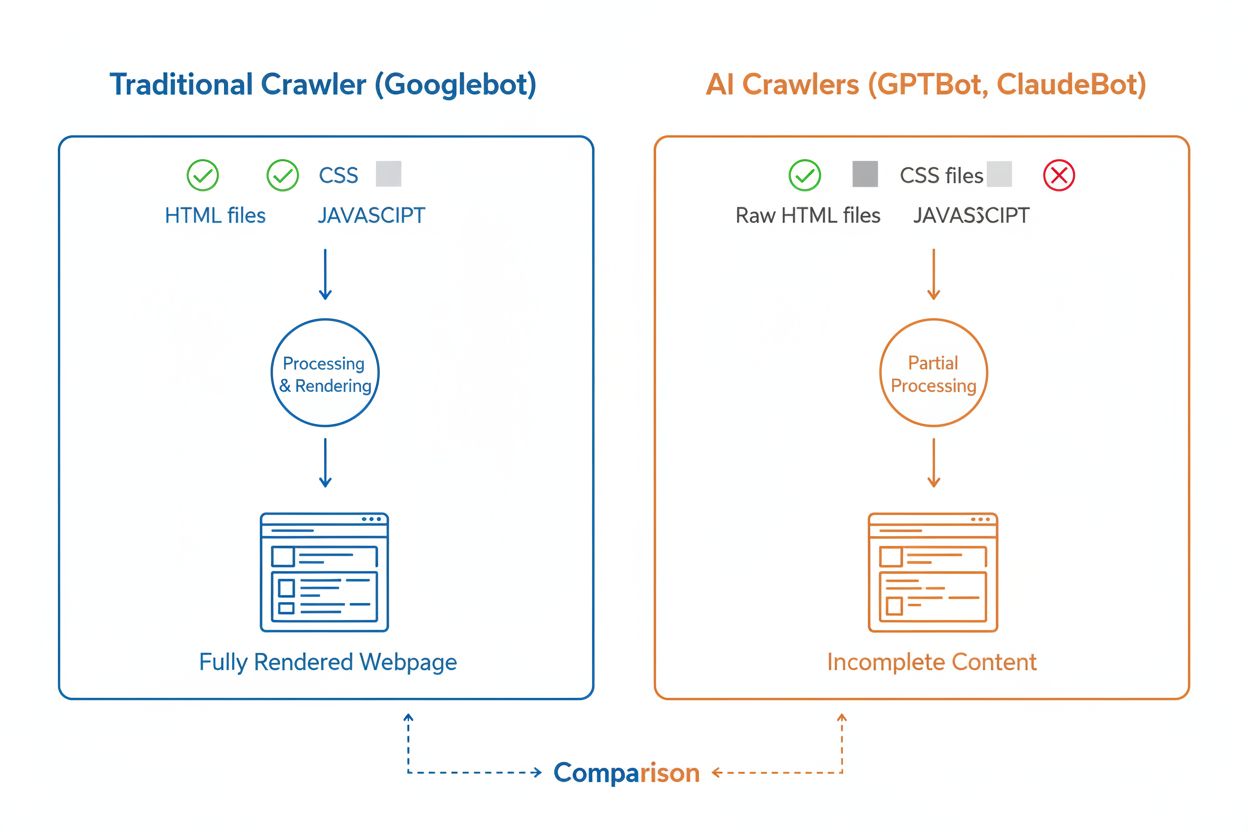
While AI crawlers and traditional search crawlers like Googlebot both systematically browse the web, their technical capabilities and behaviors differ significantly in ways that directly impact how your content is discovered and understood. The most critical difference is JavaScript rendering: Googlebot can execute JavaScript after downloading a page, allowing it to see dynamically loaded content, while most AI crawlers (GPTBot, ClaudeBot, Meta-ExternalAgent, Bytespider) only read the raw HTML and ignore any JavaScript-dependent content. This means if your website relies on client-side rendering to display key information, AI crawlers will see an incomplete version of your pages. Additionally, AI crawlers show less predictable crawl patterns compared to Googlebot’s systematic approach—they spend 34.82% of requests on 404 pages and 14.36% following redirects, compared to Googlebot’s more efficient 8.22% on 404s and 1.49% on redirects. Crawl frequency also differs: while Googlebot visits pages based on a sophisticated crawl budget system, AI crawlers appear to crawl more frequently but less systematically, with some research showing AI crawlers visiting pages over 100 times more frequently than Google in certain cases. These differences mean that traditional SEO optimization strategies may not fully address AI crawlability, requiring a distinct approach focused on server-side rendering and clean URL structures.
One of the most significant technical challenges for AI crawlers is their inability to render JavaScript, a limitation that stems from the computational cost of executing JavaScript at the massive scale required for training large language models. When a crawler downloads your webpage, it receives the initial HTML response, but any content loaded or modified by JavaScript—such as product details, pricing information, user reviews, or dynamic navigation elements—remains invisible to AI crawlers. This creates a critical problem for modern websites that rely heavily on client-side rendering frameworks like React, Vue, or Angular without server-side rendering (SSR) or static site generation (SSG). For example, an e-commerce site that loads product information via JavaScript will appear to AI crawlers as an empty page with no product details, making it impossible for AI systems to understand or cite that content. The solution is to ensure that all critical content is served in the initial HTML response through server-side rendering, which generates the complete HTML on the server before sending it to the browser. This approach ensures both human visitors and AI crawlers receive the same content-rich experience. Websites using modern frameworks like Next.js with SSR, static site generators like Hugo or Gatsby, or traditional server-rendered platforms like WordPress are naturally AI-crawler-friendly, while those relying solely on client-side rendering face significant visibility challenges in AI search.
Get the latest insights on AI mentions, brand monitoring, and optimization strategies.
AI crawlers exhibit distinct crawl frequency patterns that differ markedly from Googlebot’s behavior, with important implications for how quickly your content gets picked up by AI systems. Research shows that AI crawlers like ChatGPT and Perplexity often visit pages more frequently than Google in the short term after publication—in some cases, visiting pages 8 times more often than Googlebot within the first few days. This rapid initial crawl suggests that AI platforms prioritize discovering and indexing new content quickly, likely to ensure their models and search features have access to the latest information. However, this aggressive initial crawl is followed by a pattern where AI crawlers may not return if the content doesn’t meet quality standards, making that first impression critically important. Unlike Googlebot, which has a sophisticated crawl budget system and will return to pages regularly based on update frequency and importance, AI crawlers appear to make a judgment call on whether content is worth revisiting. This means if an AI crawler visits your page and finds thin content, technical errors, or poor user experience signals, it may take significantly longer to return—if it returns at all. The implication for content creators is clear: you cannot rely on a second chance to optimize content for AI crawlers the way you might with traditional search engines, making pre-publication quality assurance essential.
Website owners can use the robots.txt file to communicate their preferences regarding AI crawler access, but the mechanism itself has an important limitation: compliance is voluntary. A crawler only honors your robots.txt rules if its operator has chosen to implement that functionality, and some newer or less transparent crawlers ignore the file entirely. Complicating things further, some robots.txt tokens — like Google’s “Google-Extended” — don’t map to a user-agent string you’ll ever see in a server log; instead they signal the purpose of crawling, which means you can’t always verify compliance just by watching your traffic. For the actual syntax, ready-to-use blocking scenarios, and stronger enforcement options like firewall rules and .htaccess, our complete list of AI crawlers includes a full configuration playbook. What’s worth understanding here is simply that robots.txt is a request, not a lock — for genuinely reliable control, you need enforcement at the server or firewall level.
Tracking AI crawler activity is essential for understanding your AI search visibility, but it breaks the tools most site owners already rely on. Traditional analytics platforms like Google Analytics depend on JavaScript tracking, and since AI crawlers don’t execute JavaScript, they’re invisible to these tools entirely — no page views, no sessions, nothing. Pixel-based tracking fails for the same reason. The only reliable way to see AI crawler activity is server-side monitoring: analyzing HTTP request headers and raw server logs to identify crawler user-agents before the page is ever sent to the browser. This matters because AI crawlers operate on unpredictable schedules and may not return to a page if they encounter problems on a first visit — a weekly or monthly log review can miss issues that cost you a citation opportunity. For the practical side of this — the specific user-agent strings to search for and step-by-step log analysis — see the identification guide in our complete list of AI crawlers . The takeaway here: if you’re relying on your existing analytics dashboard to tell you whether AI crawlers are reaching your content, you’re looking at the wrong tool.
Optimizing your website for AI crawlers requires a distinct approach from traditional SEO, focusing on technical factors that directly impact how AI systems can access and understand your content. The first priority is server-side rendering: ensure that all critical content—headlines, body text, metadata, structured data—is included in the initial HTML response rather than loaded dynamically via JavaScript. This applies to your homepage, key landing pages, and any content you want AI systems to cite or reference. Second, implement structured data markup (Schema.org) on your high-impact pages, including article schema for blog posts, product schema for e-commerce items, and author schema to establish expertise and authority. AI crawlers use structured data to quickly understand content hierarchy and context, making it significantly easier for them to parse and cite your information. Third, maintain strong content quality standards across all pages, as AI crawlers appear to make rapid judgments about whether content is worth indexing and citing. This means ensuring your content is original, well-researched, factually accurate, and provides genuine value to readers. Fourth, monitor and optimize Core Web Vitals and overall page performance, as slow-loading pages signal poor user experience and may discourage AI crawlers from returning. Finally, keep your URL structure clean and consistent, maintain an updated XML sitemap, and ensure your robots.txt file is properly configured to guide crawlers to your most important content. These technical optimizations create a foundation that makes your content discoverable, understandable, and citable by AI systems.
The mechanics of AI crawling will keep evolving as the technology matures and enforcement tools catch up with adoption. As AI crawlers mature, expect improvements in their technical capabilities, particularly around JavaScript rendering and more efficient crawl patterns that reduce wasted requests on 404 pages and outdated content. The industry is also moving toward more standardized communication protocols, such as the emerging llms.txt specification, which allows websites to explicitly communicate their content structure and crawling preferences to AI systems. Enforcement mechanisms are becoming more sophisticated too, with platforms like Cloudflare now offering automated blocking of AI training bots by default, giving website owners more granular control without hand-rolled firewall rules. For content creators and website owners, staying ahead of these changes means keeping your technical infrastructure optimized for AI accessibility — server-side rendering, clean HTML, fast load times — and treating AI crawler behavior as a permanent, evolving part of your site’s technical foundation rather than a passing trend. For a running list of who’s actually doing the crawling as that landscape shifts, see our directory of AI crawlers .
Yasha is a talented software developer specializing in Python, Java, and machine learning. Yasha writes technical articles on AI, prompt engineering, and chatbot development.

Track how AI crawlers like GPTBot and ClaudeBot are accessing and citing your content. Get real-time insights into your AI search visibility with AmICited.
Complete reference guide to AI crawlers and bots. Identify GPTBot, ClaudeBot, Google-Extended, and 20+ other AI crawlers with user agents, crawl rates, and bloc...
Learn how to track and monitor AI crawler activity on your website using server logs, tools, and best practices. Identify GPTBot, ClaudeBot, and other AI bots.
Comprehensive guide to AI crawlers in 2025. Identify GPTBot, ClaudeBot, PerplexityBot and 20+ other AI bots. Learn how to block, allow, or monitor crawlers with...
Cookie Consent
We use cookies to enhance your browsing experience and analyze our traffic. See our privacy policy.