


Do Real Estate Brands Appear in AI Recommendations?
Real estate agents and brokerages do appear in ChatGPT, Gemini, and Perplexity recommendations, but only a few names make the cut per query. Here's the brand-wi...
26 min read

Two agents with identical brand-level GEO scores can still get wildly different AI citations if their listings and bios aren’t written for machines to extract. Here’s how to make individual listings and your personal profile citable.
Brand-level GEO signals — Google Business Profile completeness, NAP consistency, review velocity — determine whether an AI system trusts your name at all; that framework is covered in depth here . But trust alone doesn’t answer a buyer’s actual question. When someone asks an AI tool “which 3-bedroom homes in Riverside are under $500k” or “who specializes in first-time buyers in Austin’s East Side,” the system needs to extract a specific property or a specific agent’s specialization, not just recognize a trustworthy name. That’s a narrower, more mechanical problem: is the data on this one listing and this one bio structured and specific enough for an AI system to pull out and quote?
This is where a lot of otherwise well-optimized agents lose visibility. Their brand signals are strong, but their individual listing descriptions are vague marketing copy, and their bios say “experienced, dedicated, client-focused” instead of anything an AI system can match to a real query. This guide covers what makes a single listing and a single agent profile citable, independent of the broader brand trust question.

When an AI system answers a query about a specific home or a specific price range, it isn’t reasoning from your overall reputation. It’s parsing the structured and semi-structured data attached to that listing: the price, the square footage, the school district, the walkability, the days on market. ChatGPT draws primarily on training data and plugin-sourced listings, Google Gemini prioritizes listings surfaced through Google Business and Maps data, Claude favors listings with transparent, verifiable sourcing, and Perplexity pulls live from indexed listing pages with citations attached. All four rely on the same underlying signal: whether the listing page itself contains extractable facts rather than vague description.
This means a listing’s visibility in AI answers has almost nothing to do with which agent posted it and everything to do with how that specific listing page is written and marked up. Two listings from the same agent, same brokerage, same market can perform completely differently in AI answers if one is data-rich and the other is generic.
| AI Platform | How It Reads a Listing | What Increases Listing-Level Citation |
|---|---|---|
| ChatGPT | Training data plus plugin/connector feeds | Structured facts phrased plainly, consistent across sources |
| Google Gemini | Google Business, Maps, and Search listing data | Complete field data tied to a verified Google Business location |
| Claude | Live web access with a preference for transparent sourcing | Clear attribution of price, size, and features to a single verifiable page |
| Perplexity | Real-time indexed search with inline citations | Recently crawled pages with specific, quotable facts near the top of the listing |
Consider one agent with two active listings in the same neighborhood. Listing A’s description reads: “Beautiful updated home in a great location, won’t last long!” Listing B’s description reads: “3-bedroom, 2-bath home built in 2015, 2,100 sq ft, Riverside school district (rated 8/10), 0.3 miles from downtown shops, kitchen renovated in 2024 with stainless steel appliances.” When a buyer asks an AI system for “updated 3-bedroom homes near downtown in the Riverside school district,” Listing B surfaces and Listing A doesn’t, even though both belong to the same agent with the same brand-level trust signals. The difference is entirely in what the listing page itself gives the AI system to extract.

Track how AI chatbots mention your brand across ChatGPT, Perplexity, and other platforms.
Every listing detail needs to be complete, accurate, and phrased so an AI system can extract it directly. The data points AI systems consistently prioritize when parsing a listing:
Compare a vague description to a data-rich one. “Charming home in a desirable neighborhood” gives an AI system nothing to extract or quote. “3-bedroom, 2-bath home built in 2015 with 2,100 sq ft, located in the Riverside school district (rated 8/10), walking distance to downtown shops (0.3 miles), and featuring a recently renovated kitchen with stainless steel appliances” gives the system precise facts it can cite when a buyer asks about homes matching those criteria.
Implementing RealEstateProperty schema markup on the individual listing page (separate from any site-wide LocalBusiness schema) signals to AI systems that this specific page’s data is structured and reliable. And because AI systems cross-reference listing data the same way they cross-reference brand data, keeping the same listing details identical across Zillow, Realtor.com, MLS, and your brokerage website matters just as much at the listing level as NAP consistency does at the brand level.
Your agent bio is a separate optimization target from your brand’s overall authority. Brand-wide trust signals like review count and profile completeness make AI systems willing to consider you; a specific, data-backed bio is what makes AI systems match you to a specific query.
“Experienced agent serving the community” describes thousands of agents and matches nothing. A bio that states neighborhoods served, property types, buyer segments, and years of experience gives AI systems concrete language to reuse: “specializes in first-time buyers in Austin’s Riverside and East Side neighborhoods, with 40+ closings in the past 18 months and a focus on condos under $400k” tells the system exactly which query you should surface for.
This specialization language works alongside, not instead of, review quality and content authority — those broader authority-building signals are covered in the industry-wide GEO framework . What belongs here specifically is making sure your bio, your Google Business description, your FastExpert profile, and your Zillow “About” section all state the same specialization in the same specific terms, so an AI system sees one consistent, quotable claim about who you serve rather than five generic variations.
Get the latest insights on AI mentions, brand monitoring, and optimization strategies.
Not every platform carries equal weight for listing-level and profile-level data. Listing details carry the most weight on Zillow, Realtor.com, and Homes.com, while bio and specialization language carries more weight on FastExpert, HomeLight, and Google Business. The platforms AI systems most consistently pull individual property and agent information from:
| Platform | AI Priority Level | Key Optimization Focus | Update Frequency |
|---|---|---|---|
| Zillow | Very High | Complete listing data, agent “About” section, recent reviews | Weekly |
| Realtor.com | Very High | NAR-verified listing accuracy, agent bio, market stats | Weekly |
| FastExpert | High | Specialization detail, transaction history | Monthly |
| HomeLight | High | Service description, client reviews, response time | Monthly |
| Homes.com | Medium | Listing completeness, agent contact info | Monthly |
| Yelp | Medium | Profile info, review responses | As needed |
Keeping listing and bio details current across each of these matters more than being present on all of them: an AI system that finds a stale listing on one platform and a current one on another will trust the current one and may flag the discrepancy rather than resolve it in your favor.
Each platform also rewards slightly different detail. On Zillow and Realtor.com, complete field-level data (exact square footage, precise lot size, permit history) matters more than prose. On FastExpert and HomeLight, the written specialization statement and transaction history carry more weight than raw listing counts. On Google Business, recency wins: a profile updated weekly with new listings and posts reads as active practice, while one untouched for months reads as dormant regardless of how many past transactions it lists.
Beyond the listing page itself, content tied to a specific property or a specific pocket of inventory helps AI systems answer buyer questions with your material rather than a competitor’s. This is distinct from broad, brand-building content — it’s narrow, tied to the actual homes and neighborhoods you’re working in right now.
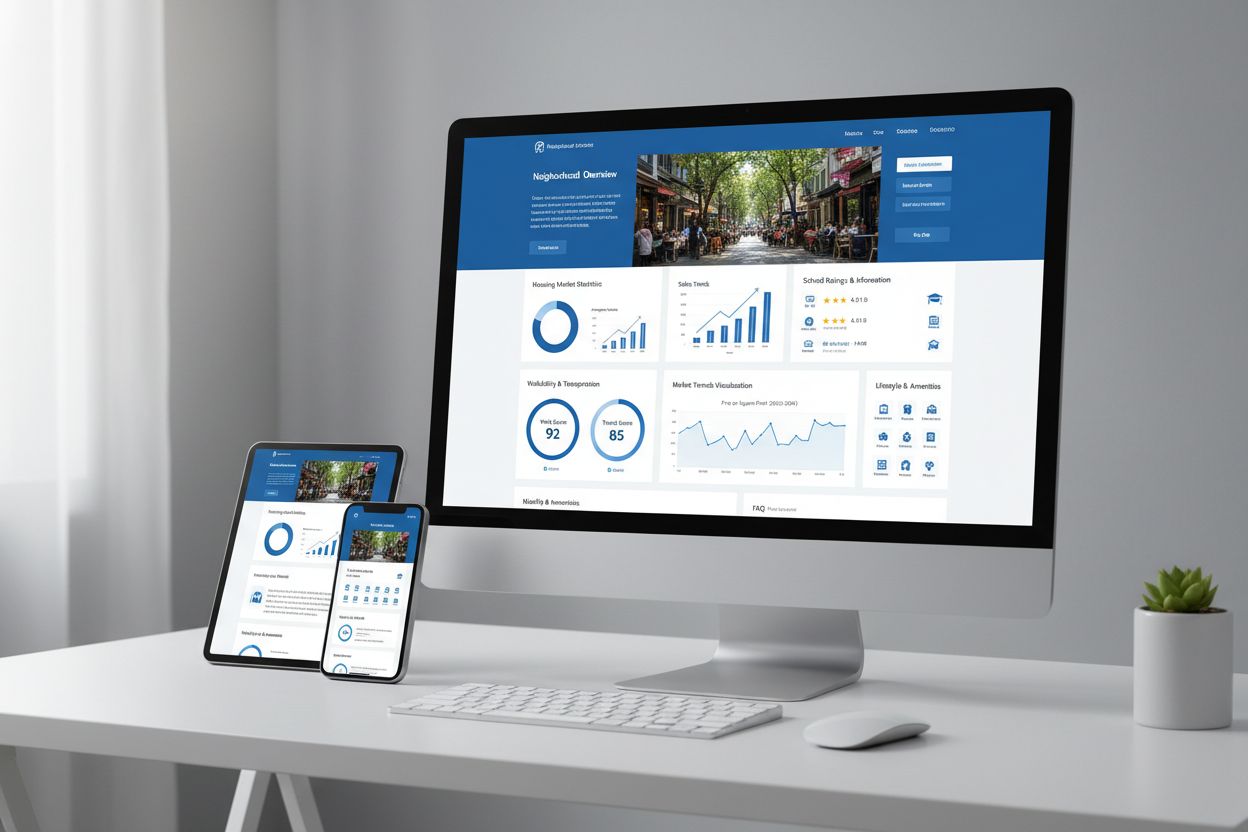
Write neighborhood guides that answer the exact questions AI systems get asked: “What’s the best neighborhood for families in [city]?”, “What are the top schools in [neighborhood]?”, “Is [neighborhood] walkable?”, “What’s the average home price in [neighborhood]?” Each guide should carry specific data points — school ratings, walkability scores, median home prices, nearby amenities — rather than subjective description, since AI systems prioritize verifiable facts. A FAQ page structured as 15-20 direct Q&A pairs for a neighborhood you actively list in is more likely to be cited than a general “about our services” page, because the format mirrors how AI systems assemble answers.
For individual properties, go beyond the standard listing copy: renovation histories, comparable sales context, and buyer testimonials tied to a specific closing give AI systems richer material to draw from when answering questions about that property or similar ones nearby. Update neighborhood guides quarterly with current data — an AI system deprioritizes content that reads as stale the same way it deprioritizes an outdated listing.
Brand-level AI visibility tracking (covered in the GEO strategy framework ) tells you whether AI systems recognize and trust your name. Listing-level and profile-level tracking is narrower: it tells you whether a specific property or a specific specialization claim actually surfaces when someone asks the exact question it’s meant to answer.
Test queries tied to your actual inventory and your actual specialization: “3-bedroom homes under $500k in [neighborhood],” “best agent for first-time buyers in [your specific area],” “[your neighborhood] real estate market right now.” Document whether your listing details or your bio language appear, word for word, in the response. AmICited automates this across ChatGPT, Perplexity, Gemini, and Google AI Overview, so you can see which specific listings and which specialization claims are actually getting pulled into answers rather than testing one query at a time by hand.
| Metric | What It Tells You | How to Read It |
|---|---|---|
| Listing citation rate | Percentage of active listings that surface for at least one matching query | Rising rate signals your listing data is specific enough to extract |
| Specialization match rate | How often your bio language appears verbatim in niche-query answers | Low rate signals a bio that’s too generic to quote |
| Cross-platform data drift | Whether the same listing shows different details on different platforms | Any drift is worth fixing immediately; AI systems treat it as a trust signal |
Run this test monthly rather than once. A listing that gets cited today can stop appearing after a price change if the update doesn’t propagate to every platform, and a bio that worked for one specialization won’t automatically transfer if you shift focus to a new neighborhood or buyer segment.
Some of the most common mistakes are narrow and easy to overlook because they don’t affect brand-level trust at all, only the citability of a specific listing or bio:
Generic listing descriptions: “Charming home in a desirable neighborhood” instead of specific square footage, school ratings, and price context. Solution: rewrite every active listing with the concrete data points AI systems extract.
Vague bios with no specialization: “Experienced agent serving the community” instead of a stated neighborhood, property type, and buyer segment. Solution: rewrite bios with specific, quotable specialization claims, and keep the wording consistent across platforms.
Missing schema markup on listings: RealEstateProperty markup skipped on individual listing pages, even when site-wide LocalBusiness schema exists. Solution: implement listing-specific schema on every active property page.
Stale listing data after a price change: Price or status updated on the MLS but not reflected on the brokerage website or a syndicated platform. Solution: audit active listings for cross-platform consistency whenever terms change, not just at initial posting.
One-size-fits-all specialization language: Using the same generic bio across every platform instead of tailoring the specific claim to the query types each platform tends to answer. Solution: keep the underlying facts identical but let the framing match how buyers search on that platform.
As AI systems get better at parsing structured listing data, the gap between data-rich and generic listings will widen rather than narrow — an AI system that can already extract price and school ratings today will extract renovation history, comparable sales, and walkability nuance tomorrow, which rewards agents who front-load that detail now. The same applies to personal branding: as AI tools develop more sophisticated buyer-matching (weighing individual preferences and financial situations against agent specialization), a vague bio will fall further behind a specific, data-backed one.
Real estate professionals who treat listing descriptions and bio language as structured data to be maintained, not one-time marketing copy, will keep compounding an advantage that’s difficult for a late adopter to close with a single rewrite. Pairing that discipline with the brand-level signals covered in the broader GEO framework is what turns individual citations into a consistent pattern of AI recommendations.
Viktor Zeman is a co-owner of QualityUnit. Even after 20 years of leading the company, he remains primarily a software engineer, specializing in AI, programmatic SEO, and backend development. He has contributed to numerous projects, including LiveAgent, PostAffiliatePro, FlowHunt, UrlsLab, and many others.

Track how AI tools like ChatGPT, Perplexity, and Google AI Overviews reference your specific properties and your agent profile. Get real-time insights into your AI visibility and stay ahead of the competition.
Real estate agents and brokerages do appear in ChatGPT, Gemini, and Perplexity recommendations, but only a few names make the cut per query. Here's the brand-wi...

Learn how real estate companies earn AI citations from ChatGPT, Perplexity, and Claude. Discover strategies for AI visibility including content optimization, sc...
Build a real estate SEO strategy for live listings, durable location pages, local market data, regulated claims, indexing health, and AI visibility growth.
Cookie Consent
We use cookies to enhance your browsing experience and analyze our traffic. See our privacy policy.