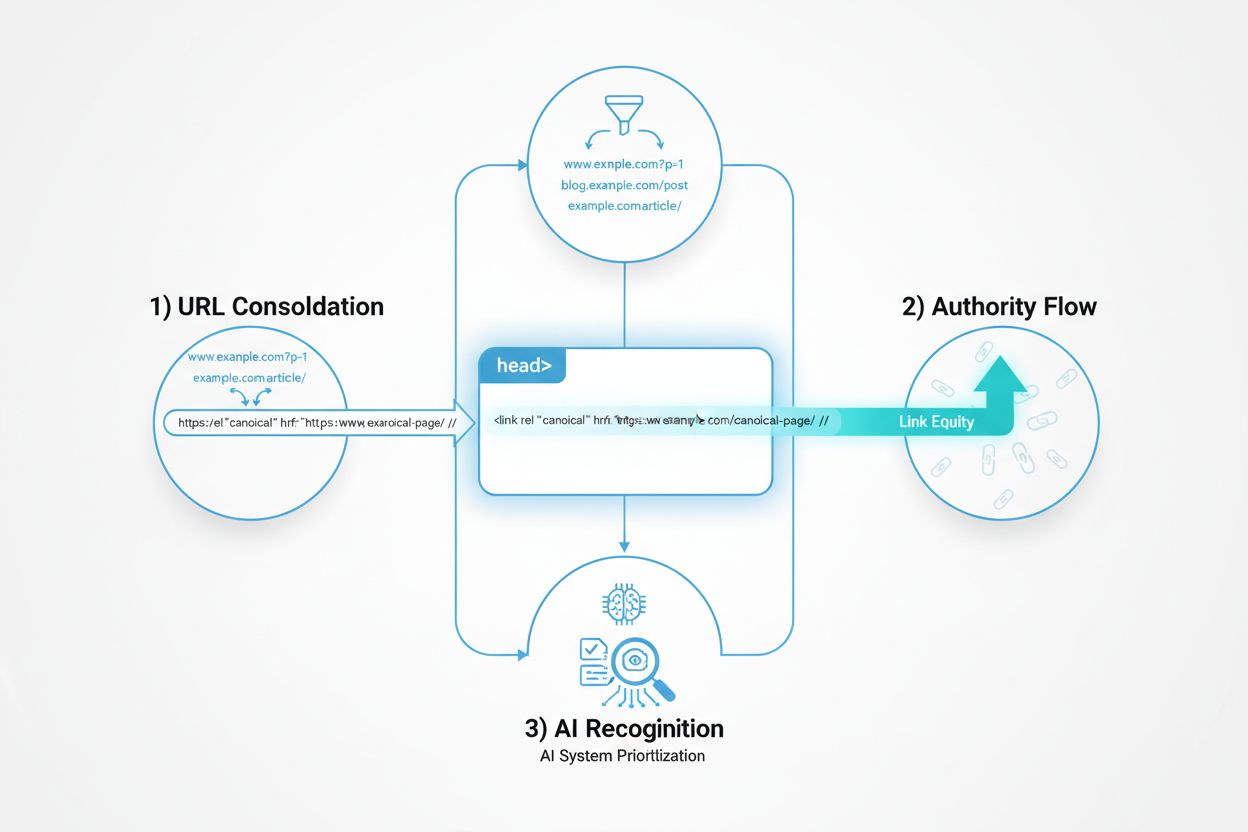
The Republishing Paradox
Republishing content across multiple channels, platforms, and formats is a legitimate and often necessary strategy for maximizing reach and engagement. However, this practice creates a fundamental tension with how search systems—particularly AI-powered ones—process and rank content. The challenge isn’t whether you can republish; it’s which content to republish, when to publish it elsewhere, and how to keep attribution pointed at your domain once it’s out in the world. The tag-level mechanics of how canonical signals work—correct syntax, cross-domain setups, common mistakes—are the technical approach duplicate content prevention takes, and they’re covered in depth in our companion implementation guide. This post focuses on the decisions that come before and after you set that tag: what’s worth republishing, how to protect attribution, and how to tell whether it worked.
Why AI Picks One Version to Represent Your Content
According to Microsoft’s technical documentation on Copilot and AI search, “LLMs group near-duplicate URLs into a single cluster and then choose one page to represent the set.” For a republishing strategy, the practical consequence is that this selection isn’t always the version you’d prefer to rank, and it isn’t fully in your control once the content exists in multiple places. The algorithm weighs factors like freshness, content quality, technical signals, and domain authority—but the weighting is opaque, and a higher-authority platform hosting your syndicated copy can out-rank your own domain if you haven’t protected attribution.
| Aspect | Traditional Search | AI Search |
|---|
| Duplicate Handling | Consolidates authority signals | Clusters and selects a single representative |
| Penalty Risk | Possible manual action | No penalty, but visibility dilution |
| Update Recognition | Gradual signal propagation | May miss updates if differences are minimal |
| Representative Selection | Rarely surprises publishers | Can select a syndication partner over your own domain |
Three risks follow directly from this selection behavior, and each one is a strategy problem before it’s a technical one:
- Intent signal dilution: when the same content lives on multiple URLs, the AI system receives conflicting signals about which version best answers a query. Instead of concentrating authority on one URL, your signals scatter across the cluster, and a piece of content that could have been a primary source becomes a secondary consideration.
- Representation risk: the version AI selects to represent your cluster may not match your business goal. You might republish a blog post to a syndication partner expecting it to drive referral traffic, only to have the AI system select the syndicated copy—one that doesn’t link back to your site—as the representative page.
- Update staleness: when you update your original content but the republished copies stay frozen, AI systems may keep citing the outdated version because the clustering algorithm doesn’t always recognize incremental changes as meaningful updates.
Ready to Monitor Your AI Visibility?
Track how AI chatbots mention your brand across ChatGPT, Perplexity, and other platforms.
Deciding What to Republish and Where
Not every piece of content is a good candidate for republishing. Comprehensive guides, original research, and cornerstone content tend to benefit most from a larger audience, because their depth gives them a durable reason to keep ranking even after they’re duplicated elsewhere. Time-sensitive campaign content is the opposite case: a marketing team republishing a promotion across email, social, paid ads, and partner sites ends up with several near-identical versions that AI systems cluster together, and when the campaign ends and pages are archived, the system may have already locked onto a now-defunct version as the representative page.
Choosing where matters as much as choosing what. Prioritize platforms that support canonical tags and honor them—some high-authority platforms strip canonical markup or don’t allow it at all, which means accepting visibility loss as the cost of the reach. Regional and localized versions are a special case worth calling out separately: publishing the same core guide on a UK domain with British spelling and local pricing isn’t really duplication, it’s intentional variation, and it should be handled with hreflang rather than treated as a syndication decision—see our canonical implementation guide for the technical setup.
Protecting Attribution When You Syndicate
The most common republishing mistake is posting to a syndication partner without securing a link—canonical or otherwise—back to the original. Picture a typical scenario: a company publishes a comprehensive guide on its own blog, then a partner site or content network picks it up and hosts it under a different URL. Without a canonical tag on the syndicated copy, the AI system’s clustering algorithm treats both versions as equally authoritative, and if the syndication platform carries more domain authority, it wins the representative slot. The original—the version you optimized, updated, and built links to—becomes invisible in AI search results, and the credit flows to the platform instead of your owned property.
Protecting attribution comes down to a short, non-negotiable list before you say yes to a syndication deal: confirm the partner will accept a canonical tag—a version pointing to your preferred original URL—or a visible “originally published at” link, confirm they won’t strip it after publication, and confirm you can verify implementation before your traffic depends on it. Content networks that refuse all three should be treated as a reach trade-off you’re making with your eyes open, not an oversight to fix later.
Stay Updated on AI Visibility Trends
Get the latest insights on AI mentions, brand monitoring, and optimization strategies.
Timing: Publish First, Update Everywhere, Retire Cleanly
Sequencing matters more than most publishers assume. Publish on your own domain first and give it time to be indexed and associated with your brand before syndicating elsewhere—simultaneous publication on a higher-authority partner increases the odds the AI system anchors on that copy instead of yours. When you update your original content after the fact, treat every syndicated or republished copy as part of the same update job: if you only update the canonical version, the clustering algorithm may not recognize the change across the rest of the cluster, and an outdated copy can keep representing you long after you’ve corrected it. This is a separate discipline from your general content refresh cadence—if you haven’t set one, our guide on how often you should update your original content for AI visibility covers that groundwork.
Retiring content deserves the same discipline. When a campaign page or syndicated placement is taken down, make sure the removal (or a redirect) happens everywhere the content lived, not just on your own domain—an orphaned syndicated copy can keep circulating in AI answers well after you’ve moved on from it.
Measuring Whether Republishing Is Working
Tracking which version of your republished content AI systems select requires monitoring beyond standard analytics. Watch for citations or references to your content and note which URL is actually appearing in AI search results—tools like Semrush, Ahrefs, and Moz are beginning to add AI search visibility metrics, though they remain less mature than traditional search tracking. UTM parameters on syndicated versions can help with attribution, but recognize that AI systems may not pass them through, so don’t rely on UTM data alone. Watch your Search Console for crawl patterns: if a secondary version is being crawled more often than your canonical, that’s an early signal the AI system may have selected the wrong representative page before you’ve even seen it show up in a citation search. Set up a recurring check across the syndication platforms you use and cross-reference what you find against your own AI visibility tracking to catch misalignment early—AmICited’s monitoring is built for exactly this kind of cross-platform comparison.
Best Practices Checklist for Safe Republishing
Before you republish anything, decide which URL should represent this content in AI search results—almost always your owned domain, not the syndication partner. Confirm the destination platform supports and will keep a canonical tag or explicit attribution link, and skip platforms that don’t. Give your own domain a head start of a few days to two weeks before the content goes live anywhere else. When you update the original, push the same update to every republished copy on the same day rather than letting secondary versions drift out of sync. Check which version AI systems are citing within the first 48 hours of a new syndication placement, and be ready to request a fix or pull the piece if attribution isn’t landing where you intended. None of this eliminates the underlying clustering behavior AI systems use to handle duplicate content—it just puts you in control of which version wins.