


How to Update Content for AI Freshness and Maintain Visibility
Learn how to update content for AI freshness with technical signals, structural changes, and refresh strategies that keep your brand visible in ChatGPT, Perplex...
12 min read
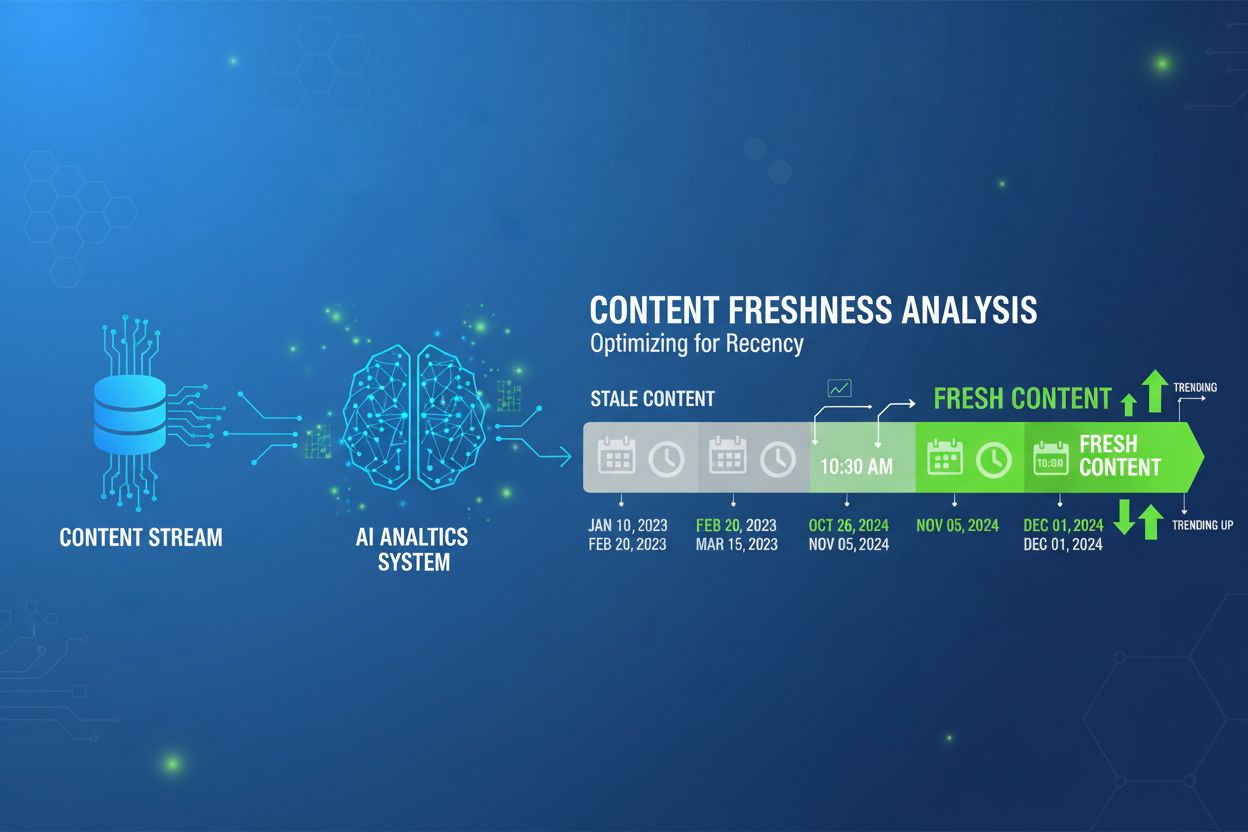
A practical playbook for when to update content for AI visibility: build an audit cadence, prioritize with a scoring framework, and signal freshness to ChatGPT, Perplexity, and Google AI Overviews without rewriting everything.
The optimal baseline for maintaining strong AI visibility is a 45-day update cycle for your highest-priority pages, frequent enough to keep freshness signals strong without creating unsustainable content operations. That baseline isn’t meant to apply evenly across your whole site: for most organizations, the practical move is identifying the 20% of content that drives 80% of your AI traffic and putting that tier on the 45-day cycle, while lower-priority content follows the slower, industry-specific schedules below.
Treat the audit itself as a recurring habit, not a one-time project. Set a monthly or quarterly checkpoint where you pull citation trends, traffic, and content age for your priority tier, flag anything showing decline, and schedule real updates before the drop becomes severe. Content that’s still climbing or holding steady doesn’t need touching yet; the cadence exists to catch decay early, not to force churn on pages that are performing. This cadence only makes sense once you understand why AI weights recency in the first place, that’s the underlying mechanics our companion piece covers in depth.

Track how AI chatbots mention your brand across ChatGPT, Perplexity, and other platforms.
The ideal update frequency depends entirely on how quickly information changes in your industry, here’s how content ages across sectors, and what cadence keeps it visible.
High-Velocity Industries (weekly to monthly, sometimes daily): Financial services and crypto platforms must track market data, interest rates, and regulatory changes constantly. SaaS and AI technology companies face frequent feature and capability changes that make existing guides obsolete quickly, best tied to release cycles rather than a fixed calendar. News and media organizations need real-time updates for breaking stories.
Medium-Velocity Industries (quarterly to bi-annually): Healthcare and wellness content needs regular review to reflect new treatment protocols or guidelines, with annual review as an absolute floor. Digital marketing best practices shift every 6-12 months as platforms and algorithms evolve. Travel and e-commerce content benefits from quarterly refreshes plus a pre-season update 30 days ahead of peak periods, since pricing and availability change seasonally even when the destination guide itself doesn’t.
Low-Velocity Industries (annual, sometimes longer): Energy and infrastructure content has a long shelf life since fundamental information changes infrequently. Legal and statutory content changes slowly at its core, though recent precedents may need adding as they emerge. Historical and evergreen educational content doesn’t require frequent factual updates, though refreshing examples or presentation can still help.
Understanding your content’s velocity, how quickly the facts underneath it actually change, is the first step in setting a realistic schedule instead of copying a cadence built for a different industry. In fast-moving categories, this dynamic can be stark: a newer guide from the current year can outrank a page with significantly more backlinks if that page hasn’t been substantively updated, simply because AI systems read it as more current and trustworthy.
Regardless of industry, certain content types age faster than others and should jump the queue in your audit:
These are the same categories that trigger Google’s Query Deserves Freshness signal, see why AI systems weight recency for how that logic works, which is exactly why they demand regular updates to remain valuable and visible in AI answers even when the rest of your site is on a slower cycle.
Get the latest insights on AI mentions, brand monitoring, and optimization strategies.
When you can’t update everything at once, a scoring model keeps the decision objective instead of reactive. Evaluate each page across five dimensions: (1) Business Impact (revenue potential, conversion value, strategic importance), (2) Organic Performance (current traffic, rankings, engagement), (3) LLM Citations (how frequently the content appears in AI responses), (4) Content Age (months since last substantive update), and (5) Competitive Freshness (how recently competing content was updated).
Score each dimension 1-10, then weight the total, for most organizations, LLM citations and business impact should carry the most weight, since those two most directly predict whether an update will move AI visibility. Prioritize pages that score high on business value but are showing declining LLM citations or rising content age; those are your highest-ROI updates. Pages that are both low-traffic and low-citation belong at the back of the queue regardless of how old they are. Concentrating real, thorough updates on your top 50 pages consistently outperforms lightly touching 500.
A full rewrite isn’t required to reset a page’s freshness signal, and treating every update as a ground-up rewrite is the fastest way to burn your update budget on too few pages. Start with the technical layer: update the dateModified field in your schema markup, refresh your XML sitemap’s lastmod timestamp, and confirm your HTTP headers and caching policy allow the page to be revalidated rather than served from stale cache. Add a prominent “Last Updated” date visible to readers, not just in metadata, since AI systems read both.
Pair every technical signal with at least one real content change: swap in current statistics, add a recent example, correct a claim that’s aged out, or expand a section that’s thin relative to what’s now ranking. Faking these signals without a substantive change doesn’t work, AI systems detect shallow edits and don’t reward them; see the common misconceptions about content freshness for why that shortcut backfires. Once the update is live, request re-indexing through Google Search Console to accelerate how quickly AI systems and search engines discover the change. This combination, real change plus aligned technical signals, is what actually moves your freshness strategy forward, as opposed to a cosmetic edit that resets a timestamp without resetting anything AI systems actually evaluate.
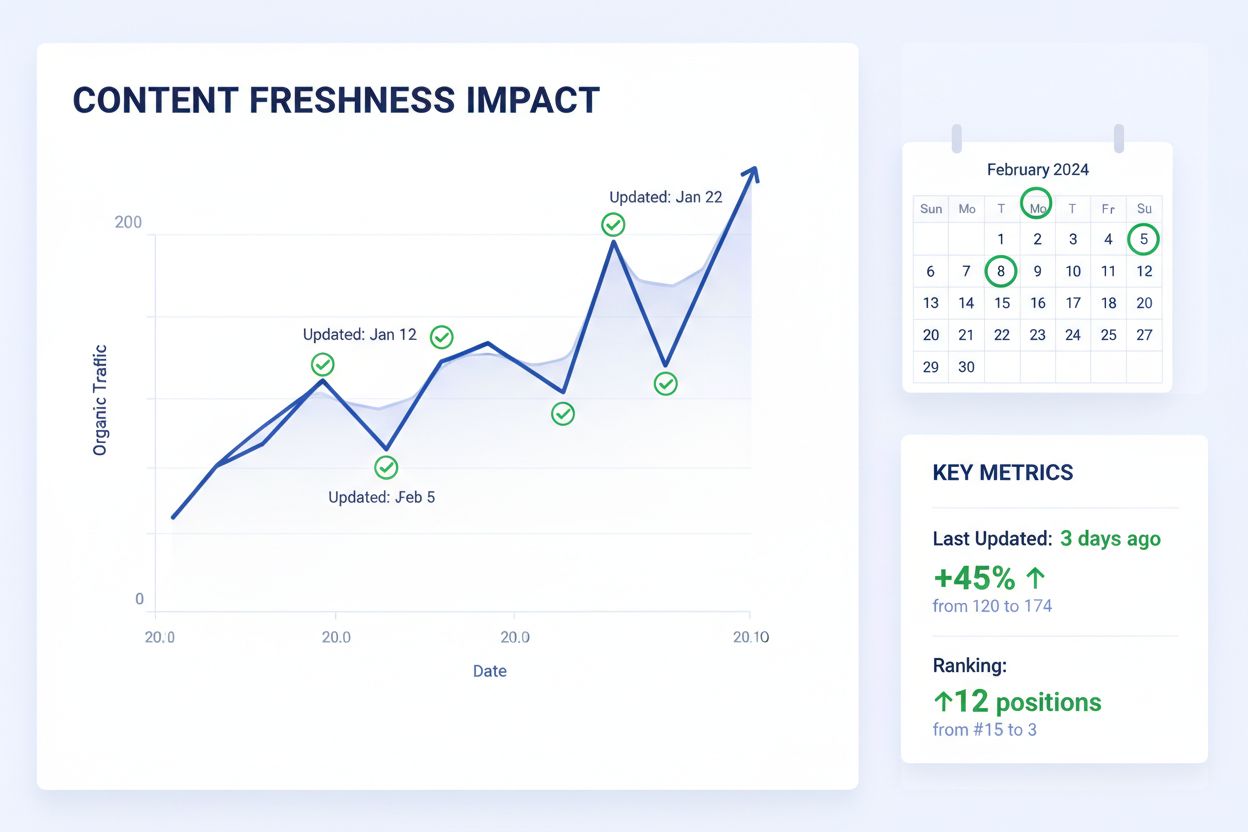
Tracking the right metrics proves whether your freshness strategy is working, rather than assuming an update helped just because it happened. Before updating, define a small set of representative prompts your target audience would actually ask, then run them against ChatGPT, Perplexity, and Google AI Overviews and log which URLs appear, their position, and the date observed. Repeat the same prompts weekly or bi-weekly after the update to see whether your citation count and position improve.
Beyond citations, monitor ranking position changes within 1-3 weeks of updating, even a modest position gain can meaningfully increase traffic. Track organic traffic growth to the refreshed page using your analytics platform. Measure AI citation count with a monitoring tool like AmICited to confirm whether the page appears more often across AI systems after the update. Check click-through rate in Google Search Console, since fresher titles and descriptions often lift CTR even at the same position. Set alerts for sudden drops (signaling decay you missed) and spikes (signaling a successful refresh worth replicating). This feedback loop is what turns your audit cadence from a guess into a system you can keep improving.
Yasha is a talented software developer specializing in Python, Java, and machine learning. Yasha writes technical articles on AI, prompt engineering, and chatbot development.

Track how AI systems reference your content and identify freshness opportunities with AmICited's AI monitoring platform.
Learn how to update content for AI freshness with technical signals, structural changes, and refresh strategies that keep your brand visible in ChatGPT, Perplex...
Community discussion on optimal content update frequency for AI search visibility. Real data from content teams on freshness strategies and what's working.
Community discussion on content freshness and update frequency for AI search visibility. Real experiences from content teams balancing freshness with evergreen ...
Cookie Consent
We use cookies to enhance your browsing experience and analyze our traffic. See our privacy policy.