



How to Update Content for AI Freshness and Maintain Visibility
Learn how to update content for AI freshness with technical signals, structural changes, and refresh strategies that keep your brand visible in ChatGPT, Perplex...
12 min read
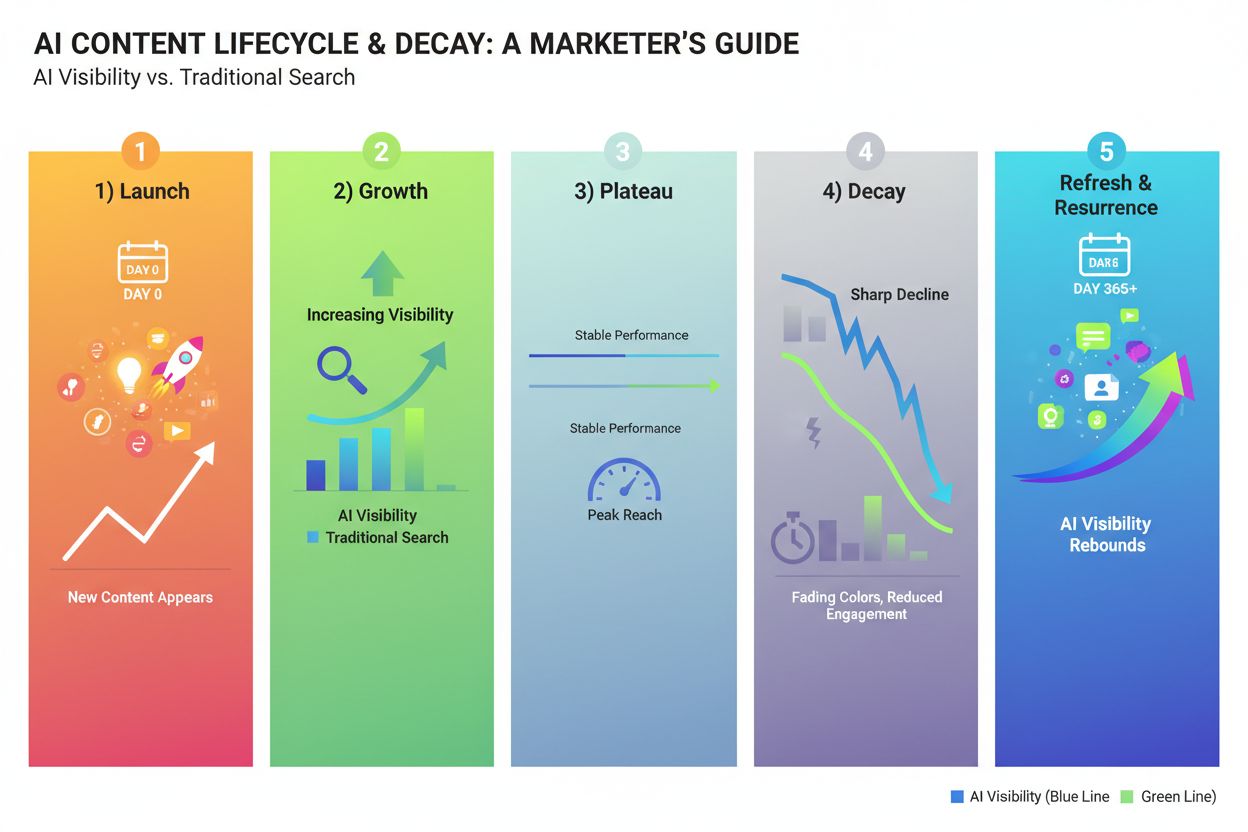
Understand why AI systems like ChatGPT, Perplexity, and Google AI Overviews weight content recency, the three signal types they read, and how visibility decays without updates.
The relationship between content freshness and visibility has fundamentally shifted with the rise of AI-powered search systems. Unlike traditional SEO, which relies on historical ranking signals accumulated over months, AI visibility depends on live retrieval systems that actively fetch and evaluate content in real time. This piece is about why that shift happened and how the underlying signals actually work. If you’re looking for the operational side, how often to update, what to prioritize first, and how to signal freshness without rewriting everything, see when to update your content for AI freshness signals .
While older search engines indexed static snapshots of the web, modern AI systems like ChatGPT, Perplexity, and Google AI Overviews continuously pull from current sources to generate responses. Research shows that 65% of AI bot hits target content published within the past year, compared to a much more distributed pattern in traditional Google results. Google’s own “Query Deserves Freshness” algorithm is the ancestor of this behavior: it detects three signals, active news coverage, high publishing volume, and spiking search volume, and prioritizes recently updated content for queries where users expect current information. AI systems inherit and amplify this same logic, but with even less patience for stale content. For queries about breaking news, product launches, or fast-moving regulations, AI systems will almost always prefer a source updated within the last few weeks over an older, more authoritative one.
The gap between the two systems is measurable, not just directional:
| Feature | Traditional Search (Google) | AI/LLM-Powered Search |
|---|---|---|
| Core Ranking Signal | One of many factors; balanced with backlinks and domain age | Primary signal for relevance and trustworthiness |
| Content Evaluation | Matches keywords to indexed documents; values static authority | Values dynamic updates and semantic clarity |
| Update Frequency | Content can remain static if it maintains authority | Quarterly or monthly updates are the new standard |
| Average Source Age | Results tend to be older | Cited content skews meaningfully fresher than organic results |
| Authority vs. Recency | High-authority old content ranks well for years | Recent content may outrank older content with far more backlinks |
The critical insight is that AI systems are trained on data with specific cutoff dates, but their retrieval mechanisms actively prefer recently updated sources because they signal reliability, accuracy, and relevance to current queries. For content creators, this means freshness has evolved from a nice-to-have ranking factor into a core visibility requirement.
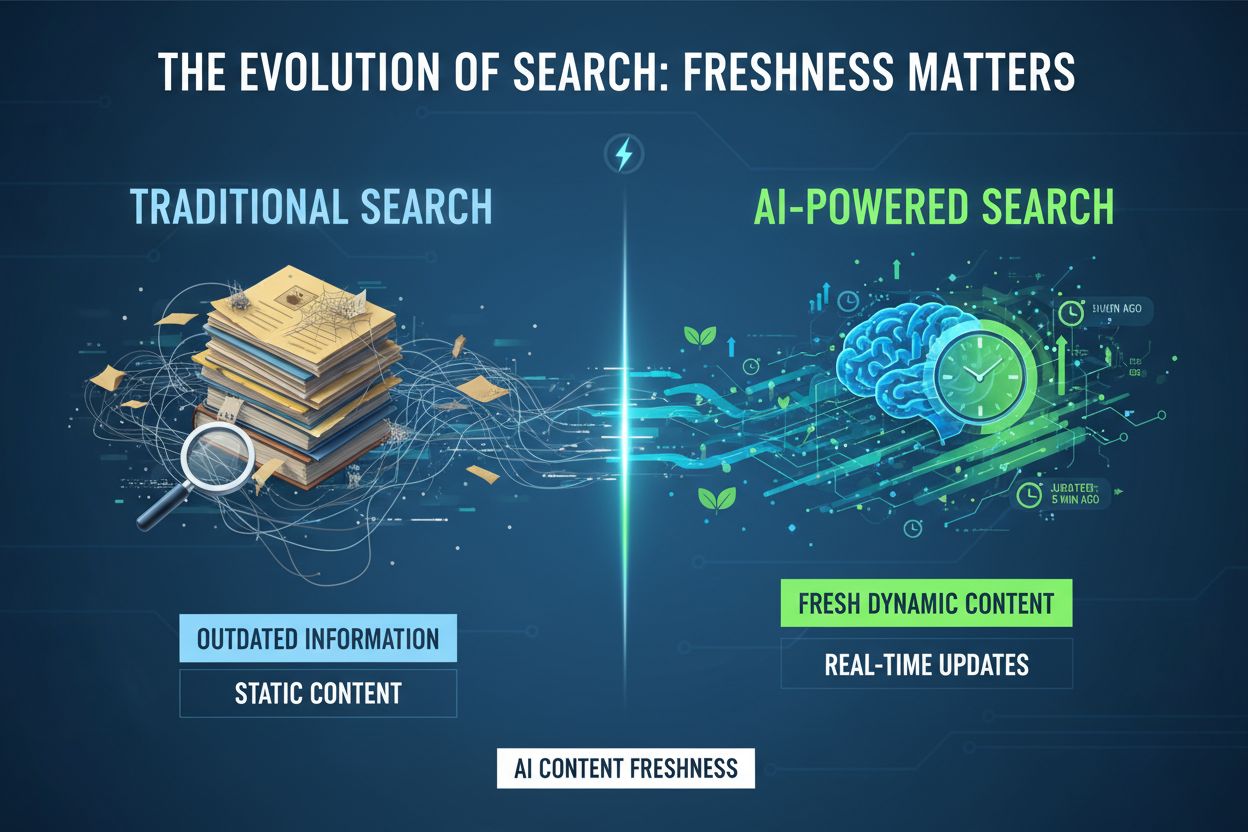
AI systems evaluate freshness through three distinct categories of signals that work together to determine citation likelihood. Textual signals include explicit date markers like publication dates, “as of” statements (e.g., “as of January 2025”), version labels, and changelogs that communicate when content was last reviewed or updated. Technical signals are embedded in your site’s infrastructure: schema markup with datePublished and dateModified fields, XML sitemap lastmod tags, HTTP headers, and structured data that machines can parse without reading the page. Behavioral signals reflect how users interact with your content, engagement metrics, click-through rates, time on page, and return visits all indicate whether content remains valuable and current.
| Signal Type | Examples | Implementation Method | AI System Priority |
|---|---|---|---|
| Textual | Publication dates, “as of” statements, version numbers, changelogs | Visible on page, in metadata | High |
| Technical | dateModified schema, lastmod in sitemap, HTTP headers | Backend/CMS configuration | Critical |
| Behavioral | User engagement, CTR, time on page, return visits | Analytics tracking, user signals | Medium-High |
These three categories explain what AI systems look for. The concrete checklist for putting them in place, which fields to update, in what order, and how often, is operational territory covered in the freshness audit playbook .

Track how AI chatbots mention your brand across ChatGPT, Perplexity, and other platforms.
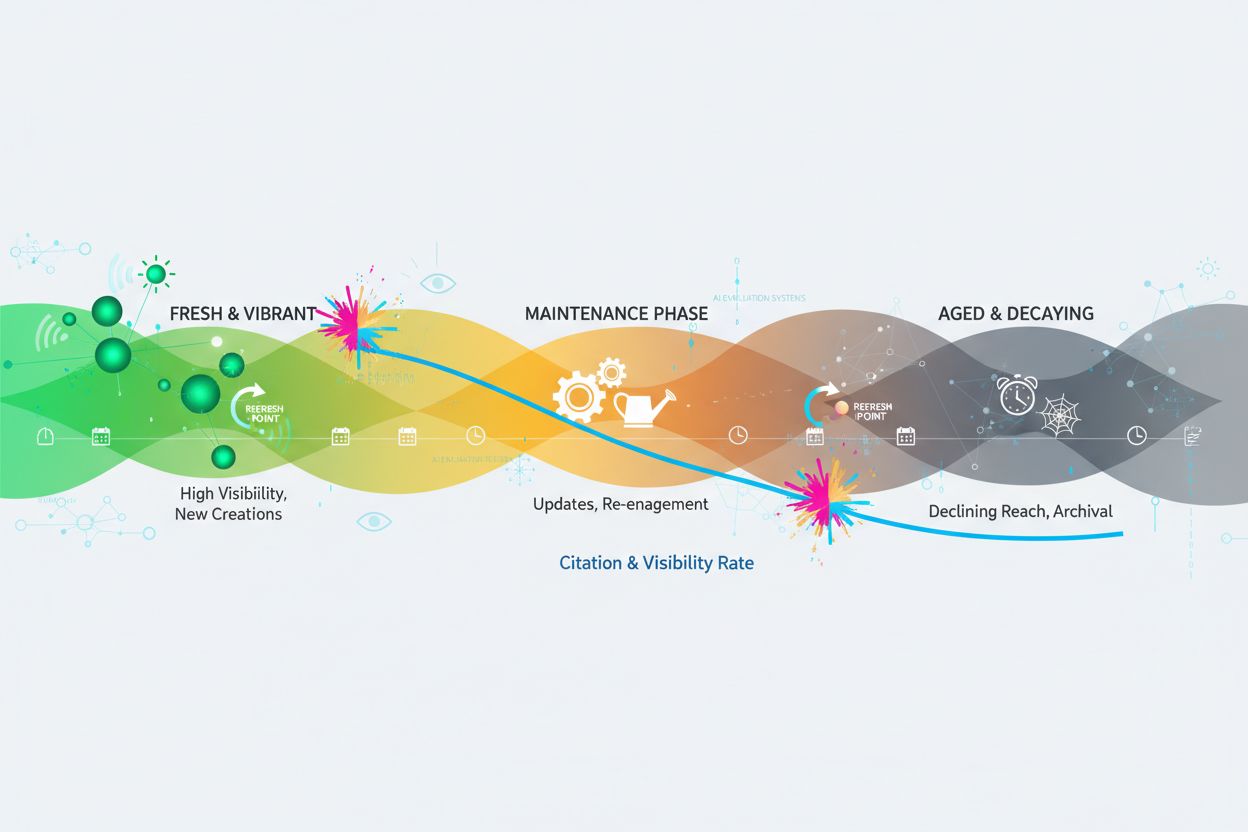
Every piece of content follows a predictable lifecycle that impacts AI visibility differently than traditional search rankings. Content experiences an initial launch phase where freshness signals are strongest, followed by a growth phase where citations and visibility increase, then a plateau phase where visibility stabilizes. Without intervention, content enters a decay phase where AI systems gradually deprioritize it as newer sources emerge and the content’s age becomes a liability rather than neutral.
The critical difference from traditional SEO is that AI visibility decay happens rapidly, within weeks rather than months, because AI systems actively compare your content’s date against competing sources in real time rather than relying on an accumulated ranking history. You can spot decaying content by watching your citations across major AI systems: a sharp, sustained drop in appearances in ChatGPT responses or Perplexity citations signals that a page has entered decay. A refresh at the right moment triggers a resurgence in visibility as the updated date resets the freshness signal, which is why strategic, well-timed updates can restore visibility to previously high-performing content without requiring a complete rewrite.
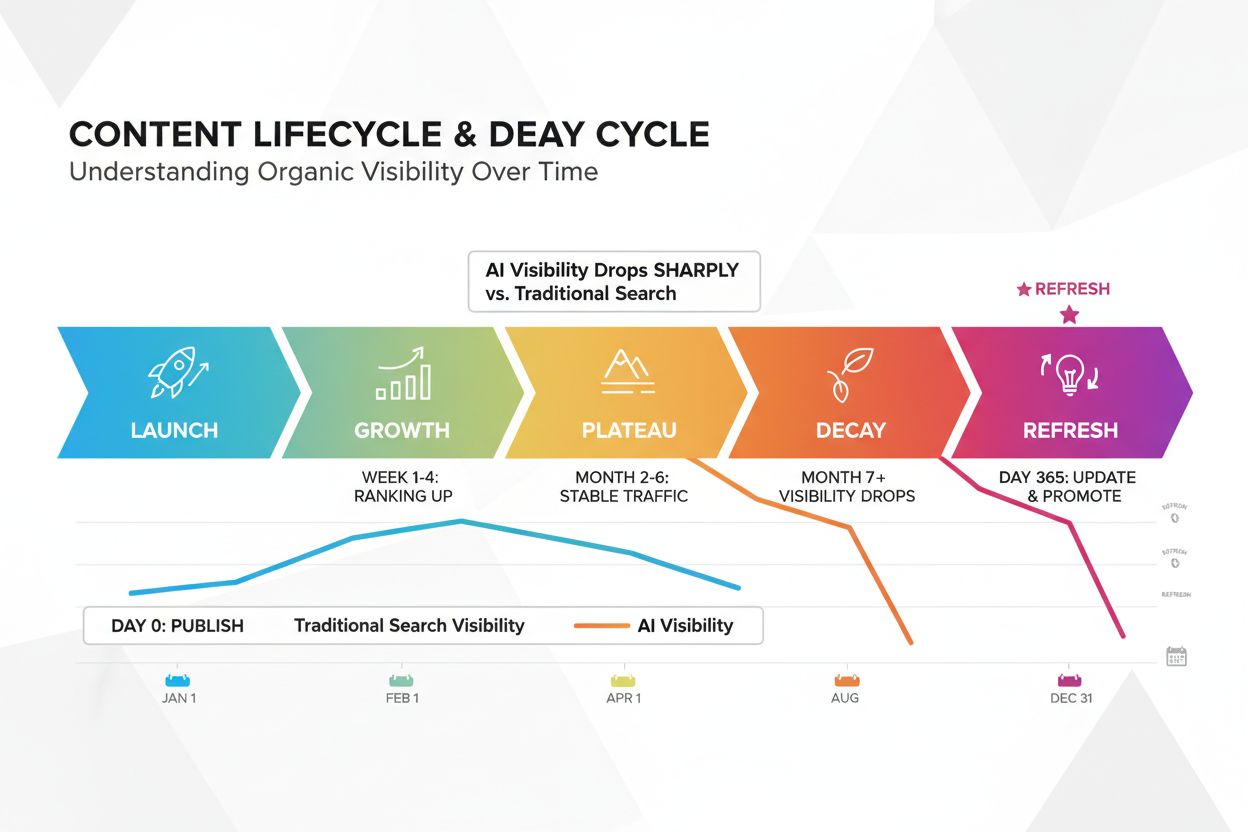
Traditional SEO trained content teams to trust authority: enough backlinks and domain history could keep a page ranking for years with little maintenance. AI systems don’t extend the same grace. Because AI visibility depends on live retrieval rather than an accumulated ranking history, a page’s age works against it far more directly, and recency frequently wins even against a competing page with substantially stronger backlink profiles or domain authority.
Authority hasn’t become irrelevant, it still acts as the tiebreaker when two competing sources are similarly fresh, and it still matters for establishing that a source is credible in the first place. But authority alone doesn’t rescue content that has clearly gone stale, and it can’t substitute for a real update once a topic’s underlying facts have moved on. The practical implication is that a content strategy built entirely on accumulating authority, without a matching plan to keep pages current, will lose AI visibility over time even as its backlink count climbs.
Get the latest insights on AI mentions, brand monitoring, and optimization strategies.
Not every topic decays at the same rate, so a single global update calendar doesn’t work. Financial services, crypto, and news deal with facts that shift daily or weekly, interest rates, market conditions, and breaking events make older content potentially misleading almost immediately. Healthcare content carries real stakes when treatment protocols or guidelines change, which pushes its minimum cadence higher than most categories. SaaS and software content ages in step with product releases rather than the calendar. Legal reference material, historical content, and foundational how-tos change slowly enough that annual reviews can sustain visibility.
Your update frequency should be set by how fast your industry’s underlying facts change, not by an arbitrary schedule copied from a different sector. For the exact cadence recommendations by industry, the scoring framework for deciding what to update first, and the technical steps for signaling freshness without rewriting everything, see the industry-by-industry update schedule .
Many organizations undermine their freshness strategy by making preventable mistakes rooted in a misunderstanding of what “freshness” actually means to an AI system. The most common error is treating cosmetic updates as real ones: changing a few words or adding a sentence without substantively improving the content. AI systems can detect shallow changes and don’t reward them with improved visibility. Equally damaging is updating timestamps without real changes, a practice that damages credibility with both AI systems and users who discover the deception once they compare the “updated” date against what actually changed on the page.
Content freshness is also frequently confused with content frequency, but they describe different things. Content freshness is a page-level attribute, how recent and current an individual piece appears. Content frequency is a site-level habit, how often you publish across your whole site. A single well-maintained page updated on a real cadence outperforms a stream of new pages that go stale the moment they’re published. If you want the operational breakdown of how to systematically identify which content updates deliver the biggest visibility gains, and how to prioritize when you can’t update everything at once, that’s the focus of our companion guide to auditing and prioritizing content updates.
Viktor Zeman is a co-owner of QualityUnit. Even after 20 years of leading the company, he remains primarily a software engineer, specializing in AI, programmatic SEO, and backend development. He has contributed to numerous projects, including LiveAgent, PostAffiliatePro, FlowHunt, UrlsLab, and many others.

Track how often your brand appears in AI-generated answers across ChatGPT, Perplexity, and Google AI Overviews. Get real-time alerts when your content freshness impacts your visibility.
Learn how to update content for AI freshness with technical signals, structural changes, and refresh strategies that keep your brand visible in ChatGPT, Perplex...
Learn how content freshness signals work in AI systems. Understand timestamps, modification dates, and technical indicators that influence AI citations and visi...
Learn why content freshness is crucial for AI search visibility. Discover how ChatGPT, Perplexity, and other AI engines prioritize fresh content and how to opti...
Cookie Consent
We use cookies to enhance your browsing experience and analyze our traffic. See our privacy policy.