Responding to Incorrect AI Information About Your Brand
The tactical playbook for fixing incorrect AI information about your brand: triage, fix the source data, report it to each platform, and verify the correction actually held.
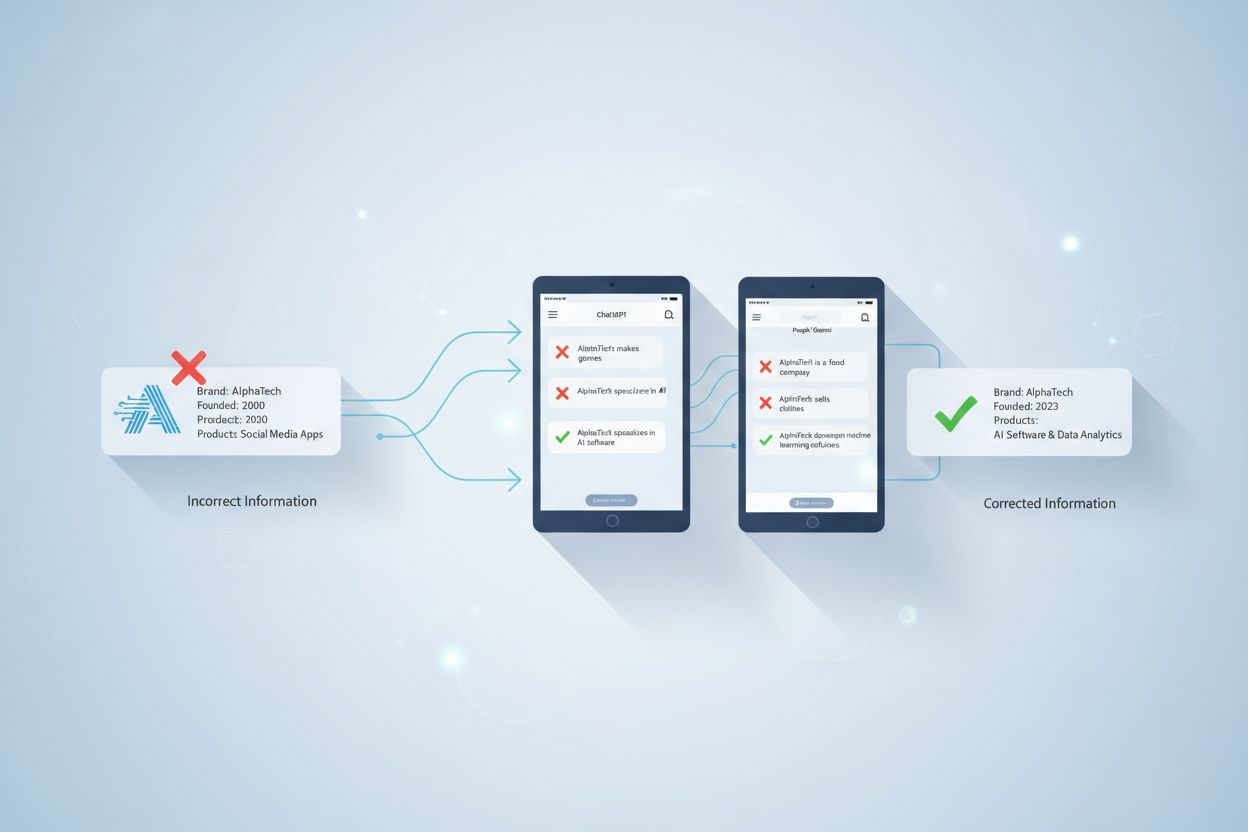
You’ve spotted incorrect information about your brand in ChatGPT, Google AI Overviews, or another AI platform — a wrong founder, a misstated location, a product that doesn’t exist. This guide is the response playbook: the exact steps to triage it, fix it at the source, report it to each platform, and confirm the correction actually held. If you’re instead trying to understand why AI systems produce these errors in the first place, why AI gets brand information wrong
covers the causes — misinformation versus AI hallucinations, why AI hallucinations happen, and the training-data dynamics behind them — in depth.
Triage: How Severe Is This Error?
Immediate action matters because misinformation spreads exponentially across AI systems — writers cite it in blog posts, bots redistribute it on social platforms, and other AI models can incorporate it into their own training data. Before you touch anything, assess severity using a simple priority matrix: Critical issues include wrong founder attribution or product misrepresentation that could harm customer decisions; High priority covers location, founding year, or leadership errors; Medium priority includes minor details and outdated information; Low priority covers formatting or non-essential details.
Set a timeline based on that tier: critical corrections should be implemented within 48 hours, high-priority fixes within one week, and medium-priority updates within two weeks. Assign clear ownership — typically your SEO or marketing team — to coordinate the response and make sure corrections land consistently across every web property, not just one page. Document each error (the prompt that triggered it, the platform, the exact wrong text) before you start fixing anything; you’ll need that record to confirm the fix later.
Ready to Monitor Your AI Visibility?
Track how AI chatbots mention your brand across ChatGPT, Perplexity, and other platforms.
You can’t edit an AI model’s output directly, so the real fix happens upstream: strengthening the brand data these systems actually read. Start by making your core facts — name, location, founding date, founder, key products — consistent across every web property: your website, social profiles, business directories, press releases, and anywhere else your brand appears. Inconsistency is what invites an AI system to guess or blend conflicting versions in the first place — see how AI models handle conflicting information. A clear, factual About page that states the corrected fact plainly — without marketing fluff — becomes the anchor point AI crawlers look to.
Next, implement or update schema markup in JSON-LD: Organization schema for your company, Person schema for founders and executives, Product schema for what you sell. Structured data removes ambiguity about what each fact means, which is exactly what stops an AI system from misattributing it:
Add sameAs links to connect your website with verified profiles on LinkedIn, Crunchbase, Wikipedia, and Wikidata — these cross-links tell AI systems that all those profiles describe the same entity, which helps them unify fragmented mentions of your brand into one corrected identity instead of resolving the conflict wrong. Create or update your Wikidata entry (one of the largest structured databases used by Google and LLMs), and publish a brand-facts.json dataset on your site — a machine-readable press kit with verified company details, leadership, products, and official URLs — so generative systems have a single point of truth to pull the corrected fact from directly and correctly understand your brand.
Reporting Errors Directly to AI Platforms
Fixing the source data is necessary but slow — most platforms don’t retrain instantly. In parallel, flag the specific bad response on the platform where you found it:
ChatGPT: Use the thumbs-down icon on the response and describe the error in the feedback box. This doesn’t rewrite the answer immediately, but it’s logged as a correction signal.
Google AI Overviews / Google Search: Use the “Feedback” link beneath the AI Overview. For your Knowledge Panel specifically, use the “Claim this knowledge panel” or “Suggest an edit” option — this is the fastest path to correcting facts Google surfaces directly.
Perplexity: Use the report icon attached to each answer to flag inaccurate or outdated content.
Microsoft Copilot: Use the feedback button in the response toolbar to report incorrect information.
Wikipedia / Wikidata: If the error traces back to an outdated Wikipedia article or Wikidata claim, edit it directly (or request an edit) — both feed into Google’s Knowledge Graph and, downstream, into several AI systems.
None of these in-platform reports are guaranteed to produce an instant fix, and none replace the source-data corrections above — think of them as a parallel track that can sometimes suppress a specific bad answer faster than waiting for the underlying data to be recrawled.
Stay Updated on AI Visibility Trends
Get the latest insights on AI mentions, brand monitoring, and optimization strategies.
Verifying Corrections Propagated
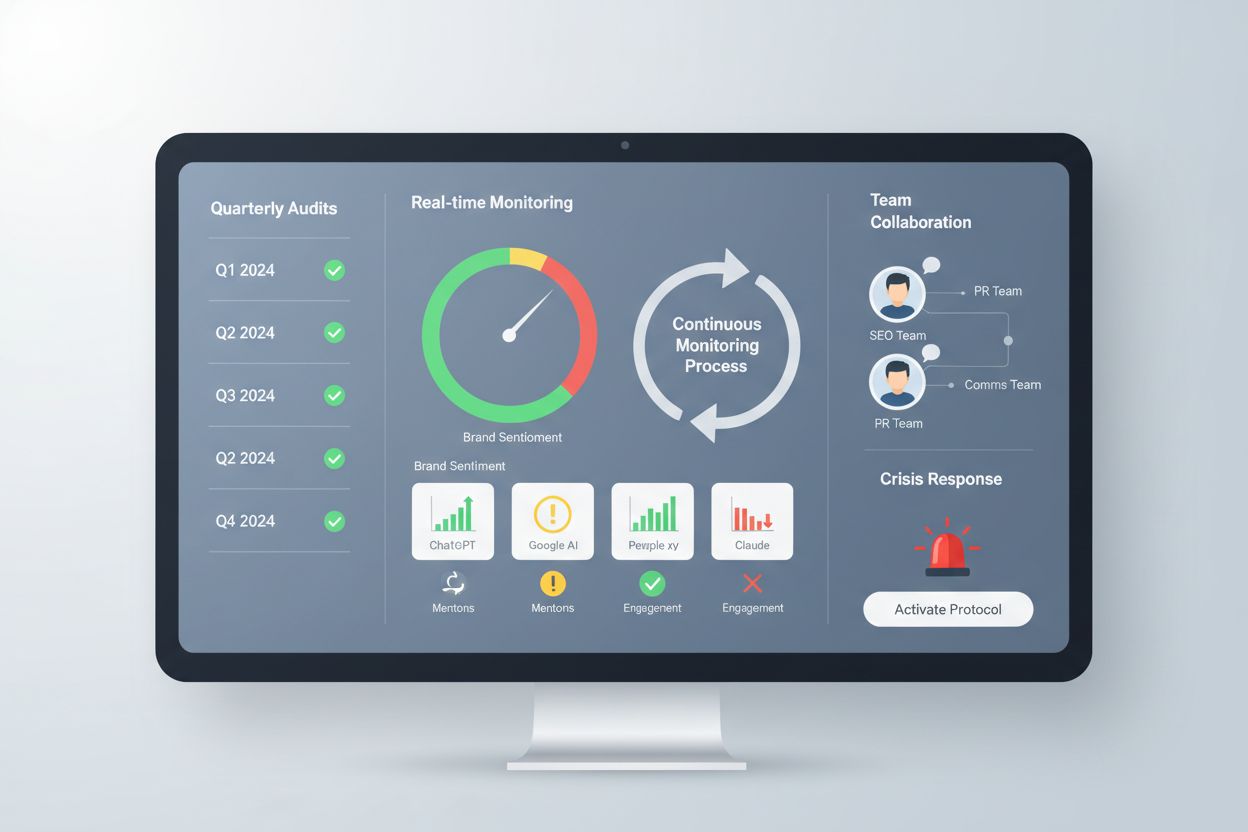
Correcting the source and flagging the platform isn’t the finish line — you need proof the fix actually took. Re-run the exact prompts that originally surfaced the error across every platform where you found it, on a fixed cadence: weekly for critical errors, monthly for everything else, until the answer comes back clean two checks in a row. Because model outputs aren’t fully deterministic, test each prompt a few times per platform rather than trusting a single clean response.
Keep a log of when each correction was made and when it was confirmed fixed on each platform — this is the evidence you need to know how long your corrections actually take, and it’s the same log you’ll want if the error resurfaces after a model update. Use a monitoring tool like AmICited.com to automate this re-checking instead of manually running prompts on a schedule; it flags if a corrected error comes back so you’re not caught off guard by a retrain reintroducing old information.
Tools That Speed Up Correction Work
A handful of specialized tools support brand protection work by making it faster to confirm exactly what’s wrong and whether your fix landed. Use the Google Knowledge Graph Search API to check how Google currently interprets your brand entity — if it still shows the old, incorrect fact, that’s the piece still cascading into AI answers. Entity extraction tools like spaCy or Diffbot can pull named items (people, products, locations) out of an AI response automatically, so you can pinpoint exactly which entity is wrong instead of re-reading the whole answer by eye. Semantic comparison tools like Sentence-BERT (SBERT) or Universal Sentence Encoder (USE) measure how closely a re-tested AI response matches your corrected, verified brand copy by meaning — a low similarity score after you’ve “fixed” something tells you the correction hasn’t propagated yet. For fragmentation where your brand shows up as multiple separate entities across datasets, entity reconciliation tools like OpenRefine can merge the near-duplicates so corrections apply to a single unified identity rather than three partial ones.
Tool
Purpose in the correction workflow
Google Knowledge Graph Search API
Check whether Google still shows the old fact
spaCy / Diffbot
Extract entities from an AI response to isolate the exact wrong fact
Sentence-BERT (SBERT) / USE
Confirm a re-tested response now matches your corrected copy
OpenRefine
Merge duplicate brand entities so a fix applies everywhere
AmICited.com
Automate re-checking across ChatGPT, Gemini, Perplexity, Claude on a schedule
Case Study: Why Detailed Answers Beat Denials
When Ahrefs tested how AI systems handle conflicting information about a fictional brand, they discovered something crucial for anyone correcting an error: the most detailed story wins, regardless of truth. The test created a fake luxury paperweight company and seeded conflicting articles across the web, then watched how AI platforms responded. The official website used vague language and declined to provide specifics (“We do not disclose…”), while third-party sources provided detailed, answer-shaped responses to every question. AI systems consistently chose the detailed third-party content over the official denials.
The lesson for your correction: a bare denial or a one-line schema fix isn’t always enough competing against a detailed wrong answer elsewhere. When you correct an error, don’t just state the correct fact — provide detailed, specific, answer-shaped content that directly addresses what users ask AI systems. Update your About page with concrete facts, add FAQ content that answers the specific question that triggered the error, and make sure your schema markup is complete rather than minimal. That gives AI systems a detailed correct answer to prefer over the detailed wrong one.
Frequently asked questions
No, you cannot directly edit information in ChatGPT, Google AI Overviews, or other generative AI platforms. Instead, you must correct the underlying data sources that these systems rely on: your website schema markup, Knowledge Graph entries, Wikidata profiles, business listings, and press releases. When you update these authoritative sources consistently, AI systems will gradually incorporate the corrections as they retrain and refresh their data.
Most major platforms have a built-in feedback path: ChatGPT lets you thumbs-down a response and describe what's wrong; Google AI Overviews has a 'Feedback' link under the answer plus a 'Claim this knowledge panel' option for your Knowledge Graph entry; Perplexity has a report icon on each answer; Microsoft Copilot has a feedback button in the response toolbar. None of these guarantee an immediate fix, but they feed signal into the platform's review process alongside the source-level corrections described below.
Timeline varies by platform and data source. Corrections to your website schema can be picked up by some AI systems within days, while Knowledge Graph updates may take weeks or months. Most AI models retrain periodically (ranging from weekly to quarterly), so corrections don't appear instantly. In-platform feedback flags can sometimes suppress a specific bad answer faster than a full retrain, but that's not guaranteed either.
Re-run the exact prompts that originally surfaced the error, across every platform where you spotted it, on a fixed schedule (weekly for critical errors, monthly otherwise) until the answer is clean two checks in a row. Don't rely on a single clean response — models are non-deterministic, so test the same prompt a few times per platform before declaring it fixed.
For small brands with limited hallucinations, internal management using the tools and strategies outlined in this guide is feasible. However, for enterprise brands with complex data ecosystems, multiple product lines, or significant misinformation, hiring an agency specializing in AI reputation management can accelerate corrections and ensure comprehensive implementation. Many brands benefit from a hybrid approach: internal monitoring with AmICited.com and external expertise for complex data infrastructure fixes.
The ROI is substantial but often indirect. Preventing misinformation protects customer trust, reduces support inquiries from confused customers, and maintains brand authority in AI search results. By correcting hallucinations early and verifying the fix held, you prevent cascading damage where misinformation spreads across multiple AI platforms and gets incorporated into training data.
AmICited.com continuously monitors how your brand appears across ChatGPT, Gemini, Perplexity, Claude, and other AI platforms. Instead of manually re-running prompts on a schedule, it re-checks for you and alerts you if a corrected error resurfaces, giving you measurable proof that a fix actually held rather than a one-time snapshot that happened to look clean.
Yasha is a talented software developer specializing in Python, Java, and machine learning. Yasha writes technical articles on AI, prompt engineering, and chatbot development.
Yasha Boroumand
CTO, FlowHunt
Verify Your Corrections Are Working
Stop guessing whether your fixes propagated. Track mentions across ChatGPT, Gemini, Perplexity, and more with AmICited to confirm corrections actually stick.
AI keeps getting facts wrong about our company - what's the actual process to correct this?
Community discussion on responding to incorrect AI mentions and misinformation. Real experiences correcting factual errors in ChatGPT, Perplexity, and other AI ...
Learn how to identify and correct incorrect brand information in AI systems like ChatGPT, Gemini, and Perplexity. Discover monitoring tools, source-level correc...
Why AI systems misrepresent brands in the first place: the scale of the problem, misinformation vs hallucinations, Reddit's outsized influence, and how to build...
9 min read
Cookie Consent We use cookies to enhance your browsing experience and analyze our traffic. See our privacy policy.