



What is Perplexity Score in Content?
Learn what perplexity score means in content and language models. Understand how it measures model uncertainty, prediction accuracy, and text quality evaluation...
8 min read
Keep seeing “perplexity score” mentioned in AI content discussions.
My confusion:
As a content strategist, what do I actually need to know?
Let me clarify this common confusion.
Two different things:
They share a name because the concept relates to language understanding, but they’re functionally different.
What perplexity score actually measures:
When a language model reads text, it predicts what word comes next. Perplexity measures how “surprised” or uncertain the model is at each prediction.
Lower perplexity = Higher confidence Higher perplexity = More uncertainty
Example:
Text: “The cat sat on the ___”
Text: “The quantum fluctuation caused ___”
For content writers:
This is primarily a model evaluation metric, not something you directly optimize for. You’re not trying to write text that’s easy for AI to predict.
The indirect relevance:
Clear, well-structured writing is generally easier for AI to process and understand - which can help with AI citations.
Correct. Here’s why.
Perplexity is for model evaluation:
| Use Case | Perplexity Relevance |
|---|---|
| Training AI models | Essential metric |
| Comparing model versions | Core evaluation |
| Assessing AI output quality | Helpful indicator |
| Writing human content | Not directly relevant |
What you should focus on instead:
The practical takeaway:
Good writing practices that work for humans also work for AI. You don’t need to think about perplexity score.
What IS worth tracking:
These metrics tell you if your content is actually appearing in AI answers - much more actionable than perplexity scores.
Technical writer perspective.
When perplexity actually matters:
If you’re building AI applications or fine-tuning models, perplexity is crucial for evaluation.
When it doesn’t matter:
Writing blog posts, marketing content, documentation for humans.
The naming confusion:
Perplexity AI (the company) chose that name because:
But using Perplexity AI (the search engine) has nothing to do with perplexity scores in your content.
What I actually track:
That’s the useful metric - not some perplexity score of my writing.
For the technically curious, here’s the math.
The formula:
Perplexity = 2^H where H is entropy
Or more specifically: Perplexity = exp(-1/N × Σ log p(w_i | context))
What this means:
Interpretation:
Perplexity of 15 = Model choosing from ~15 equally likely words at each step.
Perplexity of 50 = Model choosing from ~50 options (more uncertain).
Why content writers don’t need this:
This measures MODEL performance, not content quality.
High-quality, interesting content might have HIGHER perplexity because it’s:
The irony:
Trying to write “low perplexity” content would mean writing boring, predictable text. That’s the opposite of good content.
The SEO/GEO perspective.
Metrics that actually matter for AI visibility:
| Metric | What It Tells You | How to Track |
|---|---|---|
| Citation frequency | How often AI cites you | Am I Cited |
| Share of voice | Your visibility vs competitors | AI monitoring tools |
| Position in response | Where you appear in AI answer | Manual testing + tools |
| Topic coverage | What queries you appear for | Systematic monitoring |
Perplexity score is NOT:
What IS relevant:
Focus on these. Forget about perplexity scores.
Research perspective on content and AI evaluation.
What we’ve studied:
Relationship between content characteristics and AI citations.
Findings:
| Content Characteristic | Impact on AI Citations |
|---|---|
| Clear structure | Positive |
| Expert authority | Positive |
| Recency | Positive |
| Factual accuracy | Positive |
| “Low perplexity” writing | No correlation |
The interesting finding:
We found no correlation between how “predictable” content was (which would relate to perplexity) and citation rates.
In fact, unique, authoritative content with novel insights performed better - despite being less predictable.
The conclusion:
Write for expertise and value, not for making AI’s job easier in prediction. AI systems want to cite accurate, authoritative content - not predictable content.
ML engineer chiming in.
When I use perplexity:
When I don’t use perplexity:
The tool mismatch:
Perplexity is a screwdriver. Content quality measurement needs different tools.
Using perplexity to evaluate content is like using a thermometer to measure weight. Wrong tool, wrong job.
What content teams should use:
These tell you what you need to know.
This cleared up my confusion completely.
My takeaways:
What I’m doing instead:
The lesson:
Got distracted by a technical term that sounded relevant. The actual metrics that matter are much more practical:
Those tell me what I need to know.
Thanks for the clarity!
Get personalized help from our team. We'll respond within 24 hours.
Track how your content appears across AI platforms including Perplexity. See whether your content is being cited and how AI systems present your brand.
Learn what perplexity score means in content and language models. Understand how it measures model uncertainty, prediction accuracy, and text quality evaluation...
Perplexity Score measures text predictability in language models. Learn how this key NLP metric quantifies model uncertainty, its calculation, applications, and...
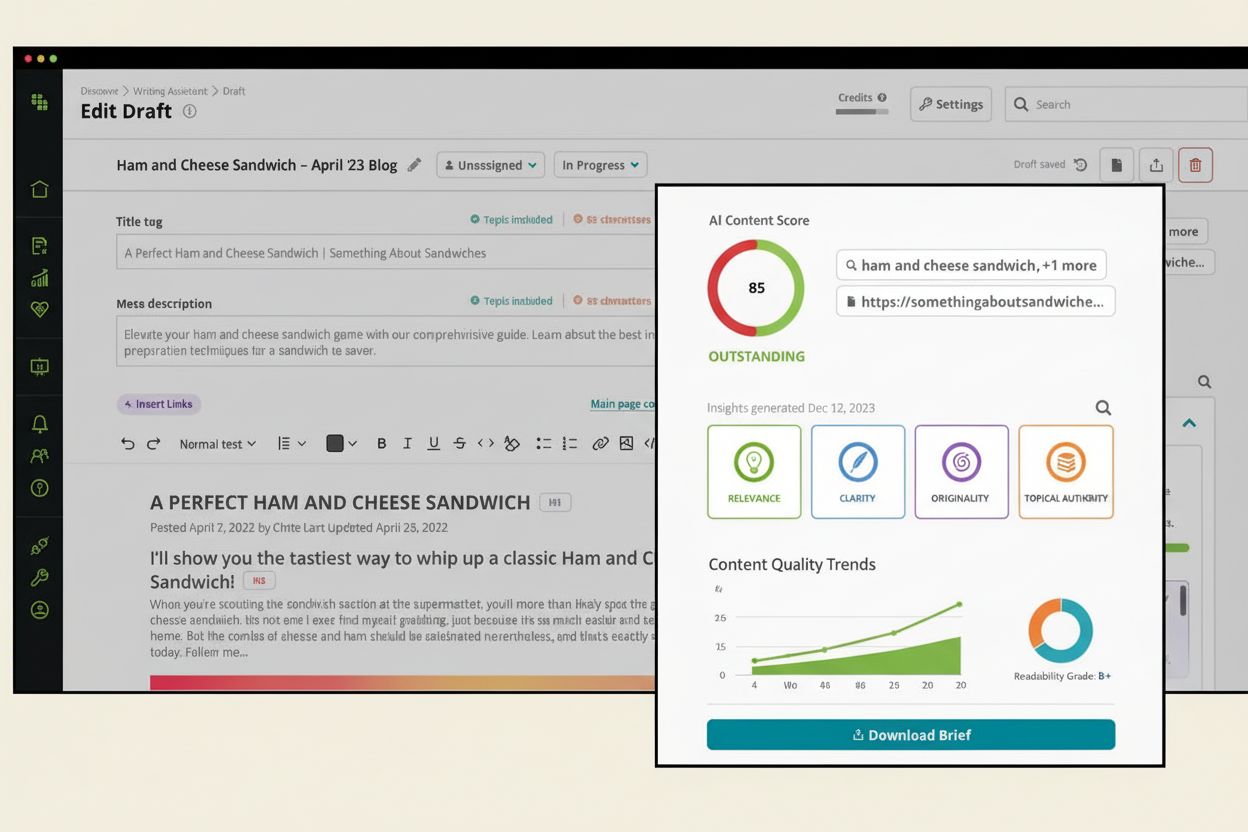
Learn what an AI Content Score is, how it evaluates content quality for AI systems, and why it matters for visibility in ChatGPT, Perplexity, and other AI platf...
Cookie Consent
We use cookies to enhance your browsing experience and analyze our traffic. See our privacy policy.