


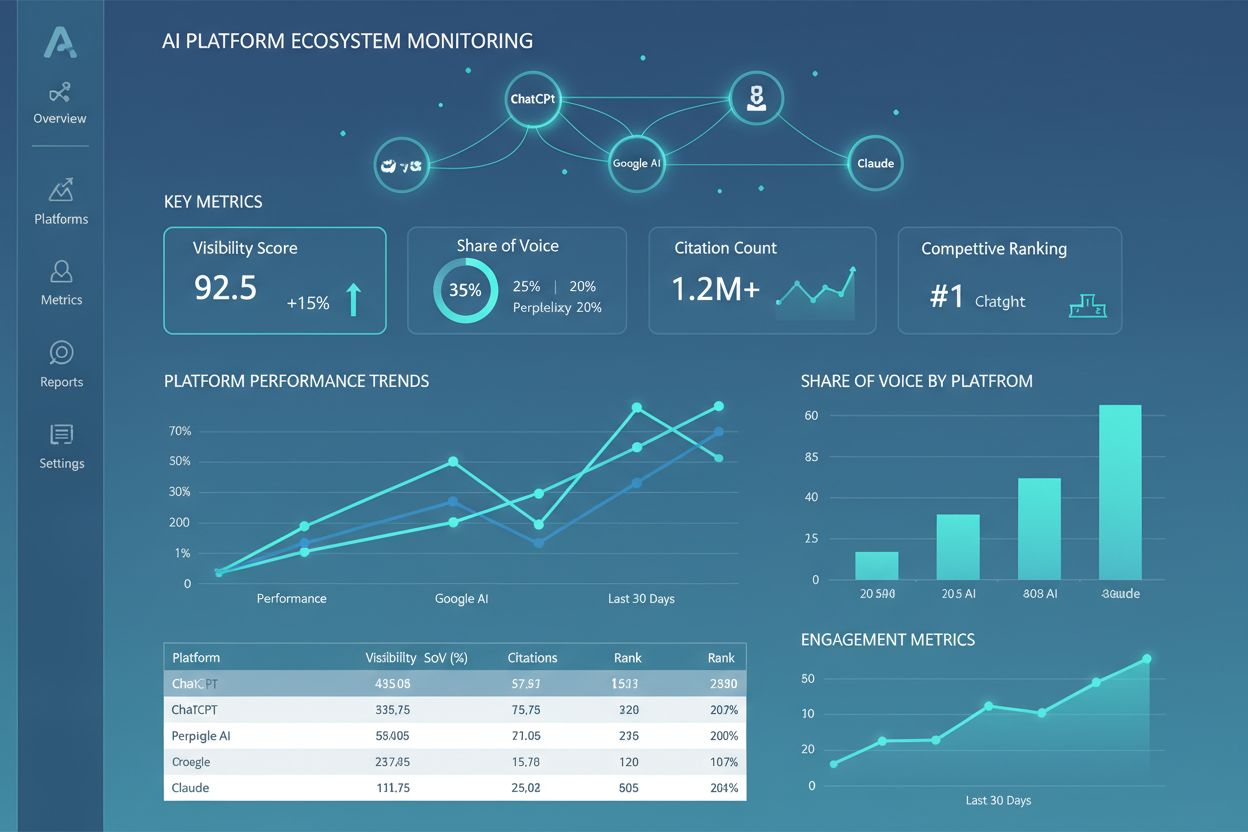
AI Platform Ecosystem
Learn what an AI Platform Ecosystem is, how interconnected AI systems work together, and why managing your brand presence across multiple AI platforms matters f...
6 min read
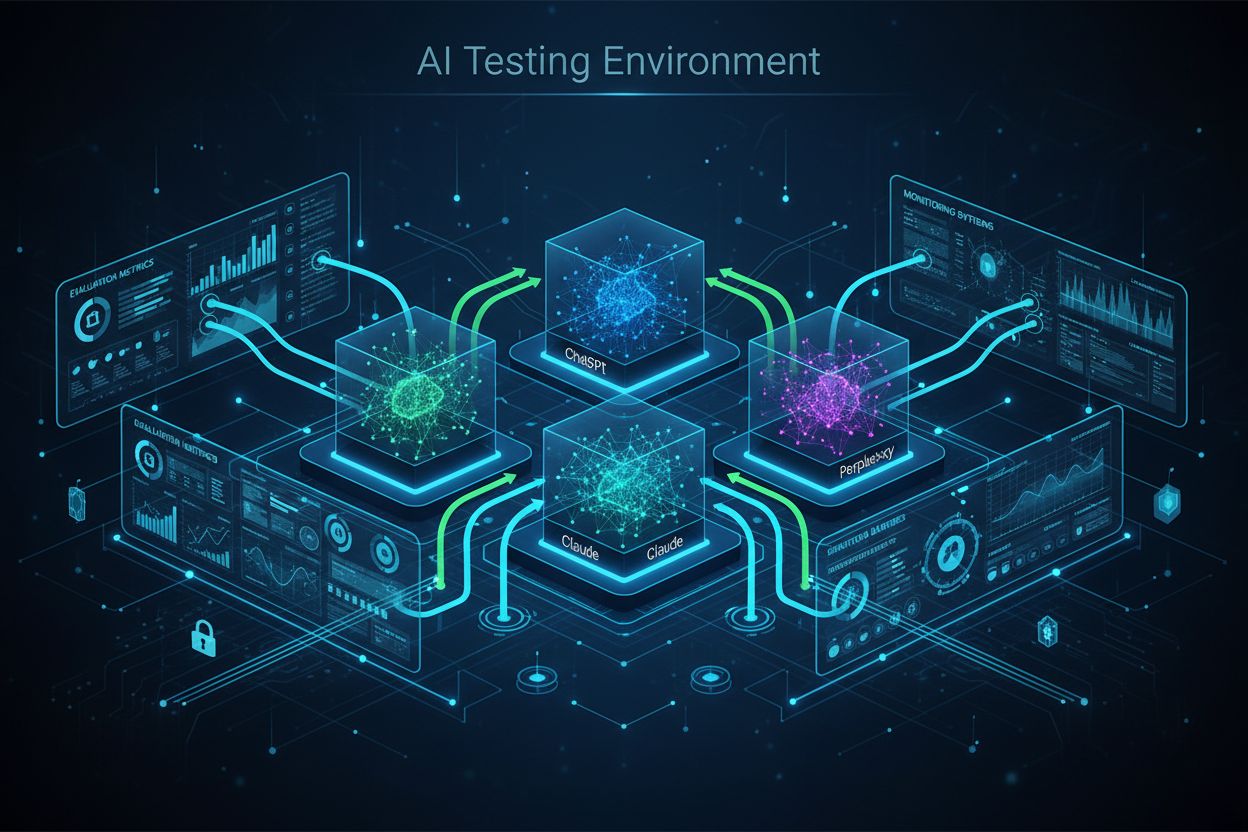
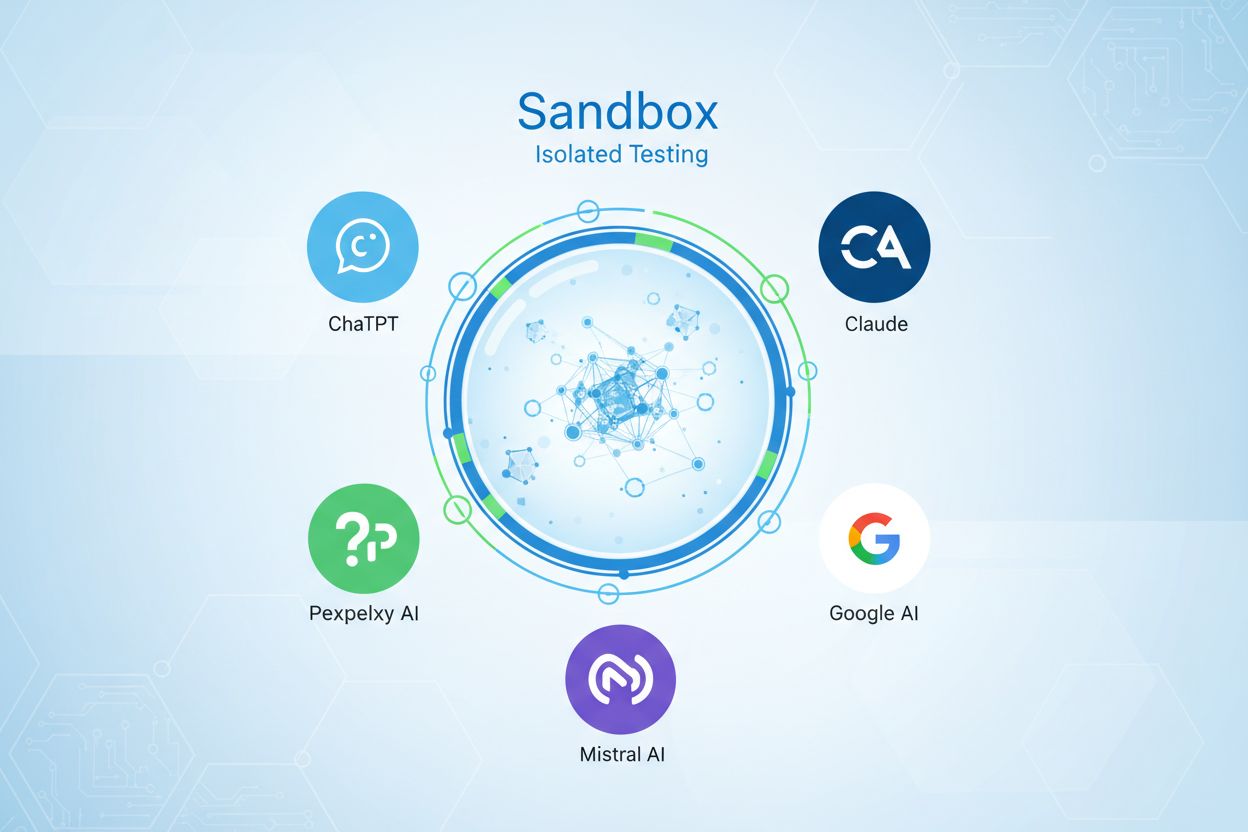
Isolated sandbox environments designed to validate, evaluate, and debug artificial intelligence models and applications before production deployment. These controlled spaces enable testing of AI content performance across different platforms, measuring metrics, and ensuring reliability without affecting live systems or exposing sensitive data.
Isolated sandbox environments designed to validate, evaluate, and debug artificial intelligence models and applications before production deployment. These controlled spaces enable testing of AI content performance across different platforms, measuring metrics, and ensuring reliability without affecting live systems or exposing sensitive data.
An AI Testing Environment is a controlled, isolated computational space designed to validate, evaluate, and debug artificial intelligence models and applications before deployment to production systems. It serves as a sandbox where developers, data scientists, and QA teams can safely execute AI models, test different configurations, and measure performance against predefined metrics without affecting live systems or exposing sensitive data. These environments replicate production conditions while maintaining complete isolation, allowing teams to identify issues, optimize model behavior, and ensure reliability across various scenarios. The testing environment acts as a critical quality gate in the AI development lifecycle, bridging the gap between experimental prototyping and enterprise-grade deployment.
A comprehensive AI Testing Environment comprises several interconnected technical layers that work together to provide complete testing capabilities. The model execution layer handles the actual inference and computation, supporting multiple frameworks (PyTorch, TensorFlow, ONNX) and model types (LLMs, computer vision, time-series). The data management layer manages test datasets, fixtures, and synthetic data generation while maintaining data isolation and compliance. The evaluation framework includes metrics engines, assertion libraries, and scoring systems that measure model outputs against expected results. The monitoring and logging layer captures execution traces, performance metrics, latency data, and error logs for post-test analysis. The orchestration layer manages test workflows, parallel execution, resource allocation, and environment provisioning. Below is a comparison of key architectural components across different testing environment types:
| Component | LLM Testing | Computer Vision | Time-Series | Multi-Modal |
|---|---|---|---|---|
| Model Runtime | Transformer inference | GPU-accelerated inference | Sequential processing | Hybrid execution |
| Data Format | Text/tokens | Images/tensors | Numerical sequences | Mixed media |
| Evaluation Metrics | Semantic similarity, hallucination | Accuracy, IoU, F1-score | RMSE, MAE, MAPE | Cross-modal alignment |
| Latency Requirements | 100-500ms typical | 50-200ms typical | <100ms typical | 200-1000ms typical |
| Isolation Method | Container/VM | Container/VM | Container/VM | Firecracker microVM |

Track how AI chatbots mention your brand across ChatGPT, Perplexity, and other platforms.
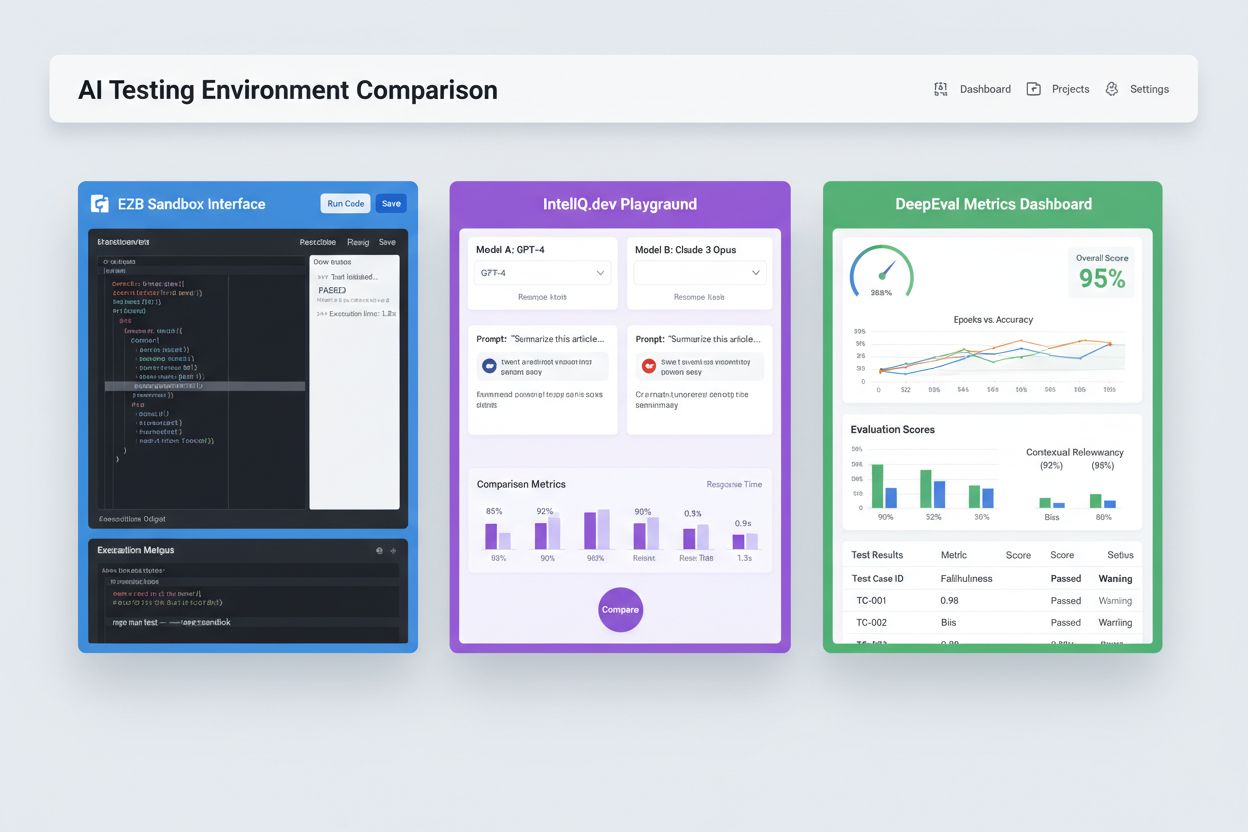
Modern AI Testing Environments must support heterogeneous model ecosystems, enabling teams to evaluate applications across different LLM providers, frameworks, and deployment targets simultaneously. Multi-platform testing allows organizations to compare model outputs from OpenAI’s GPT-4, Anthropic’s Claude, Mistral, and open-source alternatives like Llama within the same test harness, facilitating informed model selection decisions. Platforms like E2B provide isolated sandboxes that execute code generated by any LLM, supporting Python, JavaScript, Ruby, and C++ with full filesystem access, terminal capabilities, and package installation. IntelIQ.dev enables side-by-side comparison of multiple AI models with unified interfaces, allowing teams to test guardrailed prompts and policy-aware templates across different providers. Testing environments must handle:
AI Testing Environments serve diverse organizational needs across development, quality assurance, and compliance functions. Development teams use testing environments to validate model behavior during iterative development, testing prompt variations, fine-tuning parameters, and debugging unexpected outputs before integration. Data science teams leverage these environments to evaluate model performance on holdout datasets, compare different architectures, and measure metrics like accuracy, precision, recall, and F1-scores. Production monitoring involves continuous testing of deployed models against baseline metrics, detecting performance degradation, and triggering retraining pipelines when quality thresholds are breached. Compliance and security teams use testing environments to validate that models meet regulatory requirements, don’t produce biased outputs, and handle sensitive data appropriately. Enterprise applications include:
Get the latest insights on AI mentions, brand monitoring, and optimization strategies.
The AI testing landscape includes specialized platforms designed for different testing scenarios and organizational scales. DeepEval is an open-source LLM evaluation framework providing 50+ research-backed metrics including answer correctness, semantic similarity, hallucination detection, and toxicity scoring, with native Pytest integration for CI/CD workflows. LangSmith (by LangChain) offers comprehensive observability, evaluation, and deployment capabilities with built-in tracing, prompt versioning, and dataset management for LLM applications. E2B provides secure, isolated sandboxes powered by Firecracker microVMs, supporting code execution with sub-200ms startup times, up to 24-hour sessions, and integration with major LLM providers. IntelIQ.dev emphasizes privacy-first testing with end-to-end encryption, role-based access controls, and support for multiple AI models including GPT-4, Claude, and open-source alternatives. The following table compares key capabilities:
| Tool | Primary Focus | Metrics | CI/CD Integration | Multi-Model Support | Pricing Model |
|---|---|---|---|---|---|
| DeepEval | LLM evaluation | 50+ metrics | Native Pytest | Limited | Open-source + cloud |
| LangSmith | Observability & evaluation | Custom metrics | API-based | LangChain ecosystem | Freemium + enterprise |
| E2B | Code execution | Performance metrics | GitHub Actions | All LLMs | Pay-per-use + enterprise |
| IntelIQ.dev | Privacy-first testing | Custom metrics | Workflow builder | GPT-4, Claude, Mistral | Subscription-based |
Enterprise AI Testing Environments must implement rigorous security controls to protect sensitive data, maintain regulatory compliance, and prevent unauthorized access. Data isolation requires that test data never leaks to external APIs or third-party services; platforms like E2B use Firecracker microVMs to provide complete process isolation with no shared kernel access. Encryption standards should include end-to-end encryption for data at rest and in transit, with support for HIPAA, SOC 2 Type 2, and GDPR compliance requirements. Access controls must enforce role-based permissions, audit logging, and approval workflows for sensitive test scenarios. Best practices include: maintaining separate test datasets that don’t contain production data, implementing data masking for personally identifiable information (PII), using synthetic data generation for realistic testing without privacy risks, conducting regular security audits of test infrastructure, and documenting all test results for compliance purposes. Organizations should also implement bias detection mechanisms to identify discriminatory model behavior, use interpretability tools like SHAP or LIME for understanding model decisions, and establish decision logging to track how models arrive at specific outputs for regulatory accountability.
AI Testing Environments must seamlessly integrate into existing continuous integration and continuous deployment pipelines to enable automated quality gates and rapid iteration cycles. Native CI/CD integration allows test execution to trigger automatically on code commits, pull requests, or scheduled intervals using platforms like GitHub Actions, GitLab CI, or Jenkins. DeepEval’s Pytest integration enables developers to write test cases as standard Python tests that execute within existing CI workflows, with results reported alongside traditional unit tests. Automated evaluation can measure model performance metrics, compare outputs against baseline versions, and block deployments if quality thresholds aren’t met. Artifact management involves storing test datasets, model checkpoints, and evaluation results in version control systems or artifact repositories for reproducibility and audit trails. Integration patterns include:
Rolling out an AI Testing Environment works best as a sequence of concrete build steps rather than a single deployment. 1. Choose your isolation method first. Decide between containers, VMs, or Firecracker microVMs (as used by E2B) based on how sensitive your test data is—microVMs give the strongest process isolation if you’re handling regulated data. 2. Stand up the data management layer before writing test cases. Define which datasets are synthetic versus production-derived, and mask or exclude any PII before it ever enters the sandbox. 3. Wire in the evaluation framework matched to your model type—for LLMs that means metrics like semantic similarity and hallucination rate through a tool like DeepEval; for RAG systems it means context precision/recall and faithfulness. 4. Add logging and tracing at the component level, not just end-to-end, so a failing test tells you whether the retriever, the LLM call, or the tool invocation broke. 5. Connect the environment to CI/CD—DeepEval’s native Pytest integration or E2B’s GitHub Actions support lets evaluation run on every commit rather than manually before releases. 6. Set explicit deployment gates, defining the metric thresholds (accuracy floor, maximum hallucination rate, latency ceiling) that block promotion to production. 7. Document access controls and audit logging before onboarding a second team, since retrofitting compliance controls after multiple teams are already using the environment is significantly harder than building them in from the start.
AmICited tracks how AI systems reference your brand and content across ChatGPT, Claude, Perplexity, and Google AI. Get real-time visibility into your AI presence with comprehensive monitoring and analytics.
Learn what an AI Platform Ecosystem is, how interconnected AI systems work together, and why managing your brand presence across multiple AI platforms matters f...
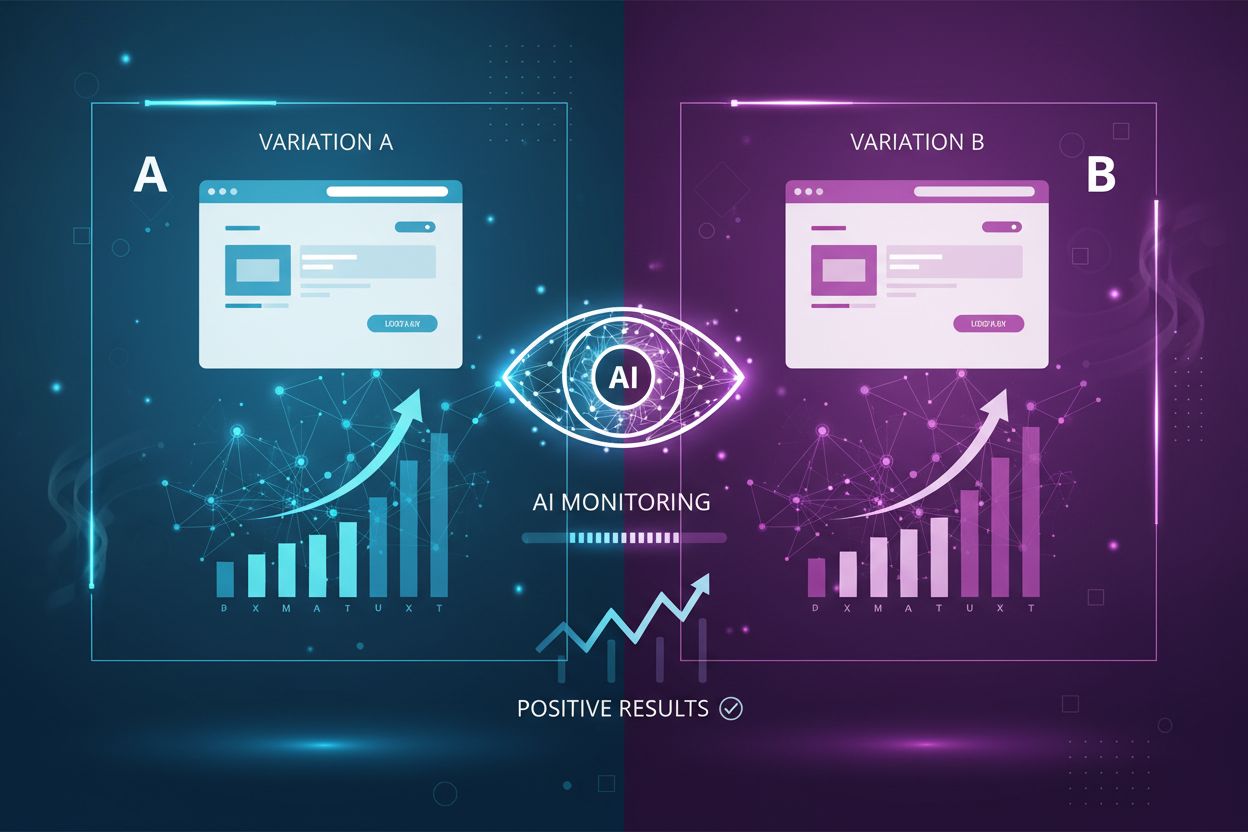
Learn how to prove a content or GEO change actually improved your AI visibility, with controlled experiments, GEO experiments, statistical significance, and the...
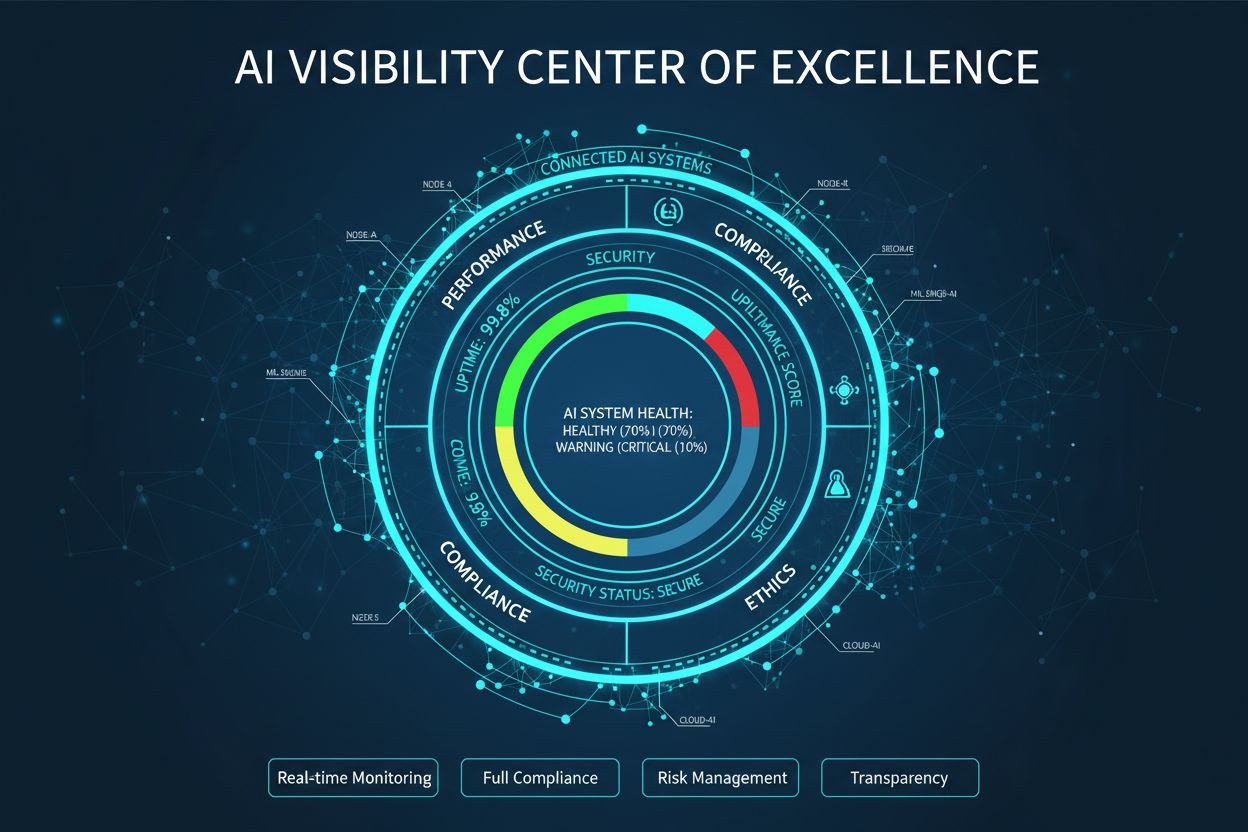
Learn what an AI Visibility Center of Excellence is, its key responsibilities, monitoring capabilities, and how it enables organizations to maintain transparenc...
Cookie Consent
We use cookies to enhance your browsing experience and analyze our traffic. See our privacy policy.