


Assortment Optimization
Assortment optimization is the practice of analyzing and adjusting a retailer's product catalog to maximize revenue, margin, and customer satisfaction from a given amount of shelf space, ad spend, or inventory investment. It looks at which products to keep, expand, bundle, or discontinue based on how they actually perform and interact with each other. For e-commerce brands, it replaces gut-feel catalog decisions with data on concentration, overlap, and cross-sell patterns.
Definition of Assortment Optimization
Assortment optimization is the discipline of shaping a product catalog to get the most revenue, margin, and customer satisfaction out of the shelf space, marketing budget, or inventory capital a business has available. It answers questions that inventory management alone can’t: which products should exist in the catalog at all, how deep should each category go, which items should be merchandised or bundled together, and which underperformers should be retired. Unlike simply “adding more products,” assortment optimization treats catalog breadth and depth as a resource-allocation problem — every SKU added has a real cost in inventory capital, warehouse space, and customer attention, so each one needs to earn its place.
How Assortment Optimization Works
Assortment optimization typically starts with a data layer that combines three things: sales velocity per product, margin contribution per product, and co-purchase patterns between products. From there, products get grouped into rough tiers — clear winners worth expanding, steady performers worth maintaining, and candidates for consolidation or discontinuation.
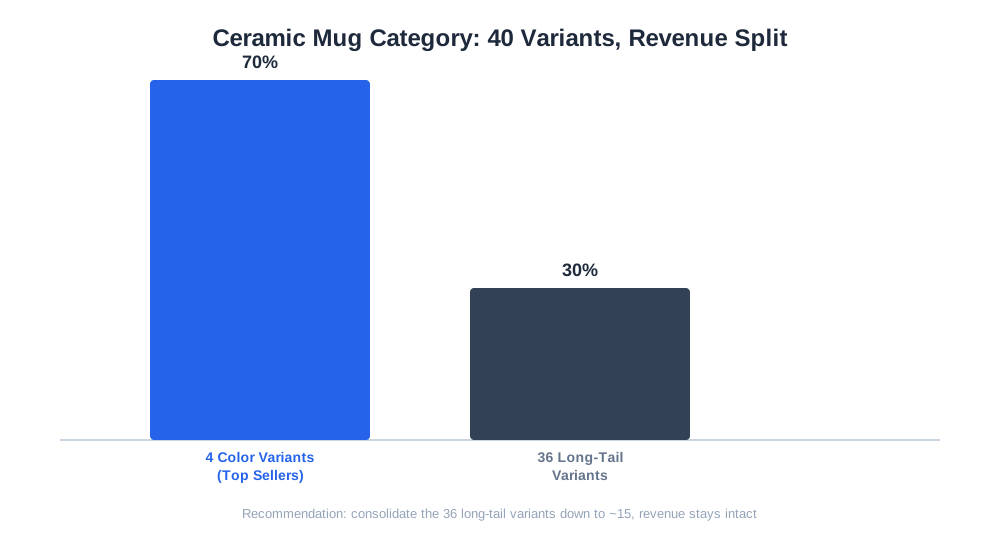
A worked example: a home goods store carries 40 variations of a single ceramic mug design across colors and sizes. Sales data shows that four color variants account for roughly 70% of the mug category’s revenue, while the remaining 36 variants combine for the other 30%, many selling only a handful of units per month. An assortment review might recommend consolidating the long tail down to 15 variants, freeing up inventory capital and simplifying the product page, without meaningfully reducing category revenue — because the volume was concentrated in a few variants all along.
Cross-sell data matters just as much as standalone performance. A slow-selling accessory that shows up in a large share of orders alongside a bestselling core product may be worth keeping even though it looks weak in isolation, because removing it could quietly reduce average order value on the bestseller it supports.

Ready to Monitor Your AI Visibility?
Track how AI chatbots mention your brand across ChatGPT, Perplexity, and other platforms.
Why Assortment Optimization Matters for E-commerce Brands
A bloated catalog isn’t free. Every additional SKU adds inventory carrying cost, photography and content production time, customer service complexity, and dilution of marketing attention across too many products. On the flip side, an assortment that’s too narrow can leave revenue on the table by missing adjacent products customers clearly want, as shown by search behavior or requests that never convert into a listing.
Assortment optimization also directly manages business risk. A catalog heavily concentrated in a small number of bestsellers is exposed if a supplier discontinues a key input, a trend shifts, or a single product runs into a quality issue — deliberately understanding and managing that concentration is part of the discipline, not an afterthought.
Assortment Health Indicators
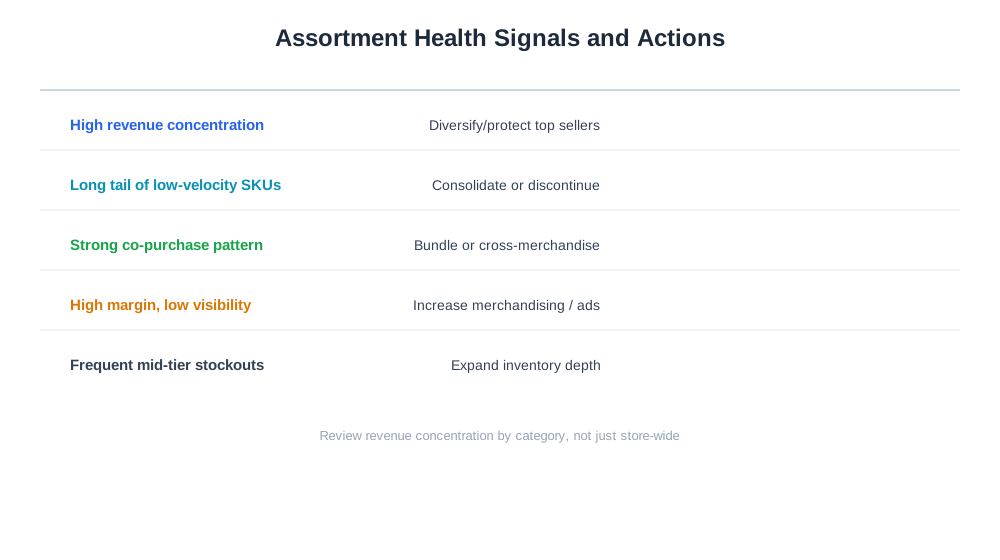
| Signal | What It Suggests | Typical Action |
|---|---|---|
| High revenue concentration in few SKUs | Business risk if a bestseller falters | Diversify or protect supply of top sellers |
| Long tail of very low-velocity SKUs | Catalog bloat, tied-up inventory capital | Consolidate or discontinue weak performers |
| Strong co-purchase pattern between two SKUs | Bundling or cross-merchandising opportunity | Create a bundle or cross-sell placement |
| High margin, low visibility product | Under-promoted profit opportunity | Increase merchandising or ad support |
| Frequent stockouts on a mid-tier SKU | Demand signal being under-served | Expand inventory depth |
Stay Updated on AI Visibility Trends
Get the latest insights on AI mentions, brand monitoring, and optimization strategies.
Assortment Optimization and AI-Driven Commerce
AI shopping assistants like ChatGPT Shopping and Perplexity Shopping tend to surface a narrower set of specific, well-differentiated products rather than an entire undifferentiated catalog, since these assistants are answering a specific customer question rather than browsing a full site. A catalog with too many near-identical variants and no clear “best answer” for common shopping questions is harder for these assistants — and for shoppers — to parse, which makes assortment discipline more relevant to AI visibility, not just internal operations.
This is exactly the kind of catalog-wide view that’s hard to build manually from order data alone. AmICited’s eshop_get_assortment tool reports how concentrated revenue is across a store’s product catalog and surfaces which products tend to sell alongside each other, giving merchants the same cross-sell and concentration signal that manual spreadsheet analysis would take far longer to produce.
Best Practices for Assortment Optimization
- Review revenue concentration by category, not just store-wide, since a healthy overall spread can still hide a dangerously concentrated subcategory
- Use co-purchase data, not just standalone sales velocity, before deciding to cut a slow-moving SKU
- Set a formal cadence for assortment reviews rather than only reacting when a stockout or overstock forces the issue
- Involve margin data in every assortment decision, not just unit sales — a high-volume, low-margin product can look better than it actually is
- Pilot assortment changes on a subset of the catalog before a full rollout, especially when cutting long-tail SKUs that might carry hidden cross-sell value
Common Assortment Optimization Mistakes
A common mistake is cutting slow-moving SKUs based purely on standalone sales velocity, without checking whether they contribute meaningfully to attach rate or average order value on a bestseller. Removing a low-velocity accessory that quietly supports a top seller can hurt overall category revenue even though the SKU itself looked unprofitable in isolation.
Another frequent issue is treating assortment optimization as a one-time cleanup project rather than an ongoing discipline. A catalog reviewed once and left alone drifts back toward bloat within a few seasons as new products get added faster than old ones are retired, and the original concentration and margin problems resurface.
Some brands also expand assortment depth reactively, adding new variants chasing a competitor’s catalog breadth without checking whether their own customer base actually wants that depth, which adds inventory cost without a corresponding revenue lift. The fix is anchoring expansion decisions in the store’s own co-purchase and demand data rather than competitor mimicry alone.