


Blended CAC
Blended CAC is the average cost to acquire a new customer across all marketing channels combined, both paid and organic, calculated by dividing total marketing spend by total new customers in a period. It differs from channel-specific CAC by giving a single, all-in efficiency number rather than a per-channel breakdown.
Definition of Blended CAC
Blended CAC (blended customer acquisition cost) is the average cost to acquire one new customer across every marketing channel a business uses, paid and unpaid combined. Rather than isolating the cost of a specific ad platform, it takes total marketing spend across the whole business over a period and divides it by the total number of new customers gained in that same period, regardless of which specific channel brought each customer in.
How Blended CAC Is Calculated
The formula is: Blended CAC = Total marketing spend (all channels) ÷ Total new customers acquired
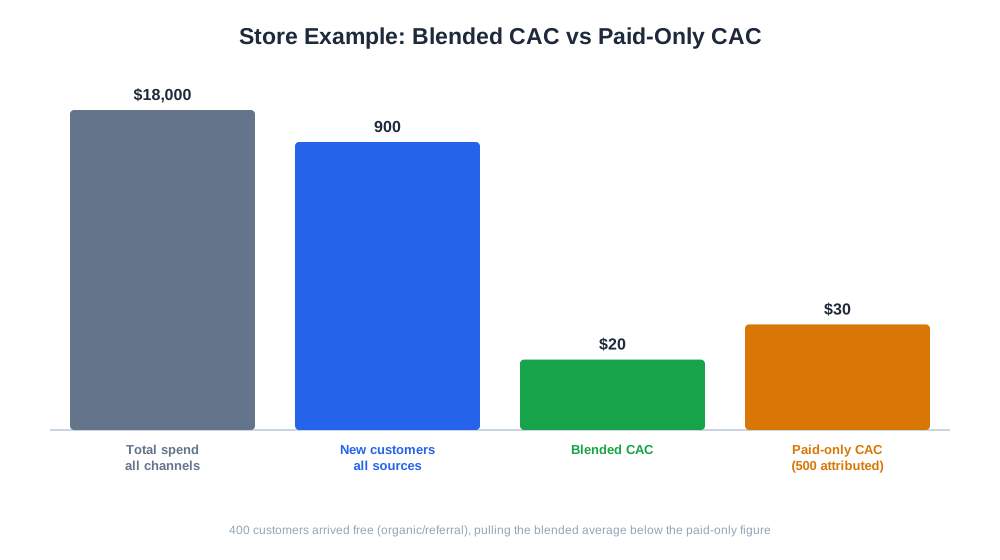
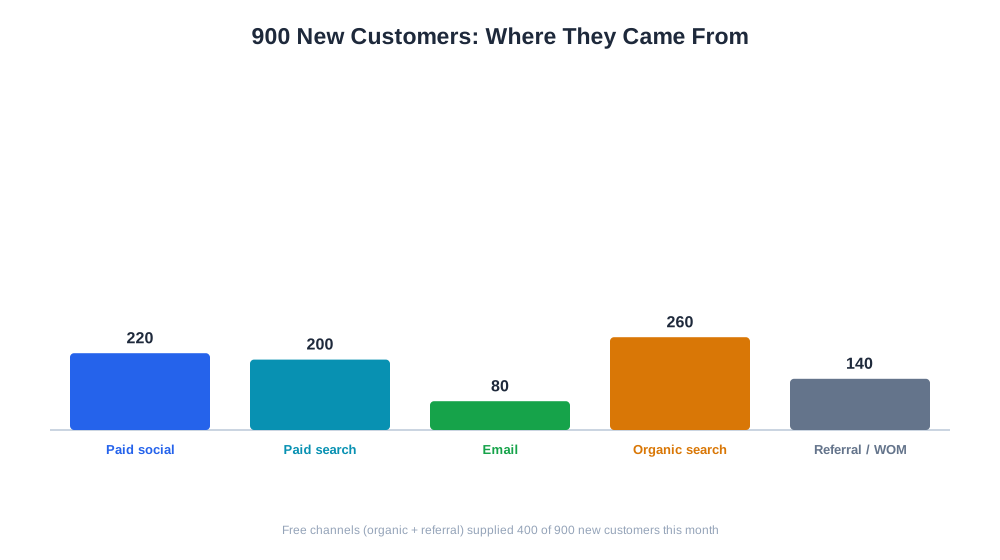
Worked example: an online store spends $18,000 total in a month across paid social, paid search, and email marketing, while also gaining customers through organic search and word-of-mouth referrals it doesn’t directly pay for. In that month, 900 new customers make their first purchase, from all sources combined. Blended CAC = $18,000 ÷ 900 = $20 per customer. If the same store looked only at paid channels, it might spend $15,000 to acquire 500 attributed customers, giving a paid CAC of $30 — notably higher than the $20 blended figure, because the 400 customers who arrived through free channels pull the average down.

Ready to Monitor Your AI Visibility?
Track how AI chatbots mention your brand across ChatGPT, Perplexity, and other platforms.
Why Blended CAC Matters for E-commerce Brands
Blended CAC gives a fast, high-level read on overall marketing efficiency and is useful for comparing against customer lifetime value at a whole-business level. It smooths out the noise of attribution modeling debates between channels, since it simply counts every dollar spent and every customer gained, without needing to resolve which specific touchpoint deserves credit for a given sale. It is a poor tool, however, for deciding where to increase or cut spend, since it can hide a specific paid channel that is quietly unprofitable behind cheap organic or referral acquisition happening at the same time.
| Metric | Scope | Best Used For |
|---|---|---|
| Blended CAC | All channels, paid and organic combined | Whole-business efficiency, LTV comparison |
| Channel CAC (e.g. paid CAC) | Single channel only | Budget allocation decisions between channels |
Blended CAC and AmICited’s Tools
AmICited’s eshop_get_cac_roas tool calculates customer acquisition cost and return on ad spend at the individual campaign level, giving merchants the channel-specific detail that a single blended number cannot provide on its own. Comparing blended CAC against this campaign-level breakdown is how a merchant identifies whether a rising overall CAC is being driven by one underperforming paid channel or a broader, storewide efficiency problem.
Stay Updated on AI Visibility Trends
Get the latest insights on AI mentions, brand monitoring, and optimization strategies.
Best Practices for Blended CAC
- Track blended CAC alongside channel-specific CAC, never as a replacement for it
- Compare blended CAC against average customer lifetime value, not against total revenue alone
- Watch the trend over time more than any single period’s number, since acquisition cost naturally fluctuates month to month
- Recalculate whenever a new marketing channel is added or a major one is paused, since the mix affects the blended average significantly
Blended CAC and AI-Driven Commerce
AI shopping assistants like ChatGPT Shopping and Perplexity Shopping are introducing a new acquisition pathway that doesn’t map cleanly onto either “paid” or “organic” in most attribution setups — a brand cited favorably in an AI-generated answer may gain a customer with no direct media spend attached to that specific interaction, similar to how organic search traffic pulls a blended CAC average down. As this channel grows, it becomes another input that can make blended CAC look healthier than the paid-channel reality underneath it, which is exactly why pairing the blended figure with channel-level detail matters more, not less, as the number of acquisition pathways multiplies.
Common Blended CAC Mistakes
The most common mistake is using blended CAC as the sole basis for a channel budget decision, since a healthy-looking blended number can mask a specific paid channel that is losing money — always check channel-level CAC before reallocating spend. Another frequent error is comparing blended CAC across businesses or competitors without adjusting for differences in organic and referral traffic share, since two businesses with identical paid channel performance can show very different blended numbers purely because one has a stronger organic presence. A related mistake is treating a rising blended CAC as automatically bad news without checking whether it’s driven by a deliberate, profitable scale-up of a working paid channel, versus a genuine efficiency decline across the board — the trend needs channel-level context to interpret correctly. Finally, some businesses calculate blended CAC using only ad platform spend and forget to include other real acquisition costs like affiliate commissions, influencer fees, or agency retainers, understating the true cost of the customers those channels bring in.