


Customer Segmentation
Customer segmentation is the practice of dividing a customer base into distinct groups based on shared characteristics, such as purchase behavior, spending level, product preferences, or lifecycle stage. It lets e-commerce brands target marketing, pricing, and retention efforts more precisely instead of treating every customer identically.
Definition of Customer Segmentation
Customer segmentation is the process of dividing a customer base into groups — segments — whose members share meaningful characteristics that predict how they’ll respond to marketing, pricing, or product decisions. Rather than sending the same email, discount, or homepage to every visitor, a segmented approach recognizes that a first-time buyer, a loyal repeat customer, and someone who hasn’t ordered in eight months need fundamentally different treatment. Segments can be built on almost any dimension: what someone buys, how often, how much they spend, where they came from, how long they’ve been a customer, or how likely they are to churn. The goal of segmentation isn’t to create as many groups as possible — it’s to create groups that are distinct enough, and large enough, that treating them differently actually changes outcomes.
How Customer Segmentation Works
Segmentation typically starts with choosing the dimension (or combination of dimensions) that matters most for the decision at hand, then defining thresholds that split customers into groups. A simple example: a merchant might define “high-value customers” as anyone in the top 20% of lifetime spend, “new customers” as anyone with exactly one order in the last 60 days, and “at-risk customers” as anyone who previously ordered at least twice but hasn’t purchased in 90 days.
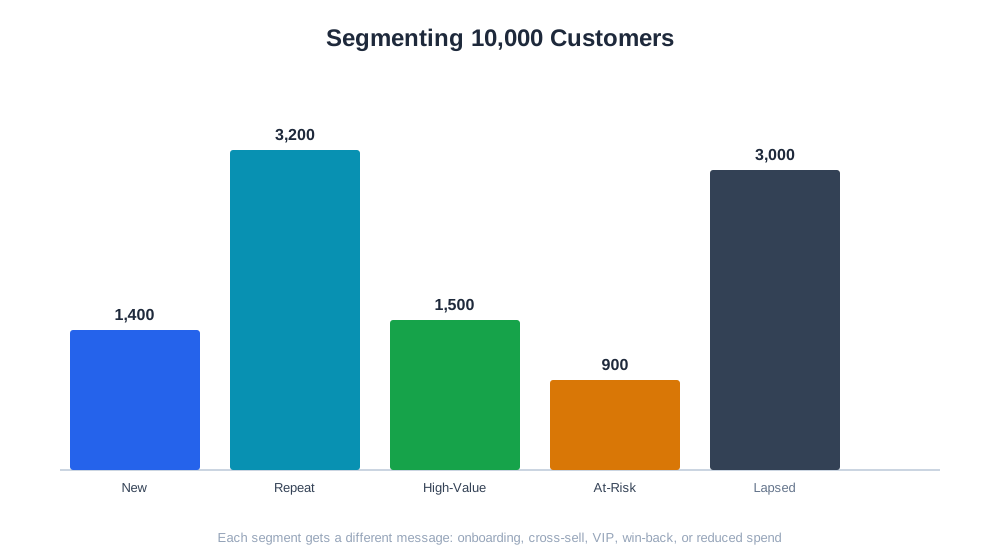
A worked example makes this concrete. Suppose a home goods store with 10,000 customers runs a segmentation pass:
- New customers (1 order, last 30 days): 1,400 customers
- Repeat customers (2+ orders, active in last 90 days): 3,200 customers
- High-value customers (top 15% by lifetime spend): 1,500 customers
- At-risk customers (2+ past orders, no purchase in 90-180 days): 900 customers
- Lapsed customers (no purchase in 180+ days): 3,000 customers
Each of these groups warrants a different message: new customers get onboarding content, repeat customers get loyalty and cross-sell offers, high-value customers get early access and VIP treatment, at-risk customers get a win-back nudge before they fully lapse, and lapsed customers get a larger incentive or are deprioritized from regular marketing spend to protect margin.

Ready to Monitor Your AI Visibility?
Track how AI chatbots mention your brand across ChatGPT, Perplexity, and other platforms.
Why Customer Segmentation Matters for E-commerce Brands
Segmentation improves marketing efficiency because it stops brands from spending the same acquisition-level effort on customers who are already loyal, and stops them from over-discounting customers who would have purchased anyway. It also protects margin: a blanket 20% discount sent to an entire list gives money away to high-value customers who didn’t need the incentive, while a segmented approach can reserve that discount for the at-risk group where it’s most likely to change behavior.
Segmentation also feeds directly into retention strategy. Without segments, “customer retention” is an abstract, store-wide number. With segments, a merchant can see that new customers have a healthy 90-day return rate but high-value customers are starting to lapse at an unusual pace — a much more actionable signal than a single blended retention percentage.
Common Customer Segmentation Models
| Model | Basis | Typical Segments | Best For |
|---|---|---|---|
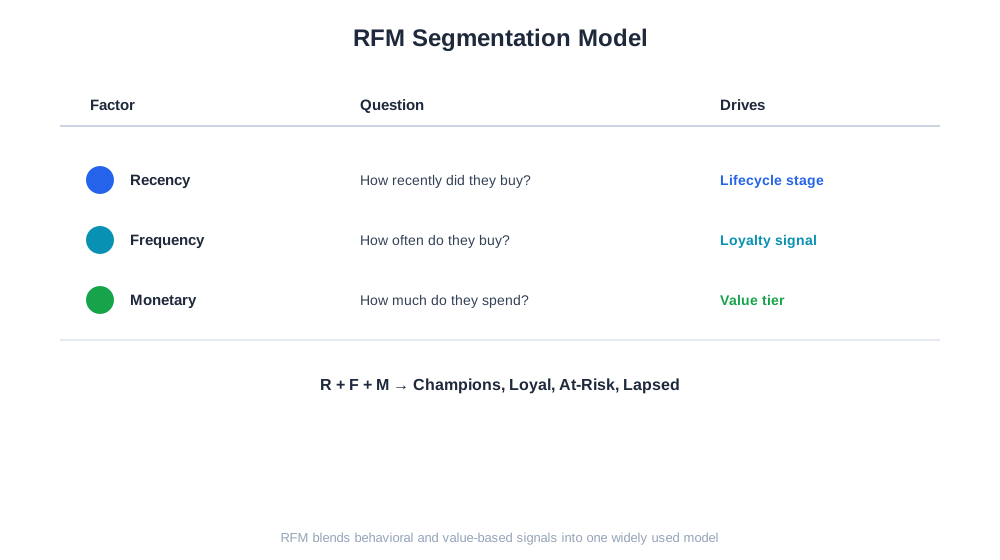
| RFM (Recency, Frequency, Monetary) | Order history | Champions, loyal, at-risk, lapsed | Retention and win-back campaigns |
| Behavioral | Browsing and purchase actions | Cart abandoners, category browsers, one-time buyers | Triggered marketing and personalization |
| Demographic | Age, location, gender | Regional segments, age bands | Localized offers and product assortment |
| Value-based | Lifetime spend or predicted LTV | High-value, mid-tier, low-value | Prioritizing service and marketing spend |
| Lifecycle | Stage in the customer relationship | New, active, at-risk, lapsed | Lifecycle email flows |
Most mature e-commerce brands blend several of these — RFM segmentation, for instance, combines behavioral and value-based signals into a single, widely used model.
Stay Updated on AI Visibility Trends
Get the latest insights on AI mentions, brand monitoring, and optimization strategies.
Customer Segmentation and AI-Driven Commerce
AI shopping assistants and product discovery tools are increasingly personalizing what they surface to a given shopper, which means the segment a customer belongs to on your own site should ideally travel with them into how you market to them elsewhere — retargeting, email, and even how you structure product feeds. A merchant who knows a customer belongs to the “high-value repeat buyer” segment can prioritize that customer’s data in feeds meant to drive AI-assisted repeat purchases, rather than treating every visitor identically.
AmICited’s eshop_get_segments and eshop_list_segment_definitions tools build these groupings automatically from connected store data, surfacing pre-defined segments like new, repeat, high-value, and at-risk customers without requiring a merchant to build the underlying cohort logic by hand. Because the segment definitions are transparent and listable, merchants can see exactly what qualifies a customer for each group and adjust strategy accordingly.
Best Practices for Customer Segmentation
- Start with 4-6 segments that map directly to a marketing action — don’t build a segment you won’t actually treat differently.
- Combine behavioral and value-based data (like RFM) rather than relying on demographics alone, which predicts behavior less reliably in e-commerce.
- Refresh recency- and lifecycle-based segments frequently, since a customer’s status shifts with every order or period of inactivity.
- Validate segments against actual outcomes — check whether your “high-value” segment really does convert or retain better before building a full campaign strategy around it.
- Keep segment definitions documented and consistent across your email platform, ad platform, and analytics tools so a “repeat customer” means the same thing everywhere.
Common Customer Segmentation Mistakes
Building segments that never change how you market. It’s easy to create a dozen finely sliced segments in a dashboard and never actually use them to change an email, offer, or ad audience. Every segment should map to at least one distinct action; if it doesn’t, merge it into a broader group.
Using stale segment data. A “new customer” segment built from a one-time export three months ago no longer reflects who’s actually new. Lifecycle and recency segments need to refresh on a regular cadence, ideally daily or weekly, or they actively mislead campaign targeting.
Segmenting on vanity metrics instead of predictive ones. Total historical revenue looks impressive but treats a customer who spent big once, years ago, the same as one who spends steadily every month. Recency-weighted or frequency-weighted value measures are usually more actionable than raw lifetime spend alone.
Ignoring segment size. A segment with 12 customers isn’t worth a dedicated campaign. Make sure each segment is large enough to justify the marketing effort of treating it differently.
Treating segmentation as a one-time project. Customer behavior and the makeup of a customer base shift over time — new acquisition channels, seasonal buying patterns, and product launches all change who belongs in each segment. Segmentation needs to be revisited, not set once and forgotten.